Understood. Following your instructions, I will adopt the persona of a quantitative trading researcher specialized in the Wyckoff Method. Based on the provided BOTZ data and historical rankings, I will compose a comprehensive and in-depth quantitative analysis report.


Quantitative Analysis Report: BOTZ

Product Code: BOTZ
Analysis Date Range: 2025-12-29 to 2026-02-25
Report Generation Date: 2026-02-26

1. Trend Analysis and Market Phase Identification

As of 2026-02-25, BOTZ's opening price was 39.58, closing price 39.66, 5-day moving average 38.72, 10-day moving average 38.50, 20-day moving average 37.91, with daily change +1.67%, weekly change +3.39%, monthly change +6.27%, quarterly change +9.47%, and annual change +9.47%.

BOTZ Price Trend Analysis Chart with closing price and multiple moving averages
  • Moving Average Alignment and Price Relationship:
    At the end of the analysis period (2026-02-25), BOTZ's closing price of $39.66 is significantly above all period moving averages (MA_5D: 38.72, MA_10D: 38.50, MA_20D: 37.91, MA_30D: 37.93, MA_60D: 37.20). Key findings are:
    • Bullish Alignment Established: Since mid-January 2026, short-term moving averages (MA_5D, MA_10D) have been consistently trading above long-term moving averages (MA_20D, MA_30D, MA_60D), and the MA_60D itself is in a stable uptrend, confirming the medium- to long-term uptrend.
    • Successful Test of Key Support: In early February 2026 (Feb 2-5), the price experienced a deep correction to $35.77, precisely testing and holding above the 60-day moving average (MA_60D ≈ 36.46). This was followed by a vigorous rebound. This is a typical successful "Secondary Test" in Wyckoff theory, confirming the validity of this long-term trendline as support.
  • Inferred Market Phase:
    • • Based on price action and moving average structure, the market is currently in a continuation of the "Markup" phase. The early February correction can be characterized as a "Shakeout" or a "natural pullback" within the trend, intended to flush out weak long positions. The rapid price recovery and new highs after testing key support (MA_60D) indicate strong demand and effective absorption of supply. There are no typical signs of topping "Distribution" yet (e.g., high-volume stalling at highs).

2. Volume-Price Relationship and Supply-Demand Dynamics

As of 2026-02-25, BOTZ's opening price was 39.58, closing price 39.66, volume 750164, daily change +1.67%, volume 750164, 7-day average volume 867562.14, 7-day volume ratio 0.86

BOTZ Volume-Price Relationship Line Chart and Historical Ranking Analysis
  • Core Supply-Demand Signal Identification:
    1. 1. Supply Exhaustion and Demand Entry (2026-02-05 to 2026-02-06):
      • • On Feb 5, the price plummeted -2.29% on a volume of 894K, slightly below the 7-day average (VOLUME_AVG_7D_RATIO: 0.93), but still high in absolute terms. This was a panic sell-off.
      • Key Day: Feb 6. The price rebounded strongly by +4.78%, with volume surging to 1.179M, exceeding the 7-day and 14-day average by over 1.27 times (VOLUME_AVG_7D_RATIO: 1.18, VOLUME_AVG_14D_RATIO: 1.27). This is a classic "high-volume rally," indicating large demand entities decisively entering at the panic low ($35.77), absorbing all selling pressure, fundamentally reversing the supply-demand relationship.
    2. 2. Demand-Driven Advance (2026-02-20 Onwards):
      • • On Feb 20, the price broke through previous highs, rising 0.98% on volume of 1.098M, 1.24-1.39 times recent averages, showing the advance was accompanied by incremental fund inflows.
      • • On Feb 25, the price reached a new phase high, rising 1.67%, but volume was 750K, below various period averages (VOLUME_AVG_7D_RATIO: 0.86). This is not a sign of weakness. In the Wyckoff framework, contracting volume on a new high within an uptrend indicates scarcity of supply, suggesting limited floating shares and low resistance to price increases, a healthy sign for an advance.
  • Conclusion: The current market is completely dominated by Demand. The panic selling in early February was absorbed with massive volume, followed by shrinking supply during the subsequent advance, allowing the price to rise easily. This is a classic bullish supply-demand structure.

3. Volatility and Market Sentiment

As of 2026-02-25, BOTZ's opening price was 39.58, 7-day intraday volatility 0.17, 7-day intraday volatility ratio 0.81, 7-day historical volatility 0.19, 7-day historical volatility ratio 0.61, RSI 64.69

BOTZ Parkinson Volatility Analysis Chart and Historical Ranking Data
  • Volatility Analysis:
    • Panic and Reversal (Early February): Around the Feb 5 price low, the 7-day historical volatility (HIS_VOLA_7D) rose to 0.16, while the 7-day Parkinson volatility (PARKINSON_VOL_7D) surged to 0.238, both recent highs. Volatility ratios (HIS_VOLA_RATIO_7D_14D: 0.68, PARKINSON_RATIO_7D_14D: 1.27) showed short-term volatility significantly exceeding medium-term, consistent with market panic.
    • Trend Acceleration (Early February Rebound): On Feb 6 and 9, HIS_VOLA_7D surged to 0.44 and 0.46, respectively, with their ratios to 14-day and 60-day volatility (HIS_VOLA_RATIO_7D_14D) reaching as high as 1.23 and 1.41. Combined with historical ranking data, the weekly maximum volatility ratio on Feb 9 (1.4072) ranked 8th over the past 10 years, indicating a statistically rare volatility spike event, typically corresponding to a strong trend initiation or acceleration.
    • Stabilization and Convergence (Late February): As of Feb 25, short-term volatility has retreated significantly from extreme highs (HIS_VOLA_7D: 0.19) and is below medium- to long-term volatility (HIS_VOLA_RATIO_7D_14D: 0.61). Concurrently, the Parkinson volatility ratio has normalized (PARKINSON_RATIO_7D_14D: 0.81). This signifies a transition in market sentiment from early February panic and early February excitement to a stable trend-following state.
  • RSI Confirmation: The RSI_14 climbed from a low of 34.53 (near oversold) on Feb 5 to 64.69 on Feb 25. It is currently in a strong zone but not overbought (>70), leaving room for further price appreciation, consistent with healthy uptrend sentiment.

4. Relative Strength and Momentum Performance

  • Momentum Analysis:
    • Strong Short-Term Momentum: Weekly return (WTD_RETURN) is +3.39%, monthly return (MTD_RETURN) is +6.27%, quarterly return (QTD_RETURN) and year-to-date return (YTD) are both at a strong +9.47%. All short- and medium-term momentum indicators are strongly positive, indicating BOTZ possesses powerful upward momentum within its own timeframe.
    • Momentum Trend Confirmation: Looking at the longer TTM (Trailing Twelve Months) return, the value rebounded from a low of 11.12% in early February to the current 20.25%, indicating this rally successfully reversed short-term downward pressure and reactivated the momentum of the long-term uptrend.

5. Large Investor ("Smart Money") Behavior Identification

  • Inferred Operational Intent:
    1. 1. Feb 5-6: Large-Scale Accumulation. Smart money utilized market panic sentiment to conduct large-scale accumulation near the key support level (MA_60D). The massive volume (1.179M) reclaiming the previous day's large bearish candle is classic "high-volume support" behavior, clearly revealing the involvement of large buyers.
    2. 2. Feb 9 Onwards: Markup and Holding. The extreme historical ranking of the volatility ratio (8th in 10 years) suggests this rally was not driven by retail investors but was the result of concentrated, rapid position building and markup by large capital. Subsequent advances on lower volume indicate these large positions are being held steady, with no distribution occurring during the rise.
    3. 3. Current Phase (Feb 25): Orderly Advance, No Distribution Signs. Prices making new highs with relatively moderate volume indicates limited floating supply and good position locking by large capital. The market is in an "orderly advance" phase, with smart money still holding positions within the trend, showing no signs of large-scale profit-taking (distribution).

6. Support/Resistance Level Analysis and Trading Signals

BOTZ Support and Resistance Level Analysis Chart and Trading Signals
  • Key Price Levels:
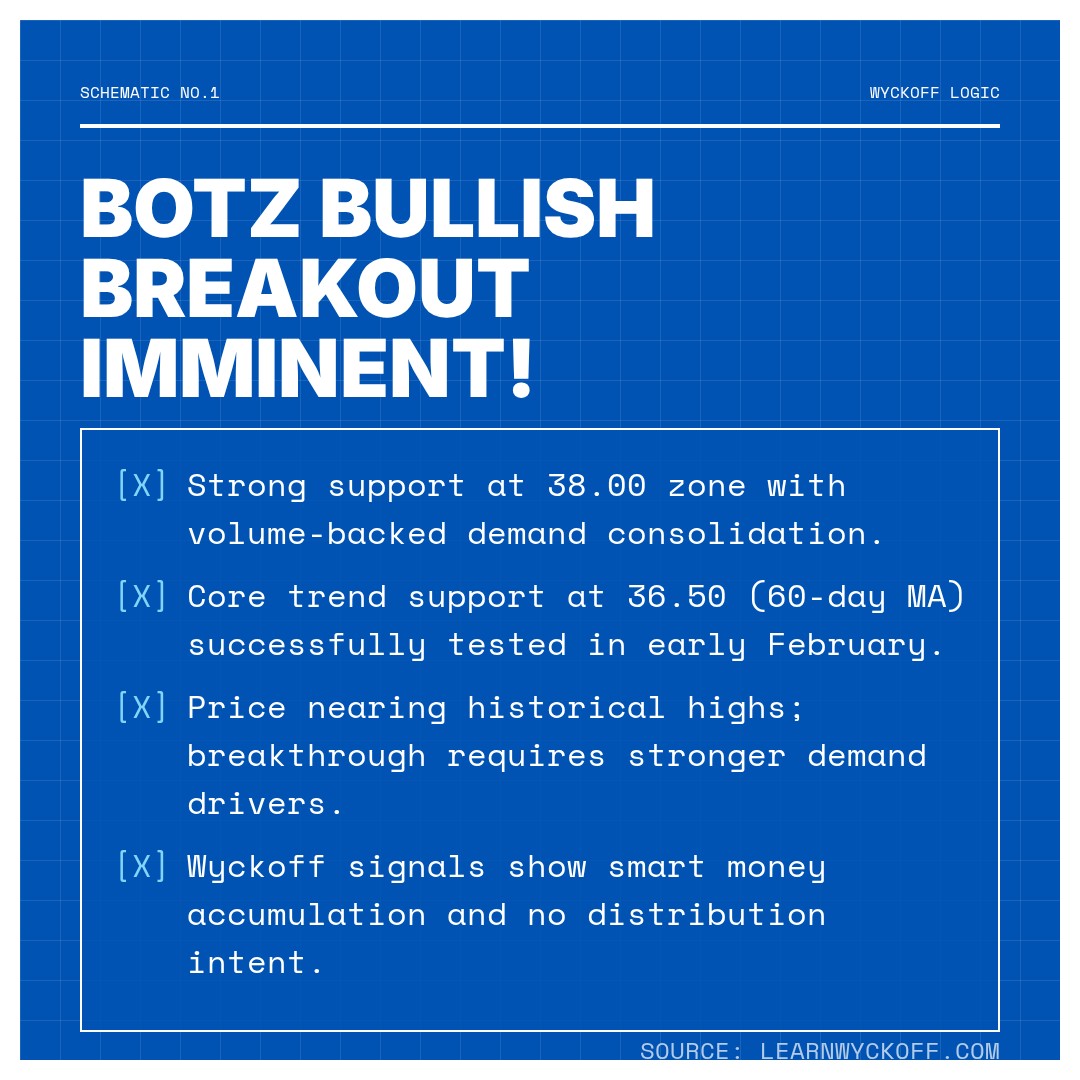
    • Near-Term Strong Support:38.00 zone. This area represents the mid-February consolidation platform, the convergence of the 20-day and 30-day moving averages, and the starting point of the large bullish candle on Feb 25, accumulating significant volume and demand.
    • Core Support:36.50 (60-day moving average). Successfully tested in early February, this is the trend's lifeline.
    • Near-Term Resistance/Target: Vicinity of historical highs. The current price of $39.66 is very close to the period's highest point. Historical ranking data shows that the closing price (39.66) and weekly high (39.778) on Feb 25 both rank 4th over the past 10 years, while the low (39.4825) ranks 2nd, indicating the price has entered a historically dense high-price zone. Breaking through this area requires new, stronger demand drivers.
  • Comprehensive Wyckoff Trading Signal:
    • Signal Direction: Bullish.
    • Basis: ① Trend shows bullish alignment; ② Supply-demand structure shows demand dominance with contracting supply; ③ Smart money accumulation at support is clear, and current holdings appear stable; ④ Momentum is strong, sentiment is healthy.
  • Operational Suggestions:
    • Potential Entry/Add-on Zone: A price pullback to the38.40 area (near short-term moving averages and previous support platform), if accompanied by low-volume stabilization or short-cycle demand signals, could be viewed as a low-risk entry opportunity.
    • Stop-Loss Level: Could be set below $37.50 (breach of key support platform), or more conservatively below $36.40 (breach of the trend lifeline).
    • Future Validation Points (Warning Signs to Monitor):
      1. 1. Price stalls on high volume or forms long upper wicks at historical highs ($39.70+). This could be an early warning sign of initial smart money distribution.
      2. 2. Price falls below the $38.00 support and rebounds weakly on low volume. Suggests temporary demand exhaustion and possible fading upward momentum.
      3. 3. A large bearish candle appears (>3% drop, volume ratio >1.5), with a close below the cluster of short-term moving averages. This would be a strong signal of sudden supply influx and a potential trend change.

Conclusion Restated: Quantitative analysis of BOTZ based on Wyckoff volume-price principles shows that after a successful support test, the asset has entered an uptrend dominated by large-scale demand. The current market structure is healthy with favorable supply-demand dynamics, and smart money shows no signs of distribution intent. The strategy should be primarily trend-following, seeking low-risk long opportunities during pullbacks while closely monitoring for signs of expanding supply at higher price levels.


Disclaimer: This report/analysis is solely market analysis and research based on publicly available information and does not constitute any investment advice or operational guidance. The author strives for objectivity and fairness in the content but makes no guarantee regarding its accuracy or completeness. The market involves risk; investment requires caution. Any investment actions based on this report are taken at one's own risk.


Thank you for your attention! Daily Wyckoff Volume-Price market analysis will be released promptly at 8:00 AM before the market opens. We kindly ask for your comments and shares. Your recognition is crucial. Let's work together to see the market signals clearly.