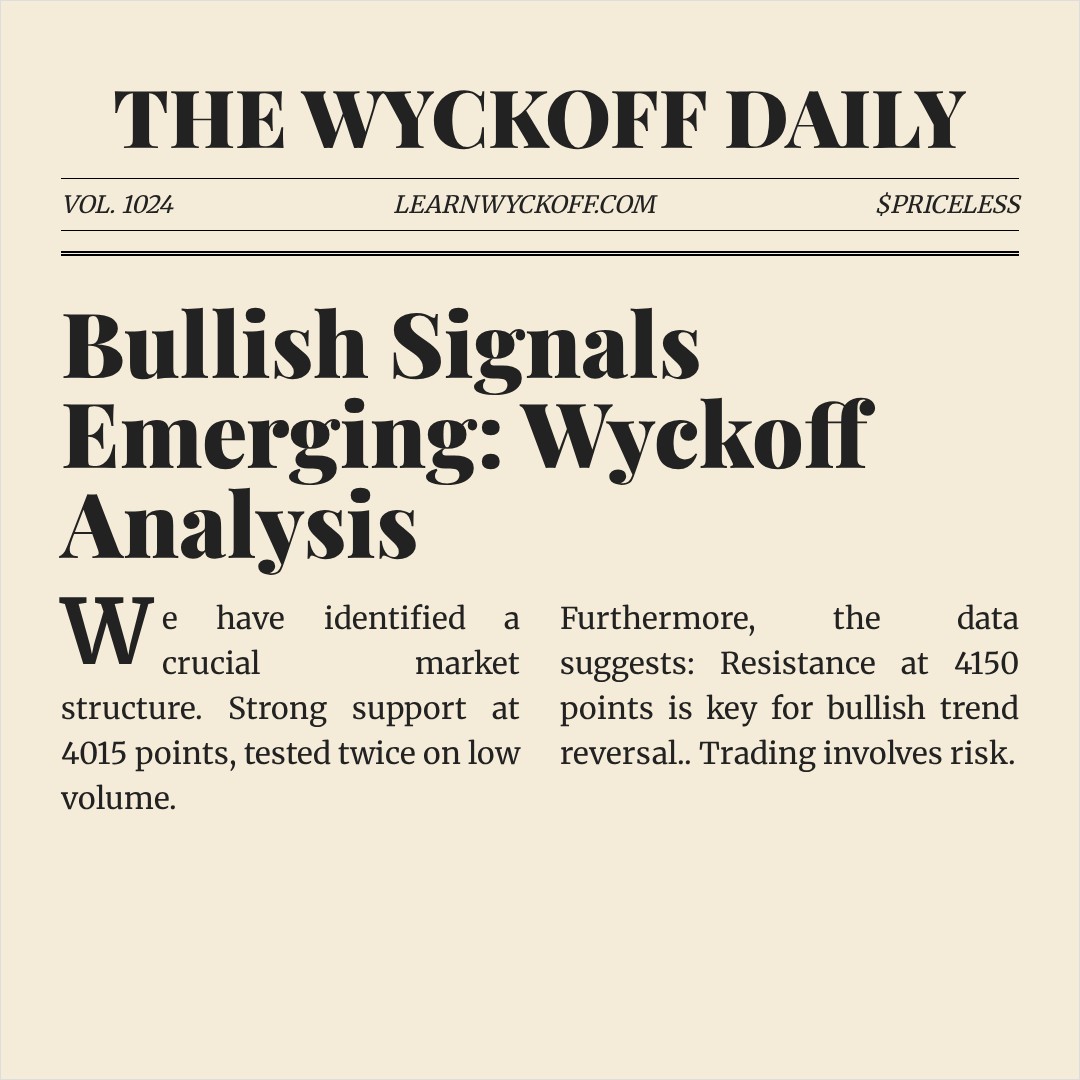
As instructed. I will now write a comprehensive, in-depth, data-driven quantitative analysis report on the provided 000001.SH data, from the perspective of a quantitative trading researcher proficient in the Wyckoff Method.


Product: 000001.SH (Shanghai Composite Index) Quantitative Analysis Report

Analysis Period: 2025-12-29 to 2026-02-25
Report Generation Date: 2026-02-25


1. Trend Analysis and Market Phase Identification

As of February 25, 2026, for the underlying asset 000001.SH: Open 4123.78, Close 4147.23, 5-Day Moving Average (MA5) 4118.77, 10-Day Moving Average (MA10) 4102.84, 20-Day Moving Average (MA20) 4111.66. Daily change +0.72%, Weekly change +1.60%, Monthly change +0.71%, Quarterly change +4.49%, Year-to-date (YTD) change +4.49%.

000001.SH Price Trend Analysis Chart, including closing price and multiple moving averages
  • Trend Status:
    • Short-Term MAs (5-day, 10-day): Currently back above the 20-day, 30-day, and 60-day MAs, forming an initial bullish alignment. However, the slope is flat, indicating a shift from a bearish to a bullish short-term trend, but it lacks strength.
    • Intermediate-Term MAs (20-day, 30-day): Intertwined and in a state of convergence, showing no clear direction. Price oscillates around them, indicating the intermediate-term trend has entered a directionless consolidation phase.
    • Long-Term MA (60-day): The 60-day MA (~4008) currently acts as a key dynamic resistance level. Price tested this line on February 2, 13, and 24 but failed to close decisively above it, forming significant short-term resistance. Historically, the 60-day MA has been flat over the past two months, showing no clear uptrend or downtrend, suggesting the long-term trend has entered a sideways range.
    • Conclusion: The market is currently in the concluding phase of a "Long-Term Trading Range". It is attempting to make a directional decision regarding the key resistance level of the 60-day MA.
  • Price Action & Market Phase:
    1. 1. Distribution Phase (2026-01-12 to 2026-01-16): After hitting a rebound high of 4165 on January 12, volume remained high (AVERAGE_VOLUME_14D reached the 1st and 2nd highest levels in nearly a decade), but price failed to advance further, instead printing a long upper-shadow candlestick, with RSI_14 hitting 81.4 (the 17th highest in nearly a decade). This formed a classic "exhaustion of demand, emergence of supply" signal of high-volume stagnation. In subsequent sessions, price declined in a high-range consolidation, confirming distribution characteristics.
    2. 2. Panic Selling Phase (2026-01-30 to 2026-02-02): Price declined consecutively from highs and, on February 2, broke through the prior consolidation platform with a nearly full-body bearish candlestick (-2.48%). Volume was high relative to recent periods, with both the 7-day Parkinson Volatility (PARKINSON_VOL_7D=0.143) and short-term Historical Volatility (HIS_VOLA_7D=0.199) spiking sharply. RSI_14 plummeted from highs to 39.8. This is typical "panic selling", often marking the end of a down move.
    3. 3. Automatic Rally & Secondary Test (2026-02-03 to Present): Following the panic decline, a natural rally occurred (to February 9), but volume contracted significantly (VOLUME_AVG_7D_RATIO repeatedly below 1). Subsequently, the index tested the vicinity of the February 2 low (~4015) again on February 13 and 24 (probing down to 4079), but closed with lower shadows, and volume did not make new lows (VOLUME decreased from 733 million shares on Feb 2 to 501 million on Feb 13). This behavior of "testing support on reduced volume" aligns with the "right-side test" characteristic of an Accumulation Range in Wyckoff theory, suggesting supply is drying up.

2. Volume-Price Relationship and Supply-Demand Dynamics

As of February 25, 2026, for the underlying asset 000001.SH: Open 4123.78, Close 4147.23, Volume 72478721400, Daily change +0.72%, Volume 72478721400, 7-Day Average Volume 53587720957.14, 7-Day Volume Ratio 1.35

000001.SH Volume-Price Relationship Line Chart and Historical Ranking Analysis
  • Key Demand Signals:
    • 2026-02-25 (Latest Trading Day): Price closed up 0.72%, with volume surging 27.98% to 7.248 billion shares, and VOLUME_AVG_7D_RATIO reaching 1.35. This is a clear demand signal of "increasing price on increasing volume", indicating incremental funds are entering at the current level.
    • 2026-02-09: Following the panic decline, the index rebounded strongly by 1.41%, with volume growing 2.86% and VOLUME_AVG_7D_RATIO at 0.82. Volume support was acceptable but still insufficient, representing a preliminary demand signal of stabilization.
  • Key Supply Signals:
    • 2026-01-13 & 2026-01-14: Price fell by 0.64% and 0.31% respectively, but volume exceeded 8.6 billion and 9.5 billion shares on consecutive days (the 12th and 6th highest in nearly a decade). This is typical "declining price on high volume at highs", indicating substantial supply emerging, possibly distribution by smart money.
    • 2026-02-02: Price plummeted 2.48%. Volume of 7.33 billion shares, while lower than the previous day, was still high relative to the end-of-January contraction levels. Combined with the large bearish candlestick, this indicates a climax of panic selling supply.
  • Supply-Demand Power Shift:
    • • Data indicates that the supply peak occurred during the high-volume decline at mid-January highs (distribution) and the panic selling in early February.
    • Demand began to manifest during the rebound on February 9 and the latest high-volume advance on February 25. The shift in VOLUME_GROWTH from -5.4% on February 13 to +27.98% on February 25 is quantitative evidence of demand regaining dominance.

3. Volatility and Market Sentiment

As of February 25, 2026, for the underlying asset 000001.SH: Open 4123.78, 7-Day Parkinson Intraday Volatility 0.08, 7-Day Parkinson Volatility Ratio 0.63, 7-Day Historical Volatility 0.16, 7-Day Historical Volatility Ratio 0.79, RSI 58.06

000001.SH Parkinson Volatility Analysis Chart and Historical Ranking Data
  • Volatility Levels and Changes:
    • Panic Period Characteristics: During the decline from January 30 to February 6, the ratio of short-term (7-day) Historical Volatility (HIS_VOLA_7D) to longer-term (14-day, 21-day) volatility (HIS_VOLA_RATIO_7D_14D, etc.) rose continuously, reaching the highest percentile range in nearly a decade (ranking 5th to 20th) from February 3 to 5. This quantifies the market state of "short-term panic far exceeding long-term norms".
    • Sentiment Recovery Period Characteristics: Entering mid-to-late February, short-term volatility receded significantly. The latest HIS_VOLA_RATIO_7D_14D has fallen to 0.79, and PARKINSON_RATIO_7D_14D is even lower at 0.63 (the 13th lowest in nearly a decade), indicating market sentiment has recovered from panic, volatility has converged, and the market is calming.
    • RSI Sentiment Indicator: RSI_14 fell rapidly from an overbought extreme (81.4) on January 12 to an oversold region (39.8) on February 2, and has recently recovered to a neutral-strong region of 58.1. This complete cycle of "overbought -> oversold -> recovery" supports the judgment that the market has completed a "distribution -> decline -> stabilization" process.

4. Relative Strength and Momentum Performance

  • Momentum Trend:
    • Short-Term (WTD/MTD): The weekly return (WTD_RETURN) is +1.60%, and the monthly return (MTD_RETURN) has turned positive to +0.71%, indicating short-term momentum has shifted from negative to positive.
    • Intermediate-Term (QTD/YTD): The quarterly return (QTD_RETURN) is +4.49%, and the year-to-date (YTD) return is also +4.49%. Despite the sharp correction from late January to February, the index maintains positive returns for the year, indicating the intermediate-term upward momentum framework remains intact, albeit weakened.
    • Conclusion: Momentum indicators align with price trend analysis, showing that after an intermediate-term adjustment, short-term momentum is recovering and attempting to realign with the still-existing, albeit diminished, intermediate-term upward momentum.

5. Large Investor (Smart Money) Behavior Identification

Based on the volume-price, volatility, and trend analysis above, we can infer the behavioral trajectory of large investors:

  1. 1. Distribution at Highs (Mid-Early January 2026): As the market hit near one-year highs with extremely optimistic sentiment (high RSI), distribution was completed through high-volume consolidation at highs (volume hitting historical records). This is typical institutional selling behavior.
  2. 2. Allowing Decline & Observation (Late January to Early February): After distribution, the market lacked large fund support, leading to a natural price decline triggering retail panic (high-volume bearish candles). Smart money did not rush to intervene during this period but observed the intensity of supply liquidation.
  3. 3. Testing Lows & Preliminary Accumulation (Mid-Late February): When the market showed secondary tests of prior lows on reduced volume (Feb 13, 24), it indicated floating supply had significantly diminished. Smart money began testing market selling pressure and, upon successful test (Feb 25), executed high-volume buying. This marks a shift in their operational intent from "distribution" to "tentative accumulation".

6. Support/Resistance Level Analysis and Trading Signals

000001.SH Support and Resistance Level Analysis Chart with Trading Signals
  • Key Support Levels:
    • S1: 4015 points: The low point of the panic selling on February 2, successfully tested twice on reduced volume, constituting the primary support level.
    • S2: 4079 points: The low point of the secondary test on February 13, forming a secondary support level.
  • Key Resistance Levels:
    • R1: 4150 points: The lower boundary of the pre-decline consolidation platform in late January, coinciding with the 60-day MA (~4008) region, is the primary near-term resistance level. A decisive breakthrough of this area is key to a trend reversal to bullish.
    • R2: 4170 points: The lower boundary of the mid-January distribution range, constituting a strong resistance level.
  • Comprehensive Wyckoff Trading Signal & Operational Recommendations:
    • Current Market Phase: The market is most likely transitioning from the "right-side accumulation stage" of a long-term trading range to the "initiation stage of a new uptrend".
    • Core Logic: Panic Selling (SC) and a successful Secondary Test (ST) have appeared, with the latest trading day showing a Sign of Strength (SOS) on increased volume, satisfying key elements of the Wyckoff accumulation structure.
    • Recommendation: Cautiously Bullish, Awaiting Key Confirmation.
      1. 1. Aggressive Strategy (Partial Position Established): Based on the February 25 high-volume advance signal, a partial, exploratory long position can be established. The stop-loss level should be set below the recent secondary test low at 4079 points.
      2. 2. Conservative Strategy (Awaiting Confirmation): Wait for price to break through and hold above the R1 resistance zone (4150 points) on increased volume (Volume Ratio > 1.2). This is a clear signal for a trend reversal to bullish and can serve as an entry or add-on point. Post-entry stop-loss can be set below 4015 points.
      3. 3. Observation Condition: If price fails to break 4150 points and shows high-volume stagnation or decline below it again, it indicates supply remains strong, potentially prolonging the accumulation process. Maintain observation.
    • Future Validation Points:
      1. 1. Confirmation Signal: Index breaks and holds above 4150 points with sustained high volume (VOLUME_AVG_7D_RATIO consistently > 1.1), and subsequent pullbacks hold above this level.
      2. 2. Invalidation Signal: Index breaks below 4079 points on increased volume again, especially breaching 4015 points, which would indicate failure of the accumulation structure, possibly leading to a deeper correction.

Disclaimer: This report/analysis content is solely for market analysis and research based on public information and does not constitute any investment advice or operational guidance. The author strives for objectivity and fairness but makes no guarantees regarding its accuracy or completeness. The market carries risks; investment requires caution. Any investment actions based on this report are undertaken at your own risk.


Thank you for your attention! Daily Wyckoff Volume-Price Market Insights are released promptly before the 8:00 AM market open. Please feel free to leave comments and share. Your recognition is crucial. Let's work together to see the market signals clearly.