XRPUSDT Wyckoff Volume-Price Analysis Report
Product Code: XRPUSDT
Analysis Date Range: 2025-12-26 to 2026-02-24
Report Generation Date: 2026-02-25
1. Trend Analysis and Market Phase Identification
As of 2026-02-24, the subject XRPUSDT has an opening price of 1.35, a closing price of 1.35, a 5-day moving average of 1.40, a 10-day moving average of 1.44, a 20-day moving average of 1.42, a daily change of 0.19%, a weekly change of -8.13%, a monthly change of -17.78%, a quarterly change of -26.48%, and an annual change of -26.48%.

- • Moving Average Alignment and Trend Judgment: As of the end of the analysis period (2026-02-24), the price (1.3544) is below all key moving averages (MA_5D: 1.402, MA_20D: 1.420, MA_60D: 1.774), exhibiting a typical and strong bearish alignment. During the entire analysis period, the price only briefly crossed above the short-term moving averages in early January 2026, but the moving average system quickly reverted to a bearish alignment and continued to diverge, confirming the market is in a clear long-term downtrend.
- • Moving Average Crossover Signals: During the rapid rally from 2026-01-02 to 01-05, a short-term golden cross occurred where MA_5D crossed above MA_20D. However, this signal failed to turn longer-term moving averages bullish and quickly became invalid after the price reached the high of 2.3695. Subsequently, all moving averages continued their downward trajectory without any significant bullish crossover signals.
- • Market Phase Inference (Wyckoff Perspective): Combining price action and volume-price relationships, the market has experienced a complete segment of the Wyckoff cycle:
- • Late December 2025 to Early January 2026 (Potential Distribution/Re-Accumulation Failure): Price rebounded from a low level and attempted to challenge a higher range, but showed signs of high-volume stagnation at the highs (detailed below). This rally can be viewed as a Rally to Resistance within a downtrend or a failed re-accumulation attempt.
- • Mid-to-late January to Early February 2026 (Decline and Panic): After the rally failed, price initiated a new round of decline. By February 5th, an extreme high-volume plunge (-19.67%) occurred with a surge in volume, marking the market's entry into a Panic Selling phase.
- • February 6, 2026 to Present (Automatic Rally and Secondary Test): A strong rebound (+21.01%) occurred the day after the panic, constituting an Automatic Rally. Subsequently, the price entered a wide-range consolidation at low levels (1.33 - 1.47) with progressively diminishing volume, potentially forming a Secondary Test or a low-trading range (potential accumulation zone), although this process is not yet confirmed to be complete.
2. Volume-Price Relationship and Supply-Demand Dynamics
As of 2026-02-24, the subject XRPUSDT has an opening price of 1.35, a closing price of 1.35, a volume of 127822943.90, a daily change of 0.19%, a volume of 127822943.90, a 7-day average volume of 102957083.16, and a 7-day volume ratio of 1.24.

- • Key Day Analysis:
- • High-Volume Rally (Demand Emergence): 2026-01-02 (+6.76%, Volume/14-day Avg Volume Ratio 2.03) and 2026-01-05 (+12.29%, Volume/14-day Avg Volume Ratio 3.13) show concentrated demand entry, pushing the price to break higher.
- • High-Volume Stagnation/Decline (Supply Dominance): 2026-01-06 (-1.86%, Volume/14-day Avg Volume Ratio 3.56) and 2026-01-07 (-6.01%, Volume/14-day Avg Volume Ratio 1.29). The price failed to sustain after making new highs, accompanied by massive volume, a classic signal of supply overwhelming demand, confirming distribution activity.
- • High-Volume Plunge (Panic Selling): 2026-02-05 (-19.67%, Volume/14-day Avg Volume Ratio 5.24), which recorded the 12th highest weekly volume ratio extreme in nearly a decade. This is a clear panic selling event, signaling a concentrated release of selling pressure.
- • Massive Absorption (Post-Panic Accumulation): 2026-02-06 (+21.01%, Volume/14-day Avg Volume Ratio 3.71). A massive rebound occurred at the panic low, indicating active buying at extreme price levels, a signal of potential Preliminary Support.
- • Low-Volume Consolidation (Supply-Demand Balance): Since mid-February 2026, volume has continuously diminished (VOLUME_AVG_7D_RATIO below 1 for multiple days) with price moving in a narrow range, indicating fading downward momentum and entry into a state of supply-demand balance.
- • Supply-Demand Transition Nodes: The high-volume decline on January 7-8 was the turning point where supply took complete control of the market. The massive candlestick combination on February 5-6 (panic selling + massive rebound) represents the transition node from selling climax to potential demand entry.
3. Volatility and Market Sentiment
As of 2026-02-24, the subject XRPUSDT has an opening price of 1.35, a 7-day intraday volatility of 0.53, a 7-day volatility volume ratio of 0.81, a 7-day historical volatility of 0.37, a 7-day historical volatility volume ratio of 0.69, and an RSI of 35.64.

- • Volatility Level and Changes: On the panic day of February 5, 2026, the 7-day historical volatility (HIS_VOLA_7D) surged to 1.435, and the 7-day Parkinson volatility (PARKINSON_VOL_7D) reached 1.314. Short-term volatility relative to long-term volatility experienced an extreme expansion; for example, the 7-day/14-day historical volatility ratio (HIS_VOLA_RATIO_7D_14D) reached 1.241 that week, ranking 12th highest in weekly maximums over nearly a decade, clearly indicating extreme panic and disorder in market sentiment.
- • Volatility Convergence: Since mid-February, short-term volatility has rapidly declined. As of February 24, HIS_VOLA_7D (0.370) and PARKINSON_VOL_7D (0.525) have decreased significantly, and volatility ratios have returned to normal ranges, suggesting that panic sentiment has been largely exhausted, and market sentiment is calming down.
- • RSI Oversold Confirmation: RSI_14 fell to 17.05 on February 5, reaching the 1st lowest weekly extreme in nearly a decade, technically confirming the market's extremely oversold condition. This, combined with the volatility spike, constitutes quantitative evidence of a sentiment breakdown. The current RSI has recovered to 35.64 but remains in a weak zone.
4. Relative Strength and Momentum Performance
- • Return Analysis: Returns across all periods are deeply negative: MTD_RETURN (-17.78%), QTD_RETURN (-26.48%), YTD (-26.48%). This indicates that XRPUSDT exhibits extremely weak momentum over the short, medium, and long term, underperforming in the market.
- • Momentum Verification: Despite a strong single-day rebound (+7.27%) on February 14, it failed to establish sustained momentum reversal. The overall momentum structure aligns with the conclusions of a downtrend and bearish moving average alignment, with bearish momentum still dominant.
5. Large Investor (Smart Money) Behavior Identification
- • Distribution at January Highs: When the price challenged the 2.0-2.4 zone, consecutive instances of "high-volume stagnation" and "high-volume decline" occurred (e.g., January 6-8). This is typical behavior of large investors distributing holdings at rally highs, providing liquidity to retail buyers chasing the rally.
- • Panic Absorption at February Lows: An enormous volume of panic selling appeared on February 5, followed immediately the next day (February 6) by a strong rebound with even greater volume. This combination of "panic selling + massive rebound" strongly suggests that large capital was actively absorbing at low prices by leveraging market panic. They absorbed panic selling, forming preliminary support.
- • Recent Testing and Balance: The low-volume, narrow-range consolidation since late February indicates that large-scale selling pressure (panic selling) has been exhausted, while large-scale buying is also not in a hurry to push prices higher. Smart money may be conducting a Secondary Test within this range, testing the solidity of underlying support with low volume and absorbing remaining weak hands, preparing for potential next steps.
6. Support/Resistance Level Analysis and Trading Signals

- • Key Support Levels:
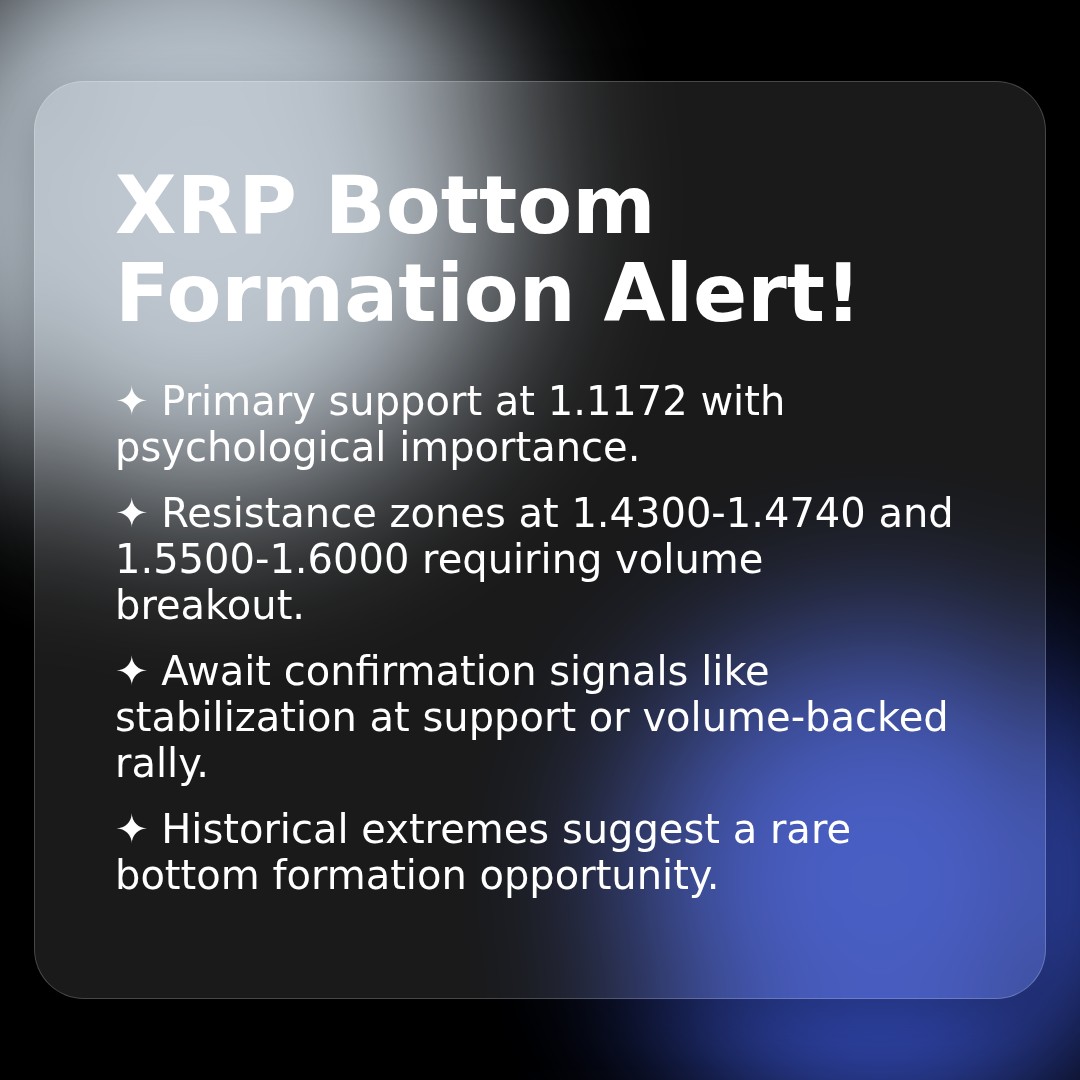
- • Primary Support (PS): 1.1172 (The low of the panic day on 2026-02-05). This level is the panic selling low and the starting point of the massive rebound, holding significant psychological and technical importance.
- • Secondary Support: 1.3300 - 1.3518 (The low range from 2026-02-23 to 24). This is the lower boundary of the recent consolidation range and can serve as a near-term strength/weakness demarcation line.
- • Key Resistance Levels:
- • Near-term Resistance: 1.4300 - 1.4740 (The range formed by multiple rebound highs in mid-February 2026). Price needs to break through this area with volume to challenge higher levels.
- • Primary Resistance: 1.5500 - 1.6000 (The lower edge of the high-volume congestion zone from late January and early February 2026). This area contains overhead supply from previous trapped longs and represents a stronger supply zone.
- • Comprehensive Trading Signals and Operational Suggestions:
- • Overall View: Cautiously Bullish / Bottom Formation Observation Period. The market has completed the Panic Selling (SC) and Automatic Rally (AR) and is currently in a potential Secondary Test (ST) phase. Smart money has demonstrated a willingness to absorb at panic lows, but a new uptrend is not yet established.
- • Operational Suggestions:
- 1. Observe / Await Confirmation Signals: The current price level is not recommended for chasing shorts as it is in a recovery period following extreme oversold conditions. Simultaneously, blind bottom-fishing is not advisable; clearer base-building signals are required.
- 2. Bullish Scenario and Entry Conditions: If the price retests the 1.3300 - 1.3518 support range again and shows signs of stabilization with significantly diminished volume (VOLUME_AVG_7D_RATIO < 0.8)**, such as a candlestick with a long lower shadow, this could be considered a low-risk opportunity for a long position test. A stronger signal would be price **breaking through and holding above 1.4740 with volume (VOLUME_AVG_7D_RATIO > 1.5).
- 3. Bearish Scenario and Risk Control: If the price breaks below 1.3300 with volume, the secondary test fails, potentially targeting the primary support at 1.1172. Any long positions should place a stop-loss below 1.3300.
- 4. Future Validation Points:
- • Confirmation Signal: After consolidating in the 1.33-1.47 range, a "high-volume rally from a higher support level" (Spring or Jump Across the Creek) appears.
- • Invalidation Signal: Price rebounds without volume to the 1.47 vicinity and turns down again, breaking below 1.33 with at least moderate volume, indicating lack of demand and potential failure of the bottom formation.
- • Historical Ranking Data Integration Conclusion: The extremely high volume ratio values (Top 12) and extremely low RSI values (1st) that appeared in this cycle statistically indicate the market experienced rare selling pressure and oversold conditions in nearly a decade. Such extreme readings often correspond to significant market turning points or阶段性 bottoms, providing strong historical data support for the current judgment that "the market may be forming a bottom." This does not imply an immediate rally but suggests a reduced statistical probability of further significant decline.
Disclaimer: This report/interpretation is solely market analysis and research based on publicly available information and does not constitute any investment advice or operational guidance. The author strives for objectivity and fairness in the content but makes no guarantees regarding its accuracy or completeness. Markets involve risks; investment requires caution. Any investment actions based on this report are undertaken at your own risk.
Thank you for your attention! Daily Wyckoff Volume-Price market interpretations are published promptly before the 8:00 AM market open. Please feel free to leave comments and share; your recognition is crucial. Let's work together to see the market signals clearly.
Member discussion: