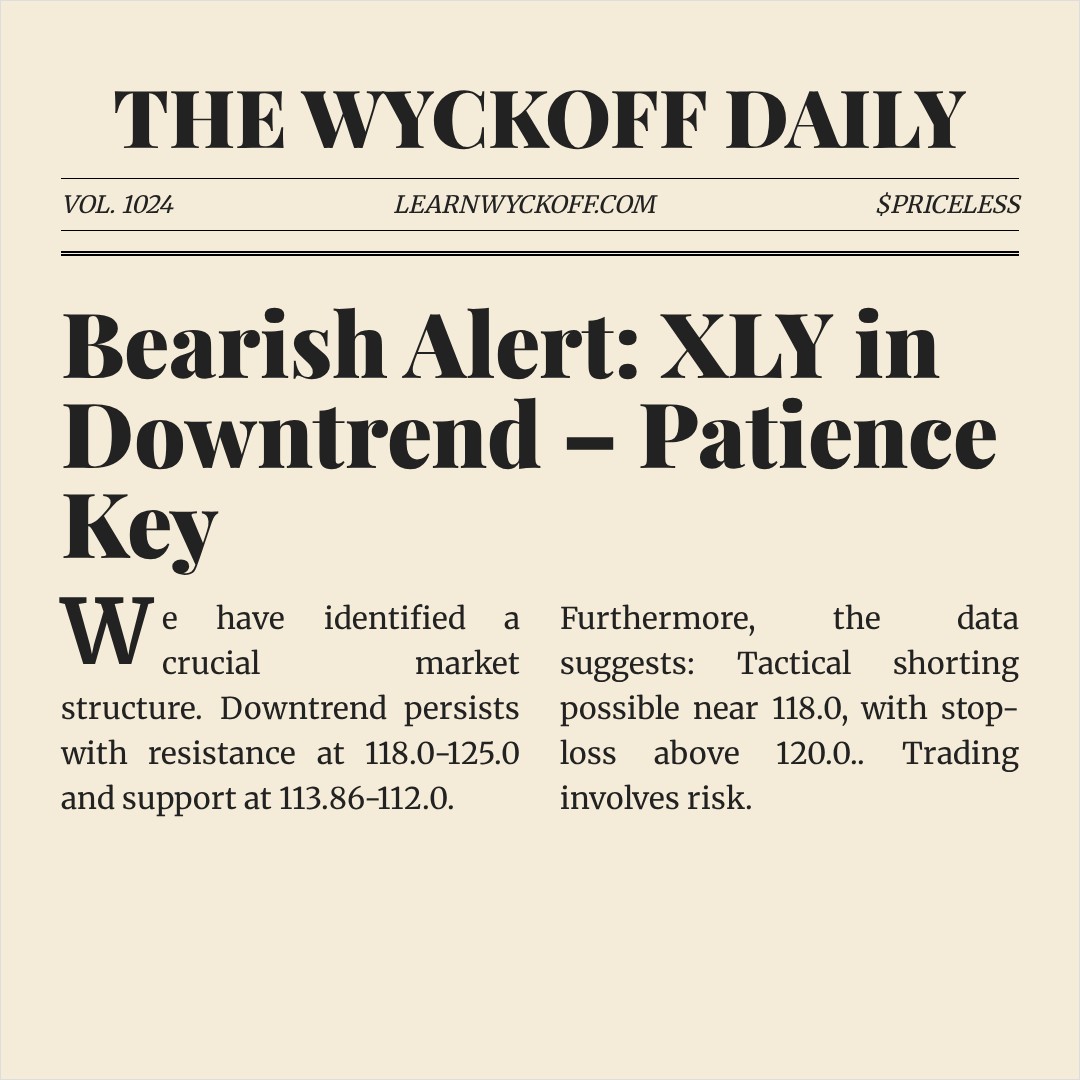
As a quantitative trading researcher proficient in the Wyckoff Method, I will draft a comprehensive quantitative analysis report on XLY based on the data you provided.
XLY Quantitative Analysis Report
Product Code: XLY
Analysis Date Range: December 26, 2025, to February 24, 2026
Report Generation Date: February 25, 2026
1. Trend Analysis and Market Phase Identification
As of February 24, 2026, the target XLY opened at 115.40, closed at 116.74, with a 5-day moving average of 116.35, a 10-day moving average of 116.77, a 20-day moving average of 118.77, a daily change of 1.52%, a weekly change of 0.60%, a monthly change of -3.66%, a quarterly change of -2.24%, and an annual change of -2.24%.

- • Moving Average Alignment and Trend Judgment:
As of the end of the analysis period (2026-02-24), the price closed at $116.74, having decisively broken below all short-term and medium-term moving averages (MA_5D: 116.348, MA_10D: 116.769, MA_20D: 118.77, MA_30D: 120.068, MA_60D: 120.126), displaying a typical bearish alignment. The MA_5D has successively crossed below the MA_10D, MA_20D, and MA_30D, confirming the formation of a short-term downtrend. - • Market Phase Identification:
Combined with price action analysis, the market experienced a complete "advance-distribution-decline" micro-cycle within the data period.- • Advance/Acceleration (2026-01-05 to 2026-01-12): The price rapidly rose from124.52, accompanied by enormous volume (VOLUME_AVG_7D_RATIO > 2.0) and a spike in short-term volatility (PARKINSON_RATIO_7D_14D > 1.45, reaching a near-decade high), consistent with characteristics of a markup or the early stages of distribution.
- • Distribution/Trend Reversal (2026-01-12 to 2026-01-20): After reaching new highs of125.01 (the #1 high in the past decade), the price failed to continue its upward push. A key signal occurred on 2026-01-12, where the price rose slightly but volume contracted significantly (VOLUME_AVG_7D_RATIO only 0.656), forming a "high-level consolidation on low volume"—a classic Wyckoff Distribution warning signal. Subsequently, the price fluctuated and retreated, breaking below short-term moving averages.
- • Decline (2026-01-20 to present): After breaking below the MA_20D, the price accelerated downward, entering a Markdown phase. Although there were rebounds during this period (e.g., 2026-01-21, 2026-02-20), they lacked sufficient volume support and failed to effectively recapture key moving averages, indicating weak demand and supply dominance.
Conclusion: The market is currently in the continuation of a Markdown phase. The supply pressure established during the preceding distribution phase is being released, and the market is searching for a new supply-demand equilibrium.
2. Price-Volume Relationship and Supply-Demand Dynamics
As of February 24, 2026, the target XLY opened at 115.40, closed at 116.74, volume 11212021, daily change 1.52%, volume 11212021, 7-day average volume 12470574.71, 7-day volume ratio 0.90.

- • Analysis of Key Demand Days:
- • 2026-01-05 / 2026-01-06: Following the prior decline, there were two consecutive days of high-volume advance (volume/7-day average ratio > 2.6), with prices recovering. This was a clear signal of demand entering the market, ending the brief panic and initiating the subsequent upward wave.
- • 2026-02-20: A high-volume rebound occurred after a continuous decline (VOLUME_AVG_7D_RATIO=1.53, PCT_CHANGE=1.04%), indicating demand attempting to resist at lower levels.
- • Key Supply Days and Warning Signals:
- • 2026-01-02: A high-volume plunge occurred (volume increase of 271.9%, ranking #3 in the past decade; VOLUME_AVG_7D_RATIO=2.88). This was a clear signal of expanding supply (panic selling), marking the beginning of the correction.
- • 2026-01-12: A textbook case of high-level consolidation on high volume. The price reached a new high, but volume contracted by 35% relative to the 7-day average (RATIO=0.656), showing that demand could no longer absorb the supply at high levels—core evidence of distribution.
- • 2026-02-05: Another high-volume decline occurred (VOLUME_AVG_30D_RATIO=1.41, PCT_CHANGE=-2.16%), with supply continuing to exert force during the downtrend, pushing prices down.
- • 2026-02-23: A significant drop (-2.09%) was accompanied by volume above recent averages (RATIO=1.23), indicating that supply persisted during the decline, and demand failed to mount an effective defense.
- • Supply-Demand Power Shift:
The volume relative ratio (VOLUME_AVG_*_RATIO) shows that demand power peaked in early January and quickly waned. Since mid-January, volume has mostly operated at or below the moving average level (RATIO < 1.2), with rebounds often occurring on low volume (e.g., 2026-01-27, RATIO=0.56), indicating a lack of willingness from demand to follow through. In contrast, several significant declines were accompanied by expanding volume, showing that the supply side (sellers) consistently held the initiative at key levels.
Conclusion: Supply-demand dynamics clearly indicate the market has shifted from demand dominance (early January) to supply dominance (mid-January to present). Recent rebounds lack support from sustained high volume, making them more likely technical retracements.
3. Volatility and Market Sentiment
As of February 24, 2026, the target XLY opened at 115.40, 7-day intraday volatility 0.18, 7-day intraday volatility ratio 0.94, 7-day historical volatility 0.23, 7-day historical volatility ratio 1.09, RSI 43.36.

- • Volatility Levels and Changes:
- • Short-term Volatility Expansion: During the early January advance and late February decline, the 7-day Parkinson volatility (PARKINSON_VOL_7D) increased, indicating heightened short-term market sentiment fluctuations. Notably, on 2026-01-09, the PARKINSON_RATIO_7D_14D reached 1.474, ranking #10 in the past decade, indicating abnormal short-term volatility expansion, often accompanying trend acceleration or extreme sentiment.
- • Long-term Volatility Reference: The 60-day historical volatility (HIS_VOLA_60D) fluctuated between 0.19-0.23, providing a long-term volatility benchmark. The current ratio of short-term volatility (7D) to long-term (60D) is around 1.25 (as of 2026-02-24), showing recent volatility is above the long-term average but not extreme.
- • Market Sentiment (RSI):
- • RSI_14 reached 64.81 on January 9, approaching overbought but not extreme, then declined after forming a bearish divergence with the price top.
- • It fell to 36.51 on February 5, entering oversold territory, and has since oscillated within the weak 30-50 range, indicating overall weak market sentiment with bears in control. The current RSI of 43.36 is in a neutral-to-weak zone, showing no severe oversold flattening, suggesting the downward momentum may not be fully exhausted.
Conclusion: Market sentiment has shifted from optimism in January to the current cautious and slightly bearish stance. The volatility structure indicates the market is in an active downtrend, not a low-volatility consolidation. The lack of extreme oversold RSI readings suggests panic selling (Capitulation) may not have occurred yet.
4. Relative Strength and Momentum Performance
- • Momentum Trends:
- • Short-term Momentum (WTD_RETURN): Recently experienced sharp fluctuations but failed to form sustained positive momentum.
- • Medium-term Momentum (MTD/QTD_RETURN): Significantly turned negative after the January high, with a YTD return of -3.656% and a QTD return of -2.236% as of February 2026, indicating a clear weakening of medium-term momentum.
- • Long-term Momentum (YTD/TTM): YTD return is -2.236%, a significant pullback from 8.8% at the end of 2025. The trailing 12-month return (TTM_12) is 7.31%, showing that while the long-term trend remains positive, recent pullbacks have been severe.
Conclusion: Momentum indicators across all timeframes consistently confirm that medium-term upward momentum has exhausted and turned negative. The price has retreated over 7% from the January high, with momentum decay resonating with the price breakdown.
5. Large Investor (Smart Money) Behavior Identification
Based on Wyckoff principles and the price-volume analysis above, the inferred intentions of large investors are as follows:
- • Distribution Confirmation: The "new high on low volume" on 2026-01-12 is a textbook signal of Distribution by smart money. Large capital utilized market optimism to reduce buying or even sell discreetly near record highs (historical rank #1), leading to price-volume divergence.
- • Behavior During Decline: During the subsequent decline, multiple high-volume down days occurred (e.g., 2026-02-05, 2026-02-23), indicating sustained supply outflow. This could be the remaining distribution of positions or trend traders joining the sell side. Although there were rebounds during this period (e.g., 2026-02-20), the lack of volume indicates large-scale demand did not significantly enter the market to buy the dip; it was more likely short-term funds or retail behavior.
- • Current Phase: The market is in a downtrend with overall shrinking volume, suggesting large investors are in a state of observation or continuing to reduce positions slightly. No clear signs of Accumulation, such as "massive volume absorbing panic selling" at key support levels, have been observed.
Conclusion: Comprehensive judgment indicates that large investors successfully executed distribution at high levels in mid-to-late January and are currently in an observation period post-distribution or in a phase of minor bearish positioning. The market needs clear signals like "high-volume price stabilization" or "massive rebound following panic selling" to infer that smart money is beginning to position contrarily.
6. Support/Resistance Level Analysis and Trading Signals

- • Key Resistance Levels (Supply Zones):
- 1. R1:125.0: Cycle top, historical high, strong supply zone.
- 2. R2:121.0: Lower boundary of the previous consolidation platform, coinciding with MA_30D and MA_60D, serving as an important bull-bear demarcation line.
- 3. R3:118.0: Recent rebound high (2026-02-20) and near the MA_20D, representing the nearest dynamic resistance.
- • Key Support Levels (Potential Demand Zones):
- 1. S1: $113.86: Recent low (2026-02-23), serving as initial psychological and technical support.
- 2. S2:112.0: A stronger support zone inferred based on prior price structure and Fibonacci retracement levels.
- • Wyckoff Events and Comprehensive Trading Signals:
- • Current Signal: Bearish/Observation. Trend, price-volume, and momentum all point to the bear side. The market is in a clear downtrend channel with no effective bottom reversal structure in place.
- • Shorting/Reduction Opportunities: If the price rebounds to near the118.0 resistance zone and shows signs of upward exhaustion with shrinking volume, it could be considered a tactical opportunity for shorting or reducing positions. A stop-loss could be placed above $120.0.
- • Trend Reversal Observation Points (Future Validation Points):
- 1. Demand Signal: A "high-volume stabilizing bullish candlestick" or a "panic-driven high-volume plunge rapidly followed by massive buying" (Spring/Shakeout) appears at $113.86 or lower levels (e.g.,112). This is the first sign of potential accumulation.
- 2. Confirmation Signal: Subsequently, a "successful secondary test" occurs—when the price retests this support area again, volume is significantly lower, and no new low is made.
- 3. Structural Breakout: The price, accompanied by sustained high volume, decisively breaks through and holds above the $120.0 resistance zone, which would initially confirm the end of the downtrend.
Final Operational Recommendation:
Hold cash and observe, awaiting clearer reversal signals. Aggressive traders might consider initiating a small short position in the118.0 area, targeting120.5. For bulls, any bottom-fishing actions at this point are counter-trend operations with extremely high risk; patience is advised to wait for the signals mentioned in the "Future Validation Points" before consideration. The market needs time to absorb supply and rebuild a demand base.
Disclaimer: This report/analysis is based solely on publicly available information for market analysis and research purposes and does not constitute any investment advice or operational guidance. The author strives for objectivity and fairness but makes no guarantees regarding the accuracy or completeness of the content. Markets involve risks, and investments require caution. Any investment actions based on this report are taken at your own risk.
Thank you for your attention! Daily Wyckoff price-volume market interpretations are released promptly at 8:00 AM before the market opens. Your comments and shares are greatly appreciated. Your recognition is crucial. Let's work together to see the market signals.
Member discussion: