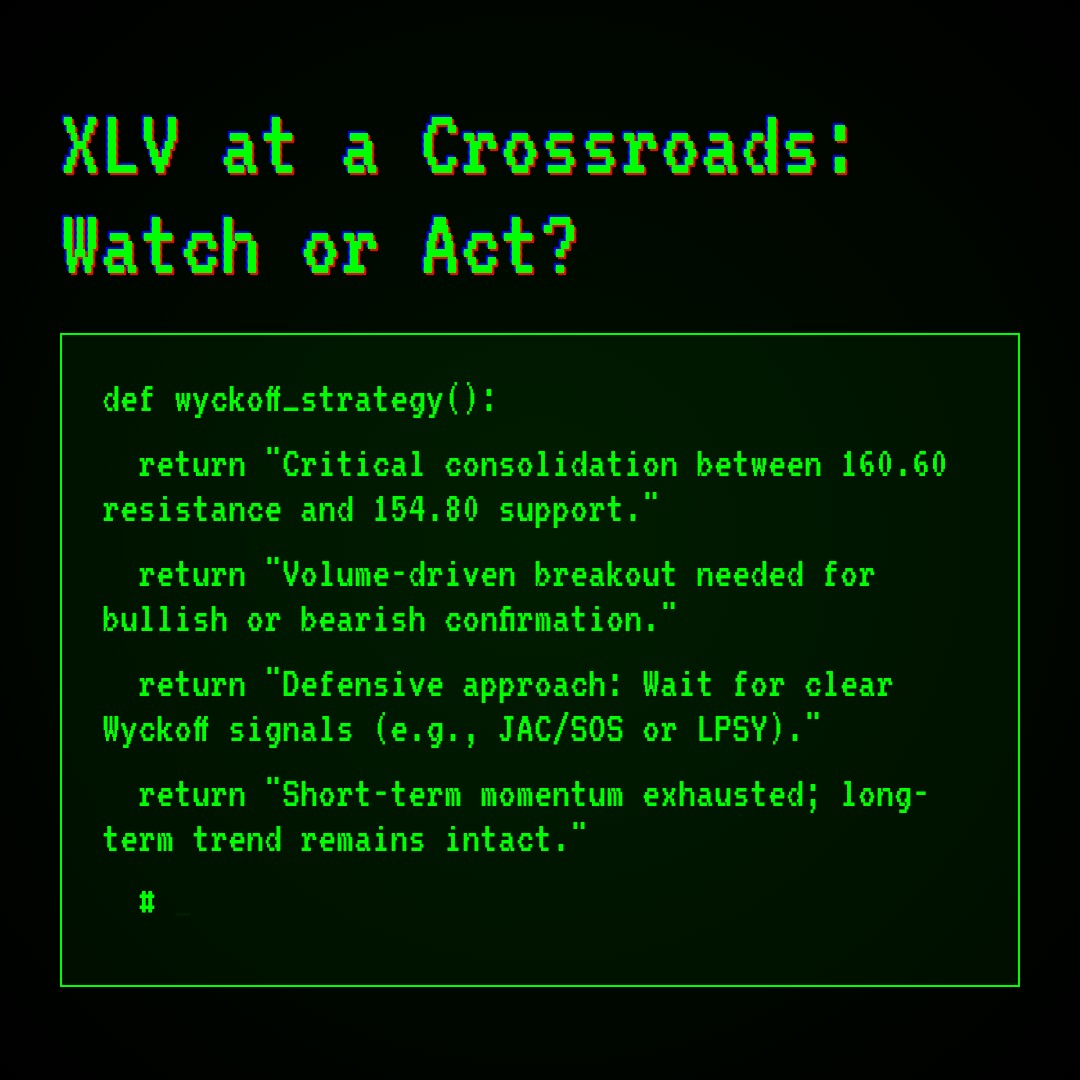
Okay, as per your instructions. Below is the comprehensive quantitative analysis report for XLV (US Healthcare Sector ETF) based on the Wyckoff method, using data from 2025-12-26 to 2026-02-24.


Wyckoff Quantitative Analysis Report - XLV

Product Ticker: XLV
Analysis Period: 2025-12-26 to 2026-02-24
Report Generation Date: Based on data up to 2026-02-24
Core Methodology: Wyckoff Price-Volume Principles


1. Trend Analysis & Market Phase Identification

As of 2026-02-24, the subject XLV had an opening price of 158.01, a closing price of 157.87, a 5-day moving average of 157.53, a 10-day moving average of 156.92, a 20-day moving average of 156.20, a daily change of -0.42%, a weekly change of 0.32%, a monthly change of 2.02%, a quarterly change of 1.98%, and an annual change of 1.98%.

XLV Price Trend Analysis Chart, including closing price and multiple moving averages
  • Moving Average Alignment & Price Position:
    As of 2026-02-24, the closing price CLOSE: 157.87 is above all major moving averages (MA_5D: 157.53, MA_10D: 156.92, MA_20D: 156.20, MA_30D: 156.51, MA_60D: 155.85), indicating a short-term bullish alignment. However, the price is close to the moving average cluster (especially the 5-day and 10-day), and has primarily oscillated around the 20-day MA over the past month (2026-01-23 to 2026-02-24), suggesting moderate short-term trend strength.
  • Moving Average Cross Signals:
    • • Reviewing historical data, around 2026-01-07, the 5-day MA (MA_5D) crossed above the 20-day MA (MA_20D), forming a bullish golden cross, confirming the strong rally in early January.
    • • Currently, the short-term MAs (5-day, 10-day) and medium-term MAs (20-day, 30-day, 60-day) are in a bullish alignment. However, the 5-day and 10-day MAs are converging with no clear directional indication, signaling weakening upward momentum.
  • Price Action & Market Phase Inference (Based on Wyckoff):
    • 2026-01-06 to 01-08: Price surged rapidly from 155.04 to 159.66 (+3.1%), then dropped back to 158.12 the next day on high volume. This behavior aligns with the characteristics of an "Upthrust (UT)" or "Buying Climax (BC)", potentially indicating initial distribution by large players following the rapid advance.
    • 2026-01-09 to 02-24: Price entered a wide trading range (157.31 - 160.59). Multiple instances of rally-failure (e.g., 01-14, 01-21) and support-testing bounces (e.g., 01-30) occurred, with volume contracting compared to the rally period. This fits the profile of a "Distribution Phase" or "Re-accumulation Phase" — consolidation at high levels after an advance, where dominant interests exchange positions. Historical ranking data shows that during this period, the highest price (160.59), highest opening price (159.15), and highest closing price (159.66) all ranked as the #1 or #2 highest records in nearly a decade, reinforcing the judgment that this is a significant price zone/resistance area.

Conclusion: The market is in a high-level consolidation phase within a medium-to-long-term uptrend. Short-term momentum has weakened, and the market may be transitioning from a "mark-up" phase to a "distribution" or "re-accumulation" phase. The record-high price area is a key supply zone (resistance).


2. Volume-Price Relationship & Supply-Demand Dynamics

As of 2026-02-24, the subject XLV had an opening price of 158.01, a closing price of 157.87, a volume of 12796009, a daily change of -0.42%, a volume of 12796009, a 7-day average volume of 14924843.57, and a 7-day volume ratio of 0.86.

XLV Volume-Price Relationship Line Chart and Historical Ranking Analysis
  • Key Demand Days (Demand Dominant):
    • 2026-01-06: Price rose +1.97% with volume of 17.78M, which is 2.43 times the 7-day average volume (7.31M) (VOLUME_AVG_7D_RATIO: 2.43). This is volume expansion on a price rise, indicating strong demand entering the market, driving the breakout.
    • 2026-01-07: Continued rise of +0.99% with volume of 14.51M, 1.54 times the 7-day average. Consecutive days of rising prices on high volume confirmed the strength of demand.
  • Key Supply Days (Supply Dominant):
    • 2026-01-08: Price fell -0.96% with volume of 17.61M, 1.62 times the 7-day average (10.85M), and 121% of the previous day's volume (VOLUME_GROWTH: 21.4%). This is a high-volume decline, indicating that after the price reached a new high (160.50), substantial supply (selling) emerged, quickly overwhelming demand. This day's volume ranked second for the week, a classic Sign of Strength (SOS) being reversed / Supply Overwhelming Demand (SOT) signal.
    • 2026-01-02: Price rose only +0.46%, but volume was 10.99M, 2.08 times the 7-day average (5.28M) (historical ranking: VOLUME_AVG_7D_RATIO was the 18th highest in nearly a decade). This is volume expansion with minimal price progress, suggesting powerful supply at higher levels, potentially an early distribution signal.
  • Current Supply-Demand State:
    Recently (2026-02-10 to 02-24), volume has generally been below various period average volumes (most VOLUME_AVG_*D_RATIO values are less than 1), and price fluctuations have narrowed. This shows overall participation has declined, with both supply and demand sides in a wait-and-see mode, and the market lacks clear direction.

Conclusion: Following the demand climax in early January, a supply-dominant high-volume decline swiftly appeared, establishing high-level resistance. Subsequent consolidation has seen contracting volume, indicating a temporary supply-demand balance. Market direction awaits confirmation through volume expansion.


3. Volatility & Market Sentiment

As of 2026-02-24, the subject XLV had an opening price of 158.01, a 7-day intraday volatility of 0.11, a 7-day intraday volatility ratio of 0.85, a 7-day historical volatility of 0.12, a 7-day historical volatility ratio of 0.76, and an RSI of 55.00.

XLV Historical Volatility Analysis Chart and Historical Ranking Data
  • Volatility Level & Changes:
    • • The current 7-day historical volatility (HIS_VOLA_7D: 12.38%) is significantly lower than the 14-day (16.22%), 21-day (16.67%), 30-day (16.05%), and 60-day (15.88%) volatilities (all related ratios <0.78). This indicates short-term volatility is contracting sharply.
    • • The 7-day Parkinson intraday volatility (PARKINSON_VOL_7D: 11.49%) is also below longer-term averages (all related ratios <0.87). Broad-based volatility contraction typically occurs during the consolidation or preparation stage of a trending move, as market sentiment calms from extremes of excitement or panic.
  • Overbought/Oversold Status:
    • • The 14-day RSI currently reads 54.99, in the neutral zone. Reviewing historical data, the RSI peaked at 68.69 on 2026-01-07 (approaching overbought) before retreating. The current RSI shows no extreme sentiment; market sentiment is moderate.

Conclusion: Market sentiment has shifted from optimism in early January (high volatility, high RSI) to current calm and watchfulness (contracting volatility, neutral RSI). Volatility contraction corroborates the volume contraction, indicating the market is searching for a new directional catalyst.


4. Relative Strength & Momentum Performance

  • Periodic Return Analysis:
    • Short-term Momentum (MTD): MTD_RETURN: 2.02%, positive but modest, consistent with the recent consolidation pattern.
    • Medium-term Momentum (QTD/YTD): QTD_RETURN: 1.98%, YTD: 1.98%. From a longer-term perspective (TTM_36: 22.85%), the subject remains in a strong long-term uptrend.
    • Momentum Comparison: Short-term momentum (MTD) is weaker than medium-term momentum (QTD/YTD), further confirming the attenuation of short-term upward momentum, though the long-term uptrend structure remains intact.

Conclusion: XLV maintains positive medium-to-long-term momentum, but short-term momentum has significantly slowed and entered consolidation. Momentum analysis aligns with the conclusions from trend and volume-price analysis.


5. Smart Money Behavior Identification

Based on Wyckoff theory and the above data analysis, the potential intentions of large investors (smart money) can be inferred:

  1. 1. Distribution Attempt: The high-volume decline around the record high (160.50) on 2026-01-08 is a classic signal of potential active distribution by smart money. They utilized the rapid early-January rally to create demand and then satisfied that demand by selling holdings near the highs. The subsequent month-plus of range-bound trading provided an environment for continued distribution across a wider price range.
  2. 2. Shakeout & Testing: Within the trading range, consecutive down days like those on 2026-01-27 and 01-28 did not see significantly expanded volume (compared to early January). This could be shakeout behavior aimed at flushing out weak holders, preparing for subsequent action (whether an upside breakout or continued distribution).
  3. 3. Current State - Watchfulness & Testing: The recent low-volume, narrow-range consolidation indicates smart money is neither aggressively buying nor selling. They are observing market acceptance at current price levels and testing support and resistance. Volume contraction is a sign of reduced smart money activity; they may be awaiting clearer fundamental or market signals.

Core Inference: Smart money realized partial profits during the rapid early-January rally and has been engaged in position adjustment (distribution/rebalancing) during the subsequent high-level consolidation. Currently in a watchful testing period, their next intention (whether to complete distribution and initiate a decline, or consolidate before another rally) will depend on the outcome of battles at key price levels.


6. Support/Resistance Level Analysis & Integrated Trading Signals

  • Key Resistance Levels:
    1. 1. Strong Resistance Zone: 160.50 - 160.60. Formed by the 2026-01-07 high (160.59) and 01-08 high (160.50), representing the absolute high area of the last decade accompanied by significant supply. Historical Rank #1 and #2 for Highest Price.
    2. 2. Secondary Resistance: 158.50 - 159.00. The recent upper boundary of the trading range (02-23 high 158.68, 02-24 high 158.50).
  • Key Support Levels:
    1. 1. Primary Support Zone: 154.80 - 155.40. The recent multiple pullback low area (bounce from 01-30 low 153.29, 02-02 low 154.40), also near the 60-day MA (155.85).
    2. 2. Secondary Support: 156.00 - 156.50. The cluster of 20-day (156.20) and 30-day (156.51) MAs, which have provided intraday support multiple times recently.
  • Integrated Trading Signals (Based on Wyckoff Events):
    • Current Signal: Neutral / Watchful (NEUTRAL / WATCHFUL).
    • Bullish Scenario: Price needs to break out with significant volume (VOLUME_AVG_7D_RATIO > 1.5) and hold above the 160.60 resistance zone to confirm the end of the distribution phase and the start of a new uptrend. This would constitute a Wyckoff "Jump Across the Creek (JAC)" or "Sign of Strength (SOS)" buy signal.
    • Bearish Scenario: If price breaks down on expanding volume through the 154.80 support zone, especially on a closing basis, it could signal the completion of distribution and the market entering a markdown phase. This would be a bearish signal akin to a "Last Point of Support (LPSY) / Breakdown".
  • Tactical Suggestions & Validation Points:
    • Long Strategy (Aggressive): Consider a light test long if price breaks above 158.50 with volume, and holds on a pullback, targeting 160.60, with a strict stop-loss below 157.00. Validation Point: Volume must expand significantly on the breakout.
    • Short Strategy (Right-side): Consider entering a short position if price breaks down below 155.00 on volume and shows weakness on any retest. Target around 152.00 (previous low area). Validation Point: Volume and price magnitude on the breakdown through key support.
    • Cautious Strategy: Within the current low-volume, directionless consolidation range, maintain a watchful stance. Wait for the above key validation points to be triggered before making decisions.

Final Conclusion: XLV is at a critical high-level consolidation / potential distribution stage within its long-term uptrend. Although the medium-to-long-term trend remains unbroken, the short-term supply-demand structure shows exhausted upward momentum, and smart money activity has turned cautious. The market urgently needs a high-volume directional breakout to guide the next move. Until such a breakout occurs, a defensive, watchful stance is recommended, using the outcome of battles at key price levels (160.60, 154.80) as the core decision-making basis.


Disclaimer: This report/interpretation is solely market analysis and research based on publicly available information and does not constitute any investment advice or operational guidance. The author strives for objectivity and impartiality but makes no guarantees regarding its accuracy or completeness. The market involves risks; investment requires caution. Any investment actions taken based on this report are at your own risk.


Thank you for your attention! Daily Wyckoff price-volume market analysis is released promptly at 8:00 AM before the market opens. Please feel free to comment and share; your recognition is vital. Let's work together to see the market signals clearly.