Quantitative Analysis Report: XLK (Technology Select Sector SPDR Fund)

Ticker: XLK
Analysis Period: 2025-12-26 to 2026-02-24
Report Generation Date: 2026-02-25
Core Methodology: Wyckoff Volume-Price Analysis | Quantitative Signal Extraction | Large Investor Behavior Identification


1. Trend Analysis and Market Phase Identification

As of 2026-02-24, the underlying asset XLK had an open price of 139.24, a close price of 140.32, a 5-day moving average of 140.00, a 10-day MA of 140.76, a 20-day MA of 142.20, a daily change of +1.30%, a weekly change of +0.60%, a monthly change of -2.47%, a quarterly change of -2.54%, and a year-to-date change of -2.54%.

XLK Price Trend Analysis Chart, including closing price and multiple moving averages
  • Moving Average Alignment and Trend Assessment:
    • Established Bearish Alignment: Throughout the analysis period, the price (CLOSE) consistently traded below all major moving averages (MA_5D, MA_10D, MA_20D, MA_30D, MA_60D). The clear and stable bearish alignment structure of MA_5D < MA_10D < MA_20D < MA_30D < MA_60D unequivocally indicates the market is in a long-term downtrend.
    • Downward Divergence of MAs: Long-term moving averages (e.g., MA_60D) descended steeply from around144, exhibiting an extreme slope, signaling strong long-term downward momentum. Short-term averages consistently failed to effectively cross above long-term averages, with any rally encountering formidable resistance at the long-term MAs.
    • Conclusion: Based on the moving average system, XLK is in a clear, strong, long-term bearish trend.
  • Market Phase Inference (Wyckoff Perspective):
    • Distribution and Markdown Phase: At the beginning of the analysis period (late December to early January), prices exhibited wide-ranging fluctuations at relatively high levels (149) accompanied by significant volume expansion (e.g., 25.58 million VOLUME on Jan 29). This, followed by the subsequent waterfall decline, aligns with the Wyckoff characteristic of transitioning from "Distribution" into the "Markdown" phase.
    • Panic Selling Phase: In early February (Feb 3-5), prices experienced consecutive massive declines (-2.19%, -2.79%, -1.80%) with volume reaching near-decade extremes (historical rankings #8, #13). This is a classic "Panic Selling" or "Selling Climax" phase, indicating a market sentiment breakdown and a concentrated outburst of supply.
    • Preliminary Support and Potential Accumulation Attempt: After Feb 6, prices rebounded multiple times after touching lows in the142 range (e.g., Feb 6, Feb 9, Feb 24). Although volume receded, it remained above earlier levels, suggesting potential weakening of downward momentum. The market may be attempting to establish "Preliminary Support" or enter the early stages of "Accumulation," though the trend has not yet reversed.

2. Volume-Price Relationship and Supply-Demand Dynamics

As of 2026-02-24, the underlying asset XLK had an open price of 139.24, a close price of 140.32, volume of 13003540, a daily change of +1.30%, volume of 13003540, a 7-day average volume of 21241395.43, and a 7-day volume ratio of 0.61.

XLK Volume-Price Relationship Line Chart and Historical Ranking Analysis
  • Key Day Analysis:
    • High-Volume Plunge (Supply Dominated):
      • 2026-02-04: Price declined -2.79%, volume 45.65 million (10-year rank #8), VOLUME_AVG_30D_RATIO as high as 3.04 (10-year rank #18). This is a textbook panic selling day with massive supply emergence.
      • 2026-02-05: Price declined -1.80%, volume 42.95 million (10-year rank #13), with turnover amount (AMOUNT) reaching the 5th highest in history. Consecutive days of extreme-volume decline confirm absolute supply dominance, marking an emotional selling phase.
    • High-Volume Rebound (Demand Testing):
      • 2026-02-06: Following the consecutive plunges, price rebounded +4.06% on volume of 37.13 million (VOLUME_AVG_30D_RATIO 2.16). This represents the "Automatic Rally" following panic selling, where demand emerges to absorb remaining supply. The significant rebound on slightly lower volume than the panic days indicates demand entered but did not establish overwhelming dominance.
    • Feeble Rebound and Re-emerging Supply:
      • 2026-02-12: Price declined -2.63% on volume of 32.15 million (VOLUME_AVG_30D_RATIO 1.63). A high-volume decline after the initial rebound indicates persistent supply pressure and new selling狙击 at higher levels.
    • Low-Volume Rebound (Insufficient Demand):
      • Feb 18, 19, 24: Prices saw minor rebounds, but VOLUME_AVG_30D_RATIO remained below 0.7, indicating weak follow-through demand during the rallies. These are technical or "exhaustion" rebounds with questionable sustainability.
  • Supply-Demand Dynamics Summary:
    • • The entire cycle was completely controlled by supply (Selling Pressure), culminating in a panic selling climax in early February.
    • • Following the panic, clear demand (Buying Interest) testing appeared (Feb 6 large bullish candle), but subsequent rebound volume was insufficient, suggesting demand remains cautious or supply is not yet fully absorbed.
    • • The current market is in a delicate equilibrium phase where the supply surge has subsided, and demand is tentatively testing but has not yet formed consensus.

3. Volatility and Market Sentiment

As of 2026-02-24, the underlying asset XLK had an open price of 139.24, a 7-day intraday volatility of 0.22, a 7-day intraday volatility ratio of 0.84, a 7-day historical volatility of 0.19, a 7-day historical volatility ratio of 0.55, and an RSI of 43.48.

XLK Historical Volatility Analysis Chart and Historical Ranking Data
  • Volatility Levels and Structure:
    • Extreme Historical Volatility: In early January, HIS_VOLA_30D reached extreme values around 2.42, ranking #2, 10, 12, 13, etc., in the 10-year historical ranking data. This indicates the market was already in a highly unstable "crisis" state at the beginning of the analysis period.
    • Abnormal Volatility Structure: HIS_VOLA_RATIO_7D_30D and HIS_VOLA_RATIO_7D_60D reached extreme lows in early January (e.g., 0.0376, 10-year rank #7). This signifies short-term volatility was far below the long-term, extremely high average volatility. This structure often appears at the end of a long-term trend, where the market calms temporarily after a plunge while long-term uncertainty remains extremely high.
    • Recent Volatility Contraction: By the end of the analysis period (Feb 24), HIS_VOLA_7D fell to 0.19 and PARKINSON_VOL_7D to 0.22. Short-term volatility has significantly receded from its peak, indicating a market transition from "panic" to a "wait-and-see" or "basing" consolidation state.
  • Sentiment Indicator (RSI):
    • Persistent Oversold Conditions: RSI_14 repeatedly fell into the oversold region below 30 throughout the period (minimum 23.54), especially during the late-January to early-February plunge. However, prices did not immediately reverse due to RSI oversold conditions, indicating that in a strong downtrend, technical oversold signals alone are insufficient; a fundamental shift in supply-demand dynamics is required.
    • Current Status: As of Feb 24, RSI_14 is 43.48, having exited the oversold zone but remaining below the 50 neutral line. This reflects a recovery in market sentiment from extreme pessimism, yet still leaning bearish.

4. Relative Strength and Momentum Performance

  • Return Analysis:
    • Comprehensive Negative Returns: YTD (Year-to-Date) is -2.54%, QTD (Quarter-to-Date) is -2.54%, TTM_12 (Trailing Twelve Months) is -39.39%. Momentum across all timeframes is negative, confirming XLK's absolute weakness.
    • Slight Short-term Momentum Repair: WTD_RETURN (Week-to-Date) is +0.60%, MTD_RETURN (Month-to-Date) is -2.47%. Compared to the steep decline in early February, short-term momentum shows signs of stabilization, but medium-term momentum (MTD) remains negative, indicating overall downward pressure persists.
  • Momentum and Volume-Price Validation:
    • • The repair in short-term momentum (WTD turning positive) aligns with the volume-price behavior of the Feb 6 rebound and subsequent minor rallies. However, the repair is weak and unsupported by sustained high volume, thus judged as a weak rebound within a downtrend, not the start of a trend reversal.

5. Large Investor ("Smart Money") Behavior Identification

  • Distribution Behavior (Dec 2025 - Jan 2026): During the initial decline from highs (e.g., Jan 8, 29), high-volume declines occurred (VOLUME 16.87M, 25.58M). This is not typical retail behavior but represents large, organized capital exiting, characteristic of the "Distribution" process.
  • Absorption During Panic (Feb 4-6, 2026):
    • Feb 4-5 (Selling): Sellers were undoubtedly dominant during the massive plunge. However, such extraordinary volume necessarily corresponds to an equivalent scale of buyers. These buyers may include passive stop-losses and panicked retail investors, but likely also include "smart money" actively accumulating at extreme prices.
    • Feb 6 (Rebound): The high-volume bullish candle makes the absorbing force visible. Smart money likely completed establishing partial positions at the panic lows.
  • Accumulation Testing (Post-Feb 6, 2026): Prices consolidated multiple times in the142 range without making new lows, and the volume magnitude on key down days (e.g., Feb 12, 23) was lower than during panic days. This aligns with the Wyckoff characteristic of an "Accumulation Range" – large investors are controlling price, repeatedly consolidating within a range to absorb floating supply, while shaking out weak holders through shakeouts (e.g., Feb 23 decline).
  • Conclusion: The likely trajectory of smart money behavior is: Distribution in Dec-Jan → Strategic accumulation beginning during the February panic → Entering a consolidation/accumulation phase in mid-to-late February. The market may currently be in the process of large investors building a bottom.

6. Support/Resistance Level Analysis and Trading Signals

XLK Support and Resistance Level Analysis Chart with Trading Signals
  • Key Support Levels:
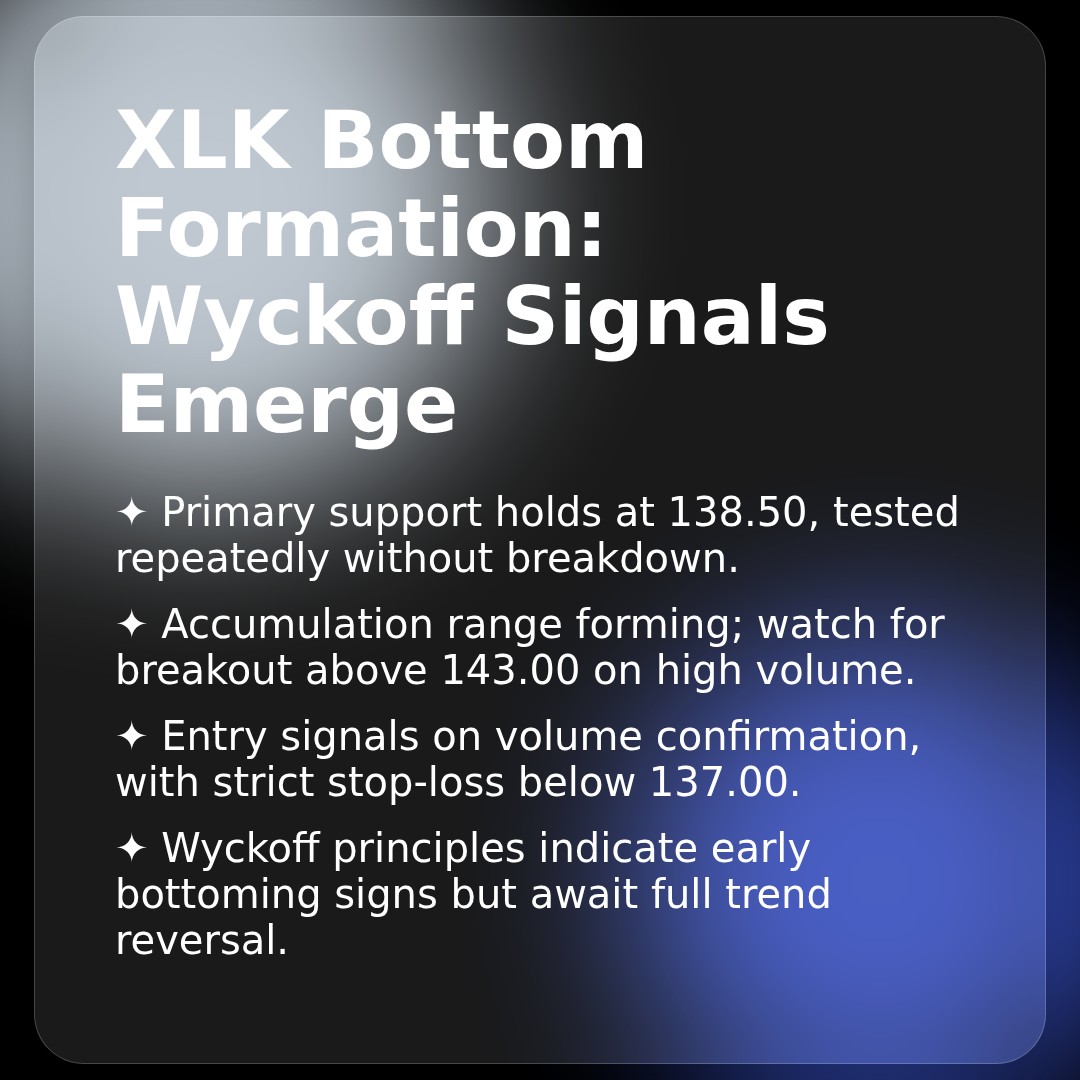
    • Primary Support Zone:138.50. This is the area of multiple pullback lows following the February panic selling (Feb 6 low 137.42, Feb 17 low 137.02, Feb 23 low 137.89). This zone has been repeatedly tested and not decisively broken, making it the most critical support line.
    • Secondary Support: Near $135.00. The extreme low from Feb 5. If the primary support zone fails, this will be the last line of defense.
  • Key Resistance Levels:
    • Immediate Strong Resistance:143.00. The upper boundary of the current accumulation range where the February rebound was repeatedly rejected (Feb 11, 13, 20).
    • Mid-term Trendline/Breakpoint:148.00. The area of late January rebound highs and the current location of the MA_20D and MA_30D. Only a high-volume breakout above this zone would provide a preliminary signal of downtrend disruption.
  • Comprehensive Wyckoff Trading Signals:
    • Current Phase Judgment: The market is in the process of potentially forming an Accumulation Range. The Panic Selling (SC) and Automatic Rally (AR) have likely occurred. The market may currently be in a Secondary Test (ST) or Shakeout phase.
    • • **Signal Nature: ** Cautiously Bullish / Bottoming Observation. The trend remains bearish, but preliminary evidence of a potential base formation has emerged.
  • Actionable Suggestions and Future Validation Points:
    1. 1. Observation/Light Position Testing Strategy: Aggressive investors could consider small, exploratory long positions if price revisits the support zone (near $138) accompanied by signs of diminishing volume on declines or a high-volume demand signal.
    2. 2. Key Entry Signal: Wait for price to break out above and hold above the143 resistance zone on high volume (VOLUME_AVG_30D_RATIO > 1.2). This could signal the potential end of the accumulation range and the beginning of a Markup phase, warranting consideration for adding to positions.
    3. 3. Strict Stop-Loss: Any long position must place a stop-loss below the $137 support level (e.g., $136.50). A high-volume breakdown below this level would invalidate the accumulation hypothesis and suggest a continuation of the downtrend.
    4. 4. Future Validation Points:
      • Confirmation: Price continues consolidating above support with progressively lower volume on declines (VOLUME_AVG_30D_RATIO < 0.8) and modestly higher volume on rallies.
      • Invalidation: Price experiences a low-volume drift lower and eventually breaks down below $137 support on high volume. This would signal the start of a new down-leg, and long positions should be strictly avoided.

Report Summary:
After experiencing a plunge dominated by near-decade extremes in volatility and selling volume (confirmed by historical ranking data), XLK has entered a critical juncture. Quantitative data suggests that the structural power of the bearish trend is waning, while bullish forces are beginning to tentatively gather at lower levels. According to Wyckoff principles, this aligns with the early characteristics of a major "Accumulation Range." However, trend reversal is never instantaneous. Traders should currently focus on identifying and validating this potential bottom, patiently awaiting the key volume-price signals that confirm demand has fully taken control, rather than chasing rallies or selling into panics.


Disclaimer: This report/analysis is solely for market analysis and research based on publicly available information and does not constitute any investment advice or operational guidance. The author strives for objectivity and fairness but makes no guarantees regarding the accuracy or completeness of the content. Markets involve risks; investments require caution. Any investment actions taken based on this report are undertaken at your own risk.


Thank you for your attention! Wyckoff volume-price market analysis is published daily at 8:00 AM before market open. Please feel free to comment and share; your recognition is crucial. Let's work together to see the market signals clearly.