All right. As a quantitative trading researcher proficient in the Wyckoff method, I will provide you with a comprehensive and in-depth quantitative analysis report based on the supplied data.

Quantitative Analysis Report

Product Code: XLF
Analysis Date Range: 2025-12-26 to 2026-02-24
Report Generation Time: 2026-02-25


1. Trend Analysis & Market Phase Identification

As of 2026-02-24, the underlying asset XLF opened at 50.45, closed at 50.98. The 5-day moving average (MA) is 52.03, the 10-day MA is 52.37, and the 20-day MA is 52.96. The daily change is +0.49%, the weekly change is -2.34%, the monthly change is -4.60%, the quarterly change is -6.92%, and the year-to-date change is -6.92%.

XLF Price Trend Analysis Chart, including closing price and multiple moving averages
  • MA Alignment & Trend Assessment:
    • • At the beginning of the analysis period (late December 2025 to early January 2026), the price (CLOSE) traded above all major moving averages (MA_5D, MA_10D, MA_20D, MA_30D, MA_60D), exhibiting a standard bullish alignment.
    • • A trend inflection point occurred on 2026-01-13. On that day, the closing price (54.23) broke below the MA_20D (55.30) for the first time, marking the initial breakdown of the uptrend.
    • • Entering February, the moving average system completely transitioned into a bearish alignment. As of February 24th, the price (50.98) is below all MAs, and the short-term MA (MA_5D: 52.03) has crossed below the long-term MA (MA_60D: 53.95), confirming the medium-term downtrend.
  • Moving Average Crossover Signals:
    • • A key bearish crossover signal occurred on 2026-02-23. On that day, the MA_5D (52.22) crossed below the MA_20D (53.08), which is typically viewed as a signal of accelerating short-term downtrend momentum.
  • Wyckoff Market Phase Inference:
    • Early January 2026 (around the 56.40 high): Combined with volume-price analysis (see below), this zone exhibited characteristics of Distribution. The price reached a near-decade high (historical rank #1), but showed signs of stagnation on high volume, suggesting smart money may have been transferring positions to the public buyers in this area.
    • Mid-January to late February 2026: The market entered the Markdown phase. The price declined in an orderly fashion, punctuated by several high-volume down days (e.g., Jan 13th, Feb 12th), indicating persistent and dominant supply. The massive sell-offs on Feb 12th and 23rd carried the nature of Panic Selling.
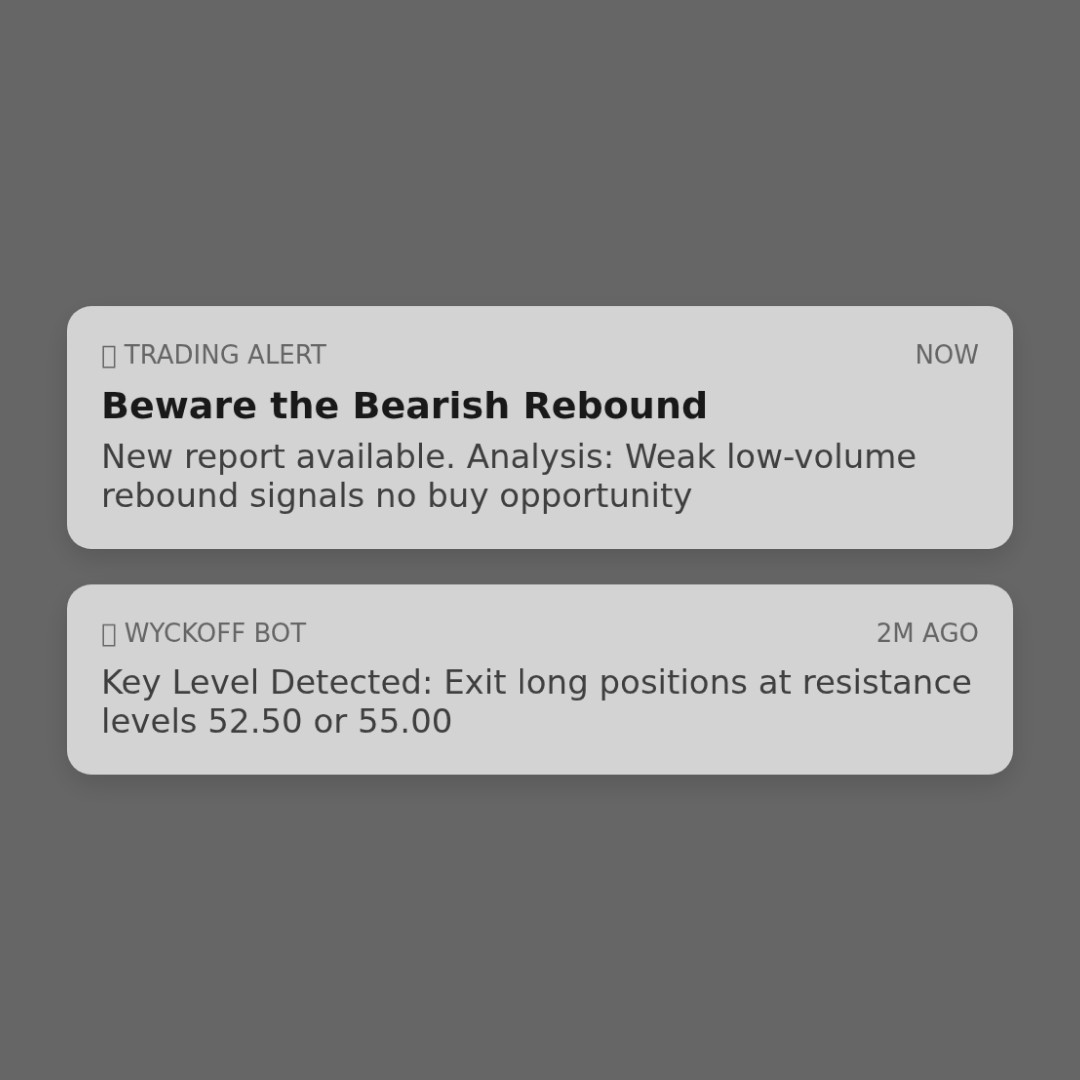
    • Current Status (2026-02-24): A minor, low-volume rebound followed the panic decline. This is likely a technical pullback within the downtrend rather than the beginning of Accumulation. It is more probable to be a "Secondary Test" or a weak bounce within the Markdown phase.

2. Volume-Price Relationship & Supply-Demand Dynamics

As of 2026-02-24, the underlying asset XLF opened at 50.45, closed at 50.98, volume was 63,085,668, daily change +0.49%. Volume: 63,085,668, 7-day average volume: 63,608,855.57, 7-day volume ratio: 0.99.

XLF Volume-Price Relationship Line Chart and Historical Ranking Analysis
  • Volume-Price Divergence on Key Reversal Days (Exhaustion of Demand / Emergence of Supply):
    • 2026-01-05: High-volume advance (volume 58.04M, VOLUME_AVG_7D_RATIO: 2.39), showing strong demand pushing price higher.
    • 2026-01-06: Volume-Price Divergence (Stagnation). Price continued rising, but volume (38.95M) contracted sharply from the previous day (VOLUME_GROWTH: -32.9%), indicating insufficient follow-through demand—the first warning sign.
    • 2026-01-07: High-volume decline (volume 44.72M, price change -1.40%). This is a clear signal of strong supply entering, confirming selling pressure at the top area.
    • 2026-01-13: Very high-volume decline (volume 77.05M, VOLUME_AVG_14D_RATIO: 2.36, price change -1.92%). This is a signature event confirming the downtrend, indicating that large-scale selling (supply) began to dominate the market.
  • Supply-Demand Characteristics During the Decline:
    • • The entire decline was not a one-sided low-volume affair but featured multiple instances of "high-volume declines," indicating active and persistent supply (e.g., Jan 20th, Feb 5th, Feb 11th).
    • Panic and Climax Signals:
      • 2026-02-12: Extreme high-volume plunge (volume 94.65M, VOLUME_AVG_60D_RATIO: 2.15, price change -1.99%). The dollar volume reached the 18th highest in the past decade (HISTORY_RANK data). Combined with the sharp price drop, this is a classic Panic Selling / Selling Climax, potentially signaling a concentrated release of short-term selling pressure.
      • 2026-02-23: Another very high-volume plunge (volume 94.60M, price change -3.35%), representing a retest of the panic low, showing supply is still present.
  • Current Supply-Demand Status (2026-02-24):
    • • The price rebounded slightly (+0.49%), but volume (63.09M) contracted significantly compared to the panic volume of the previous day (VOLUME_GROWTH: -33.3%), and the VOLUME_AVG_7D_RATIO is 0.99. This constitutes a "low-volume rebound," indicating demand remains weak, the rally lacks strong impetus from large capital, and its sustainability is questionable.

3. Volatility & Market Sentiment

As of 2026-02-24, the underlying asset XLF opened at 50.45. The 7-day intraday volatility is 0.19, 7-day intraday volatility ratio is 0.96, 7-day historical volatility is 0.30, 7-day historical volatility ratio is 1.10, RSI is 36.10.

XLF Historical Volatility Analysis Chart and Historical Ranking Data
  • Volatility Level and Changes:
    • • Historical volatility (HIS_VOLA) and Parkinson volatility significantly expanded during the price decline. Particularly in mid-to-late February, HIS_VOLA_7D surged from around 0.16 to above 0.30 (reaching 0.315 on Feb 23rd), indicating extreme market instability.
    • Volatility Ratio Anomalies: During the sharp declines on Feb 12th and 23rd, HIS_VOLA_RATIO_7D_60D reached 1.39 and 1.59 respectively, and PARKINSON_RATIO_7D_60D reached 1.42 and 1.46 respectively. This clearly indicates that short-term volatility is far above the long-term average, providing quantitative evidence that the market is in a state of panic or trend acceleration.
  • RSI Overbought/Oversold:
    • • RSI_14 reached 69.89 on Jan 6th, nearing the overbought zone (70), providing technical confirmation for the top.
    • • Subsequently, RSI declined steadily, dropping to 34.96 and 33.90 on Feb 12th and 23rd respectively, entering the oversold zone. This typically aligns with panic selling phases, but requires volume-price context to determine if it's a trend continuation or exhaustion.

4. Relative Strength & Momentum Performance

  • Complete Momentum Turn Negative: All return metrics across timeframes clearly point to deteriorating momentum.
    • Short-term Momentum (WTD_RETURN): Frequently negative throughout February, showing persistent short-term selling pressure.
    • Medium-term Momentum (MTD_RETURN, QTD_RETURN, YTD): All turned negative, with magnitudes progressively increasing (YTD: -6.92%). This indicates that XLF's medium-term trend has clearly weakened, underperforming its own year-start benchmark.
  • Conclusion Validation: The negative momentum performance, combined with the downtrend, high-volume decline price-action, and elevated volatility, mutually validates and collectively depicts a weak market structure.

5. Large Investor (Smart Money) Behavior Identification

  • Distribution Behavior Identification: In the area around the historical highs in early January (closing price historical rank #1, #2), "high-volume stagnation" followed by "high-volume decline" (Jan 6-7) occurred. This is the classic "Distribution" pattern in Wyckoff theory, inferring that large investors (smart money) conducted active selling in this high-price zone.
  • Downtrend Dominance & Panic Selling: The multiple high-volume down days on Jan 13th and subsequent declines indicate that supply (large-scale selling) consistently dominated the market, not retail behavior. The extreme high volume on Feb 12th (dollar volume historical rank #18) is a hallmark of "Panic Selling." This is typically accompanied by irrational selling from the public, while some smart money may begin to close remaining positions or conduct test-buying, but not large-scale accumulation.
  • Current Behavior Assessment (2026-02-24): A low-volume minor rebound followed the panic. This rebound lacks support from high volume, resembling short-covering or retail bottom-fishing behavior rather than large-scale "Accumulation" by smart money. Smart money is likely still观望 at this level, awaiting better prices or clearer signs of a bottom.

6. Support/Resistance Analysis & Trading Signals

XLF Support/Resistance Analysis Chart and Trading Signals
  • Key Support Levels:
    • S1: 50.00 - 50.50: The low zone formed by the recent panic decline (Feb 23rd low 50.64, Feb 24th low 50.24). This is the nearest and a psychologically key support level.
    • S2: 48.00 - 49.00: If the crucial 50.00 level is broken decisively (confirmed by closing price), the next support to watch would be a prior price consolidation zone.
  • Key Resistance Levels:
    • R1: 52.50: The rebound high on Feb 20th, also the first resistance level to overcome post-decline.
    • R2: 55.00 - 56.00: The top of the prior Distribution zone, representing the strongest medium-term resistance area where significant overhead supply exists.
  • Comprehensive Wyckoff Trading Signals & Operational Recommendations:
    • Overall Signal: Bearish/Watchful. The market structure is broken, and a clear downtrend is in place. The current low-volume rebound is weak and should not be considered a buy signal.
    • Operational Recommendations:
      1. 1. For Holders (Long Positions): Any rebound towards R1 (52.50) or R2 (55.00) presents an opportunity to reduce or exit positions. Do not add to long positions blindly based on oversold conditions here.
      2. 2. For Short Sellers or Those on the Sidelines: Be patient. An ideal (though higher-risk) shorting opportunity would be on a rebound near R1 or R2, accompanied by renewed signs of weak demand and resurgent supply (e.g., low-volume advance, appearance of upper shadows). Chasing the short side here offers an unfavorable risk-reward ratio.
      3. 3. Potential Long Opportunity (Left-side trade, High Risk): Only suitable for aggressive investors. Requires observing whether, after an "oversold bounce" near S1 (50.00), a "Secondary Test" occurs with significantly萎缩 volume (indicating supply drying up) accompanied by declining volatility. Current signals are insufficient.
    • Future Validation Points:
      • Bearish Scenario Confirmation: Price rebounds near 52.50, then shows high-volume stagnation or a down candle.
      • Bearish Scenario Negation / Early Trend Reversal Signal: Price breaks above and holds decisively above R2 (55.00) on strong volume (VOLUME_AVG_*D_RATIO > 1.2), with pullbacks on low volume.
      • Downtrend Exhaustion Signal to Watch For: Near the 50.00 support, a "long lower shadow + very high volume" panic day occurs, followed by several days of "narrow range/low volume consolidation or minor bounce," suggesting panic selling may have been absorbed.

Disclaimer: This report is based entirely on quantitative and theoretical analysis of the provided historical data and does not constitute any investment advice. Financial markets carry risks, and past performance is not indicative of future results. Investors should make independent judgments and decisions based on additional information.


Thank you for your attention! Wyckoff Volume-Price Market Analysis is published daily at 8:00 AM before the market opens. Please feel free to leave comments and share. Your recognition is crucial. Let's work together to see the market signals clearly.