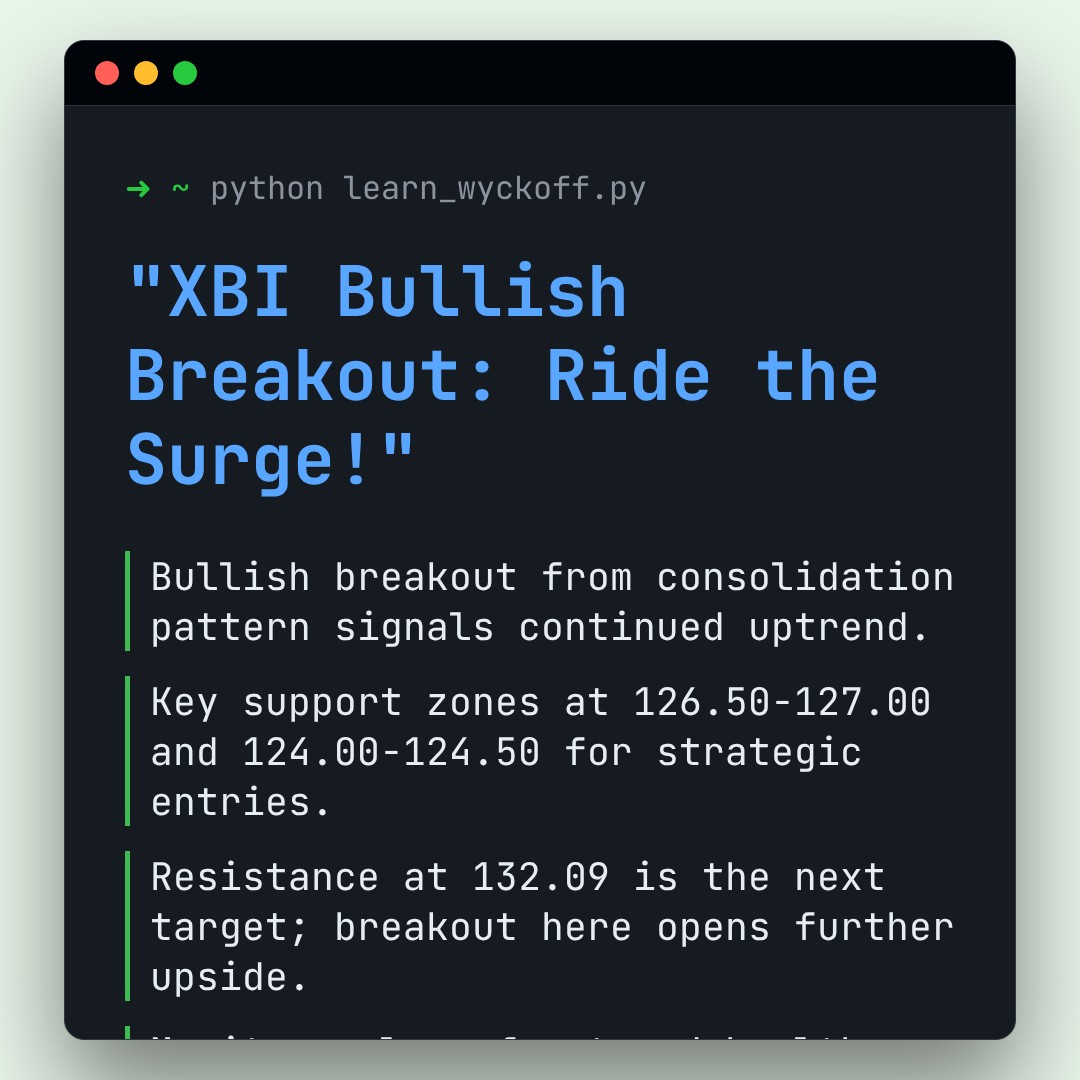
Quantitative Analysis Report on XBI Based on Wyckoff Volume-Price Principles

Product Code: XBI
Analysis Date Range: 2025-12-26 to 2026-02-24
Report Generation Date: 2026-02-25


1. Trend Analysis and Market Phase Identification

As of 2026-02-24, the underlying asset XBI had an opening price of 127.36, a closing price of 129.16, a 5-day moving average (MA) of 125.74, a 10-day MA of 125.09, a 20-day MA of 125.56, with a daily gain of 1.72%, a weekly gain of 3.63%, a monthly gain of 3.54%, a quarterly gain of 5.93%, and a year-to-date gain of 5.93%.

XBI Price Trend Analysis Chart, including closing price and multiple moving averages
  • Moving Average Alignment Analysis: As of the end of the analysis period (2026-02-24), the closing price of 129.16 is positioned above all major moving averages. Specifically: MA_5D(125.74) > MA_10D(125.09) > MA_20D(125.56) > MA_30D(125.73) > MA_60D(124.19). Although there is a slight crossover between the MA_20D and MA_30D, the overall configuration presents a clear bullish alignment, indicating a solid intermediate-term uptrend.
  • Moving Average Crossover Signals: Around the beginning of the data period (near 2025-12-26), the price oscillated near the moving averages. A key bullish crossover signal emerged on 2026-01-07, when the price surged 3.55% and the closing price (126.43) decisively broke above and moved away from all short-term moving averages (MA_5D: 121.47), confirming the trend initiation. Subsequently, the price tested the MA_20D and MA_30D multiple times (e.g., 2026-01-23, 2026-02-05), finding effective support and rebounding each time, validating the supportive role of these moving averages.
  • Market Phase Inference: Combining price action and Wyckoff Theory:
    • Accumulation/Launch Phase (2025-12-26 to 2026-01-06): The price consolidated within a narrow range of 122-126 on moderate volume. The RSI rebounded from oversold levels (47.16), exhibiting bottoming characteristics.
    • Markup Phase (2026-01-07 to 2026-01-22): Marked by the high-volume bullish candlestick on January 7th, strong demand entered the market, driving the price to rapidly break away from the consolidation zone and reach a new local high of 132.09.
    • Test/Re-accumulation Phase (2026-01-23 to 2026-02-23): The price corrected from its peak but found support above the 60-day MA (around the 120-124 range). During this period, there were several high-volume down days (e.g., Jan 23, Feb 5), but the price did not make new lows. Instead, it formed a pattern of "higher lows," consistent with the Wyckoff concept of a "secondary test" or "re-accumulation" within an uptrend.
    • Resumption of Uptrend (2026-02-24): The price broke above the upper boundary of the recent consolidation range on increased volume, closing at 129.16, near the previous high. This suggests a potential resumption of the uptrend.

2. Volume-Price Relationship and Supply-Demand Dynamics

As of 2026-02-24, the underlying asset XBI had an opening price of 127.36, a closing price of 129.16, volume of 9,410,853, a daily gain of 1.72%, volume of 9,410,853, a 7-day average volume of 9,024,326.43, and a 7-day volume ratio of 1.04.

XBI Volume-Price Relationship Line Chart and Historical Ranking Analysis
  • Key Demand-Dominant Days:
    • 2026-01-07: Price surged 3.55% on a volume spike to 19.35 million shares, which was 2.37 times the 7-day average volume (8.18 million) (VOLUME_AVG_7D_RATIO). This is a classic signal of overwhelming demand inflow, marking the initiation of the uptrend. Historical ranking data confirms that the weekly turnover (WEEK_MAX_AMOUNT) reached the 5th highest in the past 10 years, indicating a breakout driven by unusually large-scale capital, which enhances its reliability.
    • 2026-01-22: Price continued to rise by 2.64% on volume (9.72 million) above recent averages, showing ideal price-volume alignment.
    • 2026-02-24: Price rose 1.72% on healthily expanded volume (9.41 million), 1.01 times the 60-day average, confirming the breakout.
  • Key Days Showing Supply and Absorption:
    • 2026-01-23: Price dropped significantly by 2.68% on increased volume of 11.38 million shares (VOLUME_AVG_7D_RATIO: 1.16). This was the first notable supply emergence after the rally. However, the price did not continue declining in subsequent sessions and found support at the MA_30D, suggesting the selling pressure during this high-volume down day was likely absorbed by greater demand.
    • 2026-02-05: Price plunged 3.65% on massive volume of 14.46 million shares, 1.45 times the 60-day average, characteristic of panic selling. However, the next day (Feb 6), the price immediately rebounded 3.97%, recovering most of the loss. This formed a Wyckoff structure of "panic selling" immediately followed by an "automatic rally," indicating active buying at lower levels.
  • Supply-Demand Balance/Demand Deficiency: During the consolidation period from 2026-02-10 to 2026-02-13, the price declined slightly on volume contracting below its average (VOLUME_AVG_60D_RATIO between 0.71-0.93). This represents a healthy low-volume pullback, indicating supply did not expand.

3. Volatility and Market Sentiment

As of 2026-02-24, the underlying asset XBI had an opening price of 127.36, a 7-day intraday Parkinson Volatility of 0.28, a 7-day Parkinson Volatility ratio of 0.89, a 7-day historical volatility of 0.23, a 7-day historical volatility ratio of 0.64, and an RSI of 58.50.

XBI Parkinson Volatility Analysis Chart and Historical Ranking Data
  • Volatility Levels: At period-end, short-term historical volatility (HIS_VOLA_7D: 23.01%) is below long-term volatility (HIS_VOLA_60D: 30.88%), with a ratio (HIS_VOLA_RATIO_7D_60D) of 0.75. Parkinson intraday volatility shows similar convergence (PARKINSON_RATIO_7D_60D: 1.07). This indicates market sentiment has stabilized following the high volatility in late January and early February (e.g., HIS_VOLA_7D reached 41.36% on Jan 23), with no volatility spike typical of trend exhaustion.
  • Sentiment Indicators: The RSI_14 operated within a healthy 40-70 range for most of the analysis period. It briefly touched the oversold threshold at 41.31 only during the panic sell-off on Feb 5 before quickly recovering. The period-end RSI of 58.50 is in a neutral-to-strong zone, showing no extreme overbought conditions, leaving room for further potential upside.

4. Relative Strength and Momentum Performance

  • Momentum Analysis: Positive returns across all timeframes indicate strong absolute momentum.
    • • YTD (Year-to-Date): +5.93%
    • • QTD (Quarter-to-Date): +5.93%
    • • MTD (Month-to-Date): +3.54%
    • • WTD (Week-to-Date): +3.63%
  • Momentum Interpretation: Short-term momentum (WTD, MTD) is significantly stronger than long-term momentum (QTD, YTD), suggesting accelerating upward momentum. This aligns with the price behavior of breaking out of consolidation and reaching new closing highs in late February, confirming the effectiveness of the current upward momentum.

5. Large Investor (Smart Money) Behavior Identification

  • Accumulation and Position Building: The high-volume, long bullish candlestick on 2026-01-07 is a clear signal of aggressive smart money accumulation. The ranking of the 5th highest weekly turnover in the past decade suggests this was not retail-driven but rather planned entry by large capital. During subsequent pullbacks (Jan 23, Feb 5), despite high-volume selling, the price stabilized and rebounded quickly at key moving average support levels, consistent with smart money continuing to absorb supply after a "shakeout" or "test."
  • Holding and Lock-up: During the advance in mid-to-late February (especially Feb 19-24), the price rose without abnormally high volume (VOLUME_AVG_60D_RATIO hovered around 1.0). This suggests floating supply is scarce, and a significant portion of shares may be locked up by smart money. The market is in a state of "easy upward movement," aligning with the Wyckoff concept of a "trendline of distribution" within an uptrend.
  • Intent Inference: The sequence of large investor actions (high-volume breakout → absorbing panic selling during pullbacks → locking up shares to facilitate easy advance) clearly points to an intent to "propel an intermediate-term uptrend." No typical distribution behaviors, such as high-volume stalling or churning at highs, have been observed yet.

6. Support/Resistance Level Analysis and Trading Signals

XBI Support and Resistance Level Analysis Chart with Trading Signals
  • Key Resistance Levels:
    • R1: 132.09 - Previous high (2026-01-22), the most significant psychological and technical resistance for the next phase.
    • R2: 129.50-130.00 - Recent high zone.
  • Key Support Levels:
    • S1: 126.50-127.00 - The upper boundary of the recently broken consolidation range and vicinity of the MA_5D, now transformed into primary support.
    • S2: 124.00-124.50 - A confluence zone containing the MA_20D, MA_30D, and multiple pullback lows from February, serving as the intermediate-term bull/bear demarcation line.
    • S3: 120.70-121.00 - The February low zone coinciding with the MA_60D, representing the ultimate support.
  • Integrated Wyckoff Events and Trading Signals:
    • Current Primary Signal: Bullish. The market is in a clear uptrend, having just completed a breakout from a continuation pattern, with smart money behavior indicating continued market dominance.
    • Operational Suggestions:
      1. 1. Aggressive Strategy: Consider phased entry upon a pullback to the S1 (126.50-127.00) support zone, provided there are signs of stabilization on low volume.
      2. 2. Conservative Strategy: Wait for a confirmed breakout above the R1 (132.09) previous high resistance on increased volume, signaling the opening of further upside, before entering.
    • Stop-Loss Reference: Any long position should have a stop-loss placed below S2 (124.00), as a break below this level could signal damage to the uptrend structure.
    • Future Validation Points:
      1. 1. Uptrend Health: Subsequent advances should be accompanied by a moderate increase in volume. The emergence of a negative divergence (price rising on declining volume) warrants caution.
      2. 2. Supply Test: When the price approaches or tests the R1 resistance, observe for signs of stalling on high volume or long upper wicks, which could indicate distribution.
      3. 3. Support Validity: If the price pulls back, closely monitor volume behavior at the S1 and S2 support levels. Stabilization on low volume is healthy; a break below on high volume is a danger signal.

Disclaimer: This report/analysis is solely for market analysis and research based on publicly available information and does not constitute any investment advice or operational guidance. The author strives for objectivity and fairness but makes no guarantees regarding the accuracy or completeness of the content. The market involves risks; investment requires caution. Any investment actions taken based on this report are at your own risk.


Thank you for your attention! Wyckoff Volume-Price Market Analysis is published daily at 8:00 AM before the market opens. Your comments and shares are sincerely appreciated; your recognition is crucial. Let's work together to see the market signals clearly.