Alright, following your instructions. Below is a comprehensive quantitative analysis report on WCLD, centered around the Wyckoff method, incorporating the provided data and historical ranking metrics.
Wyckoff Quantitative Analysis Report: WCLD
Product Code: WCLD
Analysis Period: 2025-12-26 to 2026-02-24
Report Generation Date: 2026-02-25
1. Trend Analysis and Market Phase Identification
As of February 24, 2026, the underlying asset WCLD had an opening price of 25.31, a closing price of 26.13, with moving averages: 5-day at 27.21, 10-day at 27.60, 20-day at 28.78. Performance metrics: daily change +3.28%, weekly change -5.47%, monthly change -13.21%, quarterly change -25.36%, yearly change -25.36%.

- • Moving Average Alignment and Trend Judgment:
- • At the end of the analysis period (2026-02-24), the price (26.13) is significantly below all key moving averages (MA_5D: 27.21, MA_20D: 28.78, MA_60D: 32.60). All short-term moving averages are below the long-term ones and are diverging downwards, forming a typical bearish alignment.
- • Moving Average Crossover Signals: Since early January 2026, the MA_5D crossed below the MA_20D and MA_60D successively, and the MA_20D also crossed below the MA_60D in late January, confirming the establishment and acceleration of the medium-term downtrend.
- • Market Phase Inference:
- • Initial Phase (2025-12-26 to 2026-01-07): After oscillating in the 35-36 range, a high-volume breakdown decline occurred on January 2nd (volume increased 777%, price dropped -3.32%), marking the market's transition from a potential distribution phase into a downtrend (Markdown).
- • Mid-Phase (2026-01-08 to 2026-02-05): The price exhibited a smooth decline with no significant rebounds. Although there were single-day rallies (e.g., +2.36% on Jan 6th), their volume was generally lower than on the暴跌 days, representing weak rallies. This phase constituted the main decline wave.
- • Recent Phase (2026-02-06 to 2026-02-24): The price accelerated its decline below $30, particularly with a single-day drop of -7.26% on February 23rd accompanied by sharply increased volume. Combined with historical ranking data, the 14-day average volume (AVERAGE_VOLUME_14D) reached its highest level in nearly 10 years (Rank #1) during this period. This aligns with the characteristics of Panic Selling in Wyckoff theory, representing the final stage of a downtrend where irrational, large-scale selling occurs.
Conclusion: WCLD is in the late stage of a clear downtrend (Markdown), with recent signs of panic selling. All moving average systems exhibit a bearish alignment with a downward trend.
2. Price-Volume Relationship and Supply-Demand Dynamics
As of February 24, 2026, the underlying asset WCLD had an opening price of 25.31, a closing price of 26.13, volume of 1,852,603, daily change +3.28%, volume 1,852,603, 7-day average volume 1,152,628.00, 7-day volume ratio 1.61.

- • Key Day Analysis:
- • Supply-Driven Breakdown (2026-01-02): Volume surged (VOLUME_AVG_7D_RATIO=4.64, Historical Rank #12) with a sharp price decline. This is a clear signal of Supply (Selling) completely overwhelming demand, initiating the main decline wave.
- • Panic Selling (2026-02-03, 2026-02-23): February 3rd (price -6.48%, volume 1.79M) and February 23rd (price -7.26%, volume 1.95M) are classic panic days. Both single-day volumes rank within the top 13 in the last 10 years, and VOLUME_AVG_60D_RATIO was historically high in early February (peaking at Rank #2), indicating selling pressure on a historically rare scale.
- • Potential Demand Attempt (2026-02-24): After consecutive暴跌 days, the price on February 24th gapped down but closed higher (+3.28%), yet volume remained substantial (1.85M, Historical Rank #12). This is a noteworthy signal: after reaching a panic low (25.20), buying emerged, potentially indicating the appearance of Preliminary Support. However, note that the closing price did not exceed the midpoint of the previous day, suggesting demand strength requires further confirmation.
- • Volume Structure:
- • Throughout February, multiple average volume metrics like VOLUME_AVG_7D/14D/21D/30D reached their highest or near-highest historical ranks in nearly 10 years. This suggests massive share exchange is occurring at the current price zone (25-30), consistent with volume characteristics of late-stage panic and potential early accumulation.
Conclusion: The supply-demand dynamic fundamentally shifted in early January, with supply dominating. Recently, the market entered a panic selling phase, exhibiting historically significant volume. The high-volume bullish candlestick on February 24th is the first potentially positive signal hinting at supply exhaustion and demand attempting to enter, but requires further confirmation.
3. Volatility and Market Sentiment
As of February 24, 2026, the underlying asset WCLD had an opening price of 25.31, 7-day intraday volatility 0.48, 7-day intraday volatility ratio 0.97, 7-day historical volatility 0.70, 7-day historical volatility ratio 1.17, RSI 32.11.

- • Volatility Level and Changes:
- • Volatility Surge: Short-term volatility (HIS_VOLA_7D, PARKINSON_VOL_7D) spiked sharply during the February decline. For example, HIS_VOLA_7D reached 0.696 on Feb 24, and PARKINSON_VOL_7D exceeded 0.51 around Feb 5-6, both at high levels within the data period.
- • Abnormal Volatility Ratios: HIS_VOLA_RATIO_7D_60D (short-term/long-term volatility ratio) was as high as 1.647 on Feb 24 (historical ranking indicates extreme highs), and PARKINSON_RATIO_7D_60D was near 2.0 around Feb 5-6. This shows short-term volatility far exceeds long-term normal levels, quantitatively confirming panic sentiment and trend acceleration.
- • Overbought/Oversold Status:
- • RSI_14 Deeply Oversold: The RSI touched an extreme low of 19.04 on Feb 5 (Historical Rank #1, the lowest in nearly 10 years), and probed down to 25.40 again on Feb 23. From a momentum perspective, this confirms market sentiment is in an extremely oversold zone, creating an inherent need for a technical rebound.
Conclusion: Volatility data aligns with price action, showing the market transitioned from panic (volatility spike) to intense博弈 (sustained high volatility). The extreme oversold RSI state provides momentum-based justification for a potential technical rebound.
4. Relative Strength and Momentum Performance
- • Periodic Return Analysis:
- • All periodic returns are deeply negative: MTD_RETURN: -13.21%, QTD_RETURN: -25.36%, YTD: -25.36%. This indicates WCLD exhibits extremely weak momentum across short, medium, and long-term dimensions.
- • The price's significant deviation from all moving averages (e.g., ~20% below MA_60D) further confirms its absolute and relative strength are both very weak.
Conclusion: WCLD's momentum is significantly negative across all timeframes, situated within a strong downtrend, making it a weak performer in the market.
5. Large Investor (Smart Money) Behavior Identification
Based on the above price-volume, volatility, and phase analysis, the inferred intent of large investors is as follows:
- 1. Distribution Completion and Panic Creation: The high-volume breakdown in early January likely marked the first wave of decline triggered by large investors liquidating positions after completing distribution. The暴跌 in February, accompanied by historically high volume, more resembles long-position leverage unwinding and collective panic selling, which inherently flushed out大量weak holdings.
- 2. Signs of Absorption During Panic: The high-volume bullish candlestick on Feb 24th after hitting a new low is a critical observation point. Historically significant volume means that at this level, massive selling (from panicked retail, stop-losses) was met with equally massive buying. Who is buying? Wyckoff principles hold that after panic selling, informed "smart money" begins tentative accumulation. Therefore, the Feb 24th candlestick can be preliminarily interpreted as an attempt by large investors to initiate Preliminary Accumulation.
- 3. Comprehensive Behavior Judgment: The likely trajectory of large investor behavior is: Completed distribution/reduction in January → Utilized market decline and panic sentiment for large-scale washout and testing in February → Began establishing initial positions at extreme lows in late February. The record-breaking 14-day/21-day average volume (Historical Rank #1) throughout February strongly suggests that large-scale, possibly institutional-level, share exchange is occurring near current price levels.
6. Support/Resistance Level Analysis and Trading Signals

- • Key Price Levels:
- • Immediate Resistance: 27.30 (Feb 24 high), 28.73 (Feb 20 high). Any rebound needs to overcome these levels first.
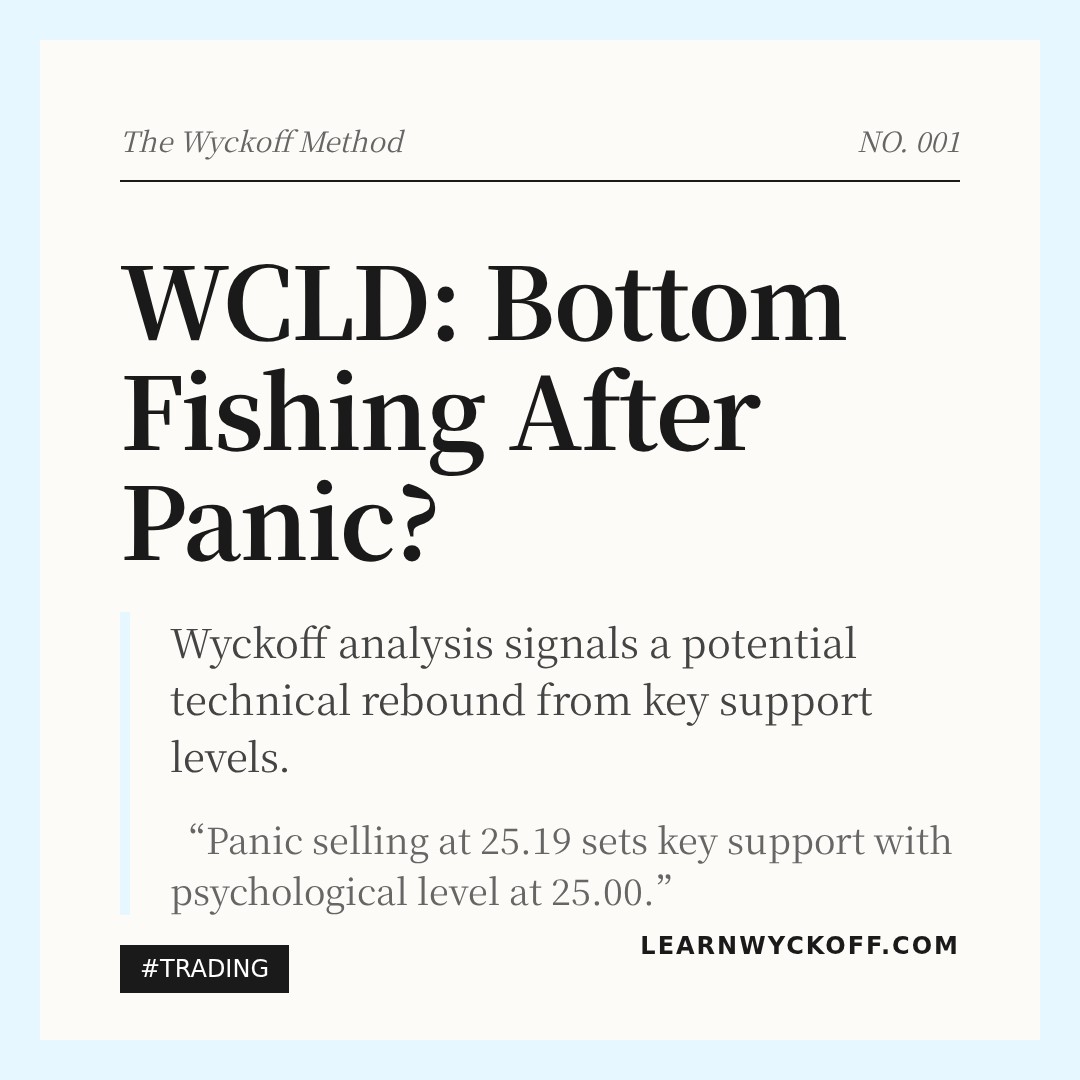
- • Immediate Support/Panic Low: 25.19 (Feb 23 low), the low created by panic selling and the first area where demand noticeably appeared. A key psychological level below is 25.00.
- • Major Resistance: 30.00 (psychological level and lower boundary of Jan-end consolidation platform), 32.50 (Jan late反弹 high).
- • Comprehensive Wyckoff Trading Signals:
- • Current Phase Signal: Preliminary Support following Panic Selling. The market has shown a "Panic" event (Feb 23) and preliminary signs of "Preliminary Support" or "Secondary Test" (Feb 24).
- • Operational Recommendations:
- • Bullish/Rebound Opportunity Seekers: Chasing shorts is not advisable now. Focus on price behavior during a re-test of the 25.20-25.00 support zone. If signs of decline halting on low volume or another advance on high volume appear, it could be considered a high-risk, light-position opportunity to博弈 for a technical rebound.
- • Entry Reference: Price stabilizes in the 25.00-25.50 zone, coupled with demand signals (e.g., high-volume bullish candlestick on 30min/1hr chart).
- • Initial Stop-Loss: A clear break below the 25.00 level.
- • Preliminary Target Levels: First target 27.30-28.00, second target 29.50-30.00.
- • Future Validation Points (Require Close Observation):
- 1. Demand Follow-through: In subsequent rallies, price increases should be accompanied by moderate volume expansion, while pullbacks see volume contraction, to confirm sustained demand.
- 2. Secondary Test: Observe if the price retests the 25.19 vicinity low again. An ideal Secondary Test should feature significantly lower volume than the Feb 23 panic day and no new low. This is a key signal for the establishment of a Wyckoff accumulation structure.
- 3. Signal Failure: If the price breaks below 25.00 on high volume, it indicates current support is invalid, selling pressure is not yet exhausted, downside potential may reopen, and the above rebound logic becomes invalid.
Final Conclusion: WCLD has undergone a complete downtrend, with recent historically significant panic selling. The market has entered the late stage of the decline, exhibiting typical bottoming area characteristics: extreme oversold conditions, volatility explosion, and record-breaking volume. The high-volume bullish candlestick on Feb 24 suggests the possibility of "smart money" tentatively介入. The composite signal is: Late-stage downtrend, presenting a博弈 opportunity for a technical rebound, but strict attention must be paid to the integrity of the 25.00 key support level, awaiting confirmation of a bottoming structure via a Secondary Test. It is suggested that higher-risk-tolerant investors can begin looking for light-position rebound opportunities, while conservative investors should wait for a more definitive bottoming structure (e.g., a successful low-volume Secondary Test) to form before making decisions.
Disclaimer: This report/analysis is solely market analysis and research based on publicly available information and does not constitute any investment advice or operational guidance. The author strives for objectivity and fairness but makes no guarantees regarding accuracy or completeness. Markets carry risks; investments require caution. Any investment actions based on this report are undertaken at one's own risk.
Thank you for your attention! Wyckoff Price-Volume Market Analysis is released daily at 8:00 AM before market open. Please feel free to leave comments and share. Your recognition is crucial. Let's work together to see the market signals clearly.
Member discussion: