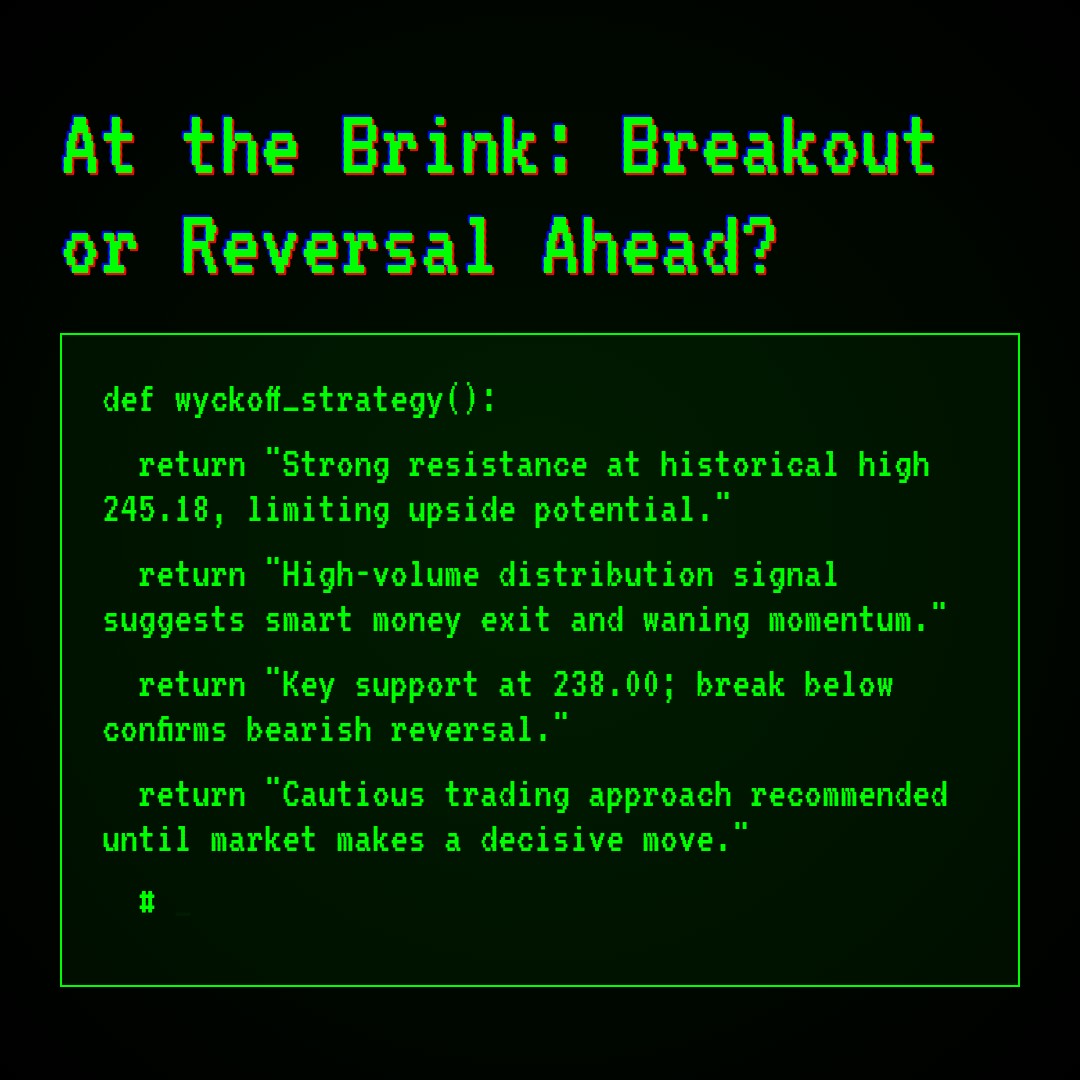
As a quantitative trading researcher proficient in the Wyckoff Method, I will draft a comprehensive and in-depth quantitative analysis report based on the VAW data and historical rankings you provided.


VAW Quantitative Analysis Report

Product Code: VAW
Analysis Date Range: 2025-12-26 to 2026-02-24
Report Generation Date: 2026-02-25


1. Trend Analysis and Market Phase Identification

As of February 24, 2026, the underlying asset VAW had an opening price of 240.71, a closing price of 243.38, a 5-day moving average of 240.59, a 10-day moving average of 240.52, a 20-day moving average of 235.59, a daily gain of 0.91%, a weekly gain of 1.97%, a monthly gain of 8.14%, a quarterly/ year-to-date gain of 17.26%.

VAW Price Trend Analysis Chart, including closing price and multiple moving averages

Data Derivation:

  • Moving Average Alignment: As of the last day of the analysis period (2026-02-24), the short, medium, and long-term moving averages exhibit a classic bullish alignment: MA_5D (240.592) > MA_10D (240.518) > MA_20D (235.592) > MA_30D (232.334) > MA_60D (219.618). The price (CLOSE: 243.380) is trading above all moving averages.
  • Trend Evolution: Throughout the analysis period, the price has shown a volatile upward trend. Starting from 2026-01-02, the price broke through the previous consolidation zone (around 211-212) and initiated a strong uptrend. All moving average systems have been continuously diverging upward since the end of 2025, with no signs of a death cross or downward turn.
  • Moving Average Crossover Signals: No significant "death cross" (where short-term moving averages cross below long-term moving averages, MA_CROSS_5_20 < 0) occurred during the period. The main signals have been the reinforcement of the bullish alignment following sustained "golden crosses."
  • Price Action: The price has been consistently making higher highs and higher lows. Notably, the closing prices on 2026-02-11 and 2026-02-24 both set new records within the period.

Wyckoff Principle Interpretation and Phase Identification:
Based on price-volume action and the moving average system, the market is in the latter stages of an "Uptrend (Markup)" phase or the early stages of a "Distribution" phase.

  1. 1. Trend Confirmation: The clear bullish alignment and sustained new highs in price action confirm the dominant trend as upward.
  2. 2. Potential Phase Transition Signal: After a strong rally, the trend reached a historical high of 245.175 on 2026-02-12 (historical rank #1). Although the price subsequently approached this high again, combined with the subsequent volume-price analysis (see Dimension 2), it suggests that demand may be encountering strong supply at elevated levels. The market may be transitioning from a pure markup phase to a preparation period for distribution, characterized by intensified buyer-seller struggle. The frequent occurrence of indicators like WEEK_MAX_CLOSE and WEEK_MAX_HIGH in the historical ranking data also confirms the price is in a historically high region.

2. Price-Volume Relationship and Supply-Demand Dynamics

As of February 24, 2026, the underlying asset VAW had an opening price of 240.71, a closing price of 243.38, a trading volume of 91805, a daily gain of 0.91%, a trading volume of 91805, a 7-day average volume of 70228.29, and a 7-day volume ratio of 1.31.

VAW Price-Volume Relationship Line Chart and Historical Ranking Analysis

Key Finding: During the analysis period, there was a textbook example of a historically rare "high-volume price stagnation" event, which is a critical signal for judging a shift in market supply and demand.

Critical Day Analysis:

  • 2026-01-15 (Abnormal Volume Day):
    • Price: Minor gain of 0.47%, with a narrow daily range (224.455 - 226.410).
    • Volume: Skyrocketed to 1,165,851 shares, an increase of 1402% compared to the previous day (VOLUME_GROWTH).
    • Volume Ratios: VOLUME_AVG_7D_RATIO: 15.44 (rank #6 in the past 10 years), VOLUME_AVG_14D_RATIO: 19.25 (rank #4), VOLUME_AVG_30D_RATIO: 22.69 (rank #3). The turnover of 263 million also ranked #4 historically.
    • Wyckoff Interpretation: This is a classic "overbought climax" or "distribution" signal. While the price was at a high within the rising channel (closing at 225.76, already up about 7% from the end of 2025), an astronomical volume appeared with the price nearly stagnating. This strongly indicates massive supply (selling pressure) emerged at this point and was entirely absorbed by robust demand (buying pressure). This is often a signature move by large investors (smart money) to distribute holdings amidst market euphoria.
  • 2026-01-23 (Volume-supported Gain):
    • • Price increased 0.64% on a volume of 231,388 shares (VOLUME_AVG_60D_RATIO: 3.13).
    • • Occurred after the high-volume event on Jan 15th, following a price pullback and subsequent rise. The volume was significantly higher but not at extreme levels, indicating demand was still attempting to regain market control, yet the shadow of supply (from Jan 15th) remained.
  • 2026-02-24 (Recent Performance):
    • • Price increased 0.91% on a volume of 91,805 shares (VOLUME_AVG_60D_RATIO: 1.06).
    • • The price approached the previous high with a moderate increase in volume. The VOLUME_AVG_7D_RATIO rose to 1.31, showing some demand activity ahead of a key resistance level, but its intensity was far below the extreme levels seen on Jan 15th.

Supply-Demand Dynamics Summary:

  1. 1. Demand-Dominated Period (2026-01-02 to 2026-01-14): Price increases accompanied by moderate or significant volume expansion (e.g., Jan 2nd, 6th, 9th), indicating strong demand.
  2. 2. Supply Emergence Period (2026-01-15): The historic high-volume price stagnation event marks the first clear appearance of large-scale supply. A significant supply zone (resistance zone) may have formed here.
  3. 3. Demand Counterattack and Struggle Period (2026-01-16 to Present): Demand attempted to counterattack after the high-volume event, pushing prices to new highs, but the peak volume failed to surpass that of Jan 15th. Particularly, a pullback occurred after reaching the highest price on Feb 12th (Feb 12th-17th), indicating persistent supply pressure at highs. Recent price-volume coordination shows demand is still making an effort but faces a severe test against powerful supply at historical highs.

3. Volatility and Market Sentiment

As of February 24, 2026, the underlying asset VAW had an opening price of 240.71, a 7-day intraday volatility of 0.18, a 7-day intraday volatility ratio of 0.96, a 7-day historical volatility of 0.15, a 7-day historical volatility ratio of 0.56, and an RSI of 65.96.

VAW Parkinson Volatility Analysis Chart and Historical Ranking Data

Data Derivation:

  • Volatility Levels: Historical volatility (HIS_VOLA) and Parkinson volatility (PARKINSON_VOL) reached local peaks around 2026-02-05 (e.g., HIS_VOLA_7D reached 0.374, PARKINSON_VOL_7D reached 0.211), corresponding to a sharp single-day price decline of -2.87%. Volatility subsequently converged gradually.
  • Volatility Structure: During price adjustments (e.g., late January, mid-February), short-term volatility often exceeded long-term volatility (HIS_VOLA_RATIO_7D_14D, PARKINSON_RATIO_7D_14D > 1), indicating heightened market nervousness and increased volatility. By the period's end, volatility ratios had fallen back below normal ranges (HIS_VOLA_RATIO_7D_14D: 0.56), suggesting sentiment has stabilized.
  • Overbought/Oversold (RSI): The RSI_14 spent most of the period within the strong range of 60-77. It reached 75.95 and 76.82 on 2026-01-15 and 2026-01-23 respectively, entering overbought territory. Historical rankings show the RSI on Jan 23rd was the 14th highest in the past 10 years, validating the extreme optimism at that time. The current RSI is 65.96, having retreated from overbought levels but still within the strong range.

Sentiment Interpretation:
Market sentiment has evolved from "Euphoria (mid-January)" -> "Panic (sharp decline in early February)" -> "Cautiously Optimistic (current)." Sentiment peaked in mid-January alongside rising prices and extreme RSI overbought readings, only to be suppressed by massive supply and high volatility. Current sentiment has recovered from extremes, but the RSI remains elevated, indicating bullish sentiment has not fully dissipated, providing a psychological foundation for continued buyer-seller struggle at highs.

4. Relative Strength and Momentum Performance

Data Derivation:

  • Short-term Momentum (WTD): The latest weekly return (WTD_RETURN) is +1.97%, showing positive performance.
  • Medium-term Momentum (MTD/QTD/YTD): The month-to-date return (MTD_RETURN) is +8.14%, and the quarter-to-date/year-to-date return (QTD_RETURN/YTD) is as high as +17.26%, indicating very strong medium-term upward momentum.
  • Momentum Trajectory: Momentum was strongest in mid-January, then slowed slightly due to price adjustments, but has recently strengthened again, pushing prices to challenge previous highs.

Conclusion: VAW has demonstrated extremely strong medium-term relative strength and momentum during the analysis period. Despite the emergence of high-volume supply signals and price pullbacks, demand forces recovered quickly, propelling prices back to highs, suggesting the momentum of the bullish trend has not yet exhausted. However, this momentum now encounters a historically significant supply zone at elevated levels, increasing uncertainty regarding trend continuation.

5. Large Investor (Smart Money) Behavior Identification

Based on the above price-volume, volatility, and phase analysis, large investor behavior is inferred as follows:

  1. 1. Distribution Behavior: The high-volume price stagnation on 2026-01-15 is the core evidence. Smart money likely utilized the opportunity of heightened market sentiment and prices being at highs within the rising wave to conduct large-scale distribution. The astronomical volume implies a massive transfer of shares, while price stagnation suggests a "balance" between buyers and sellers at that point. Considering the location, this appears more like active supply by sellers being passively accepted by buyers.
  2. 2. Accumulation Behavior Not Evident: No clear signs of panic selling with high volume or low-volume reversal patterns at lows were observed at the beginning of the period (end of 2025), therefore typical large-scale accumulation behavior was not identified.
  3. 3. Test and Shakeout: During the price pullback after Jan 15th (e.g., a -2.36% decline on Jan 30th), volume did not expand significantly and was even below average (VOLUME_AVG_60D_RATIO: 1.45). This may have been a "test" of underlying demand (or support from the prior distribution area), with smart money observing whether selling pressure had eased. The pullback did not trigger panic, indicating limited floating supply.
  4. 4. Current Intent: Prices have returned near previous highs with moderate volume. Smart money may be conducting a Secondary Test — probing whether pressure from the previous high supply zone remains strong and whether follow-through demand is sufficient, to decide whether to continue distributing remaining holdings or guide prices for a breakout.

6. Support/Resistance Level Analysis and Trading Signals

VAW Support and Resistance Level Analysis Chart and Trading Signals

Key Price Levels:

  • Resistance Levels (Resistance):
    1. 1. R1: 245.18 - The all-time high set on 2026-02-12 (historical rank #1), the ultimate resistance.
    2. 2. R2: 234.00 - 235.00 - The price congestion zone formed by the high-volume price stagnation event on 2026-01-15, a significant supply zone/resistance area.
  • Support Levels (Support):
    1. 1. S1: 238.00 - Support area formed by recent swing lows (2026-02-17, 23).
    2. 2. S2: 225.00 - The panic selling low from 2026-01-30, also a key support area near the 60-day moving average.
    3. 3. S3: 218.00 - 220.00 - The breakout platform from mid-January, constituting a strong support region.

Comprehensive Trading Signals and Operational Recommendations:

  • Overall Assessment: Cautiously Bearish/Watchful. The market is in a clear uptrend but faces strong resistance at historical highs, coupled with a rare high-volume distribution signal from the past decade (2026-01-15). This suggests upward momentum may be waning, and smart money may be exiting. The current price retesting resistance is a high-risk area.
  • Bearish Scenario (Short or Reduce Long Positions):
    • Entry Signal: Price shows stagnation (e.g., long upper shadows, bearish candles) in the R1 (245.18) or R2 (234-235) area, coupled with another instance of abnormally high volume, forming another signal of supply overwhelming demand.
    • More Definitive Entry Signal: Price breaks below S1 (238.00) with high volume, confirming a breakdown of the uptrend structure and supply taking control.
    • Stop Loss: Place above 246.50 (above R1) to guard against a false breakout.
  • Bullish Scenario (For Trend Traders Only):
    • Entry Signal: Price powerfully breaks above R1 (245.18) with significant volume (notably higher than recent averages) and closes above it. This requires demand to fully absorb all supply at historical highs, a low-probability but high-conviction signal of strength.
    • Stop Loss: Place below 238.00.
  • Watchful Recommendation: For most investors, watching or gradually taking profits is recommended at current levels. New strategies should be formulated only after the market makes a clear choice (breakout or reversal) at key resistance levels.

Future Validation Points:

  1. 1. Confirm Distribution: If price fails to break 245.18, turns downward, and is accompanied by expanding volume, it will confirm the judgment of a distribution phase.
  2. 2. Confirm Trend Continuation: If price breaks above 245.18 with very high volume, reassessment is required, as it may initiate a new upward wave.
  3. 3. Observe Test Results: Monitor volume behavior if price falls back to S2 (225) or S3 (218-220). If it stabilizes on low volume, the trend may resume after a healthy correction; if it breaks down with high volume, the risk of trend reversal increases significantly.

Disclaimer: This report/interpretation is solely for market analysis and research based on publicly available information and does not constitute any investment advice or operational guidance. The author strives for objectivity and fairness but makes no guarantee regarding accuracy or completeness. The market carries risks; investments require caution. Any investment actions based on this report are taken at one's own risk.


Thank you for your attention! Wyckoff price-volume market interpretations are published daily at 8:00 AM before the market opens. Your comments and shares are greatly appreciated. Your recognition is crucial. Let's work together to see the market signals clearly.