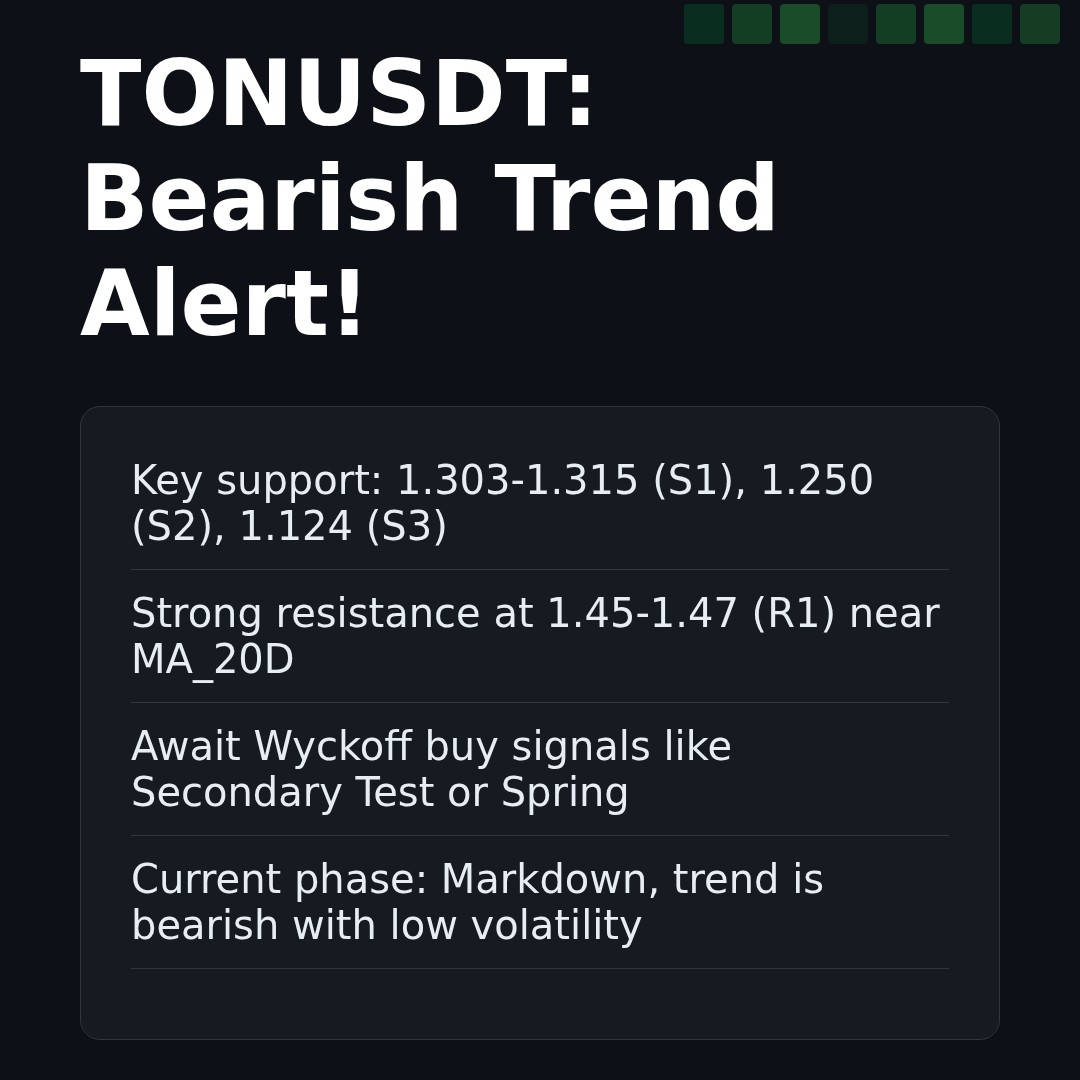
As a quantitative trading researcher specializing in the Wyckoff method, I will compile a comprehensive quantitative analysis report based on the TONUSDT data sheet and historical ranking indicators you provided, in accordance with your instructions.
Quantitative Analysis Report: TONUSDT
Product Code: TONUSDT
Analysis Date Range: 2025-12-26 to 2026-02-24
Report Generation Date: 2026-02-25
Core Methodology: Wyckoff Volume-Price Principles
1. Trend Analysis and Market Phase Identification
As of 2026-02-24, the underlying TONUSDT has an opening price of 1.34, a closing price of 1.32, a 5-day moving average of 1.35, a 10-day moving average of 1.40, a 20-day moving average of 1.39, a daily change of -2.08%, a weekly change of -7.78%, a monthly change of -2.74%, a quarterly change of -20.74%, and an annual change of -20.74%.

- • Moving Average Alignment and Price Relationship: As of the final day of the analysis period (2026-02-24), the price (1.315) has fallen significantly below all key moving averages. MA_5D (1.345) < MA_10D (1.399) < MA_20D (1.386) < MA_30D (1.406) < MA_60D (1.553). Short-term moving averages are below long-term ones, and the price is trading below all moving averages, forming a classic bearish alignment. Since hitting a high of 1.95 in early January 2026, the price has declined steadily, consistently trading below the medium-term (MA_20D, MA_30D) and long-term (MA_60D) moving averages, confirming a downtrend.
- • Moving Average Crossover Signals: In mid-January, after the price broke below MA_30D and MA_60D, MA_5D and MA_10D subsequently crossed below MA_20D and MA_30D, and MA_20D recently crossed below MA_30D. These crossovers confirmed and reinforced the bearish trend. No meaningful, sustained golden cross signals appeared during this period.
- • Inferred Market Phase: Combined with price action and Wyckoff theory:
- • Distribution (Distribution): In early January (Jan 2-6), the price experienced a sharp rally within the 1.80-1.95 range accompanied by massive volume (VOLUME_AVG_14D_RATIO peaked at 2.34), while RSI_14 reached its fourth-highest level in nearly a decade (71.85). This is a typical "Climax" rally, marking the end of the Distribution Phase.
- • Markdown (Markdown): Following distribution, the price entered the Markdown Phase. In late January to early February (Jan 31, Feb 5), Panic Selling occurred, characterized by sharp price drops and historically high volume (detailed later). After the panic, the market entered a phase of low-volume, gradual decline, which represents the current market profile.
- • Potential Accumulation Signals: Currently, the price is at a significantly low level, with historically extreme volatility contraction (detailed later). However, no clear signs of "Stopping Action" or successful "Secondary Tests" have been observed. The Accumulation Phase is not yet confirmed.
2. Volume-Price Relationship and Supply-Demand Dynamics
As of 2026-02-24, the underlying TONUSDT has an opening price of 1.34, a closing price of 1.32, volume of 4293885.52, a daily change of -2.08%, volume of 4293885.52, a 7-day average volume of 3658968.24, and a 7-day volume ratio of 1.17.

- • Key High-Volume Day Analysis:
- • Supply-Dominated High-Volume Decline (Panic Selling):
- • 2026-01-31: The price plummeted -7.27%, with volume surging 127.98% (VOLUME_GROWTH), 3.18 times the recent average (VOLUME_AVG_7D_RATIO), ranking as the 10th highest weekly extreme in nearly a decade. This is classic Panic Selling, indicating absolute dominance of supply (selling pressure).
- • 2026-02-05: The price fell again by -9.42%, with volume 2.95 times the 14-day average (WEEK_MAX_VOLUME_AVG_14D_RATIO rank 12) and 2.69 times the 60-day average (rank 13). This was a high-volume breakdown of prior lows, confirming persistent supply.
- • Demand Attempt (Failed) High-Volume Rally:
- • 2026-02-06: A +10.87% bounce occurred after the panic (WEEK_MAX_PCT_CHANGE rank 3) on massive volume (2.54x the 14-day average). However, this rally failed to sustain, and the price continued its gradual decline thereafter. This can be viewed as a "dead cat bounce" or weak rally, where demand attempted to enter but was overwhelmed by greater supply.
- • Current Supply-Demand Status:
- • During the final days of the analysis period (Feb 20-24), the price continued its gradual decline on relatively low volume compared to the 7-day and 14-day averages (VOLUME_AVG_7D_RATIO between 0.63-1.17, VOLUME_AVG_14D_RATIO between 0.37-0.92). This suggests that at low price levels, demand remains weak, and while supply has moderated, it persists. The market exhibits a "low-volume, gradual decline" pattern of exhaustion.
- • Supply-Dominated High-Volume Decline (Panic Selling):
3. Volatility and Market Sentiment
As of 2026-02-24, the underlying TONUSDT has an opening price of 1.34, a 7-day intraday Parkinson volatility of 0.46, a 7-day intraday volatility ratio of 0.95, a 7-day historical volatility of 0.30, a 7-day historical volatility ratio of 0.59, and an RSI of 38.43.

- • Volatility Levels and Changes:
- • During the panic selling period in late January to early February, short-term volatility spiked sharply. For example, on Feb 6, HIS_VOLA_RATIO_7D_14D reached 1.39 (rank 15 in nearly a decade), and PARKINSON_RATIO_7D_14D reached 1.48 (rank 13), indicating extreme panic and confusion.
- • Currently (end of analysis period), volatility has contracted significantly. HIS_VOLA_7D dropped to 0.30, and PARKINSON_VOL_7D dropped to 0.46. More critically, short-term volatility relative to medium/long-term volatility has fallen to historically low extremes: For instance, on Feb 21-23, HIS_VOLA_RATIO_7D_21D fell to 0.34-0.39 (ranks 7, 17, 20 lowest), and PARKINSON_RATIO_7D_21D fell to 0.57-0.65 (ranks 19, 20 lowest). This extreme volatility convergence typically occurs during the "exhaustion" phase after a prolonged decline, as market sentiment shifts from panic to apathy and despair.
- • Overbought/Oversold Status (RSI):
- • RSI_14 reached 71.85 on Jan 6 (rank 4 in nearly a decade), confirming the overbought condition and distribution top at that time.
- • The current RSI_14 is 38.43, in a weak zone but not at an extreme oversold level (<30). Combined with volatility contraction and low-volume decline, market sentiment leans more towards weakness and apathy rather than extreme panic.
4. Relative Strength and Momentum Performance
- • Returns Across Timeframes:
- • Weak Short-Term Momentum: WTD_RETURN is -7.78%, and MTD_RETURN is -2.74%, both negative, indicating ongoing short-term downward momentum.
- • Extremely Weak Medium/Long-Term Momentum: QTD_RETURN is -20.74%, YTD is -20.74%, and TTM_12 is -61.46%. This shows the asset's very weak performance over medium and long-term horizons, within a pronounced downtrend.
- • Momentum and Volume-Price Validation: The negative momentum performance is entirely consistent with the conclusions of a bearish trend and supply-dominated volume-price relationships. The brief strong momentum in early January (Jan 2 PCT_CHANGE +6.38%) has been completely erased by the subsequent prolonged decline.
5. Large Investor (Smart Money) Behavior Identification
Based on Wyckoff principles interpreted from volume-price and volatility data:
- 1. Distribution Phase (Early January): Smart money engaged in large-scale distribution within the 1.80-1.95 range when RSI was extremely overbought and market sentiment was euphoric (high-volume rally at highs). Historical-level volume ratios (e.g., VOLUME_AVG_14D_RATIO ranks 12, 19) indicate this was not retail activity.
- 2. Capitalizing on Panic Selling (Late Jan - Early Feb): During the disorderly panic selling in the market (e.g., Jan 31, Feb 5), smart money likely engaged in selective absorption, evidenced by the massive volume (panic selling was absorbed). However, this absorption was insufficient to reverse the trend and may only represent initial positioning for future operations.
- 3. Current Watchfulness and Testing (Mid to Late February): Following the panic selling, the market entered a low-volatility, low-volume gradual decline. Smart money is currently in a watchful state and is not exhibiting strong buying demand. The low-volume decline suggests floating supply (from retail or weak holders) is still slowly exiting, and smart money is not rushing in to halt the decline. They are likely testing the market's true support and points of supply exhaustion, awaiting the formation of a clearer bottom structure.
6. Support/Resistance Level Analysis and Trading Signals

- • Key Support Levels:
- • S1: 1.303 - 1.315 (Recent Low Concentration Zone): The current price area, tested as a low multiple times recently. A high-volume break below opens new downside.
- • S2: 1.250 (2026-01-31 Low): The low generated from panic selling, a significant psychological and technical support.
- • S3: 1.124 (2026-02-06 Low): The absolute low of this decline, the ultimate strong support. A break below signifies a complete deterioration of the trend.
- • Key Resistance Levels:
- • R1: 1.45 - 1.47 (Recent Rally High / Near MA_20D): The area unsuccessfully tested during the mid-February bounce, also near the declining MA_20D, forming a strong near-term resistance.
- • R2: 1.66 - 1.69 (2026-01-15 to 19 Consolidation Platform): A consolidation platform during the earlier decline, accumulating some trapped positions.
- • R3: 1.80 - 1.95 (Distribution Zone): The primary distribution area, a major long-term resistance.
- • Comprehensive Wyckoff Trading Signals and Operational Recommendations:
- • Current View: Neutral / Cautiously Bearish. The market is in the Markdown phase following distribution. Panic has subsided, replaced by low-volatility decline. While volatility contraction to historical lows hints at a potential proximity to a phase bottom, no clear Wyckoff buy signals of expanding demand or exhausted supply have been observed (e.g., high-volume stopping bar, successful Secondary Test).
- • Operational Recommendations:
- • Bears / Neutral Observers: Maintain bearish positions or stay neutral. Any bounce towards the R1 (1.45-1.47) zone, if accompanied by low volume or stalling, presents a potential bearish opportunity. Stops can be placed above R2 (1.66).
- • Potential Bulls / Bottom Fishers: Strictly avoid blind left-side bottom fishing. Patiently await Wyckoff signals of bottom formation:
- 1. Preliminary Support (PSY) / Selling Climax (SC): Already occurred in the S2, S3 zones.
- 2. Automatic Rally (AR): Already occurred on Feb 6.
- 3. Secondary Test (ST): Focus on whether, upon price retesting S1 or S2/S3 support, volume contracts significantly (VOLUME_AVG_7D_RATIO < 0.8) and price refuses to make new lows or forms bullish engulfing/hammer patterns. This is the first potential bullish warning signal.
- 4. Spring / Jump Across the Creek: A price dip briefly below key support (e.g., 1.124) followed by a rapid recovery on expanded volume is a strong buy signal.
- • Future Validation Points:
- 1. Bearish Failure Signal: Price breaks and holds strongly above R1 (1.47) on high volume (VOLUME_AVG_7D_RATIO > 1.5), with short-term moving averages (MA_5D, MA_10D) turning upward.
- 2. Bullish Confirmation Signal: The emergence of the aforementioned Wyckoff buy structures ("Secondary Test" or "Spring") at key support levels (S1, S2, S3), followed by a "Jump Across the Creek (JOC)" after accumulation—a high-volume breakout above the nearest downswing high (e.g., 1.47).
Summary Conclusion:
TONUSDT is currently in a clear bearish trend. Price structure, volume-price relationships, volatility convergence, and momentum indicators all point to market weakness. Historical ranking data shows it has recently undergone a process of extreme supply release (panic selling) and extreme sentiment convergence (volatility at historical lows). Large investors have completed distribution at highs and are now in a watchful testing phase. Trading strategy should prioritize trend-following and defense, actively seeking bounce/short opportunities. Going long requires extreme patience, waiting for the establishment of a Wyckoff bottom structure and clear evidence of strong demand returning. The market is transitioning from "panic" to "despair/apathy." A genuine trend reversal requires time and new signals of supply-demand balance.
Disclaimer: The content of this report/interpretation is solely for market analysis and research based on public information and does not constitute any investment advice or operational guidance. The author strives for objectivity and impartiality but makes no guarantees regarding accuracy or completeness. Markets involve risks; investments require caution. Any investment actions based on this report are undertaken at your own risk.
Thank you for your attention! Wyckoff Volume-Price Market Analysis is published daily at 8:00 AM before market open. Please leave comments and share; your support is crucial. Let's work together to see the market signals clearly.
Member discussion: