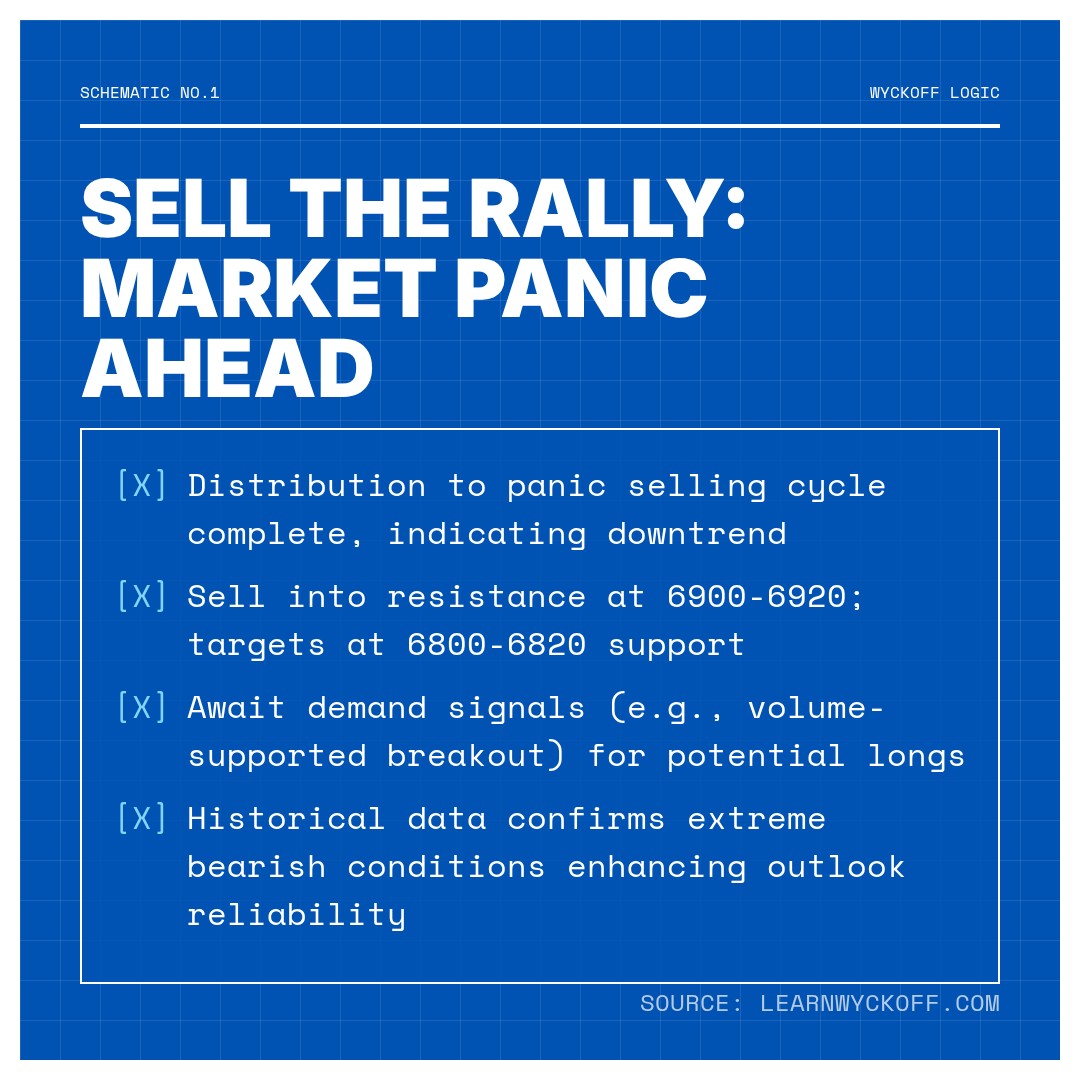
Wyckoff Quantitative Analysis Report: .SPX Index

Product Code: .SPX
Analysis Date Range: 2025-12-26 to 2026-02-24
Report Generation Date: 2026-02-25

I. Trend Analysis & Market Phase Identification

As of February 24, 2026, the underlying .SPX has an opening price of 6837.37, a closing price of 6890.07, a 5-day MA of 6866.74, a 10-day MA of 6885.07, and a 20-day MA of 6908.66. The daily return is 0.77%, the weekly return is 0.68%, the monthly return is -0.71%, the quarterly return is 0.65%, and the yearly return is 0.65%.

.SPX Price Trend Analysis Chart, including closing price and multiple moving averages
  1. 1. Moving Average Alignment & Trend Structure:
    • Earlier Period (Late December to Late January): The price (CLOSE) consistently traded above all key moving averages (MA_5D/10D/20D/30D/60D), showing a standard bullish alignment. MA_5D > MA_20D > MA_60D, indicating upward trends in the short, medium, and long term.
    • Trend Turning Point (Late January): After hitting a phase high of 6978.6 on January 27, the price broke below both the MA_5D and MA_10D for the first time on January 30. Subsequently, during the decline in early February, it broke below the MA_20D, MA_30D, and MA_60D consecutively.
    • Current Status (As of February 24): The closing price of 6890.07 remains below all major moving averages (MA_5D=6866.74, MA_20D=6908.66, MA_60D=6885.58). The moving average system has transitioned into a bearish alignment. The rebound high on February 20 (6915.86) was precisely capped by resistance from the MA_20D (then around 6912) and subsequently pulled back, validating the resistance role of the moving average. Conclusion: The primary trend has shifted from rising to falling. The market is currently in a rebound/consolidation phase within the downtrend.
  2. 2. Wyckoff Market Phase Inference:
    • Distribution Phase (Mid to Late January): Between January 12 and January 29, prices repeatedly made new highs in the 6950-6980 range (historical ranking data shows the closing price of 6978.6 on January 27 was the highest in nearly 10 years). However, RSI showed a bearish divergence (price making new highs while RSI failed to do so), and signals of "volume surge without price follow-through" appeared (see Part II). This aligns with the characteristics of "Distribution" in Wyckoff theory, where smart money exits discreetly amid public euphoria.
    • Decline and Panic Phase (Early February): From February 3 to February 5, prices experienced consecutive, rapid declines with sharply increased volume (February 4 volume ranked 16th highest in the past 10 years) and surging volatility. This represents a classic "Panic Selling" episode, marking the acceleration of the downtrend following distribution and potentially seeding a new point of supply-demand equilibrium.
    • Current Phase (Mid to Late February): Following panic selling, prices have fluctuated widely within the 6780-6920 range. The rebound on February 24 showed "diminishing volume" characteristics (volume approximately 8% lower than the 7-day average) and failed to convincingly hold above key moving averages. The current market is likely in an "Automatic Rally" or "Secondary Test" phase after the downtrend, testing the strength of supply and the possibility of demand recovery.

II. Price-Volume Relationship & Supply-Demand Dynamics

As of February 24, 2026, the underlying .SPX has an opening price of 6837.37, a closing price of 6890.07, volume of 3153443986, a daily return of 0.77%, volume of 3153443986, a 7-day average volume of 3428305884.00, and a 7-day volume ratio of 0.92.

.SPX Price-Volume Relationship Line Chart & Historical Ranking Analysis
  1. 1. Key Price-Volume Signal Identification:
    • Distribution Signal (January 27): Price rose 0.41% to close at a new high, but volume (3246M) increased by 7.8% from the previous day. However, the relative 7-day average volume ratio was only 0.93, indicating volume did not significantly exceed recent average levels, presenting a "volume surge without price follow-through." This suggests supply began emerging at high levels, and demand could not fully absorb it.
    • Panic Selling Signal (February 4, 5): Consecutive days of high-volume decline.
      • • February 4: Price fell -0.51%, volume surged to 5158M (VOLUME_AVG_7D_RATIO=1.38, ranking 16th in daily volume over the past 10 years). This is a typical high-volume plummet, with supply completely dominating the market.
      • • February 5: Price continued to fall sharply by -1.23%, volume remained high (4363M, VOLUME_AVG_7D_RATIO=1.08), confirming the continuation of panic sentiment.
    • Demand-Deficient Rebound (February 24): Price rose 0.77%, but volume (3153M) decreased by 3.9% compared to the previous day, and VOLUME_AVG_7D_RATIO was 0.92. This is a clear "low-volume rebound," indicating the rise lacks active follow-through from large capital and demand is weak, casting doubt on the sustainability of the rebound.
    • Demand Attempt Signal (February 6): Following the panic, price surged 1.97%. Volume (3864M), while lower than the panic volumes of the previous two days, had a VOLUME_AVG_7D_RATIO of 0.92. Combined with the extreme low of the previous day, this can be viewed as a volume-supported rebound from the decline, showing initial signs of demand intervention.
  2. 2. Supply-Demand Power Shift:
    • Supply Climax: The massive bearish candlesticks on February 4-5 represent a clear supply climax. Historical ranking data confirms their extremity.
    • Demand Attempt: The bullish candlestick on February 6 was a response to the supply climax, showing buyers stepping in at low levels.
    • Current Equilibrium: Since then, the market has entered consolidation. Volume has receded from extreme highs but remains generally above the low levels seen in late December. This indicates a tug-of-war between bulls and bears at the current level, but given the low-volume rebounds, the overall pattern still slightly favors supply.

III. Volatility & Market Sentiment

As of February 24, 2026, the underlying .SPX has an opening price of 6837.37, a 7-day intraday Parkinson volatility of 0.13, a 7-day Parkinson volatility ratio of 0.91, a 7-day historical volatility of 0.12, a 7-day historical volatility ratio of 0.70, and an RSI of 49.75.

.SPX Parkinson Volatility Analysis Chart & Historical Ranking Data
  1. 1. Volatility Levels and Changes:
    • Spike During Panic Period: During the decline in early February, short-term volatility spiked sharply. On February 5, PARKINSON_VOL_7D rose to 0.1458 (highest within the data period), and HIS_VOLA_7D rose to 0.1104. Volatility ratios also reached extreme levels. For example, PARKINSON_RATIO_7D_60D reached as high as 1.5056 on February 6, indicating short-term volatility far exceeded the long-term normal range, signaling extreme market panic.
    • Current Convergence: By February 24, PARKINSON_VOL_7D has retraced to 0.1303, and HIS_VOLA_7D to 0.1221. Volatility ratios have also retreated from extreme highs (e.g., PARKINSON_RATIO_7D_60D is 1.277). This indicates panic sentiment has been largely released, but short-term volatility remains above long-term benchmarks. The market is in a recovery phase post-panic, not yet fully calm.
  2. 2. Overbought/Oversold Status (RSI):
    • • RSI was only 58.56 at the January 27 high, not entering the overbought zone (>70). This weakens the traditional technical signal for distribution at highs, but combined with the bearish divergence and price-volume relationship, its warning remains valid.
    • • At the panic low on February 5, RSI dropped to 38.93, entering the oversold zone, creating conditions for a subsequent technical rebound.
    • • Current (February 24) RSI is 49.75, in the neutral zone, providing no clear overbought or oversold signals, indicating market sentiment is stabilizing.

IV. Relative Strength & Momentum Performance

  1. 1. Periodic Return Analysis:
    • Short-term Momentum (WTD_RETURN): The weekly return as of February 24 is 0.68%, showing weak rebound momentum on a very short-term basis.
    • Medium-term Momentum (MTD_RETURN, QTD_RETURN, YTD): The monthly return to date for February is -0.71%, the quarterly return is 0.65%, and the year-to-date return is 0.65%. All medium-term momentum indicators have significantly weakened or even turned negative, confirming the upward momentum from the January high has been exhausted and reversed.
    • Conclusion: Momentum analysis supports the judgment of a trend change. The market has lost its sustained upward momentum, and the current rebound lacks strong medium-term momentum support.

V. Large Investor ("Smart Money") Behavior Identification

Based on cross-validation of the above four dimensions, the behavior of large investors is inferred as follows:

  1. 1. Distribution Operations (Mid to Late January): Amid the optimistic atmosphere of reaching historical highs (the highest and second-highest closing price rankings in nearly 10 years), large investors successfully distributed holdings to the chasing public through "volume surge without price follow-through" candlestick patterns. This is classic "Distribution" behavior.
  2. 2. Testing Demand Using Panic (Early February): After inducing panic selling (Supply Climax), large investors conducted a tentative purchase with a high-volume bullish candlestick on February 6. The purpose may have been: a) to test if selling pressure was exhausted after the panic; b) to establish a partial position at relatively lower levels.
  3. 3. Current Observation and Testing (Mid to Late February): During the subsequent choppy rebound, large investors have not been aggressively buying (manifested as low-volume rebounds). They may be observing the selling willingness of the public (testing supply above the rebound) or waiting for lower prices or a clearer bottoming structure. Current behavior leans more towards "Testing" rather than "Accumulation."

VI. Support/Resistance Level Analysis & Trading Signals

.SPX Support & Resistance Level Analysis Chart & Trading Signals
  1. 1. Key Levels:
    • Strong Resistance Zone: 6970-6980. This is the lower boundary of the previous distribution range and the historical high area, also the starting point of the current decline. Any rebound to this level will face significant selling pressure.
    • Secondary Resistance / Bull-Bear Line: 6900-6920. This is where multiple moving averages (MA_20D, MA_30D) currently converge and where multiple rebounds in mid-to-late February were rejected. A convincing breakout of this zone is the first signal of short-term strength.
    • Dense Trading & Key Support: 6800-6820. The low area repeatedly tested in February. A break below would open further downside potential.
    • Ultimate Support: 6780. The low formed by panic selling on February 5, representing the extreme low of this adjustment.
  2. 2. Integrated Wyckoff Trading Signals & Operational Suggestions:
    • Overall Signal: Bearish/Wait-and-See. The primary trend is downward, rebounds are low-volume and rejected by key moving averages, and smart money shows no active buying behavior.
    • Operational Recommendations:
      • Bears/Hedgers: The 6900-6920 zone can be considered an ideal area for selling into rebounds. Stops can be placed above 6950 (i.e., a break above the upper bound of the previous consolidation platform). Targets look towards the 6800-6820 support zone, with further downside potential below 6780 upon a break.
      • Bulls/Potential Buyers: Maintain patience, strictly avoid chasing highs. Worthwhile long opportunities require meeting one of the following conditions:
        a) Successful Secondary Test: Price retreats again to around 6800 or even 6780, but volume contracts significantly (indicating exhaustion of supply), followed by a volume-supported bullish candlestick confirming support.
        b) Demand-Driven Breakout: Price breaks out and holds firmly above the 6920 resistance zone with strong volume (VOLUME_AVG_7D_RATIO > 1.2), at which point a potential trend change can be considered.
    • Future Validation Points:
      1. 1. Invalidating the Bearish Signal: Price closes above 6920 for three consecutive days, accompanied by steadily increasing volume (VOLUME_AVG_7D_RATIO consistently >1.0).
      2. 2. Confirming the Bearish/Strengthening the Downside Signal: Price rebounds to around 6900 and again shows low-volume stalling or high-volume decline candlesticks, or directly breaks below the 6780 support with volume.

Summary of Core Report Conclusions:
The .SPX index has completed a classic cycle from "Distribution" to "Panic Selling" and is currently in a weak rebound phase within a downtrend. All data dimensions (trend, price-volume, volatility, momentum) point to a market dominated by bears. Historical ranking data confirms the extremity of the distribution high (new high in nearly 10 years) and the panic selling volume (16th highest in nearly 10 years), enhancing the reliability of the current assessment. Investors should adopt a defensive strategy, utilizing opportunities of rebounds to key resistance levels for risk control or trend-following operations, and await clearer signals of demand entry.


Disclaimer: This report/interpretation is solely market analysis and research based on publicly available information and does not constitute any investment advice or operational guidance. The author strives for objectivity and impartiality but makes no guarantees regarding its accuracy or completeness. The market carries risks; investing requires caution. Any investment actions based on this report are taken at one's own risk.


Thank you for your attention! Daily Wyckoff price-volume market analysis is released punctually at 8:00 AM before the market opens. Please feel free to leave comments and share. Your recognition is paramount. Let's work together to see the market signals clearly.