Understood. Following your instructions. As a quantitative trading researcher proficient in the Wyckoff Method, I will author an in-depth quantitative analysis report on SOXX based on the data you provided. All conclusions strictly adhere to Wyckoff's price-volume principles and are derived from the data.
SOXX Quantitative Analysis Report (Based on the Wyckoff Method)
Product Code: SOXX
Analysis Period: 2025-12-26 to 2026-02-24
Report Generation Time: 2026-02-25
1. Trend Analysis and Market Phase Identification
As of 2026-02-24, the underlying asset SOXX opened at 361.60, closed at 362.04. The 5-day moving average (MA) is 356.82, 10-day MA is 355.47, 20-day MA is 351.24. Daily change: +1.46%, weekly change: +2.24%, monthly change: +4.55%, quarterly change: +20.22%, annual change: +20.22%.

Data Observations and Inferences:
- • Long-term Trend (Bullish): Throughout the analysis period, the closing price (CLOSE) of SOXX has consistently traded above the MA_60D (294.24 - 326.13), and the MA_60D has been continuously rising. This indicates a solid long-term uptrend.
- • Mid-term Structure and Change: Before 2026-01-02, the market was in a phase of consolidation with short-term MAs (MA_5D, MA_10D) converging. The high-volume bullish candle on January 2nd (+4.16%) effectively broke through all short-term MAs and subsequently led to a classic bullish alignment of MA_5D, MA_10D, MA_20D, and MA_30D. This state persisted until the historical high of 361.13 was reached on January 29th.
- • MA Crossover Signals: After the sharp market decline on February 4th (-4.41%), the price quickly fell below MA_10D and MA_20D. The MA_5D also turned downward and formed a death cross with the MA_20D, signaling exhaustion in short-term upward momentum.
- • Price Action and Phase Assessment:
- • 2025-12-26 to 2026-01-02: Can be viewed as "Accumulation/Testing in the early stages of an advance" or "Consolidation before a breakout." Prices gradually raised their lows (from 305.29 to 308.56) within narrow fluctuations, culminating in a high-volume breakout on January 2nd.
- • 2026-01-02 to 2026-01-29: A clear "Markup" phase. Prices rose rapidly, continuously setting new highs with active volume.
- • 2026-01-30 to 2026-02-04: A mixed phase of "Distribution" and "Panic Selling." After reaching a historical high, a high-volume decline occurred on January 30th (volume 8.44 million, -4.11%), marking an initial distribution signal. February 4th witnessed an extreme event: a sharp price drop (-4.41%) accompanied by a surge in volume to 15.23 million shares and trading value (AMOUNT) reaching 5.063 billion. Historical ranking data shows this day's trading value was the second highest in the past ten years. According to Wyckoff principles, this is a classic characteristic of panic selling, typically triggered by large investor sell-offs.
- • 2026-02-05 to Present: The market has entered a phase of "Secondary Test" and potential "Weak Rally." Prices rebounded following the panic selling but failed to set new highs, and volume has shown a declining trend during the rally.
2. Price-Volume Relationship and Supply-Demand Dynamics
As of 2026-02-24, the underlying asset SOXX opened at 361.60, closed at 362.04, volume 6,149,541, daily change +1.46%, 7-day average volume 6,161,562.43, 7-day volume ratio 1.00.

Core Data and Event Inferences:
- • Demand-Driven Breakout (2026-01-02):
PCT_CHANGE +4.16%,VOLUME_GROWTH +187.43%,VOLUME_AVG_30D_RATIO 1.47. This is a textbook signal of strong demand: price increase accompanied by volume significantly above average, indicating aggressive buying by large capital. - • High-Volume Stalling/Decline at Highs (Distribution Signals):
- • 2026-01-30: Price declined -4.11%, but volume reached 8.71 million shares (
VOLUME_AVG_30D_RATIO 1.60). High-volume decline at elevated prices indicates supply (selling) beginning to overwhelm demand. - • 2026-02-12: Price rallied to a new high and then reversed (
HIGH 365.38new high,CLOSE 351.5down -2.42%), with volume of 9.49 million shares (VOLUME_AVG_30D_RATIO 1.43). This is a classic "Upthrust" or rally-failure distribution pattern, showing massive supply appearing at the highs.
- • 2026-01-30: Price declined -4.11%, but volume reached 8.71 million shares (
- • Panic Selling (2026-02-04):
PCT_CHANGE -4.41%,VOLUME 15.23 million(VOLUME_AVG_30D_RATIO 2.80). This was an extreme supply-dominated day. Historical ranking data confirms its extremity (trading value ranked 2nd in past ten years). A rally typically follows panic, but its quality needs observation. - • Demand-Lacking Rally (Recent): Following the February 4th panic, the market rallied to close at 362.04 on February 24th. However, the advances after February 20th (
PCT_CHANGE 1.01%, 0.90%, 1.46%) corresponded toVOLUME_AVG_30D_RATIOvalues of 0.90, 0.94, and 0.91, all below 1. This indicates volume failed to exceed the 30-day average during price increases, showing lackluster demand follow-through, constituting a price-volume divergence.
3. Volatility and Market Sentiment
As of 2026-02-24, the underlying asset SOXX opened at 361.60, 7-day intraday Parkinson volatility 0.26, 7-day Parkinson volatility ratio 0.75, 7-day historical volatility 0.17, 7-day historical volatility ratio 0.39, RSI 61.02.

Data Inferences:
- • Volatility Spike and Panic Confirmation: On and around the February 4th panic selling day, both
HIS_VOLA_7DandPARKINSON_VOL_7Dspiked significantly. More importantly, their short-term/long-term volatility ratios reached extreme levels:PARKINSON_RATIO_7D_30Dreached 1.85-1.93 on February 5-6. Historical ranking data shows the value of this indicator on February 6th (1.9256) ranked 12th in the past ten years, clearly indicating market sentiment had entered a state of extreme tension and panic. - • Volatility Convergence and Sentiment Recovery: By the end of the analysis period (February 24th), short-term volatility had significantly receded.
HIS_VOLA_7Ddropped to 0.169,HIS_VOLA_RATIO_7D_14Dfell to 0.395,PARKINSON_RATIO_7D_14Ddeclined to 0.752. This indicates that the short-term volatility impulse triggered by panic has largely subsided, and market sentiment has calmed. - • RSI Overbought and Pullback: The
RSI_14entered the overbought region (73.39-73.65) on January 28-29, followed by a significant price correction. The current RSI is 61.02, in the neutral-to-strong zone, showing no extreme readings.
4. Relative Strength and Momentum Performance
Data Inferences:
- • Strong Medium-to-Long Term Momentum: Metrics like
YTD (20.22%),TTM_12 (65.53%),TTM_36 (167.33%)indicate SOXX has exhibited very strong absolute return momentum across multiple time horizons. - • Weakening Short-Term Momentum: Despite overall strength, recent momentum has shown signs of fatigue.
WTD_RETURNplunged to -8.39% during the week of February 4th before rebounding. WhileMTD_RETURN (4.55%)andQTD_RETURN (20.22%)remain positive, the key point is that short-term (WTD, MTD) momentum has not strengthened in sync with the price rebound after the new high, corroborating the conclusion of price-volume divergence.
5. Large Investor (Smart Money) Behavior Identification
Behavior Inferences Based on Wyckoff Events:
- 1. Accumulation and Initial Markup (Late Dec - Early Jan): Large investors quietly built positions during the relatively light year-end trading (most
VOLUME_AVG_30D_RATIObelow 0.5) and launched an attack with massive buy orders on January 2nd, quickly moving the price away from their cost basis. - 2. Distribution at Highs (Late Jan - Early Feb): After prices reached historical highs (361-365 range), smart money began distribution operations. The "high-volume stalling/decline" patterns on January 30th and February 12th are clear traces of distribution. High volume implies significant share turnover, and at historical highs, this is more likely early holders transferring shares to the chasing public.
- 3. Triggering and Utilizing Panic (February 4th): Sustained distribution eventually triggered a panic sell-off (February 4th). Historical ranking data (trading value ranked 2nd in ten years) indicates this is not a scale achievable by retail action; it likely resulted from institutional algorithmic trading or concentrated selling by large funds. In Wyckoff theory, such panic selling is often seen as the culmination of the "distribution phase."
- 4. Current Behavior (Mid-to-Late Feb): The post-panic rally has been accompanied by declining volume (
VOLUME_AVG_30D_RATIO <1). This suggests that significant demand has not re-entered the market in a big way at these price levels. Smart money is likely in a wait-and-see mode or using the rally for remaining distribution. They are more likely to wait for lower prices for the next accumulation phase.
6. Support/Resistance Level Analysis and Trading Signals

Key Level Identification:
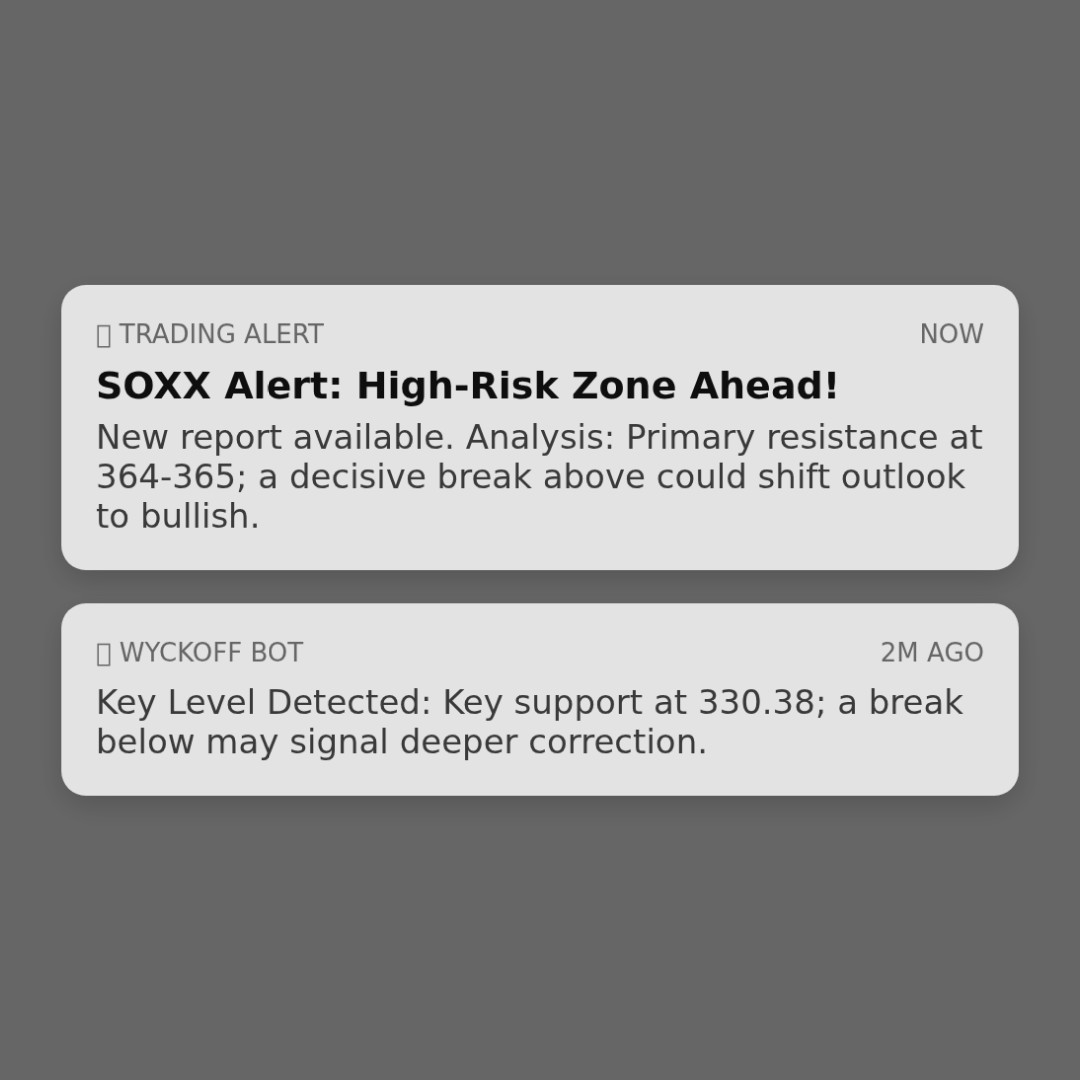
- • Primary Resistance: 364.74 - 365.38 (the recent historical high price range). This is the key barrier determining whether the market can initiate a new advance.
- • Secondary Resistance/Supply Test Zone: The 360 - 363 range. The recent rally has faced repeated resistance in this area, forming a minor supply zone.
- • Key Support: 330.38 (around the closing price of the February 4th panic selling day). This level represents the "freezing point" of the panic sell-off and the starting point of the subsequent rebound, holding significant psychological and technical importance.
- • Secondary Support: 345.64 (the February 3rd low) and the 340 psychological level.
- • Ultimate Support/Trend Support: MA_60D (currently 326.13). Breaking below this moving average would seriously threaten the long-term uptrend.
Integrated Wyckoff Events and Trading Signals:
- • Current Market Phase Assessment: Based on price action, price-volume relationships, and volatility characteristics, SOXX is highly likely to be in the final stage of the "Distribution phase" or the "Secondary Test" phase of an initial decline. Signature events include the high-volume stalling at historical highs (late Jan), the subsequent panic selling (Feb 4), and the current low-volume rally approaching resistance.
- • Core Contradiction: The long-term trend remains bullish, but clear signs of distribution and demand exhaustion have emerged in the medium-to-short term.
- • Trading Signals:
- • Primary Signal: Bearish/Alert to Correction Risk. Based on multiple pieces of evidence—distribution at highs, panic selling, and the current low-volume rally into resistance—the current price zone offers an unfavorable risk-reward ratio, prioritizing defense against downside risk.
- • Operational Recommendations:
- 1. Long Position Holders: Should consider reducing exposure or setting tight stop-losses (e.g., below 360.00) near the 364-365 resistance zone. An inability to break the previous high accompanied by a high-volume down candle is a clear exit signal.
- 2. Shorts/Those on Sidelines: Chasing shorts at current levels is not advisable. A better strategy is to wait for a clearer signal: if price exhibits high-volume stalling or a rally-failure (i.e., a failed secondary test) again in the 364-365 resistance zone, it could be considered a tactical, high-risk/high-reward shorting opportunity, with an initial stop-loss placed above 365.50. Downside targets could be set towards the key support zone of 330-335.
- 3. Potential Long Opportunity: If price can break through 365.38 decisively with strong volume (
VOLUME_AVG_30D_RATIO > 1.2), the above distribution assessment may be invalidated, and the market could enter a new markup phase, at which point re-entering long positions could be considered.
- • Future Validation Points:
- 1. Confirming Bearish View: Price encounters resistance in the 364-365 zone, accompanied by increased volume but declining price (re-emergence of supply), subsequently breaking below the recent rally trendline and the 355-350 support area.
- 2. Invalidating Bearish View: Price decisively breaks and sustains above 365.50 with volume significantly above average (
VOLUME_AVG_30D_RATIO > 1.5), indicating the entry of new, strong demand and breaking the distribution structure.
Summary of Conclusions:
After a strong long-term advance, SOXX exhibited clear signals in late January to early February 2026 that align with the Wyckoff distribution framework. These include high-volume stalling at historical highs, a record-setting panic sell-off, and the current price-volume divergence during a low-volume rally into resistance. Historical ranking data (e.g., trading value ranked 2nd in ten years) reinforces the extremity and importance of these signals. Data analysis infers that large investors (smart money) have completed or are in the process of distribution at historical highs. The current market is in a high-risk zone, recommending a defensive posture and seeking high-probability shorting opportunities. The key future validation point lies in the outcome of price tests against the historical high resistance level.
Disclaimer: This report/interpretation is solely market analysis and research based on publicly available information and does not constitute any investment advice or operational guidance. The author strives for objectivity and impartiality but makes no guarantees regarding accuracy or completeness. Markets involve risk; investing requires caution. Any investment actions based on this report are taken at one's own risk.
Thank you for your attention! Wyckoff Price-Volume Market Analysis is published daily before the 8:00 market open. Please feel free to leave comments and share. Your recognition is crucial. Let's work together to see the market signals clearly.
Member discussion: