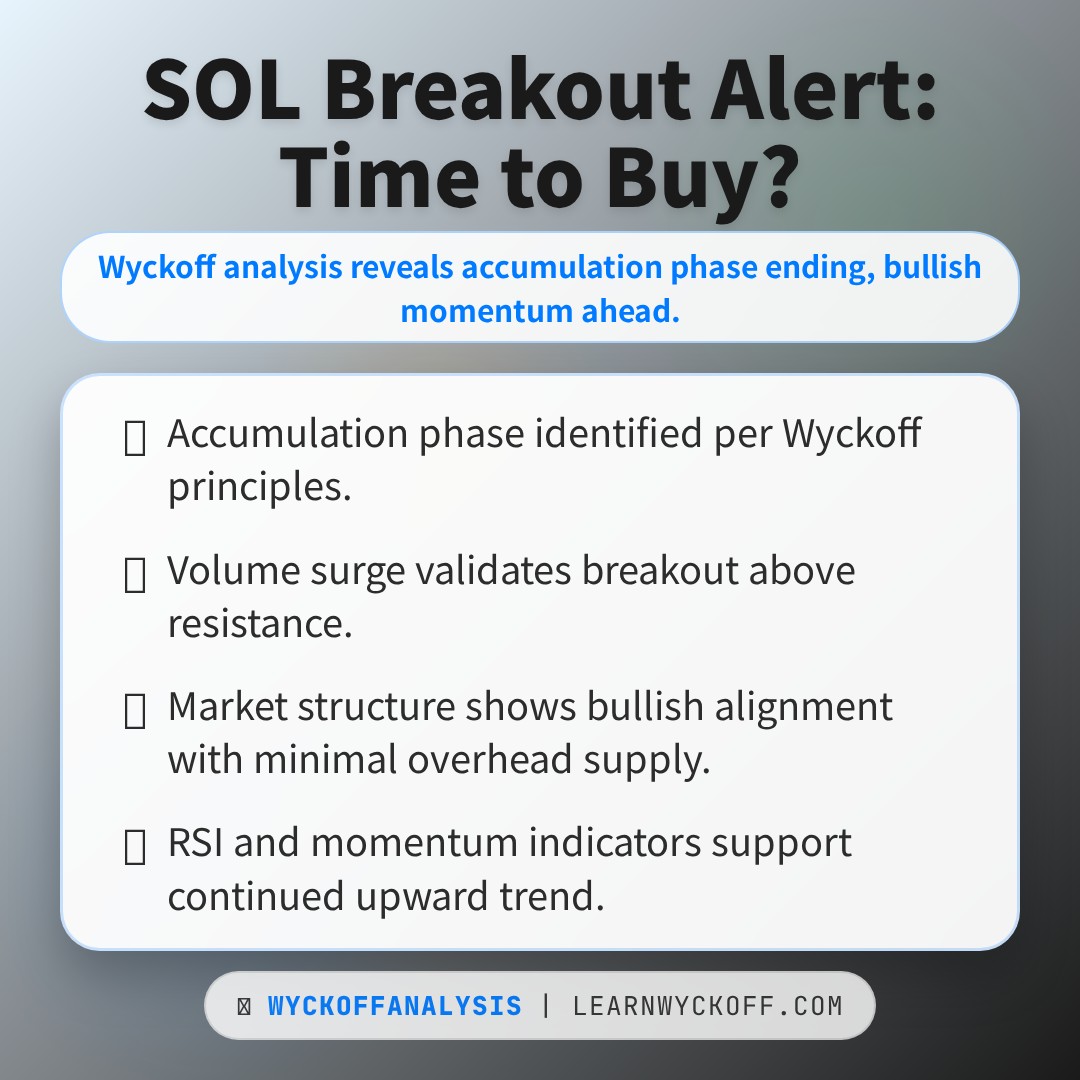
As a quantitative trading researcher proficient in the Wyckoff Method, I will prepare a comprehensive and in-depth quantitative analysis report for you based on the provided SOLUSDT data.

Disclaimer: This report is solely a quantitative analysis based on historical data and does not constitute any investment advice. The cryptocurrency market is highly volatile. Invest with caution.


SOLUSDT Wyckoff Quantitative Analysis Report

Product Code: SOLUSDT
Analysis Date Range: 2025-12-26 to 2026-02-24
Report Generation Date: 2026-02-25


1. Trend Analysis & Market Phase Identification

As of February 24, 2026, the underlying asset SOLUSDT had an opening price of 77.91, a closing price of 78.46, with moving averages of MA_5D at 82.61, MA_10D at 84.04, MA_20D at 84.23. The daily return was 0.72%, weekly return -7.78%, monthly return -25.69%, quarterly return -37.06%, and annual return -37.06%.

SOLUSDT Price Trend Analysis Chart, including closing price and multiple moving averages
  • Moving Average Alignment & Trend: Throughout the analysis period, SOLUSDT exhibited a clear medium-to-long-term bearish trend. Since mid-January 2026, the price (CLOSE) has consistently traded below all key moving averages (MA_5D, MA_10D, MA_20D, MA_30D, MA_60D), forming a standard bearish alignment. As of February 24, the MA_5D (82.61) has significantly broken below the MA_60D (113.90), indicating strong short-term downward momentum and extremely weak medium-term trends.
  • Market Phase Evolution: According to price action and Wyckoff Phase Theory:
    • Distribution to Markdown Phase (Dec 2025 to Mid-Jan 2026): After forming a double top in the 140-150 range (January 13, 14), the price broke down through key support levels (MA_20D, 130) accompanied by high volume (e.g., volume of 4.195 million on January 13, above average), confirming the completion of distribution and entry into the Markdown Phase.
    • Panic Selling Phase (Late Jan to Early Feb 2026): From January 20 to February 5, the price experienced a waterfall decline, dropping from 125.80 to a low of 67.50, a decline of nearly 46%. During this period, there were multiple single-day plunges exceeding 10% (e.g., -10.21% on Jan 31, -14.95% on Feb 5), accompanied by sharply increased volume, aligning with the characteristics of "Panic Selling" in Wyckoff theory, marking a concentrated release of downward momentum.
    • Initial Accumulation or Automatic Rally Phase (Mid-Feb 2026 to Present): After hitting a low of 67.50 on February 6, the price experienced a high-volume rebound (+11.63%), subsequently entering a narrow consolidation range between 77-87. Volume receded from extreme highs, and prices attempted to stabilize, suggesting panic selling may have temporarily exhausted, and the market has entered an "Initial Accumulation" or "Automatic Rally" phase. However, clear, sustained signals of demand taking control are not yet evident.

2. Volume-Price Relationship & Supply-Demand Dynamics

As of February 24, 2026, the underlying asset SOLUSDT had an opening price of 77.91, a closing price of 78.46, volume of 3197993.96, a daily return of 0.72%, volume 3197993.96, 7-day average volume 3036866.99, 7-day volume ratio 1.05.

SOLUSDT Volume-Price Relationship Line Chart and Historical Ranking Analysis
  • Panic Selling & Demand Absorption (Key Signals):
    1. 1. 2026-01-31: Price plummeted -10.21% to 105.58, volume surged to 8.567 million, 2.96 times the 7-day average volume (VOLUME_AVG_7D_RATIO: 2.96). HISTORY_RANK shows that the daily volume growth (VOLUME_GROWTH) reached 79.95%, ranking 2nd in the past decade. This is a classic "Panic Selling" day with massive supply emergence.
    2. 2. The following day, 2026-02-06: Price rebounded strongly from 78.34 to 87.46 (+11.63%), with volume further expanding to 11.811 million, 1.87 times the 7-day average. This formed the classic Wyckoff combination of a "Panic Selling" event followed immediately by a "High-Volume Rally," representing a "Selling Climax" (SC) and an "Automatic Rally" (AR). The huge volume indicates significant buying (demand) actively absorbing supply at the panic low, altering the purely seller-dominated market structure.
  • Supply Test & Demand Response:
    • 2026-02-23/24: On February 23, price declined again by -5.91% to 77.90, with volume at 5.163 million (1.84 times the 7-day average), indicating renewed supply. However, the next day (Feb 24), price rebounded slightly by +0.72% on significantly shrunken volume of 3.198 million (VOLUME_GROWTH: -38.06%). This structure of "stabilization on low volume following a high-volume decline" suggests short-term supply may be exhausted, selling pressure is easing, and conditions are being set for a demand counterattack.
  • Overall Supply-Demand Conclusion: Within the February consolidation range, multiple instances of the volume-price structure "rally on higher volume, pullback on lower volume" have appeared (e.g., Feb 13, 14). This indicates that at current levels, demand is beginning to manifest and can effectively respond to supply. The supply-demand relationship is shifting from a one-sided supply dominance towards a dynamic balance, which is a positive signal for a potential bottoming process.

3. Volatility & Market Sentiment

As of February 24, 2026, the underlying asset SOLUSDT had an opening price of 77.91, 7-day intraday volatility 0.55, 7-day intraday volatility volume ratio 0.82, 7-day historical volatility 0.61, 7-day historical volatility volume ratio 0.89, RSI 32.91.

SOLUSDT Parkinson Volatility Analysis Chart and Historical Ranking Data
  • Extreme Volatility Spike & Panic: During the early February crash, volatility metrics reached historically extreme levels. On February 6, the Parkinson volatility ratio PARKINSON_RATIO_7D_60D reached 2.5093, ranking 10th in the past decade; HIS_VOLA_RATIO_7D_60D reached 2.2209, ranking 16th. This clearly indicates a sharp, acute amplification of short-term volatility, far exceeding long-term normal levels, providing quantitative evidence of market sentiment plunging into extreme panic and disorder.
  • Volatility Convergence & Sentiment Stabilization: Entering late February, short-term volatility rapidly converged. As of February 24, PARKINSON_RATIO_7D_60D has retreated to 0.776, and HIS_VOLA_RATIO_7D_60D to 0.758. The normalization of volatility ratios indicates that the most panicked phase has passed, and market sentiment is calming down from extremes.
  • Confirmation of Oversold Conditions: The RSI_14 indicator touched 19.69 on February 5, setting a new decade-long historical low (ranking 1st), indicating extreme oversold conditions. Although the RSI has rebounded somewhat since then, as of February 24 it remains at a low level of 32.91, suggesting the market is still in an overall oversold region, and selling momentum appears fatigued after substantial release.

4. Relative Strength & Momentum Performance

  • Extremely Weak Momentum: Returns across all periods are deeply negative. QTD_RETURN is -37.06%, YTD is -37.06%, indicating this asset has performed very poorly recently and year-to-date, exhibiting strong relative weakness.
  • Slight Short-Term Momentum Improvement: Following the high-volume rally on February 6, WTD_RETURN briefly turned positive but failed to sustain. Over the past two weeks (February 10 to 24), weekly returns have fluctuated widely between -15% and +2.5%, showing intense struggle between bulls and bears at current levels, with no consistent upward or downward momentum yet established. Overall, the dominance of the downtrend's momentum remains unchanged, but the slope of the decline has noticeably flattened.

5. Large Investor (Smart Money) Behavior Identification

Based on Wyckoff principle-based volume-price analysis, the operational intent of large investors can be inferred:

  • Absorbers During Panic Selling: The massive, high-volume plunges on January 31 and February 5 are typical manifestations of panic selling by the public (retail investors). The subsequent high-volume rally on February 6, with volume reaching new highs, is certainly not attributable to retail behavior. This clearly indicates that large capital (smart money) utilized the market's extreme panic sentiment to conduct large-scale, proactive buying and absorption at low levels. This marks the beginning of "Accumulation" behavior.
  • Testing & Secondary Accumulation During Consolidation: During the consolidation in the 77-87 range in mid-to-late February, smart money was likely engaged in two types of operations:
    1. 1. Testing Supply: By gently pushing prices higher (e.g., Feb 13, 14), they observed whether new selling pressure (supply) would emerge when prices rebounded to certain levels (e.g., 86-88). The high-volume decline on February 23 can be viewed as a supply test; the result showed selling pressure still existed but diminished the next day, indicating floating supply is limited.
    2. 2. Patient Accumulation: Near the lower boundary of the consolidation range (around 77-80), when prices declined due to minor selling, smart money would absorb筹码 in batches with relatively restrained buy orders, manifested as declines not accompanied by extremely high volume (compared to the panic period). This "low-volume decline" is one of the characteristics of institutional accumulation.

6. Support/Resistance Level Analysis & Trading Signals

SOLUSDT Support Resistance Level Analysis Chart and Trading Signals
  • Key Support Levels:
    1. 1. Near-term Strong Support: 77.00 - 78.50 zone. This zone is the lower boundary of the February consolidation range and also contains the February 23 low of 77.15. A high-volume break below this zone would invalidate the current bottoming structure and signal the start of a new downtrend.
    2. 2. Ultimate Panic Low (Support to be confirmed): 67.50 (2026-02-06 LOW). This is the extreme low of this decline, accompanied by historically significant volume and volatility. This level theoretically holds strong psychological and technical support significance.
  • Key Resistance Levels:
    1. 1. Near-term Strong Resistance: 87.00 - 90.00 zone. This zone is the upper boundary of the February consolidation range, where price has been rejected multiple times (e.g., Feb 7, 15, 20). A decisive breakout above this zone is the first key signal that demand is truly dominant and the rebound有望 upgrade.
    2. 2. Major Technical Resistance: 110.00 - 115.00 zone. This is the platform from which the late-January crash began and is also where the MA_60D currently resides. Reclaiming this level would imply a potential fundamental reversal of the medium-term trend.
  • Comprehensive Wyckoff Events & Trading Signals:
    • Major Event: The market has shown a clear combination of "Panic Selling" (SC) and "High-Volume Rally" (AR), which is a preliminary marker for a potential bear market termination and the beginning of an Accumulation cycle.
    • • **Current Signal: Cautiously Bullish / Seeking Dip-Buying Opportunities. The market structure shows supply was largely released during the panic, and demand has begun介入 at lower levels. However, the overall downtrend has not yet reversed, and the market remains in the complex consolidation typical of early Accumulation.
    • Operational Suggestions:
      1. 1. Aggressive Strategy (Left-Side): Consider establishing a small long position near the 77.00 - 80.00 support zone, combined with candlestick patterns indicating exhaustion of selling on low volume (e.g., Doji, Hammer). Place a strict stop-loss below 76.50 (breaching the recent consolidation low).
      2. 2. Conservative Strategy (Right-Side): Wait for stronger confirmation signals of demand. The key entry signal is a price breakout above 87.50 on high volume (VOLUME_AVG_7D_RATIO > 1.2), closing above it. This can be viewed as a Spring or Jump Across the Creek (JOC) signal following a successful Secondary Test (ST), allowing for a long entry with a stop-loss set below the low of the breakout candle.
      3. 3. Bearish Strategy: The risk-reward ratio for shorting is currently unfavorable. However, if the price rallies to the 87-90 resistance zone and shows clear signs of stalling on high volume or forms a long upper shadow, it could be considered a signal of secondary distribution, allowing for a short-term试探 short with a stop-loss above 90.50.
    • Future Validation Points:
      1. 1. Confirmation Signal: Subsequently, price experiences a "low-volume retest of support" without making a new low (Wyckoff "Secondary Test") within the 77-87 range or higher, followed by another advance on increasing volume. This would strengthen the Accumulation thesis.
      2. 2. Invalidation Signal: Price breaks below 77.00 on high volume and subsequent rebounds fail to reclaim above this level. This would indicate the current consolidation is merely a pause within the downtrend (a bear flag), Accumulation has failed, and the market will enter a new Markdown phase.

Thank you for your attention! Wyckoff Volume-Price Market Interpretation is published daily at 8:00 AM before the market opens. Your comments and shares are greatly appreciated. Your recognition is crucial. Let us see the market signals together.