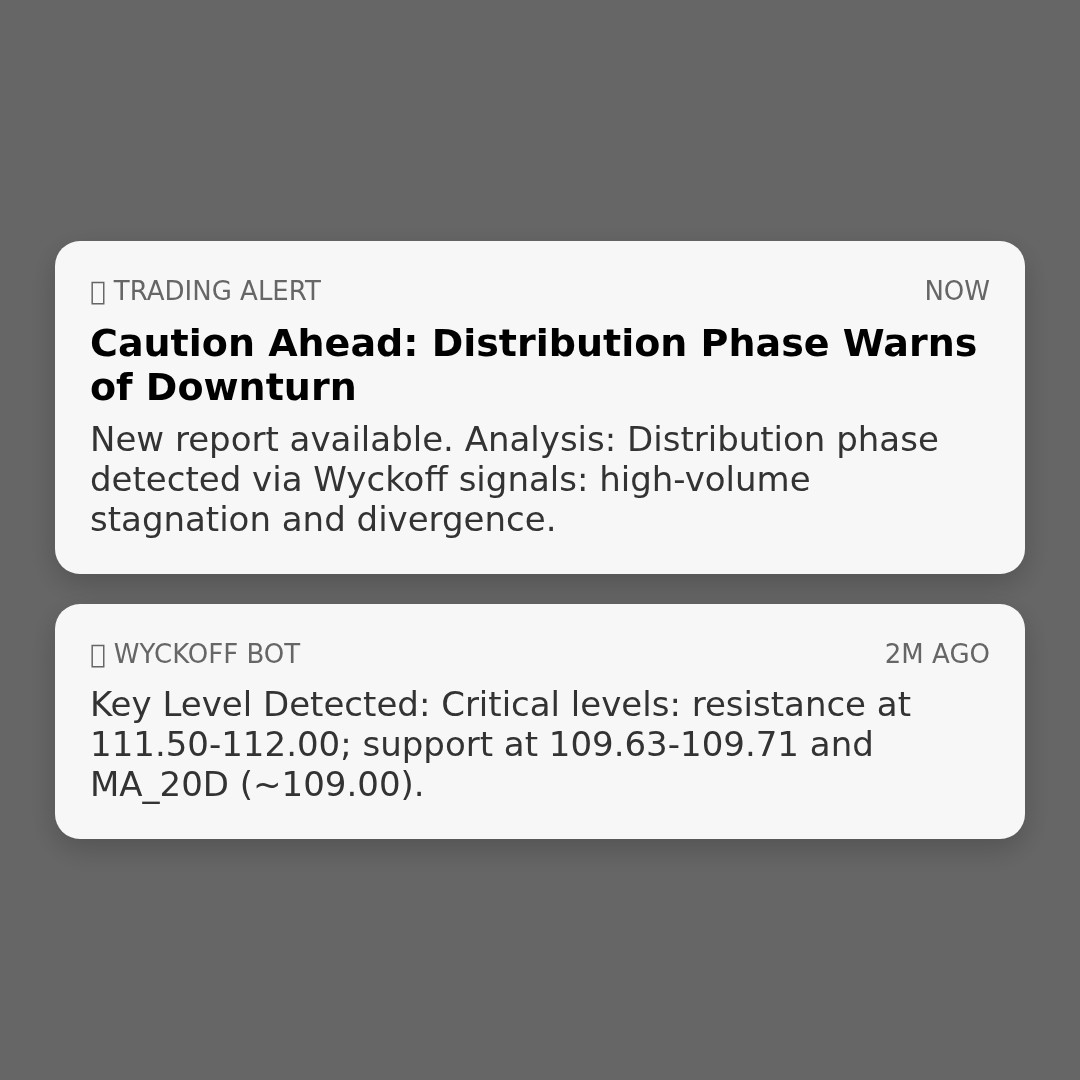
Very well, as a quantitative trading researcher proficient in the Wyckoff method, I will prepare a comprehensive and in-depth quantitative analysis report based on the PPH data you have provided.


Wyckoff Volume-Price Principle Quantitative Analysis Report

Product Code: PPH
Analysis Period: 2025-12-26 to 2026-02-24
Report Generation Date: 2026-02-25


1. Trend Analysis & Market Phase Identification

As of 2026-02-24, the underlying asset PPH has an opening price of 110.51, a closing price of 110.81, with moving averages: MA_5D: 111.03, MA_10D: 110.64, MA_20D: 108.99. Price changes: Daily: -0.08%, Weekly: -0.75%, Monthly: 3.74%, Quarterly (QTD): 7.41%, Year-to-Date (YTD): 7.41%.

PPH Price Trend Analysis Chart, including closing price and multiple moving averages
  • Moving Average Alignment: As of 2026-02-24, the closing price (110.81) is significantly above all moving averages (MA_5D: 111.03, MA_10D: 110.64, MA_20D: 108.99, MA_30D: 107.87, MA_60D: 105.02), presenting a standard bullish alignment pattern. Since late December 2025, the price has consistently traded above key moving averages (especially MA_20D and MA_60D), confirming the long-term uptrend.
  • Moving Average Crossover Signals:
    • • At the beginning of the analysis period (2025-12-26), MA_5D (102.90) had already crossed above MA_20D (101.16), issuing a medium-term bullish signal.
    • • Throughout the analysis period, MA_5D and MA_20D maintained their bullish alignment. Although there were minor convergences (e.g., on 2026-01-30), a death cross never occurred, indicating a solid uptrend structure.
  • Market Phase Inference: Based on price action and Wyckoff theory, the market is most likely in the late stage of the Distribution Phase.
    • Evidence: The price reached new all-time highs in early February 2026 (the top 1-6 highest price records all occurred in February), but showed divergence in upward momentum. Specifically, during the process of making new highs, volume exhibited abnormal expansion followed by stagnation (see point 2), and volatility spiked sharply (see point 3). These are classic characteristics of large investors supplying shares to the market at historical high levels. The market has not entered a "Panic" or "Markdown" phase because the price is still oscillating strongly at high levels, without consecutive high-volume crashes.

2. Volume-Price Relationship & Supply-Demand Dynamics

As of 2026-02-24, the underlying asset PPH has an opening price of 110.51, closing price 110.81, volume 874646, daily change -0.08%, volume 874646, 7-day average volume 328168.86, 7-day volume ratio 2.67.

PPH Volume-Price Relationship Line Chart and Historical Ranking Analysis
  • Core Supply-Demand Analysis:
    • Demand-Dominated Phase: On 2026-01-06 and 2026-01-07, the price experienced two consecutive days of significant gains (+1.87%, +1.06%). Volume reached 701,546 and 537,304 respectively, with VOLUME_AVG_7D_RATIO values of 1.43 and 0.94, indicating strong demand that successfully drove the breakout.
    • Supply-Domination and Distribution Signals:
      • Key Signal 1 (High-Volume Stagnation at Highs): On 2026-02-12, volume surged to 1,003,232 shares (VOLUME_AVG_7D_RATIO: 1.75), but the price only increased by a mere 0.009%, essentially closing flat. This is a textbook case of "high-volume stagnation," indicating that massive supply (selling) at the historical high (closing price 110.30, historical rank #9) completely absorbed buying pressure, leaving demand unable to push the price higher.
      • Key Signal 2 (High-Volume Decline): On 2026-02-03, the price fell -1.86% on volume of 837,638 shares (VOLUME_AVG_7D_RATIO: 1.72). This high-volume decline confirmed the strong emergence of supply. Although there was a rebound the next day (02-04), volume contracted (VOLUME_AVG_7D_RATIO: 0.85), indicating insufficient demand for the bounce.
      • Latest Signal: On 2026-02-24 (the report's base date), the price declined slightly by -0.08%, but volume expanded abnormally to 874,646 shares (VOLUME_AVG_7D_RATIO: 2.67, a recent high), forming a "high-volume stagnation on a decline." This is a clear signal of persistent supply entering the market, suggesting large investors may be continuing distribution at current high levels.
    • Weak-Demand Rebound: On 2026-02-23, the price rose 0.47%, but volume was only 180,984 shares (VOLUME_AVG_7D_RATIO: 0.52). This constitutes a low-volume rebound, indicating weak demand that is unlikely to support sustained upward price movement.

3. Volatility & Market Sentiment

As of 2026-02-24, the underlying asset PPH has an opening price of 110.51, 7-day intraday volatility 0.12, 7-day intraday volatility ratio 0.86, 7-day historical volatility 0.09, 7-day historical volatility ratio 0.51, RSI 61.80.

PPH Historical Volatility Analysis Chart and Historical Ranking Data
  • Volatility Levels and Changes:
    • • Short-term volatility (HIS_VOLA_7D and PARKINSON_VOL_7D) expanded significantly from late January to early February 2026. HIS_VOLA_7D peaked at 0.306 on 02-05, and PARKINSON_VOL_7D peaked at 0.205 on 02-09.
    • Abnormal Volatility Ratios: The HIS_VOLA_RATIO_7D_14D reached 1.37 on 02-05, and PARKINSON_RATIO_7D_14D reached 1.25 on 02-04 (historical rank #16), indicating short-term volatility far exceeding medium-term volatility. This typically occurs during phases of trend acceleration or extreme sentiment. Combined with the price being at highs, it leans more towards volatility intensification caused by distribution-related euphoria.
    • • Recently (02-24), volatility has converged (HIS_VOLA_7D: 0.095, PARKINSON_VOL_7D: 0.116), but this is a decline following extreme volatility, possibly suggesting the market is cooling slightly from distribution frenzy and turning indecisive.
  • RSI Sentiment Indicator: The RSI_14 reached a recent high of 67.75 on February 17th, approaching overbought territory but not entering extremes (>70). The current (02-24) RSI is 61.80, residing in the neutral-to-strong zone. This indicates market sentiment, while not extremely euphoric, remains optimistic, providing an ideal environment for distribution.

4. Relative Strength & Momentum Performance

  • Momentum Analysis: The product exhibited strong medium-term momentum during the analysis period. Both QTD_RETURN (7.41%) and YTD (7.41%) recorded substantial positive returns. However, short-term momentum has already weakened: WTD_RETURN is -0.75%, and the growth rate of MTD_RETURN (3.74%) has also significantly slowed compared to the highs in early February.
  • Momentum and Volume-Price Confirmation: The strong medium-term momentum contradicts the high-level volume-price divergence (high-volume stagnation). This further confirms the exhaustion of upward momentum, aligning with the "momentum peak" characteristic of the distribution phase.

5. Large Investor (Smart Money) Behavior Identification

Based on the above analysis, the behavioral intent of large investors can be clearly inferred:

  1. 1. Distribution is the Core Activity: During the process of the price reaching near-decade highs (February data), multiple instances of high-volume stagnation and high-volume decline occurred. Historical ranking data also shows that the trading amounts (AMOUNT) at these highs rank prominently within the past decade (e.g., ranks #14, #16, #17). This is not achievable by retail investor activity alone. Large investors are systematically distributing their holdings to momentum-chasing buyers, capitalizing on high market sentiment and ample liquidity.
  2. 2. Counterparty Identification: Within the massive volume, the primary buyers are momentum-chasing funds attracted by the strong trend and new highs (including some institutions and many retail investors). The sellers are the "smart money" that accumulated positions at lower levels earlier.
  3. 3. Current Status: The "high-volume stagnation on a decline" on 02-24 indicates that even with a slight price pullback, supply (selling) remains very determined, while demand has shown fatigue. The distribution activity by large investors is ongoing.

6. Support/Resistance Level Analysis & Trading Signals

PPH Support and Resistance Level Analysis Chart and Trading Signals
  • Key Price Levels:
    • Resistance (Supply Zone): 112.58 (2026-02-17 high, historical #1), 111.96 (2026-02-13 high, historical #2). This area is a clear supply-dominated zone.
    • Near-Term Support (Demand Test Points): 109.71 (2026-02-20 low, historical #7), 109.635 (2026-02-10 low, historical #8). If the price retreats to this area, observe volume changes to judge whether demand is entering or supply is persisting.
    • Major Support (Trend Lifeline): MA_20D (~109.00). A high-volume break below this level would strongly confirm the completion of distribution and the market's entry into a markdown phase.
  • Comprehensive Wyckoff Trading Signal: Bearish/Wait-and-See, Awaiting Shorting Opportunities.
    • Primary Logic: Multiple pieces of evidence (high-volume stagnation at highs, abnormal volatility, momentum divergence) collectively point to a distribution phase. The risk-reward ratio is unfavorable for establishing new long positions.
    • Operational Recommendations:
      1. 1. Current Holders: Should consider reducing positions on rallies or setting tight trailing stop-losses (e.g., using a level just below the recent low of 109.63 as a reference).
      2. 2. Sidelined Investors/Short Sellers: Await bearish confirmation signals. Valid signals include: the price breaking below the key support zone of 109.63-109.71 on high volume, or exhibiting low volume or high-volume stagnation again near the 111.50-112.00 resistance zone during a rebound. Potential short entry levels could be set around 110.80-111.30 (areas of weak rebound), with initial stops placed above 112.60.
  • Future Validation Points:
    1. 1. Invalidating the Bearish View: To invalidate the current distribution judgment, the price must break above the 112.60 resistance decisively on significant volume (VOLUME_AVG_7D_RATIO > 1.2), and subsequent pullbacks must occur on low volume, suggesting a new uptrend.
    2. 2. Confirming the Bearish View: The price breaking below 109.00 (MA_20D) on high volume, with rebounds failing to reclaim this moving average, would confirm the end of distribution and the beginning of a markdown trend.

Disclaimer: All conclusions in this report are derived based on the provided historical data and the Wyckoff Volume-Price Principle and do not constitute any investment advice. Financial markets involve risks. Investors should make independent judgments based on their own circumstances.


Thank you for your attention! Wyckoff Volume-Price Market Insights are released daily at 8:00 AM before the market opens. Your comments and shares are sincerely appreciated, as your recognition is crucial. Let's work together to see the market signals clearly.