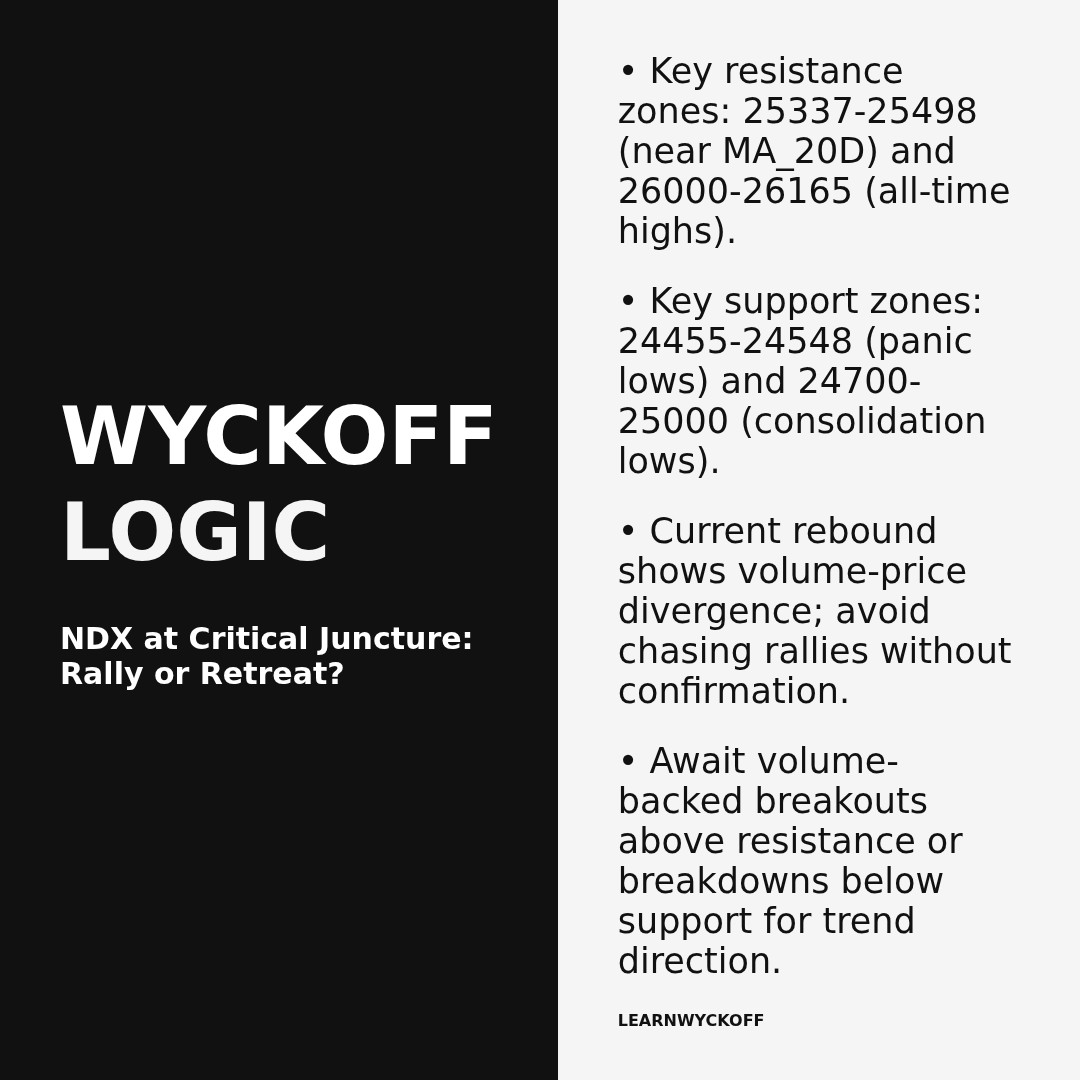
As a quantitative trading researcher proficient in the Wyckoff Method, I will compile a comprehensive and in-depth quantitative analysis report based on the NDX data you have provided.

Quantitative Analysis Report for the NASDAQ 100 Index (NDX)

Product Code: NDX
Analysis Date Range: 2025-12-26 to 2026-02-24 (Total of 42 trading days)
Report Generation Time: 2026-02-25
Analytical Framework: Wyckoff Volume-Price Principles / Quantitative Supply-Demand Analysis


1. Trend Analysis and Market Phase Identification

As of February 24, 2026, the subject NDX had an opening price of 24763.84, a closing price of 24977.05, a 5-day moving average (MA) of 24823.87, a 10-day MA of 24913.67, a 20-day MA of 25192.11, a daily change of +1.09%, a weekly change of +1.12%, a monthly change of -2.25%, a quarterly change of -1.08%, and a year-to-date change of -1.08%.

NDX Price Trend Analysis Chart, including closing price and multiple moving averages
  • Moving Average Alignment and Price Relationship Analysis:
    • Early Period (2025-12-26 to 2026-01-20): The price oscillated near historical highs (around 25600), with the MA_5D, MA_10D, and MA_20D tightly interwoven and the MA_60D positioned below. Overall, a consolidation pattern at highs was observed, and the bullish alignment structure began to loosen.
    • Critical Turning Point (2026-01-20): The price plunged -2.12%, decisively breaking below all short-term moving averages (MA_5D, MA_10D, MA_20D) with a large bearish candlestick, signaling the breakdown of the uptrend.
    • Mid-Period (2026-01-21 to 2026-02-24): The market entered a phase dominated by bears. The MA_5D crossed below the MA_20D multiple times (e.g., on Jan 20 and Feb 4), confirming downward momentum. By the end of the report period (Feb 24), the price (24977) was above the MA_5D (24824) but remained pressured below the MA_20D (25192) and MA_60D (25363), exhibiting characteristics of a technical rebound within a bearish alignment.
  • Market Phase Inference (Based on Wyckoff):
    • Early to Mid-January 2026 (~Before Jan 28): The market was in the Distribution phase. The price reached a new all-time high (high of 26165.08 on Jan 28), but volume was relatively subdued (VOLUME_AVG_7D_RATIO at 0.93), forming a preliminary "Effort versus Result" signal, indicating that smart money might have been distributing holdings in this range.
    • Late January to Early February 2026 (Jan 29 - Feb 6): Entered the Panic Selling phase. The price experienced a cliff-like drop with a sharp surge in volume (volume reached 1.91B on Feb 4, ranking 17th highest in the past decade) and spiking volatility, aligning with panic characteristics.
    • Mid to Late February 2026 (Feb 9 to present): The market is undergoing a Secondary Test or an Automatic Rally/Shakeout following the panic. The price has rebounded from lows, but volume has contracted during the rally (VOLUME_AVG_7D_RATIO at 0.99 on Feb 24), indicating insufficient demand follow-through. The market is seeking balance or a new accumulation range.

2. Volume-Price Relationship and Supply-Demand Dynamics

As of February 24, 2026, the subject NDX had an opening price of 24763.84, a closing price of 24977.05, a volume of 1273870687, a daily change of +1.09%, a 7-day average volume of 1283881221.71, and a 7-day volume ratio of 0.99.

NDX Volume-Price Relationship Line Chart and Historical Ranking Analysis
  • Key Volume-Price Divergences and Confirmations:
    1. 1. Distribution Signal (Exhaustion of Demand): On 2026-01-28, the price hit a new all-time high (26165.08), but volume (128.4M) was only 93% of the 7-day average (VOLUME_AVG_7D_RATIO: 0.93), showing "Price Rise on Decreasing Volume," a classic warning signal that demand could not sustain new highs.
    2. 2. Supply-Dominated Decline (Confirming Distribution): On 2026-01-29, the price fell -0.53%, yet volume surged to 158.3M (VOLUME_AVG_7D_RATIO: 1.18), constituting "Price Drop on Increasing Volume," confirming a massive influx of supply as the distribution phase transitioned into the markdown phase.
    3. 3. Panic Selling (Climactic Supply): From 2026-02-04 to 02-05, the price experienced two consecutive sharp declines (-1.77%, -1.38%), with volumes reaching extremely high levels of 1.91B and 1.80B respectively (ranking among the top in the past decade). Heavy-volume plunges signify public panic selling and are areas where large investors may begin to absorb shares.
    4. 4. Demand Attempts Entry (But Power is Limited): On 2026-02-06, the price rebounded +2.15% on sustained high volume (1.71B), showing attempted demand buying. However, in subsequent rallies (e.g., +1.09% on Feb 24), volume (1.27B) had retreated to near the 7-day average (VOLUME_AVG_7D_RATIO: 0.99). Price Rise on Average Volume indicates insufficient demand to chase the rally, casting doubt on its sustainability.
  • Volume Anomaly Analysis:
    • Extreme Value Identification: According to historical rankings, recent volume and its ratios have repeatedly touched extreme ranges over the past decade. For instance, volume on Feb 4 was the 17th highest in ten years; VOLUME_AVG_7D_RATIO on Jan 5 (1.72) was the 16th highest in ten years, indicating trading activity during these periods reached historically significant levels.
    • Supply-Demand Transition: The shift from extremely low volume ratios at the end of December (multiple volume ratios on Dec 26 were in the lowest 3-14th percentile over the past decade) to very high volume ratios in early January and early February clearly outlines a complete market cycle: Liquidity Dry-up (Watchfulness) -> Active Contention (Distribution) -> Panic Selling (Climactic Supply) -> Rebound Test (Demand Attempt).

3. Volatility and Market Sentiment

As of February 24, 2026, the subject NDX had an opening price of 24763.84, a 7-day Parkinson Volatility of 0.17, a 7-day Parkinson Volatility Volume Ratio of 0.89, a 7-day Historical Volatility of 0.16, a 7-day Historical Volatility Ratio of 0.68, and an RSI of 47.32.

NDX Historical Volatility Analysis Chart and Historical Ranking Data
  • Volatility Levels and Structure:
    • Characteristics of the Panic Period: From late January to early February 2026, HIS_VOLA_7D spiked rapidly from around 0.16 to 0.28 on Feb 6, and PARKINSON_VOL_7D rose from 0.12 to 0.23. Short-term volatility far exceeded long-term volatility (e.g., HIS_VOLA_RATIO_7D_60D reached 1.40 on Feb 6), presenting a typical "volatility spike" corresponding to the panic selling.
    • Current Status: As of Feb 24, short-term volatility has retreated significantly from its peak (HIS_VOLA_7D: 0.16, PARKINSON_VOL_7D: 0.17) and is below medium-to-long-term volatility (HIS_VOLA_RATIO_7D_60D: 0.87). This indicates that market panic has been released, and the market has entered a volatility contraction or consolidation phase.
  • Sentiment Indicator (RSI) Verification:
    • • After reaching a high of 60.97 on Jan 28 (approaching overbought), RSI_14 declined rapidly with the price drop, touching a low of 34.57 on Feb 5 (approaching oversold), accurately reflecting the shift in market sentiment from optimism to panic.
    • • The current RSI_14 is 47.32, in a neutral-to-weak zone, corroborating with the price rebound on insufficient volume, indicating that market sentiment has not become overly optimistic with the rebound and caution remains.

4. Relative Strength and Momentum Performance

  • Momentum Cycle Analysis:
    • Short-term Momentum Turns Negative: WTD_RETURN was negative for most of February, showing short-term downward momentum. Although it turned positive for the week ending Feb 24 (+1.12%), the strength is limited when combined with the contracting volume.
    • Mid-term Momentum Deteriorates: MTD_RETURN (-2.25%) and QTD_RETURN (-1.08%) have both turned negative, confirming that the mid-term correction pattern since the January highs has been established.
    • Long-term Momentum Persists but is Weakening: YTD (-1.08%) and TTM_12 (16.98%) remain positive but have significantly declined from their levels at the January highs (YTD >3%, TTM_12 >23%), indicating exhaustion of long-term upward momentum.

5. Large Investor (Smart Money) Behavior Identification

Integrating volume-price, volatility, and trend analysis allows us to infer the trajectory of large investor behavior:

  1. 1. Distribution (Early to Mid-January): Around historical highs (26000+), smart money likely completed distribution by creating signals such as "Effort versus Result" (new highs on low volume) and the "Last Point of Supply" (down day on high volume on Jan 29). Historical rankings show many price metrics (open, close, high, low) for this area were in the TOP20 of the past decade, providing an ideal location for distribution.
  2. 2. Allowing Decline and Absorption (Late January - Early February): During the initial panic selling, smart money likely did not strongly support the market, instead allowing emotional selling to flush out weak hands. On climax panic days (Feb 4-5), enormous volume implies counterparties absorbed the panic selling, which could well be smart money beginning accumulation at lower levels.
  3. 3. Testing and Control (Mid to Late February): During the rebound, smart money has not been eager to drive prices significantly higher (manifested as low rebound volume), possibly intending to:
    • Test for Exhaustion of Supply: Observe if new selling pressure emerges when the price rebounds to certain levels (e.g., 25000-25300).
    • Continue Accumulation at Lower Levels: Continue gathering shares at relatively low prices by controlling the pace of price increases.
    • Create Shakeouts: A renewed price suppression near key resistance (e.g., MA_20D) to shake out weak longs cannot be ruled out.

6. Support/Resistance Level Analysis and Trading Signals

NDX Support and Resistance Level Analysis Chart with Trading Signals
  • Key Levels:
    • Resistance 1: The 25337 - 25498 zone (rebound highs from Feb 9-11, near MA_20D). This is a strong recent resistance area where demand has faltered.
    • Resistance 2: The 26000 - 26165 zone (late January all-time highs). This is the primary distribution area and constitutes a major long-term resistance.
    • Support 1: The 24455 - 24548 zone (panic lows from Feb 5-6). This support band formed during panic selling is a critical demarcation line.
    • Support 2: The psychological 25000 level and the area around 24700 (late February consolidation lows).
  • Integrated Trading Signals and Operational Recommendations:
    • Current Market State: The market is in a downtrend following distribution, undergoing a secondary test/rebound from panic lows. Supply and demand are seeking a new equilibrium at lower levels.
    • Core Trading Viewpoint: Adopt a cautious, wait-and-see approach, awaiting clearer accumulation signals. The current rebound exhibits volume-price divergence, making chasing the rally inadvisable.
    • Bullish Scenario (Requires Validation): If the price can break above the 25498 resistance on strong volume (VOLUME_AVG_7D_RATIO > 1.2) and stabilize above the MA_20D, it may signal the completion of a new accumulation phase, allowing consideration of trend-following long positions. Entry Reference: Above 25500. Stop-loss: Below 25200.
    • Bearish Scenario (Requires Validation): If the price shows increased volume with stalling or declining prices again near the current resistance zone (around 25300), or breaks below the 24700 support after a low-volume rebound, it would indicate a failed secondary test, and the downtrend may resume. Consider shorting on rallies near resistance. Entry Reference: Upon encountering resistance around 25300. Stop-loss: Above 25500.
    • Key Future Validation Points:
      1. 1. Demand Validation: Observe if low-volume stabilization or high-volume bounce occurs when the price again approaches the 24700 or 24455 support zones. This is a crucial signal for testing demand presence.
      2. 2. Supply Validation: Monitor volume changes when the price rebounds to the 25300-25500 zone. High-volume stalling suggests supply remains strong; moderate-volume breakout suggests supply may have been absorbed.

Disclaimer: This report is based on historical data and quantitative model analysis. All conclusions are probabilistic inferences and do not constitute any investment advice. Financial markets involve risks; please make decisions with caution.


Thank you for your attention! Daily Wyckoff volume-price market insights are released promptly before the market opens at 8:00. Your feedback and shares are greatly appreciated. Let's work together to see the market signals clearly.