Understood, as a quantitative trading researcher proficient in the Wyckoff method, I will draft a comprehensive and in-depth quantitative analysis report based on the META data (2025-12-26 to 2026-02-24) and historical ranking metrics provided. The report will strictly adhere to the six dimensions you specified. All conclusions are derived from data and are consistent with Wyckoff price-volume principles.
Wyckoff Price-Volume Analysis Report for META
Product Code: META
Analysis Date Range: 2025-12-26 to 2026-02-24
Report Generation Time: 2026-02-25
1. Trend Analysis & Market Phase Identification
As of 2026-02-24, for the subject META: Opening price 633.08, Closing price 639.30, 5-day MA 644.04, 10-day MA 652.64, 20-day MA 669.70, Daily change 0.32%, Weekly change 0.00%, Monthly change -10.77%, Quarterly change -3.15%, Year-to-date change -3.15%

- • Moving Average Alignment & Crossovers:
- • Initial State (2025-12-26): MA_5D (663.44) > MA_20D (654.31) > MA_60D (668.15), showing a state of entanglement where the short-to-medium-term was bullish but the price was below the long-term moving average.
- • Key Changes:
- 1. 2026-01-13 to 01-20: The price plummeted, causing MA_5D to quickly cross below MA_20D and MA_30D, forming a clear short-term bearish alignment.
- 2. 2026-01-22 to 01-29: The price rebounded strongly, with MA_5D rapidly crossing above MA_10D, MA_20D, and MA_30D, forming a short-term bullish alignment. However, MA_20D and MA_30D consistently failed to effectively cross above MA_60D, indicating persistent pressure from the long-term trend.
- 3. 2026-02-24 (Current): MA_5D (644.04) < MA_10D (652.64) < MA_20D (669.70) < MA_30D (656.67) < MA_60D (655.59). With the exception of MA_30D vs. MA_60D, a clear bearish alignment is present. The price (639.30) is below all major moving averages, which is a typical bear market structure.
- • Price Action & Market Phase Inference:
- • Phase One (2025-12-26 to 2026-01-14): Decline & Panic. The price dropped consecutively from around615. This period was accompanied by several high-volume plunges (e.g., Jan 13, volume 18.03 million, far exceeding the average). The RSI dropped to a low of 33.99, aligning with the characteristics of a "panic sell-off" in Wyckoff theory.
- • Phase Two (2026-01-22 to 2026-01-29): Automatic Rally & Potential Distribution. The price rebounded rapidly and steeply from the lows. Particularly on Jan 29, driven by an event (presumably earnings), the price surged 10.4% in a single day, with volume exploding to an extreme historical value (59.85 million, ranking third in trading value over the past decade). This "climactic" rise is often a signal for the beginning of distribution.
- • Phase Three (2026-01-30 to 2026-02-24): Secondary Test & Decline. After the peak on Jan 29, the price failed to sustain its upward momentum, instead falling and breaking below the starting point of the rally. Volume contracted during the rally and expanded moderately during the decline as the price gradually moved lower. The current market is in the "decline phase following distribution", searching for a new supply-demand equilibrium.
2. Volume-Price Relationship & Supply-Demand Dynamics
As of 2026-02-24, for the subject META: Opening price 633.08, Closing price 639.30, Volume 10140914, Daily change 0.32%, Volume 10140914, 7-day average volume 12492217.86, 7-day volume ratio 0.81

- • Key Day Analysis:
- • High-Volume Plunge (Supply Dominant):
- • 2026-01-13: Price fell -1.69%, volume 18.03 million (1.67 times the 14-day average). High-volume decline, indicating strong supply (selling pressure) dominating the market.
- • 2026-01-14: Price continued to drop significantly by -2.47%, volume 15.53 million (1.42 times the 14-day average). Consecutive high-volume declines confirmed the supply-driven downtrend.
- • Extreme-Volume Surge (Climax/Distribution Signal):
- • 2026-01-29: Price surged 10.40%, volume skyrocketed to 59.85 million. The
VOLUME_AVG_14D_RATIOfor that day reached 3.62, andVOLUME_AVG_21D_RATIOreached 4.10, both ranking in the top 20 historically over the past 10 years (18th and 13th respectively). This is typical climax behavior. Wyckoff Perspective: Such enormous volume likely represents informed large capital ("smart money") distributing shares to the public buyers flocking in, leveraging positive news.
- • 2026-01-29: Price surged 10.40%, volume skyrocketed to 59.85 million. The
- • High-Volume Stalling/Retreat (Supply Reappearance):
- • 2026-01-30: Price retreated -2.95% from its high, volume 23.74 million (0.96 times the 7-day average, but still far above the long-term average). A high-volume retreat following a climax day is preliminary evidence of supply re-entering and demand exhaustion.
- • Low-Volume Rally (Insufficient Demand):
- • 2026-02-24 (Latest Trading Day): Price rose slightly by 0.32%, volume 10.14 million, only 0.81 times its 7-day average (
VOLUME_AVG_7D_RATIO = 0.81). A low-volume rally after consecutive declines indicates weak demand, insufficient buying interest, and suggests the rally is unsustainable.
- • 2026-02-24 (Latest Trading Day): Price rose slightly by 0.32%, volume 10.14 million, only 0.81 times its 7-day average (
- • High-Volume Plunge (Supply Dominant):
- • Supply-Demand Shift:
- • The January decline was driven by "strong supply".
- • The late-January rally was triggered by "event-driven, pulse-like demand", but was quickly overwhelmed by stronger supply.
- • The current market displays a pattern of "contracting demand and moderate supply release". Lacks the signal of "expanding demand" characterized by high-volume advances.
3. Volatility & Market Sentiment
As of 2026-02-24, for the subject META: Opening price 633.08, 7-day intraday volatility 0.30, 7-day intraday volatility volume ratio 0.85, 7-day historical volatility 0.29, 7-day historical volatility volume ratio 0.89, RSI 43.76

- • Volatility Level & Changes:
- • Historical Volatility (HIS_VOLA):
HIS_VOLA_7Dpeaked at 0.8178 on Jan 30, then gradually contracted, falling to 0.2866 by Feb 24.HIS_VOLA_RATIO_7D_60Dreached 2.01 on Jan 30, indicating extreme short-term volatility anomaly, far exceeding the long-term norm, often associated with major events or panic. - • Intraday Volatility (PARKINSON_VOL):
PARKINSON_VOL_7Dpeaked at 0.4091 on Feb 6, coinciding with the period of sharp price swings. It has currently retreated to 0.2969. - • Volatility Conclusion: The market has transitioned from "high volatility from extreme panic/excitement" (late January) to "moderate volatility during a trending decline" (current). Volatility has contracted but not to low levels, indicating the market has not yet entered a completely dormant state.
- • Historical Volatility (HIS_VOLA):
- • Market Sentiment (RSI):
- • On Jan 14, the RSI_14 dropped to 33.99, entering the oversold zone. Combined with the high-volume plunge, this formed a classic "panic sell-off" scenario.
- • On Jan 29, the RSI_14 surged to 73.75, entering the overbought zone. Combined with the extreme-volume surge, this formed a "climax buying" topping signal.
- • Current (2026-02-24), the RSI_14 is at 43.76, in a neutral-to-weak range. It is neither oversold nor overbought, indicating relatively calm market sentiment with no immediate reversal force stemming from extreme sentiment.
4. Relative Strength & Momentum Performance
- • Periodic Return Analysis:
- •
WTD_RETURN (0.00%): Weekly momentum is nearly zero, indicating short-term market stalemate. - •
MTD_RETURN (-10.77%): The monthly return is significantly negative, confirming the medium-term downtrend since February. - •
QTD_RETURN (-3.15%)andYTD (-3.15%): Negative quarterly and year-to-date returns show that momentum has weakened from a medium-to-long-term perspective.
- •
- • Momentum Conclusion: META's short-term momentum has vanished, medium-term downward momentum is strong, and long-term momentum has turned negative. This corroborates the conclusions from trend analysis of a "bearish alignment" and "post-distribution decline."
5. Large Investor ("Smart Money") Behavior Identification
Synthesizing volume-price, volatility, and trend analysis, the inferred intentions and actions of large investors are as follows:
- 1. Accumulation/Testing?: During the panic decline in mid-January, no sustained, organized large-volume absorption was observed. The decline process accompanied by high volume resembled active supply-side pressure more than systematic accumulation by smart money.
- 2. Distribution: The extreme-volume surge on Jan 29 is the core signal. Combined with historical ranking data (volume ratios reaching multi-year highs), this is highly likely large investors conducting large-scale distribution, leveraging strong earnings reports or market optimism. They satisfied the frenzy-driven demand from the public fueled by news, successfully transferring holdings.
- 3. Withdrawal & Watchful Waiting: Post-distribution, the February chart shows: rallies on low volume, declines on (moderately) higher volume. This indicates large investors did not actively re-accumulate during pullbacks and may have continued exiting during failed rallies. The current low-volume environment also suggests smart money is in a watchful waiting state, awaiting better price levels or clearer signals.
Key Answers:
- • Who was buying on Jan 29 with such huge volume? Most likely event-driven public investors (retail, momentum-chasing capital).
- • Who was selling? Most likely "smart money" and some institutional investors who had positioned earlier, completing distribution at high levels.
- • Who is currently on the sidelines with low volume? Smart money and most institutional investors, waiting for prices to fall to a more attractive valuation zone or for new accumulation signals to appear.
6. Support/Resistance Level Analysis & Trading Signals

- • Key Price Levels:
- • Upper Resistance:
- 1. Strong Resistance: $738.31 (2026-01-29 high, top of distribution zone).
- 2. Secondary Resistance: The680 area (rebound highs in early February 2026, also the current convergence area of MA_30D/MA_60D).
- • Lower Support:
- 1. Recent Support: The630 area (consolidation lows from mid-to-late January 2026).
- 2. Strong Support/Panic Zone: The615 area (dense low area formed between 2026-01-14 and 01-20).
- • Upper Resistance:
- • Wyckoff Integrated Trading Signal:
- • Primary Signal: Bearish/Watchful Waiting. The market is in a clear post-distribution decline phase. The primary trend is down, and the price is below all moving averages. Lacks Signs of Strength (demand expansion).
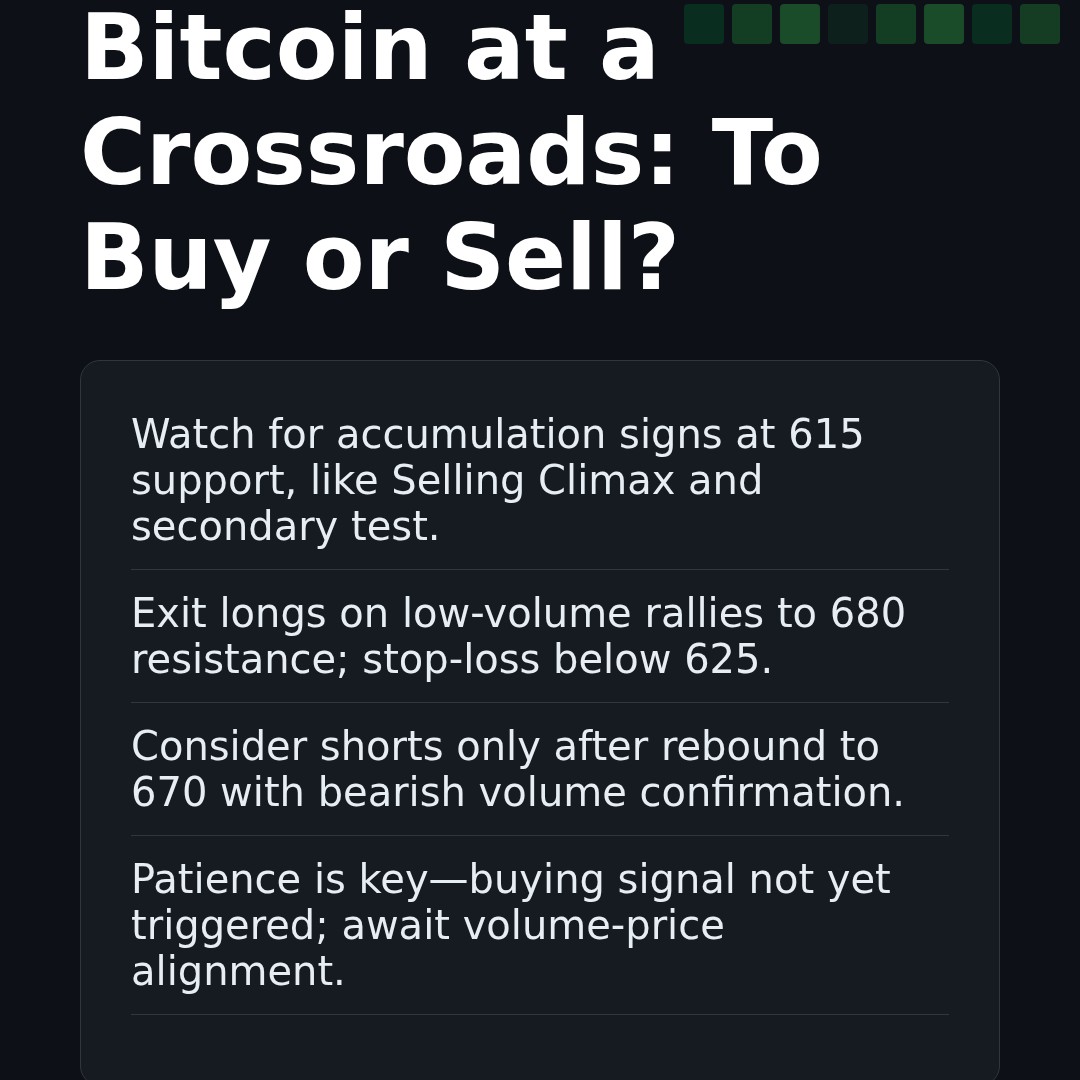
- • Secondary Signal: Be alert for potential "secondary testing" behavior near the strong support zone (615). Observe if accumulation characteristics such as "low-volume selling exhaustion" or "rapid rebound following high-volume panic" appear then.
- • Operational Suggestions & Future Validation Points:
- • For Existing Holders (Long Positions): Any rally towards the680 resistance zone, if accompanied by low volume (
VOLUME_AVG_7D_RATIO < 1.0), presents an opportunity to reduce or exit positions. A stop-loss can be placed below the recent low around $625. - • For Short Sellers or Those on the Sidelines: It is not advisable to chase shorts at the current price (~$639), as a short-term decline has already occurred and the price is near prior support. A better strategy is to wait for a price rebound into the670 resistance zone, accompanied by signs of renewed supply (e.g., a high-volume bearish candlestick showing stalling), before considering shorting. A stop-loss for shorts can be placed above $680.
- • For Potential Long Buyers: Maintain patience. The buying opportunity has not yet arrived. Need to wait for clear signs of an accumulation structure to appear:
- 1. Preliminary Signal: After the price falls to the615 strong support zone, a "rapid rebound following a high-volume panic plunge" – a Selling Climax phenomenon.
- 2. Confirmation Signal: Subsequently, a "secondary test" with low volume and no new low.
- 3. Entry Signal: Price breaks above the downtrend line or a key resistance level (e.g.,650) on significantly increased volume (
VOLUME_AVG_7D_RATIO > 1.2).
- • Key Validation Points:
- 1. Price action in the615 zone (Does it find support? What is the volume-price relationship?).
- 2. Price action upon rebounding to the670 zone (Does it break out on volume or stall and retreat?).
- 3. Whether volume contracts to extremely low levels during declines (
VOLUME_AVG_7D_RATIOconsistently below 0.7), which could be an early sign of declining momentum exhaustion.
- • For Existing Holders (Long Positions): Any rally towards the680 resistance zone, if accompanied by low volume (
Disclaimer: This report is entirely based on analysis of the provided historical data and does not constitute any investment advice. Financial markets involve risks, and past performance is not indicative of future results. Investors should make independent judgments and exercise caution in their decision-making.
Thank you for your attention! Daily Wyckoff Price-Volume market insights are published punctually at 8:00 AM before market open. We kindly ask for your comments and shares; your recognition is crucial. Let's work together to see the market signals clearly.
Member discussion: