Here is your customized quantitative analysis report.


Wyckoff Price-Volume Analysis Report: KWEB

Product Code: KWEB
Analysis Date Range: Dec 26, 2025 - Feb 24, 2026
Report Generation Time: Feb 25, 2026
Analyst: Wyckoff Quantitative Research Assistant


I. Trend Analysis and Market Phase Identification

As of February 24, 2026, the target KWEB had an opening price of 31.85, a closing price of 32.25, a 5-day moving average (MA_5D) of 32.67, a 10-day MA (MA_10D) of 33.17, and a 20-day MA (MA_20D) of 34.09. Performance metrics: daily change -0.09%, weekly change -1.44%, monthly change -8.85%, quarterly change -5.29%, year-to-date change -5.29%.

KWEB Price Trend Analysis Chart with Closing Price and Multiple Moving Averages
  1. 1. Moving Average Alignment and Trend Direction:
    • • Throughout the observation period, the closing price of KWEB has consistently remained below all cycle moving averages (MA_5D, MA_10D, MA_20D, MA_30D, MA_60D), indicating a strong bearish alignment.
    • • Short-term moving averages (e.g., MA_5D) are always positioned below long-term ones (e.g., MA_20D, MA_60D), with the averages in a descending divergence state, confirming the market is in a clear downtrend.
    • Price Action: Since the peak of 37.66 on January 12, 2026, the price has exhibited a lower-high and lower-low pattern, continuously setting new recent lows, eventually closing at 32.25.
  2. 2. Inferred Market Phase:
    • Phase 1 (Late Distribution / Early Downtrend Emergence): In early January 2026, the price rebounded from a low (34.05) and surged 5.1% to 37.66 on January 12 on high volume. However, the price retreated immediately after this rise, and trading volume failed to sustain its expansion. The price could not effectively break through the resistance of medium-to-long term moving averages. This aligns with the "Distribution" characteristic in Wyckoff theory, where large investors distribute holdings to the public chasing the rally at relatively high levels.
    • Phase 2 (Panic Selling): Entering February, the price decline accelerated, especially during the period from February 4 to February 13, featuring consecutive days of high-volume declines with significant drops. This indicates the public falling into panic, triggering a selling wave, and the market entering a panic selling phase.

Conclusion: KWEB has been in a clear bearish trend throughout the analysis period. The market phase transitioned from a potential distribution zone in mid-January to a panic selling phase in February. As of February 24, the trend is in its final stage, but no clear demand-driven signs of stabilization have been observed.

II. Price-Volume Relationship and Supply-Demand Dynamics

As of February 24, 2026, the target KWEB had an opening price of 31.85, a closing price of 32.25, a volume of 20,724,394, a daily change of -0.09%, a 7-day average volume of 22,984,869.29, and a 7-day volume ratio of 0.90.

KWEB Price-Volume Relationship Line Chart and Historical Ranking Analysis
  1. 1. Key Day Price-Volume Analysis:
    • Demand Signals:
      • 2026-01-02: Price rose 4.64%, volume surged by 311.6% (VOLUME_GROWTH), and the VOLUME_AVG_7D_RATIO reached 3.11, indicating rising on high volume and preliminary demand emergence.
      • 2026-01-12: Price rose 5.11%, volume grew 154.98%, VOLUME_AVG_21D_RATIO reached 2.52, showing demand dominance again.
    • Supply Dominance and Panic Signals:
      • 2026-01-07: Fell 2.26%. While volume decreased sequentially, the VOLUME_AVG_30D_RATIO remained high at 1.12, showing the first high-volume decline after a rally, indicating supply emergence.
      • 2026-02-04: Plunged 2.91%, volume remained high, VOLUME_AVG_14D_RATIO was 1.16, a high-volume decline indicating strong supply.
      • 2026-02-12: Plunged 3.84%, volume surged 51.72%, VOLUME_AVG_60D_RATIO reached a high of 1.44, a classic panic selling event, marking a climax in supply.
  2. 2. Volume Trend Interpretation:
    • • In the latter half of February, despite continued price declines, VOLUME_GROWTH turned negative multiple times, and VOLUME_AVG_*D_RATIO indicators gradually fell below 1.0 (e.g., 0.90 on Feb 24). This suggests selling pressure (supply) has weakened after the panic days, but no signal of substantial demand-side buying on high volume has been observed, indicating a low-volume, gradual decline pattern.

Conclusion: The supply-demand relationship clearly illustrates the process: "demand attempts a rally → supply strongly suppresses → panic selling → selling pressure subsides." The current market is in a phase following panic selling where supply is temporarily exhausted, but demand has not yet entered on a large scale.

III. Volatility and Market Sentiment

As of February 24, 2026, the target KWEB had an opening price of 31.85, a 7-day intraday volatility (PARKINSON_VOL_7D) of 0.20, a 7-day intraday volatility ratio of 0.91, a 7-day historical volatility (HIS_VOLA_7D) of 0.10, a 7-day historical volatility ratio of 0.35, and an RSI of 29.54.

KWEB Historical Volatility Analysis Chart and Historical Ranking Data
  1. 1. Volatility Levels and Changes:
    • Historical Volatility (HIS_VOLA): The 7-day historical volatility peaked in January (>0.5) and remained relatively elevated (0.3-0.4) during the panic decline in February. Notably, by February 24, HIS_VOLA_7D sharply dropped to 0.1048.
    • Volatility Ratios: The key signal comes from volatility ratios. On February 24, HIS_VOLA_RATIO_7D_14D dropped to 0.3533, which, according to historical ranking data, is in the 17th percentile over the past decade (i.e., very low). Similarly, HIS_VOLA_RATIO_7D_30D dropped to 0.3224 (19th percentile). This marks a "crash" in short-term volatility relative to medium-to-long-term volatility, typically occurring after the climax of panic selling in a trending decline, suggesting an extreme release and potential exhaustion of selling momentum.
    • Intraday Volatility: PARKINSON_VOL_7D also retreated in late February, consistent with the converging trend in historical volatility.
  2. 2. Sentiment Indicator (RSI):
    • • Throughout the period, RSI_14 operated mostly in the weak zone below 50.
    • • During declines in late January and mid-February, RSI repeatedly touched or fell below the 30 oversold line. Currently (Feb 24), the RSI is 29.54, back in the oversold zone, indicating extremely pessimistic market sentiment.

Conclusion: Volatility data provides a key alpha signal: the sharp drop in short-term volatility (especially its extremely low historical ranking relative to longer periods), combined with sustained RSI oversold conditions, indicates market sentiment has shifted from "panic" to "despair" or "apathy." This is a typical sentiment characteristic suggesting a downtrend may be nearing its end (though not necessarily its reversal).

IV. Relative Strength and Momentum Performance

  • Comprehensive Momentum Deterioration: All cycle returns are negative, with recent performance deteriorating sharply.
    • WTD_RETURN: -1.44% (short-term weakness)
    • MTD_RETURN: -8.85% (sharp monthly decline)
    • QTD_RETURN: -5.29% (quarterly turned negative)
    • YTD: -5.29% (year-to-date turned negative)
  • Momentum Confirmation: The momentum data (negative returns for all periods) perfectly validates the conclusion from trend and price-volume analysis of bearish dominance and strong downward momentum. The sharp recent momentum deterioration aligns with the panic selling phase in February.

V. Large Investor ("Smart Money") Behavior Identification

Based on Wyckoff principles and the data above, inferences regarding large investor behavior are as follows:

  1. 1. Early January Rally (Jan 02 - Jan 12): Smart money likely utilized year-end/New Year liquidity for a technical bounce operation. The high-volume rise followed by failure to sustain suggests this was more likely distribution within a rally rather than the start of a new accumulation phase.
  2. 2. February Panic Decline (Feb 04 - Feb 12): This period saw consecutive very high-volume declines. This represents panic selling by the public. Typical smart money behavior here includes: ① Stealthily absorbing panic selling in small amounts (insufficient to reverse the trend); ② Temporarily standing aside, waiting for supply to be completely exhausted. Current data (low-volume decline) supports the second scenario more, i.e., smart money is awaiting a clearer, safer entry signal.
  3. 3. Current Situation (Feb 24): Volatility crash, shrinking volume, slight price decline. This aligns with the initial characteristics of a natural rally or secondary test following Panic Selling in Wyckoff theory. Smart money is likely observing: whether the price can stabilize on low volume, and the supply response during a re-test of the lows.

Answers to Core Questions:

  • Who was buying during the high-volume January rally? Retail investors chasing the rally and some short-term funds; smart money used this opportunity for distribution.
  • Who was selling during the high-volume February decline? Primarily panicking retail investors and some institutional stop-loss selling.
  • Who is on the sidelines during the current low-volume period? Both buyers and sellers are watching. Supply is temporarily exhausted, but smart money demand has not entered aggressively. The market is in a temporary, fragile balance.

VI. Support/Resistance Level Analysis and Trading Signals

KWEB Support and Resistance Level Analysis Chart and Trading Signals
  1. 1. Key Levels:
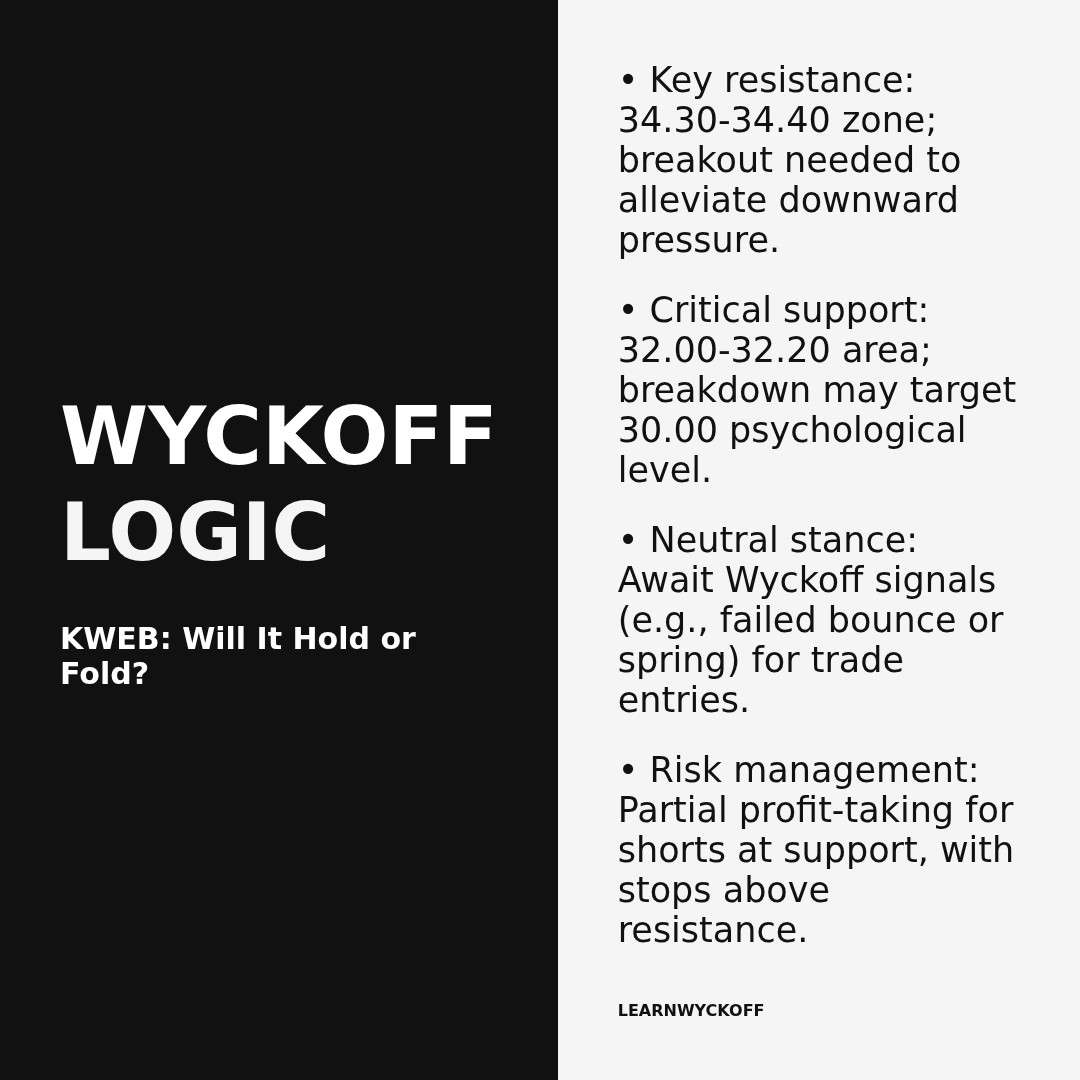
    • Near-term Resistance: The 34.30 - 34.40 zone (multiple bounce highs from early February, now converted to strong resistance). A breakout and hold above this area is needed to initially alleviate downward pressure.
    • Near-term Support: The 32.00 - 32.20 zone (low area from Feb 23-24). A breakdown opens potential for a new leg down.
    • Psychological/Long-term Support: The 30.00 round number may serve as a significant psychological and technical support level.
  2. 2. Wyckoff Integrated Trading Signal and Recommendations:
    • Current Signal: Neutral / Awaiting Short Opportunities on a Bounce. The market is in a No Demand Rally or Retest phase at the tail end of a downtrend. The volatility crash and extreme oversold conditions advise against blindly chasing shorts, but the absence of demand also dictates no bottom-fishing.
    • Operational Recommendations:
      • Aggressive (Right-side, Failed Bounce Strategy): If the price bounces near the 34.30-34.40 resistance zone and shows stalling, high-volume non-advancement, or low-volume candlestick patterns, it can be considered a failed secondary test and a high-probability shorting opportunity. Place stops above this resistance zone.
      • Conservative (Left-side, Bottom-fishing Strategy): Remain neutral. Wait for clear Wyckoff "Spring" or "Secondary Test" signals—i.e., when the price re-tests support around 32.00, showing extremely low volume (supply exhaustion) or a strong recovery candle with high volume (forceful demand intervention). Do not initiate any long positions before such signals appear.
      • Short Position Management: Existing short positions can consider partial profit-taking around 32.00. Remaining positions may be held with tightened stop-losses.
    • Future Validation Points:
      1. 1. Bullish Validation: Price rallies above 34.40 accompanied by significantly increased volume (VOLUME_AVG_7D_RATIO > 1.2), indicating demand is starting to dominate, suggesting the downtrend may pause or a bottom may form.
      2. 2. Bearish Validation: Price rallies near 34.30 and then forms a long upper shadow or a large bearish candle with increased volume (VOLUME_AVG_7D_RATIO > 1.0), indicating supply remains strong and the downtrend will continue.
      3. 3. Breakdown Risk: Price breaks below 32.00 on high volume, confirming a new phase in the downtrend, with a target potentially towards the 30.00 area.

Disclaimer: This report is generated entirely based on the provided historical data and quantitative model analysis and does not constitute any specific investment advice. Financial markets carry risks; investment decisions should be made prudently.


Thank you for your attention! Daily Wyckoff Price-Volume Market Insights are released promptly at 8:00 AM before the market opens. Please leave comments and share; your recognition is crucial. Let's work together to better see the market's signals.