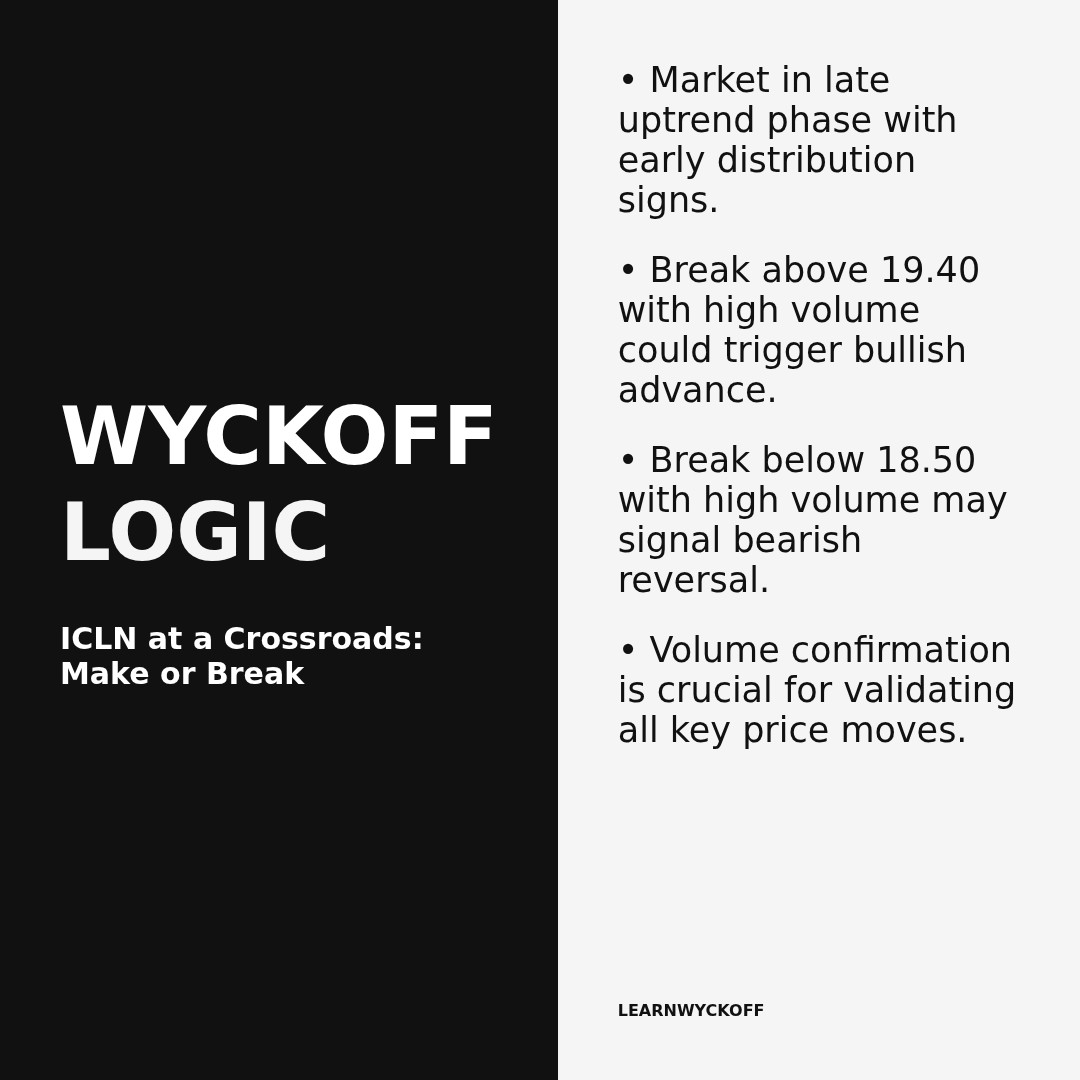
Quantitative Analysis Report: ICLN (2025-12-26 to 2026-02-24)

Product Code: ICLN
Analysis Date Range: 2025-12-26 to 2026-02-24
Report Generation Date: 2026-02-25


1. Trend Analysis and Market Phase Identification

As of 2026-02-24, the underlying asset ICLN has an opening price of 18.97, a closing price of 19.19, a 5-day moving average of 18.89, a 10-day moving average of 18.82, a 20-day moving average of 18.66, a daily price change of +1.11%, a weekly change of +2.46%, a monthly change of +5.73%, a quarterly change of +16.80%, and a yearly change of +16.80%.

ICLN Price Trend Analysis Chart, including closing price and multiple moving averages
  • Trend Direction and Alignment: During the analysis period, ICLN exhibited a clear uptrend. The price rose from 16.62 at the beginning of the period to 19.19 at the end, an increase of 15.46%. The moving average system displays a classic bullish alignment pattern: MA_5D (18.89) > MA_10D (18.82) > MA_20D (18.66) > MA_30D (18.33) > MA_60D (17.51). The price has consistently traded above the MA_20D, indicating a solid medium-term uptrend. The MA_20D has been trending upward continuously since 2026-01-15 with a steep slope, providing dynamic support.
  • Moving Average Crossover Signals: Two critical bullish crossovers occurred during this period.
    1. 1. MA_5D crossing above MA_20D (around 2026-01-07): This crossover occurred in the early stage of the price rise (at 17.10), confirming a shift from consolidation to an upward short-term trend, aligning with the medium-term trend and representing a strong buy signal.
    2. 2. MA_10D crossing above MA_60D (around 2026-02-10): This crossover occurred around 18.85, signaling that the medium-term uptrend gained confirmation from the long-term trend, indicating the market entered a strong bullish phase.
  • Market Phase Inference (Based on Wyckoff Theory): The overall market is in the "Markup" phase. Specifically:
    • 2025-12-26 to 2026-01-05: Can be considered the late stage of "Accumulation" transitioning to markup initiation. The price declined slightly at the end of December (16.62 -> 16.43), but volume contracted (VOLUME_AVG_7D_RATIO<1), and RSI was near neutral-low (~47). On 2026-01-02, a gap-up, high-volume, long bullish candle appeared (+4.08%, with a surge in volume). This is a classic Wyckoff signal of demand overwhelming supply and trend initiation, akin to an "Upthrust" or "Jump Across the Creek".
    • 2026-01-06 to 2026-01-27: A typical "Markup" phase. The price rose steadily along an upward channel, forming a structure of "higher highs and higher lows". Although there were pullbacks (e.g., 2026-01-07), they found support near the MA_10D with contracting volume during the pullbacks, indicating limited supply.
    • 2026-01-28 to Present: The market entered the late stage of markup, showing early signs of "Distribution". After hitting a high of 19.03 on Jan 28th, the following day saw a high-volume reversal from highs (volume 856K, price down -2.73%, forming a long upper shadow), a clear signal of emerging supply. Subsequently, the price has been in wide-range consolidation between 18.15-19.19, with increased volatility, suggesting intensified tug-of-war between bulls and bears. On Feb 24th, the price attacked higher again on high volume, but the closing price (19.19) still failed to decisively break the Jan 28th high, raising caution for a potential double top or higher resistance level.

2. Volume-Price Relationship and Supply-Demand Dynamics

As of 2026-02-24, the underlying asset ICLN has an opening price of 18.97, a closing price of 19.19, volume of 6,776,758, a daily price change of +1.11%, volume of 6,776,758, a 7-day average volume of 3,543,058.86, and a 7-day volume ratio of 1.91.

ICLN Volume-Price Relationship Line Chart and Historical Ranking Analysis
  • Key Demand Days (Demand Dominant):
    • 2026-01-02: PCT_CHANGE: +4.08%, VOLUME: 6.5M, VOLUME_AVG_7D_RATIO: 2.70. High-volume breakout, strong demand, initiating the main advance.
    • 2026-01-28: PCT_CHANGE: +2.42%, VOLUME: 9.07M, VOLUME_AVG_7D_RATIO: 1.63. High-volume accelerated rise, strong chasing demand, but planted the seed for subsequent distribution.
    • 2026-02-24: PCT_CHANGE: +1.11%, VOLUME: 6.78M, VOLUME_AVG_7D_RATIO: 1.91. Another high-volume upward attack, attempting to break the previous high, but the price gain is relatively small compared to the volume, requiring observation of its effectiveness.
  • Key Supply Days (Supply Dominant) / Signs of Distribution:
    • 2026-01-29: PCT_CHANGE: -2.73%, VOLUME: 8.56M, VOLUME_AVG_7D_RATIO: 1.39. High-volume decline from highs, with a long bearish candle, is clear evidence of substantial supply entering, consistent with Wyckoff "Distribution" characteristics.
    • 2026-01-30: PCT_CHANGE: -1.94%, volume remained above the 30-day average (VOLUME_AVG_30D_RATIO: 1.02). Decline accompanied by sustained high volume, confirming supply pressure.
    • 2026-02-05: PCT_CHANGE: -3.36%, VOLUME: 5.09M. Decline on above-average volume, disrupting the short-term rebound structure.
  • Supply-Demand Inflection Point: 2026-01-29 is the key supply-demand inflection point. Before this, rising volume on advances and contracting volume on pullbacks indicated demand controlled the market. Afterward, advances showed signs of stalling or smaller gains with high volume, while declines frequently occurred on high volume, indicating increased strength from the supply side and a loosening grip on market control.

3. Volatility and Market Sentiment

As of 2026-02-24, the underlying asset ICLN has an opening price of 18.97, a 7-day intraday Parkinson volatility of 0.27, a 7-day intraday volatility ratio of 0.82, a 7-day historical volatility of 0.19, a 7-day historical volatility ratio of 0.51, and an RSI of 61.37.

ICLN Parkinson Volatility Analysis Chart and Historical Ranking Data
  • Volatility Levels and Changes:
    • Historical Volatility: HIS_VOLA_60D remained stable in the 0.30-0.33 range. Short-term volatility HIS_VOLA_7D spiked significantly during the initial breakout (2026-01-02) and the recent high-volatility consolidation period (2026-01-29/30), reaching 0.31 and 0.40 respectively, indicating heightened market excitement.
    • Parkinson Intraday Volatility: Showed similar characteristics. Notably, in late December 2025, PARKINSON_RATIO_7D_14D and PARKINSON_RATIO_7D_30D dropped to extremely low levels (0.62-0.54). According to historical ranking data, these ratios rank as the 5th lowest and 7th lowest in the past 10 years respectively. This extreme convergence of short-term volatility relative to medium/long-term volatility typically signals "the calm before the storm," a precursor to a significant directional move, which was subsequently validated by the upward breakout.
    • Recent Volatility: As of Feb 24th, HIS_VOLA_7D has retreated significantly from highs to 0.19, and PARKINSON_RATIO_7D_14D is 0.82, indicating a calming of short-term market volatility and panic sentiment.
  • Overbought/Oversold Status:
    • RSI_14 reached a high of 77.23 on Jan 28th, entering the overbought zone, which immediately triggered a correction.
    • • The current RSI is 61.37, having retreated from overbought levels but still within the strong bullish zone (50-70), indicating bullish sentiment has not completely receded, but upward momentum has weakened compared to before.

4. Relative Strength and Momentum Performance

  • Momentum Trend: Momentum indicators across all timeframes show strong performance, confirming the uptrend.
    • Short-term: WTD_RETURN: +2.46% (positive), MTD_RETURN: +5.73% (positive), indicating positive short-term momentum.
    • Medium-term: QTD_RETURN: +16.80%, YTD: +16.80% (data calculated from 2026), indicating very strong medium-term momentum.
    • Long-term: TTM_12: +68.33%, TTM_24: +40.28%, indicating excellent long-term performance and strong relative strength.
  • Momentum Validation: The strong momentum performance validates the bullish moving average alignment and the demand-dominant phases identified in the volume-price analysis. However, momentum peaked in late January and has since entered high-level consolidation with a slowing ascent slope, consistent with the judgment of early "Distribution" signs.

5. Identification of Large Investors ("Smart Money") Behavior

Based on Wyckoff analysis of volume-price and volatility, the behavioral evolution of large investors can be inferred:

  1. 1. Accumulation/Position Building (Late December 2025): During the year-end price decline and historically low volatility, smart money likely engaged in stealthy accumulation. Low volatility and muted volume allowed them to accumulate positions without significantly pushing up prices.
  2. 2. Markup and Crowd Following (January 2026): The high-volume long bullish candle on Jan 2nd was the signal for smart money to officially initiate the rally. Subsequently, during healthy price pullbacks in the uptrend (e.g., Jan 7th, 13th), volume contracted, indicating large capital did not exit but was controlling the pace of the advance.
  3. 3. Distribution Begins (Late January to February 2026): As the price reached above 19 and market sentiment became extremely optimistic (RSI overbought), smart money began distribution operations. The huge volume long bearish candle on Jan 29th is typical evidence—they provided substantial supply amidst high demand. Subsequent high-level consolidation (e.g., high-volume days on Feb 3rd, 10th, 24th) provided more opportunities to transfer positions to chasing retail and momentum traders. "Who is buying on huge volume?" — At high price levels, the huge volume buyers are likely late-to-the-party retail and momentum traders; "Who is selling?" — it is the smart money and some institutional investors who built positions early at low cost.
  4. 4. Current Behavior: As of Feb 24th, smart money may still be engaged in high-level distribution through consolidation. The high-volume attack failing to make a new high could be a "Test", aiming to see if there is sufficient demand left to break the previous high. It could also be an "Upthrust After Distribution" (UTAD), creating a false breakout for final distribution.

6. Support/Resistance Level Analysis and Trading Signals

ICLN Support and Resistance Level Analysis Chart and Trading Signals
  • Key Resistance Levels:
    • R1: 19.30 - 19.40: The zone formed by the Jan 28th high (19.03) and the Feb 24th high (19.38), representing the ultimate test to determine if the market can initiate a new wave of advance.
    • R2: 19.00: A psychological level and a price tested multiple times recently.
  • Key Support Levels:
    • S1: 18.50 - 18.70: The lower bound of the recent consolidation range (Feb 12th, 20th lows) and near the MA_20D (18.66), serving as the near-term strength/weakness demarcation line.
    • S2: 18.00 - 18.15: The area of late January pullback lows, representing critical support for the medium-term trend. A break below would damage the uptrend structure.
  • Comprehensive Wyckoff Trading Signals:
    • Current Signal: Neutral/Cautiously Bullish, but Prepared to Shift. The market is at the tail end of an uptrend with initial signs of smart money distribution, but the trendline has not been broken.
    • Bullish Scenario (Requires Validation): A decisive, high-volume (VOLUME_AVG_7D_RATIO >1.2) breakout (solid bullish candle >2%) above 19.40 would negate the distribution hypothesis, pointing to new upside. An entry point could be set on a confirmed pullback after breaking 19.40, with a stop-loss below 19.00.
    • Bearish Scenario (Requires Validation): A high-volume break below the S1 support zone (18.50-18.70), especially a closing price below the MA_20D, would be the first warning sign of weakening uptrend and potential transition from distribution to a markdown phase. A further high-volume break below S2 (18.00) would confirm a trend reversal, representing a Wyckoff "Break of Ice" or "Downthrust" signal. A potential shorting opportunity could arise on a failed rebound after breaking 18.50, with a stop-loss above 18.80.
  • Future Validation Points:
    1. 1. Demand Validation: Does the price exhibit a "Spring" or "Sign of Strength (SOS)" pattern (low-volume decline followed by high-volume advance) at the S1 or S2 support levels?
    2. 2. Supply Validation: When testing the R1 resistance, does the price again show "high-volume stalling" (high volume, small candle body or upper shadow) or "high-volume decline"?
    3. 3. Volume Validation: Are breakouts or bounces at key price levels (support/resistance) confirmed by significant volume?

Summary Conclusion:
ICLN completed a strong rally during the analysis period. Data suggests that smart money likely accumulated in the low-volatility zone in late December, initiated and propelled the rally in January, and showed signs of distribution in late January at high price levels. The market is currently at a critical juncture between the "late stage of an uptrend" and a "potential distribution phase". While moving averages remain in bullish alignment, the signs of divergence at highs and emerging supply cannot be ignored. It is recommended that investors avoid chasing highs at this level and adopt a more defensive posture. Closely monitor price action at the two key levels, 19.40 and 18.50, along with accompanying volume behavior, as this will determine the market's next major direction. Historical ranking data shows that the extreme convergence of volatility earlier was a leading indicator for a significant move. The outcome of the current high-level struggle will determine where the next "extreme" will manifest.


Disclaimer: This report/interpretation is solely market analysis and research based on publicly available information and does not constitute any investment advice or operational guidance. The author strives for objectivity and impartiality but makes no guarantees regarding its accuracy or completeness. The market involves risks; investment requires caution. Any investment actions based on this report are undertaken at one's own risk.


Thank you for your attention! Daily Wyckoff volume-price market interpretations are released promptly at 8:00 AM before the market opens. Please feel free to leave comments and share. Your recognition is crucial. Let's work together to see the market signals clearly.