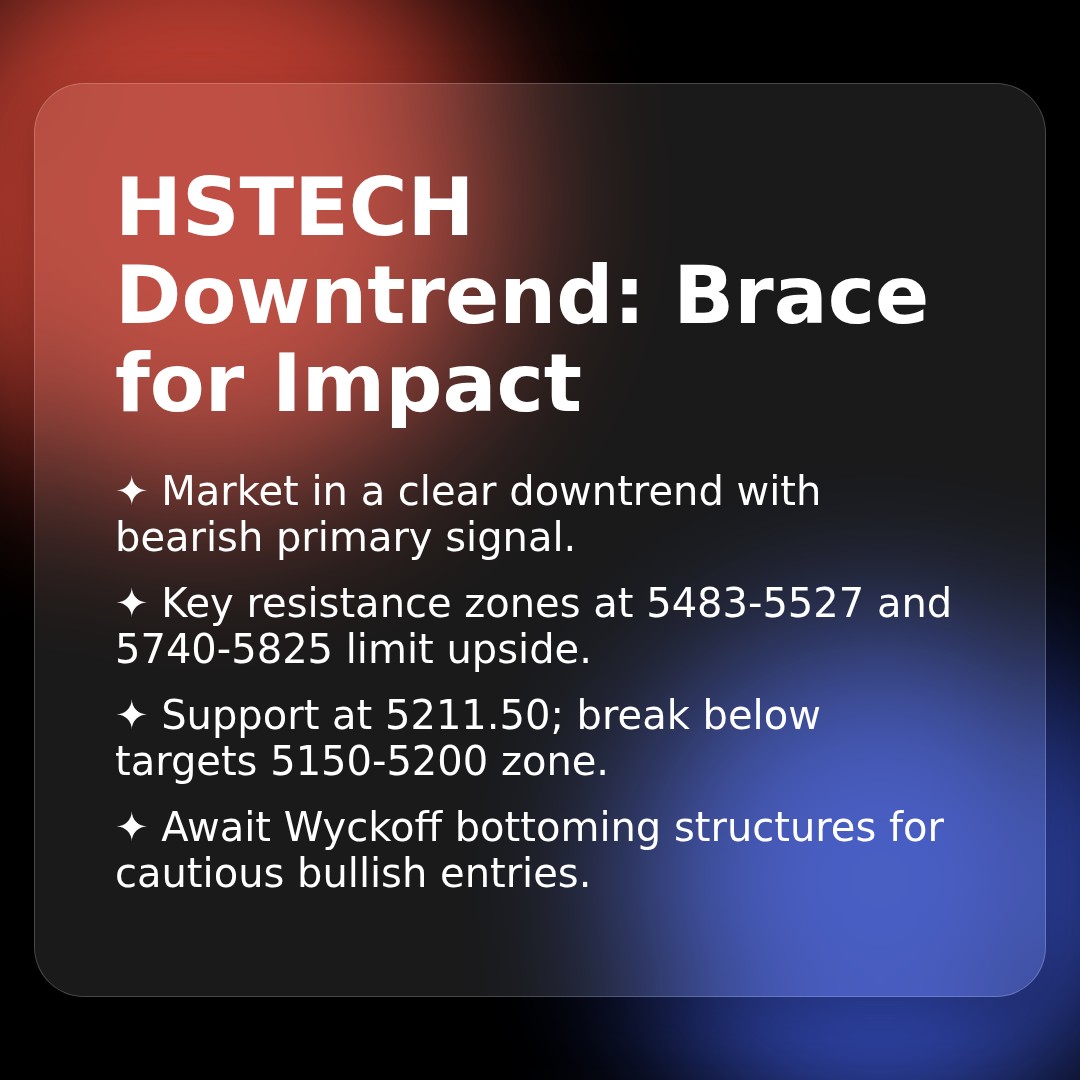
HSTECH Quantitative Analysis Report (Based on Wyckoff Principle)

Product Code: HSTECH
Analysis Date Range: 2025-12-29 to 2026-02-24
Report Generation Date: 2026-02-24


1. Trend Analysis and Market Phase Identification

As of February 24, 2026, the underlying asset HSTECH had an opening price of 5330.26, a closing price of 5270.70, a 5-day moving average (MA) of 5346.75, a 10-day MA of 5385.47, a 20-day MA of 5535.77. The daily change was -2.13%, the weekly change -1.80%, the monthly change -7.83%, the quarterly change -4.45%, and the yearly change -4.45%.

HSTECH Price Trend Analysis Chart, including closing price and multiple moving averages
  • Trend Structure: During the analysis period, the market experienced a complete "rally-decline" cycle. From early to mid-January (until January 14th), the price rallied from 5483.01 to 5908.26, an increase of approximately 7.8%. Subsequently, the market entered a sustained downtrend, reaching a cycle low of 5211.50 on February 20th. As of the report date (February 24th), the price closed at 5270.70.
  • Moving Average Alignment: Currently displaying a standard bearish alignment. The price (5270.70) has fallen below all key moving averages (MA_5D: 5346.75, MA_20D: 5535.77, MA_60D: 5599.47). More importantly, the MA_60D has been on a persistent downtrend from 5842.53 on December 29th to 5599.47 on February 24th, confirming the long-term downtrend. The MA_5D and MA_20D formed a death cross at the end of January and have continued to diverge downwards, reinforcing the medium-term downward momentum.
  • Inferred Market Phase (Wyckoff-based): Synthesizing price action and volume-price relationships, the market is currently in the decline phase following Distribution, and may be approaching the tail end of a potential "Selling Climax" or "Secondary Test".
    • Distribution Phase: The rally high in January (6001.02, January 13th) accompanied by high volume (VOLUME_AVG_7D_RATIO: 1.22) and choppiness is a classic feature of distribution.
    • Decline Phase: The decline in February was smooth, with the price easily breaking below the January low (5741.63, January 7th), confirming the downtrend.
    • Current Potential Phase: A panic-like sell-off with high volume occurred on February 20th (price -2.91%, volume significantly above average), followed by a minor rebound (February 23rd) which was quickly overwhelmed by stronger selling pressure (another high-volume decline on February 24th). This aligns with the characteristic of a failed "Secondary Test" after a "Selling Climax" appears near the end of a decline, as the market attempts to find support.

2. Volume-Price Relationship and Supply-Demand Dynamics

As of February 24, 2026, the underlying asset HSTECH had an opening price of 5330.26, a closing price of 5270.70, volume of 63035011623, a daily change of -2.13%, volume of 63035011623, a 7-day average volume of 48828104685.86, and a 7-day volume ratio of 1.29.

HSTECH Volume-Price Relationship Line Chart and Historical Ranking Analysis
  • Key Day Analysis:
    • Panic Selling (Overwhelming Supply Dominance): From 2026-02-02 to 02-05, the price experienced consecutive significant declines (-3.36% to -1.84%) accompanied by abnormally high volume (VOLUME_AVG_7D_RATIO between 1.33 and 1.53). This clearly indicates a large influx of supply and market panic.
    • High-Volume Stagnation/Decline (Persistent Supply): On 2026-02-24, the price fell -2.13% with volume 29% above the 7-day average (VOLUME_AVG_7D_RATIO: 1.29). Declining on high volume shows supply remains strong, and demand is unable to absorb it.
    • Signs of Weak Demand: The rebound from February 9th to 11th (cumulative +2.49%) was accompanied by persistently contracting volume (VOLUME_AVG_7D_RATIO decreasing from 0.72 to 0.71). This is a classic "low-volume rally," indicating insufficient demand and a fragile rebound.
  • Volume Anomaly Quantification:
    • • The recent volume strength (VOLUME_AVG_7D_RATIO) during down days has been significantly higher than during rally days, confirming the bearish volume-price structure of "price rises on low volume but falls on high volume."
    • • The average volume level in February (AVERAGE_VOLUME_7D) was significantly higher than in January, proving the decline phase attracted greater market participation and selling pressure.

3. Volatility and Market Sentiment

As of February 24, 2026, the underlying asset HSTECH had an opening price of 5330.26, a 7-day intraday volatility of 0.21, a 7-day intraday volatility ratio of 0.84, a 7-day historical volatility of 0.40, a 7-day historical volatility ratio of 1.15, and an RSI of 38.86.

HSTECH Historical Volatility Analysis Chart and Historical Ranking Data
  • Volatility Level and Change:
    • Historical Volatility (HIS_VOLA): Short-term volatility (7D) surged sharply from an extremely low level of 0.153 on December 29th to 0.405 on February 24th. Short-term volatility (0.405) has significantly exceeded its 60-day average (0.286), with a ratio (HIS_VOLA_RATIO_7D_60D) as high as 1.41, reaching a peak during the analysis period. This indicates market sentiment has rapidly shifted from calm to panic and turmoil.
    • Intraday Volatility (PARKINSON_VOL): Shows a similar pattern, with PARKINSON_VOL_7D rising from 0.160 to 0.208, and its ratio to the 60-day average (PARKINSON_RATIO_7D_60D) also reaching a high level of 0.97.
    • Historical Ranking Interpretation: At the beginning of the analysis period, multiple volatility metrics were at historical extremes (e.g., WEEK_MIN_PARKINSON_VOL_7D ranked 3rd and 5th, WEEK_MIN_HIS_VOLA_21D ranked 8th). This highlights the particularly intense nature of the current volatility spike. The market is transitioning from an abnormal calm (potentially the calm of an Accumulation or Distribution phase) to a high-volatility trending decline.
  • Overbought/Oversold Status:
    • • The RSI_14 has steadily declined from its January high of 63.14 to the current 38.86, which is in a weak zone but not yet in extreme oversold territory (<30). This suggests the downward momentum is not yet fully exhausted, or the market is digesting selling pressure through time (grinding decline) rather than through price space (sharp decline), consistent with the characteristics of a decline continuation.

4. Relative Strength and Momentum Performance

  • Periodic Return Analysis:
    • All Periodic Momentum is Negative: WTD_RETURN (-1.80%), MTD_RETURN (-7.83%), QTD_RETURN (-4.45%), YTD (-4.45%) are all negative. This indicates that HSTECH is in a clear downtrend across weekly, monthly, and yearly timeframes.
    • Momentum Deterioration: TTM_12 (trailing twelve-month return) has turned negative (-8.96%), confirming that the long-term upward momentum has been broken and the market has entered a technical weak phase.
  • Conclusion Verification: The negative momentum is highly consistent with the bearish moving average alignment and supply-dominated volume-price relationship. Multiple dimensions mutually verify the current market downtrend and weakness.

5. Large Investor ("Smart Money") Behavior Identification

  • Clear Distribution Intent: The high-level consolidation with high volume in the 5800-6000 range in January, combined with the subsequent smooth decline, is a classic pattern of institutional distribution at highs.
  • Supply Dominance During Decline, Smart Money Not Entering: During the February decline, every instance of high volume corresponded with a price drop, with no clear signs of high-volume absorption platforms at lows. Particularly, the high-volume decline on February 24th indicates that supply (large sell orders) still dominates absolutely, and smart money is not conducting large-scale, organized accumulation at this price level.
  • Behavioral Inference: The operational chain of large investors may be: Completed distribution at highs in January -> Utilized negative market sentiment or their own selling pressure to drive prices down in February -> At the current stage, they are likely observing the degree of market panic and waiting for lower prices or clearer signs of a slowdown to plan their next move (testing or initial accumulation). The current volume-price action suggests they are still patiently waiting or continuing to apply pressure.

6. Support/Resistance Level Analysis and Trading Signals

HSTECH Support and Resistance Level Analysis Chart with Trading Signals
  • Key Resistance Levels:
    • R1: 5483 - 5527 Zone: This is the dense trading low from late 2025 and the high of the early February 2026 rebound, which has been confirmed as strong resistance.
    • R2: 5740 - 5825 Zone: The lower boundary of the late January consolidation platform, representing a more significant medium-term resistance.
  • Key Support Levels:
    • S1: 5211.50: The recent cycle low established on February 20th, serving as the frontline for bearish tests.
    • S2: 5150 - 5200 Zone (Psychological and Structural Support): If 5211.50 is decisively broken, there is a lack of clear historical structural support below, potentially leading to a test of the psychological round-number levels.
  • Comprehensive Wyckoff Trading Signals:
    • Primary Signal: Bearish/Watch. The market is in a clear downtrend with no effective signs of demand entry.
    • Specific Operational Recommendations:
      1. 1. Bearish Strategy (Aggressive): Wait for a price rebound to the R1 (5483-5527) resistance zone. If signs of stagnation (e.g., long upper shadows) or another high-volume decline candle appear, it could serve as a reference for bearish entry. Initial stop-loss should be placed above the upper boundary of this resistance zone (e.g., above 5550). Target is towards S1 (5211) or lower.
      2. 2. Bullish Strategy/Bearish Exit Observation Point (Cautious): This is absolutely not the time to bottom-fish. Potential bullish signals require waiting for: A clear "Selling Climax" day (sharp decline, huge volume) near the S1 (5211.50) level or a new low, immediately followed by a "Secondary Test" day (price retests the low but with significantly diminished volume and a close off the lows). Only upon the appearance of such Wyckoff bottoming structures should considering a light long position be appropriate.
  • Future Validation Points:
    • Confirm Bearish View: Price rebound fails to decisively break above R1 (5483-5527), or price breaks below S1 (5211.50) on high volume.
    • Invalidate Bearish View (Shift to Neutral/Bullish): Price breaks above the R2 (5740-5825) zone decisively on high volume (demand), or the aforementioned clear Wyckoff bottom reversal structure appears.

Disclaimer: This report is based on historical data and quantitative model analysis and does not constitute any direct investment advice. Financial markets involve risks, and investors should make independent judgments and decisions with caution.


Thank you for your attention! Wyckoff volume-price market insights are released daily before the market opens at 8:00. Your comments and shares are greatly appreciated. Your recognition is paramount. Let's work together to better perceive market signals.