Wyckoff Quantitative Analysis Report: DOGEUSDT
Product Code: DOGEUSDT
Analysis Date Range: 2025-12-26 to 2026-02-24
Report Generation Date: 2026-02-25
Executive Summary
Based on two months of price-volume data analysis, DOGEUSDT has undergone a complete market phase transition of "Distribution - Decline - Panic - Initial Accumulation." As of the current date (2026-02-24), the price is consolidating at low levels following a prolonged downtrend. Data indicates that after the panic-driven plunge in early February, the market has exhibited its strongest demand entry signals (high-volume selling exhaustion and rebound) since December 2025. Several key indicators (RSI, Volume Ratio, Volatility Ratio) have reached areas near their decade-long historical extremes, suggesting a preliminary recovery from extreme panic, although the overall market structure remains fragile. A comprehensive assessment suggests that large investors may have conducted initial accumulation at the panic lows. The market has entered a phase of testing and consolidating the panic lows, with the near-term direction contingent on whether demand can be sustained.
1. Trend Analysis and Market Phase Identification
As of February 24, 2026, the underlying asset DOGEUSDT had an opening price of 0.09, a closing price of 0.09, a 5-day moving average (MA) of 0.10, a 10-day MA of 0.10, a 20-day MA of 0.10, with a daily change of -0.62%, a weekly change of -8.51%, a monthly change of -11.67%, a quarterly change of -21.61%, and a yearly change of -21.61%.

- • Trend Status: During the analysis period, the price declined unilaterally from above0.080, a drop of nearly 50%, confirming the primary trend as a clear downtrend. As of February 24, all moving averages (MA_5D: 0.097, MA_10D: 0.100, MA_20D: 0.098, MA_60D: 0.119) are positioned above the current price (0.092), forming a standard bearish alignment, indicating the long-term downtrend remains intact.
- • Moving Average Crossover Signals: The rebound in early January briefly caused MA_5D to cross above MA_20D, forming a "Golden Cross" (e.g., on 2026-01-04). However, momentum failed to sustain, and the crossover quickly became invalidated as the price reverted to a bearish alignment. Recently, the moving average system has continued to diverge downwards, with no bullish crossover signals present.
- • Market Phase Deduction:
- • Distribution Phase (2025-12-26 to 2026-01-09): Price exhibited high-volume stagnation within the0.15 range (e.g., on 2026-01-02, a gain of 11.87% accompanied by a surge in volume to 22.4 billion, with VOLUME_AVG_7D_RATIO reaching a high of 3.88). This is a classic Wyckoff "Distribution" characteristic, where smart money transfers holdings to the public chasing rallies at relatively high levels.
- • Decline Phase (2026-01-10 to 2026-01-31): Price broke below the distribution range, accompanied by intermittent high-volume declines (expanding supply). Overall volume contracted (VOLUME_AVG_7D_RATIO mostly below 1), indicating a lack of demand. The decline was driven by passive and some active selling.
- • Panic Phase (2026-02-01 to 2026-02-06): The market entered a panic sell-off. Price accelerated downwards with a sharp increase in volume (February 5th volume was 31.7 billion, VOLUME_AVG_7D_RATIO=2.11), and volatility spiked to extreme levels (HIS_VOLA_7D reached 1.68). This is a typical manifestation of the "Final Selling Climax" or "Panic".
- • Initial Accumulation / Automatic Rally Phase (2026-02-07 to Present): Following the formation of the panic low (0.088-$0.104 range, with volume receding from extreme highs. This aligns with the Wyckoff characteristics of an "Automatic Rally" and potential "Secondary Test" following a "Panic Sell-off," hinting at possible large-scale buying interest intervening at panic levels.
2. Volume-Price Relationship and Supply-Demand Dynamics
As of February 24, 2026, the underlying asset DOGEUSDT had an opening price of 0.09, a closing price of 0.09, volume of 643,982,554.00, a daily change of -0.62%, volume of 643,982,554.00, a 7-day average volume of 643,921,982.86, and a 7-day volume ratio of 1.00.

- • Key Demand Days (Signs of Smart Money Buying):
- • 2026-02-06: Demand Counterattack Post-Panic. After hitting a new low of $0.080, the price closed up 11.29% for the day, with volume surging to 28.9 billion (VOLUME_AVG_7D_RATIO=1.63). This is the clearest demand-dominant signal within the analysis period, indicating significant capital absorbing sell orders at extreme lows.
- • 2026-02-14: High-Volume Breakout from Consolidation. Price rose from0.111, a gain of 14.87%, with volume at 13.5 billion (VOLUME_AVG_7D_RATIO=1.75). This represents a strong correction to the prior decline, showing concentrated demand re-emerging.
- • Key Supply Days (Smart Money Distribution or Public Selling):
- • 2026-01-31: High-Volume Breakdown Decline. Price plummeted 9.97% on volume of 24.6 billion (VOLUME_AVG_7D_RATIO=3.30), marking a new low for the phase. This is a clear signal of expanding supply, triggering the subsequent panic phase.
- • 2026-02-05: Climax of Panic Selling. Price crashed 14.77% on volume of 31.7 billion (VOLUME_AVG_7D_RATIO=2.11). This represents irrational selling by the public driven by fear, typically signaling exhaustion of downward momentum.
- • Supply-Demand Balance Shift: The Volume Ratio (VOLUME_AVG_*D_RATIO) shows that supply-dominant high-volume periods (ratio >1.5) were concentrated in the decline and panic phases from late January to early February. During the rebound starting February 6th and thereafter, although absolute volume remained high, the ratio relative to the 7-day average has retreated from extreme levels, indicating panic selling has subsided and the market has entered a tug-of-war between buyers and sellers.
3. Volatility and Market Sentiment
As of February 24, 2026, the underlying asset DOGEUSDT had an opening price of 0.09, a 7-day intraday Parkinson volatility of 0.54, a 7-day intraday volatility ratio of 0.72, a 7-day historical volatility of 0.33, a 7-day historical volatility ratio of 0.35, and an RSI of 37.07.

- • Volatility Extremes: In early February, short-term volatility (HIS_VOLA_7D) spiked sharply to 1.68, far exceeding its 14-day, 21-day, and 60-day averages (HIS_VOLA_RATIO_7D_14D peaked at 1.37). The Parkinson intraday volatility also surged concurrently. This indicates market sentiment entered a state of extreme panic and disorder.
- • Volatility Contraction and Sentiment Recovery: As of February 24th, short-term volatility has significantly retreated (HIS_VOLA_7D=0.33, PARKINSON_VOL_7D=0.54), and short-term volatility is now below medium-to-long-term volatility (HIS_VOLA_RATIO_7D_14D=0.35). The rapid convergence of volatility from extreme levels is a technical characteristic of panic sentiment subsiding and the market entering a consolidation and repair phase.
- • Oversold Extreme Confirmation: The RSI_14 dropped to 22.36 on 2026-02-05. According to historical ranking data, this represents the second-lowest weekly RSI extreme in nearly a decade. This data strongly confirms that the market was in a historically oversold state at that time, with sentiment extremely pessimistic, providing a momentum foundation for the subsequent rebound.
4. Relative Strength and Momentum Performance
- • Momentum Universally Weakened: All period returns are deeply negative (YTD: -21.61%, QTD: -21.61%, MTD: -11.67%), confirming the asset is under strong intermediate-term downward momentum.
- • Signs of Short-Term Momentum Improvement: Despite the weekly return (WTD_RETURN) remaining negative (-8.51%), observing the recent momentum structure reveals significant positive momentum during the rebound from the February 6th low to the February 14th high. However, this momentum failed to sustain, and the price retreated again, indicating the strength of the demand rebound is still insufficient to reverse the overall downward momentum, and the market remains in a weak pattern.
5. Large Investor (Smart Money) Behavior Identification
- 1. Distribution Behavior: Within the0.15 range in early January, high-volume stagnation (flat/slight price increase with massive volume) occurred. This is the classic "Distribution" behavior where large investors transfer holdings to the public.
- 2. Accumulation Behavior: During the panic sell-off on February 5-6, one of the largest single-day volumes of this cycle occurred. According to Wyckoff principles, the holdings sold in a panic must be absorbed by equally strong demand for the decline to halt. The high-volume bullish candlestick on February 6th, which recovered most of the previous day's losses, is strong evidence of large investors conducting "initial accumulation" at panic price levels.
- 3. Testing Behavior: From February 7th to the present, the price has oscillated within the0.104 range, repeatedly retesting support near $0.09. During these tests, volume has contracted significantly (e.g., on February 21-22, VOLUME_AVG_7D_RATIO was below 0.43). This constitutes a "test" of the validity of support at the panic lows, aimed at observing whether any residual supply (selling pressure) remains.
- 4. Behavioral Synthesis and Inference: Having completed distribution in January, smart money allowed the price to decline and conducted large-scale accumulation in the0.090 area when the market plunged into full-scale panic in early February. Current behavior has shifted to "testing" and "consolidation," potentially building strength for a future upward effort (if any) while shaking out weak holders.
6. Support/Resistance Level Analysis and Trading Signals

- • Key Support Levels:
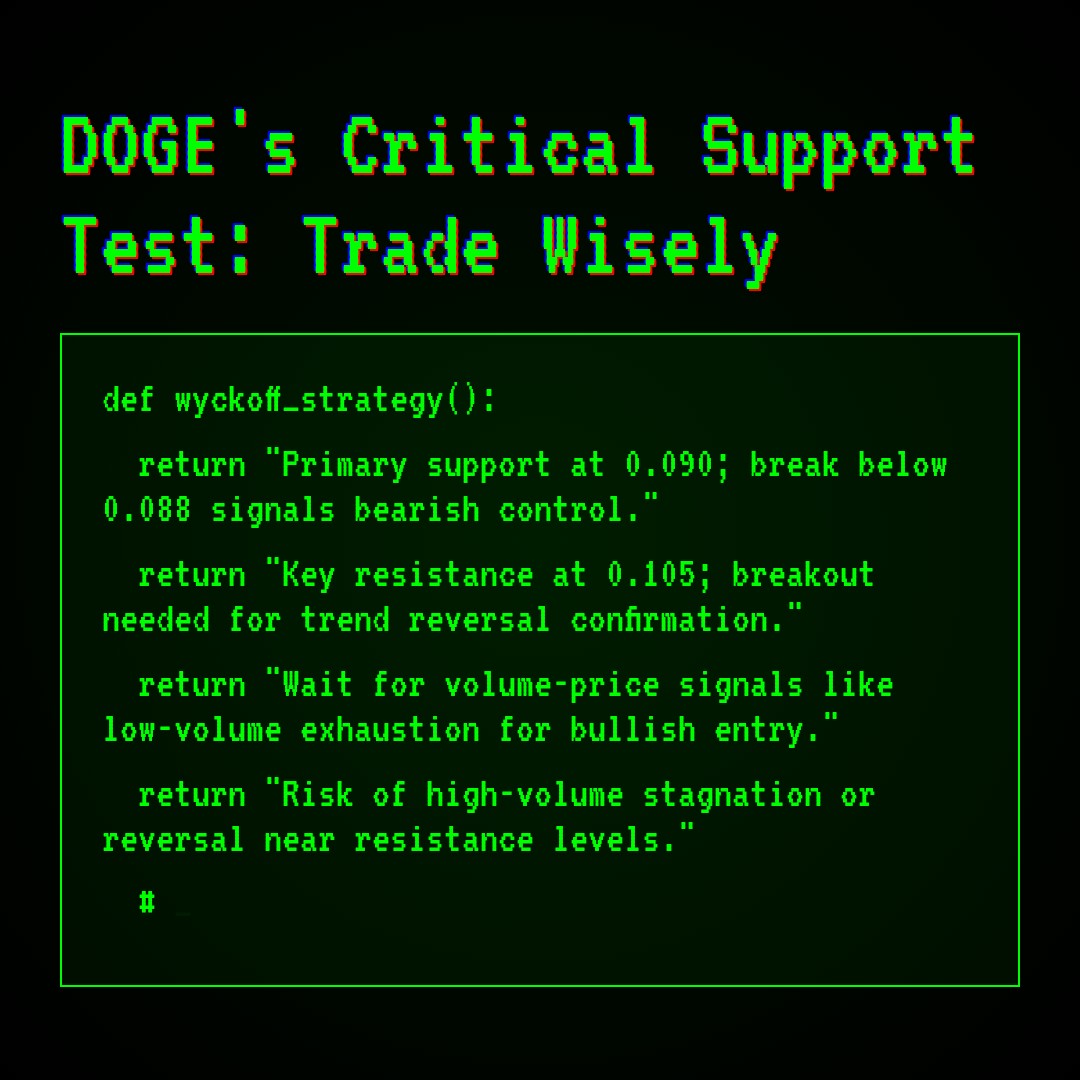
- • S1 (Primary Support):0.090. The low zone formed during the February panic sell-off, also the starting point of the high-volume rebound on February 6th. A decisive break below this zone would signify accumulation failure, potentially initiating a new decline.
- • S2 (Secondary Support): $0.080. The absolute low of this cycle, representing the final psychological defense line.
- • Key Resistance Levels:
- • R1 (Initial Resistance):0.105. The area near recent multiple rally highs and the February 1st low, where natural supply exists.
- • R2 (Strong Resistance):0.114. The February 14th rally high and the lower boundary of a previous minor consolidation platform.
- • R3 (Trend Resistance):0.124. The dynamic 60-day moving average and the lower boundary of the late January trading congestion zone.
- • Comprehensive Trading Signals and Operational Recommendations:
- • Primary Signal: Wait / Await Secondary Test Confirmation. The market is currently in a phase of testing and consolidating the panic lows, with direction unclear.
- • Bullish Scenario (Required Validation Points): A clear "low-volume selling exhaustion" or "high-volume rebound" signal (i.e., Wyckoff's "Successful Secondary Test" or "Jump Across the Creek") appears when the price retreats again to the support zone0.091. This would represent a high-probability long entry opportunity.
- • Suggested Action: If the validation point appears, consider entering a light long position.
- • Entry Reference:0.093.
- • Stop-Loss Reference: Below $0.088.
- • Target Reference: Initial target R1 (0.111) upon a breakout.
- • Bearish Scenario (Signals Requiring Caution): "High-volume stagnation" (feeble price advance with large volume) or a "low-volume rebound" followed by a reversal downwards occurs when the price rallies near R1 (0.111).
- • Suggested Action: If the aforementioned bearish volume-price signals appear, they can serve as a reference for shorting on rallies.
- • Risk Warning: If the price breaks below the $0.088 support on high volume, it indicates prior accumulation has failed and supply has regained control of the market. Immediately abandon any long plans and consider following the bearish trend.
Conclusion Reiteration: DOGEUSDT is in a critical contention period following a prolonged downtrend. The data clearly reveals the behavioral trajectory of large capital from distribution to accumulation during panic. The current market is digesting panic sentiment and testing support. Traders should remain patient, waiting for the price to provide clear demand entry signals (low-volume exhaustion or high-volume rebound) near key support levels before making decisions. Until a decisive breakout above the0.105 resistance zone leads to a repair of the moving average system, any advance should still be treated as a rebound.
Disclaimer: This report/interpretation is solely market analysis and research based on publicly available information and does not constitute any investment advice or operational guidance. The author strives for objectivity and impartiality but makes no guarantees regarding the accuracy or completeness of the content. Markets involve risks; investment requires caution. Any investment actions based on this report are taken at one's own risk.
Thank you for your attention! Wyckoff Volume-Price Market Interpretations are released promptly at 8:00 AM daily before the market opens. We kindly ask for your comments and shares; your recognition is crucial. Let's work together to see the market signals clearly.
Member discussion: