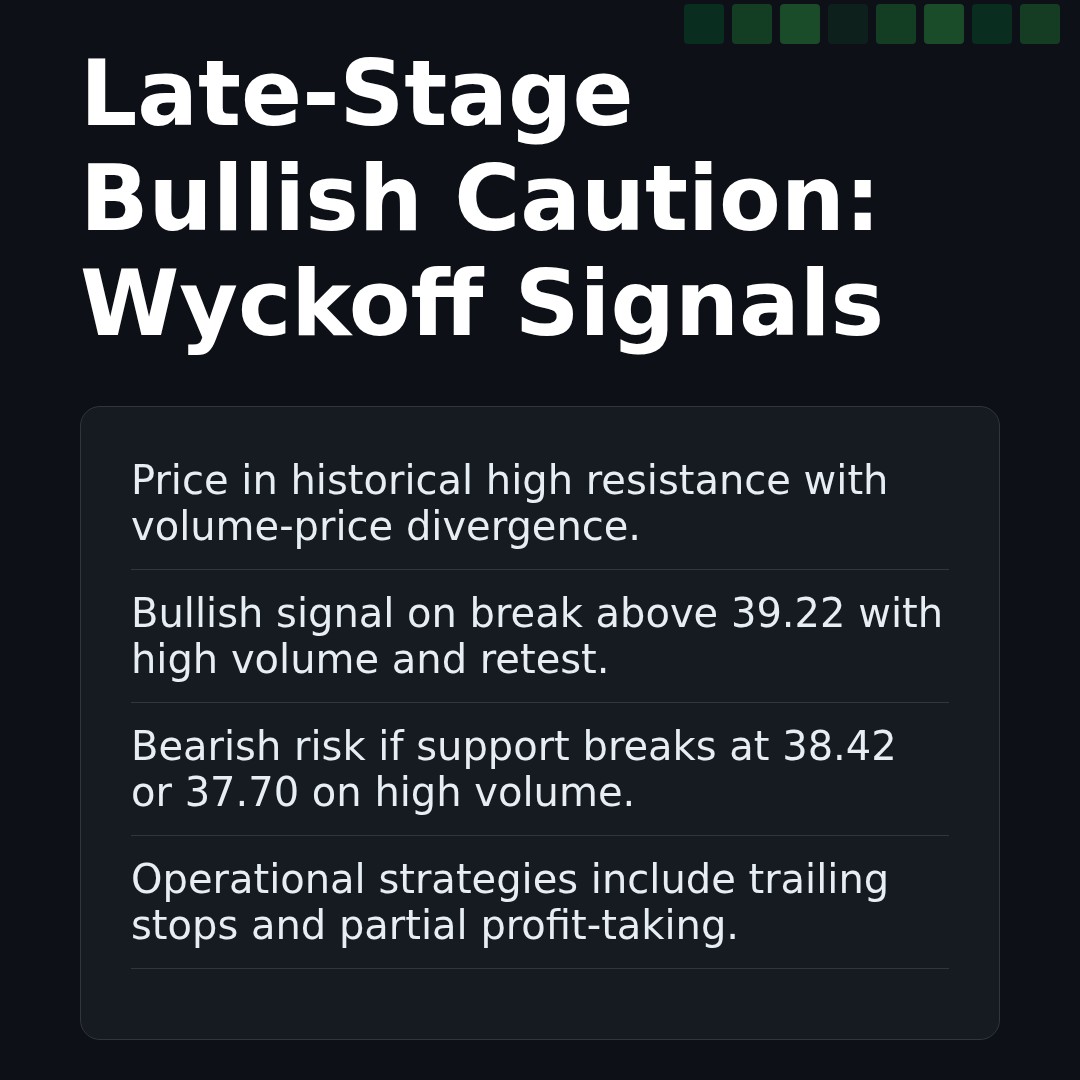
As a quantitative trading researcher proficient in the Wyckoff method, I have conducted an in-depth analysis of the BOTZ data you provided. Below is the comprehensive quantitative analysis report I have prepared for you. All conclusions are strictly derived from data and Wyckoff principles.

BOTZ Quantitative Analysis Report

Product Ticker: BOTZ
Analysis Period: 2025-12-26 to 2026-02-24
Report Generation Date: Based on data as of 2026-02-25


1. Trend Analysis and Market Phase Identification

As of February 24, 2026, the underlying asset BOTZ had an open price of 38.57, a close price of 39.01. The 5-day moving average was 38.64, the 10-day was 38.41, and the 20-day was 37.86. The daily price change was +1.11%, weekly change +1.01%, monthly change +4.53%, quarterly change +7.67%, and annual change +7.67%.

BOTZ Price Trend Analysis Chart, including closing price and multiple moving averages
  • Price vs. Moving Averages Relationship: As of February 24, the closing price of $39.01 is above all key moving averages. The price structure shows a pattern of "MA_5D (38.644) > MA_10D (38.414) > MA_20D (37.862) ≈ MA_30D (37.899) > MA_60D (37.128)", forming a classic bullish alignment. This indicates a clearly defined upward trend in the short-to-medium term.
  • Trend Evolution:
    • Early January to early February: The price initiated a strong rally from January 2 (36.71), reaching a high of 39.22 on February 20. During this period, it effectively broke through and held above all moving averages, establishing the primary uptrend.
    • Recent Price Action: After reaching the 39.22 high, the price experienced a minor pullback (low of 38.281 on February 23) but quickly rebounded to close at 39.01 on February 24, holding support at the short-term moving average (MA_5D), indicating that the trend momentum has not yet weakened.
  • Inferred Market Phase: Based on Wyckoff theory and price action:
    • • The high-volume rally from early to mid-January can be viewed as confirmation of the "Markup" phase.
    • • In early February, the price experienced a significant sell-off (low of 35.77 on February 5) but was quickly reclaimed by a high-volume bullish candle (February 6). This behavior aligns with the characteristics of a "Shakeout"—using a rapid, deep decline to flush out weak long positions.
    • • Currently, after reaching a near-decade high (historical rank #6), volume has not reached a corresponding new high, suggesting the market may be entering the early stages of "Distribution" or a "Secondary Test" at the end of the uptrend. The key validation point is whether a subsequent, high-volume breakout above the previous high (39.22) can be achieved.

2. Volume-Price Relationship and Supply-Demand Dynamics

As of February 24, 2026, the underlying asset BOTZ had an open price of 38.57, a close price of 39.01, a volume of 757,652, a price change of +1.11%, a 7-day average volume of 873,896.86, and a 7-day volume ratio of 0.87.

BOTZ Volume-Price Relationship Line Chart and Historical Ranking Analysis
  • Demand-Driven Rally (Accumulation and Markup):
    • January 5 & January 7: Prices increased by 2.45% and 0.61% respectively, with volumes (1.217M, 1.179M) reaching 1.55x and 1.47x of the 60-day average volume (VOLUME_AVG_60D_RATIO). This is a classic "rally on high volume", representing strong buying pressure (demand) influx.
    • February 6: Following a panic sell-off, a decisive bullish candle appeared (+4.78%) with volume (1.180M) at 1.42x the 60-day average. This is a clear signal of "high-volume accumulation/demand recovery after a panic sell-off", marking the end of the decline and a trend reversal.
  • Signs of Emerging Supply (Potential Distribution):
    • January 8 & January 13: Prices declined by 1.13% and 1.53% at relatively high levels (37.96, 38.44), but volumes (888K, 953K) were significantly higher than recent average levels (VOLUME_AVG_7D_RATIO of 1.15 and 0.94, respectively). This constitutes "high-volume stalling/decline", indicating significant selling pressure (supply) encountered at high levels.
    • February 24: The price rebounded 1.11% to a recent high (39.01), but volume (758K) was relatively low (VOLUME_AVG_60D_RATIO 0.95). This is a "low-volume rally", suggesting waning follow-through demand and raising questions about the sustainability of the price increase.
  • Core Conclusion: The uptrend was driven by genuine institutional buying (demand), evidenced by multiple high-volume rallies. However, near historical highs, signs of supply participation and weak demand have been observed. The current rally requires new high volume to confirm that demand remains dominant; otherwise, it may face distribution pressure.

3. Volatility and Market Sentiment

As of February 24, 2026, the underlying asset BOTZ had an open price of 38.57, a 7-day intraday Parkinson volatility of 0.19 (7-day ratio 0.83), a 7-day historical volatility of 0.17 (7-day ratio 0.55), and an RSI of 60.21.

BOTZ Parkinson Volatility Analysis Chart and Historical Ranking Data
  • Volatility Level: As of February 24, short-term historical volatility (HIS_VOLA_7D: 0.173) has declined significantly from its peak in early February (0.462 on February 9) but remains above the 60-day long-term volatility (HIS_VOLA_60D: 0.252). Parkinson intraday volatility shows a similar converging trend.
  • Volatility Structure:
    • During the period from February 6 to February 13, the ratio of short-term volatility (7-day) to medium/long-term volatility (14-day and above) (HIS_VOLA_RATIO_7D_14D) consistently exceeded 1.2, reaching a peak of 1.41 (February 9). Historical ranking data shows this ratio of 1.407 ranks #8 in the past 10 years, indicating an extreme level. This is typically associated with trend acceleration or panic/euphoria, consistent with BOTZ's V-shaped reversal breakout during that period.
    • • Currently, this ratio has fallen back to 0.55, indicating that the short-term euphoria triggered by the breakout has subsided, and the market has entered a relatively stable phase of trend continuation or consolidation.
  • Sentiment Indicator (RSI): The RSI_14 currently reads 60.21, within the neutral-to-strong range, not entering overbought territory (>70). This aligns with the price making new highs without extreme sentiment readings, suggesting the rally may not be driven purely by retail euphoria and could still have structural support.

4. Relative Strength and Momentum Performance

  • Periodic Returns:
    • Strong Short-Term Momentum: Both MTD_RETURN (4.53%) and WTD_RETURN (1.01%) are positive, indicating recent upward momentum.
    • Strong Medium-Term Trend: The YTD (7.67%) and QTD_RETURN (7.67%) returns are substantial, significantly outperforming the longer-term TTM_12 (18.14%). This indicates the recent rally pace has accelerated, showing very strong medium-term momentum.
  • Momentum and Volume-Price Validation: The strong short-to-medium-term momentum (YTD, QTD) validates the observed multiple high-volume rallies (evidence of demand) and the sustained price advance following the V-shaped reversal, confirming this is an effective uptrend driven by powerful buying.

5. Large Investor (Smart Money) Behavior Identification

  • Accumulation and Markup (Late December 2025 - January 2026): The consecutive high-volume rallies in early January, coupled with orderly volume contraction during pullbacks, align with the smart money's "accumulation while marking up" operational model in the early trend phase.
  • Shakeout and Consolidation (Early February 2026): The rapid, deep decline in early February (low of 35.77) accompanied by high volatility was completely reversed by a single high-volume bullish candle. This was very likely a "Shakeout", aimed at flushing out weak hands and testing market supply before breaking through key resistance. Smart money engaged in large-scale buying at the panic low.
  • Potential Distribution Behavior (Current): After entering the near-decade high range (historical rank #6-9), signs of high-volume stalling (January) and recent low-volume new highs have emerged. This suggests smart money may be "distributing" some holdings to latecomers chasing highs. The February 24 high-price, low-volume rally can be interpreted as smart money "testing" whether sufficient follow-up demand exists at these high levels.
  • Core Inference: Large investors have led the entire process from accumulation, markup, to shakeout. At current price levels, their behavior is shifting from one-way buying to two-way testing and potential structural distribution. The volume-price performance at these high levels over the next 1-2 weeks is critical.

6. Support/Resistance Level Analysis and Comprehensive Trading Signals

  • Key Resistance Levels:
    1. 1. Historical Strong Resistance: 39.22 (High on 2026-02-20, historical rank #6). This is the most immediate and strongest resistance.
    2. 2. Psychological Round Number: 40.00.
  • Key Support Levels:
    1. 1. Recent Breakout Level/Shakeout High: 38.42 (Low on 2026-02-20, historical rank #17). A break below this level could signify the first major breach of upward momentum.
    2. 2. Bull Trend Lifeline: 37.70 - 38.00 zone. This area converges the MA_20D, MA_30D, and the volume concentration zone from mid-to-late January. It is also the starting point of the post-shakeout rebound and serves as the core support band for determining if the trend has reversed.
    3. 3. Ultimate Support: 35.77 (Low on 2026-02-05). A break below this level would invalidate the entire upward structure.
  • Wyckoff Comprehensive Trading Signal:
    • Current Status: Cautiously bullish, but in a late-trend博弈阶段 (Note: '博弈' is contextually 'late-stage positioning' here). The price structure remains bullish, but it has entered the historical high resistance zone, and volume-price divergence has appeared.
    • Bullish Signal Validation Point (Demand Recovery): Price breaks above and holds 39.22 on high volume (VOLUME_AVG_60D_RATIO > 1.2), followed by a pullback that shows a "low-volume test" of this breakout level. This would confirm the start of a new demand-driven rally.
    • Bearish Signal Validation Point (Distribution Confirmation): Price exhibits "high-volume stalling" (long upper shadow + high volume) or "high-volume breakdown" (large bearish candle) again in the 39.00-39.22 area, or breaks below the 38.42 support on high volume. A bearish divergence on the RSI would strengthen the signal.
    • Trend Failure Signal: Price breaks below the 37.70 support zone on high volume.
  • Operational Recommendations:
    • For Existing Holders: Consider moving stop-loss levels up to the 38.40-38.00 zone. Consider partial profit-taking on the first touch of the 39.22 resistance. Use a trendline or MA_20D as a trailing stop for remaining positions.
    • New Entry (Aggressive): Only consider entering with a light position if price breaks above 39.22 on high volume and subsequently retests this level without breaking it on low volume. Set a stop-loss just below 38.90. This carries higher risk and requires strict stop-loss discipline.
    • New Entry (Conservative): Maintain a wait-and-see approach. The current risk-reward ratio is unfavorable. A safer approach is to wait for the market to show a clear directional choice: either follow up after a clear "demand recovery" signal as mentioned above, or wait for a price pullback to the 37.70-38.00 strong support zone and look for signs of stabilization (e.g., small candles, low volume) before considering entry.

Disclaimer: This report is generated based on historical data and quantitative model analysis. All conclusions are merely probabilistic descriptions of market conditions and do not constitute any investment advice. Financial markets involve risks. Please make independent decisions based on your own judgment.


Thank you for your attention! Wyckoff volume-price market analysis is published daily at 8:00 AM before the market opens. We appreciate your comments and shares; your recognition is crucial. Let us see the market signals together.