Alright, as a quantitative trading researcher proficient in the Wyckoff Method, I will compose a comprehensive and in-depth quantitative analysis report based on the BNBUSDT data and historical ranking indicators you have provided.
BNBUSDT Wyckoff Volume-Price Analysis Report
Product Code: BNBUSDT
Analysis Period: 2025-12-26 to 2026-02-24
Report Generation Date: 2026-02-25
Executive Summary
Based on a comprehensive analysis of volume-price data, volatility, and historical rankings over the past two months (2025-12-26 to 2026-02-24), BNBUSDT has undergone a complete cycle from high-level distribution to panic-driven plunge, potentially entering a phase of initial accumulation. The core conclusions are as follows:
- 1. Market Phase: The price entered a clear downtrend after reaching a high in mid-January 2026 (~$950). A Selling Climax was reached in early February (Feb 4th-5th), with both volume and volatility hitting historical extremes. The current price is located in the panic low zone, showing preliminary signs of supply exhaustion and tentative demand entry.
- 2. Supply-Demand Dynamics: During the panic selling phase, massive selling (supply) was absorbed by unknown capital. Recently (Feb 23rd-24th), a contradictory phenomenon of high volume but narrowing price decline occurred as the price hit new lows, suggesting that supply may be being systematically absorbed by large investors.
- 3. Large Investor Intent: Smart money likely conducted initial Accumulation on Panic during the climax and is now engaged in testing and secondary accumulation at the current low zone. This behavior aligns with the Wyckoff principle of "buying when the public is selling."
- 4. Trading Signal: Synthesizing the judgment, the market has moved past the most panic-stricken phase and entered a potential accumulation range. The strategy shifts towards cautiously bullish / seeking structural long opportunities, pending confirmation of the accumulation hypothesis by price action.
- 5. Extremity Confirmation: Key indicators (Volume Ratio, Volatility Ratio, RSI lows) rank within the top 20, even top 10, in the past decade's history. This strongly confirms that the market was at a rare extreme point of sentiment and liquidity in early February, typically foreshadowing trend exhaustion and an approaching turning point.
Six-Dimensional Deep Dive Analysis
1. Trend Analysis & Market Phase Identification
As of 2026-02-24, for the underlying asset BNBUSDT: Open: 596.40, Close: 588.07, MA_5D: 614.11, MA_10D: 616.82, MA_20D: 625.78, Daily Change: -1.40%, Weekly Change: -4.80%, Monthly Change: -24.74%, Quarterly Change: -31.96%, Yearly Change: -31.96%

- • Moving Average Alignment: As of 2026-02-24, the price (588.07) is significantly below all moving averages (MA_5D: 614.11, MA_60D: 795.50). All moving averages (MA_5 < MA_10 < MA_20 < MA_60) are aligned in a perfect bearish order, confirming the market is in a strong downtrend.
- • Price Action & Phase Classification:
- 1. Distribution Phase: January 10 to January 20, 2026. Price oscillated between $910-950. On January 13th, a single-day high volume (312k, a recent peak) surge of +4.19% occurred, but failed to sustain upward momentum, followed by consecutive declines (e.g., Jan 15th, Jan 20th). This "high-volume advance failure" is a classic distribution characteristic, indicating smart money distributing shares amidst market enthusiasm.
- 2. Markdown & Panic Phase: After January 20th, the price broke below the $900 support, accelerating its decline. February 4th to February 6th was the critical panic selling period. Price plummeted from 754.78 to 608.30, accompanied by exceptionally high volume. The single-day drop on February 5th was -12.76% with a volume of 799k, the absolute highest during the analysis period. The price action displayed "high-volume vertical decline," consistent with Wyckoff panic selling characteristics.
- 3. Potential Accumulation Phase: After the panic low on February 6th (608.30), the price rebounded weakly (e.g., low-volume sideways movement Feb 7th-10th). On February 23rd, the price tested the low again and set a new low (596.41 vs. prior 608.30), but the daily volume was again high (245k) without a proportionate plunge in price (only -2.99%). This "high-volume resistance to decline" or "high-volume support test" is a common signal during accumulation.
2. Volume-Price Relationship & Supply-Demand Dynamics
As of 2026-02-24, for the underlying asset BNBUSDT: Open: 596.40, Close: 588.07, Volume: 157110.78, Daily Change: -1.40%, Volume: 157110.78, 7-Day Avg Volume: 121917.67, 7-Day Volume Ratio: 1.29

- • Key Day Analysis:
- • 2026-01-13: High-Volume Rise (Volume 312k, +4.19%). The
VOLUME_AVG_60D_RATIOwas as high as 1.61, with historical ranking indicating an extremely high volume level. However, the subsequent failure to sustain gains evolved into a distribution signal. - • 2026-02-04 to 2026-02-06: Consecutive High-Volume Plunge. Particularly on February 5th, the
VOLUME_AVG_60D_RATIOreached a staggering 4.52, ranking 14th highest in the past decade. This represents the concentrated release of panic supply. The massive volume implies an equivalent amount of capital was absorbing it, raising the question of "who is buying?" - • 2026-02-23: High-Volume Decline but Relative Price Resilience. Volume was 245k (
VOLUME_AVG_60D_RATIO1.46), yet the price fell only -2.99%. TheVOLUME_GROWTHwas 257.40%, ranking 19th in the past decade, indicating a sudden surge in trading activity. Combined with the price not making a significantly lower low (relative to Feb 5th), this more closely resembles supply being absorbed by strong demand rather than a new panic sell-off.
- • 2026-01-13: High-Volume Rise (Volume 312k, +4.19%). The
- • Supply-Demand Shift: The data clearly illustrates the shift in dominance:
- 1. January: Supply Dominant. Volume during price rises was average, while declines often saw higher volume (e.g., Jan 20th, Jan 25th).
- 2. Early February: Extreme Supply Dominance (Panic). High-volume plunge.
- 3. Late February: Supply Exhaustion, Demand Testing. New price lows coincided with huge volume but limited decline. Furthermore, volume remained relatively high in the following two days (Feb 23rd-24th, 157k, 157k), hinting at persistent buying.
3. Volatility & Market Sentiment
As of 2026-02-24, for the underlying asset BNBUSDT: Open: 596.40, 7-Day Intraday Volatility: 0.43, 7-Day Intraday Volatility Ratio: 0.91, 7-Day Historical Volatility: 0.38, 7-Day Historical Volatility Ratio: 1.02, RSI: 29.12

- • Volatility Extremes: During the panic period, short-term volatility spiked dramatically.
PARKINSON_VOL_7Dreached 1.245 on Feb 6th, andHIS_VOLA_7Dreached 1.039 on Feb 5th. More importantly are their relative values:- •
PARKINSON_RATIO_7D_14Dreached 1.560 and 1.559 on Feb 4th and 6th respectively, ranking 7th and 8th in the past decade. - •
PARKINSON_RATIO_7D_60Dreached 2.772 on Feb 6th, ranking 15th in the past decade. - • Conclusion: Short-term volatility far exceeded the medium-to-long-term average, reaching historical extremes. This is a classic quantitative characteristic of market panic and trend acceleration approaching a climax (panic bottom).
- •
- • Sentiment Indicator:
RSI_14dropped to 16.46 on Feb 5th, the fifth lowest oversold level in the past decade, confirming extreme pessimism. The current RSI (Feb 24th) is 29.12, still in oversold territory but off the extreme low, indicating slight sentiment repair.
4. Relative Strength & Momentum Performance
- • Universal Negative Returns: Returns across all timeframes are deeply negative, confirming strong downward momentum.
- •
MTD_RETURN: -24.74% (Month-to-date) - •
QTD_RETURN: -31.96% (Quarter-to-date) - •
YTD: -31.96% (Year-to-date)
- •
- • Momentum Validation: The extremely weak momentum is highly consistent with the downtrend and panic volume-price behavior. Momentum itself does not provide reversal signals but explains the intensity and continuity of the price decline.
5. Large Investor (Smart Money) Behavior Identification
Based on Wyckoff principles and data deduction:
- 1. Distribution Behavior: The oscillation and high-volume stagnation in the $900-950 range in mid-January is typical behavior of smart money transferring holdings to retail buyers chasing highs.
- 2. Creating Panic & Initial Accumulation: The early February plunge resulted from smart money withdrawing support or actively selling post-distribution, combined with chain-reaction panic triggered by negative sentiment. The historically extreme volume implies organized large-scale capital absorption at panic prices. Retail investors only sell, not buy massively, during panic.
- 3. Testing & Secondary Accumulation: The "high-volume test" on February 23rd is a key smart money action. They tested whether significant residual selling pressure remained. The price making a marginal new low without triggering another collapse, coupled with high volume, indicates:
- • Positive Test Result: Floating supply is limited.
- • Behavior Purpose: To continue gathering shares at relatively confirmed low prices while shaking out final weak hands (shakeout).
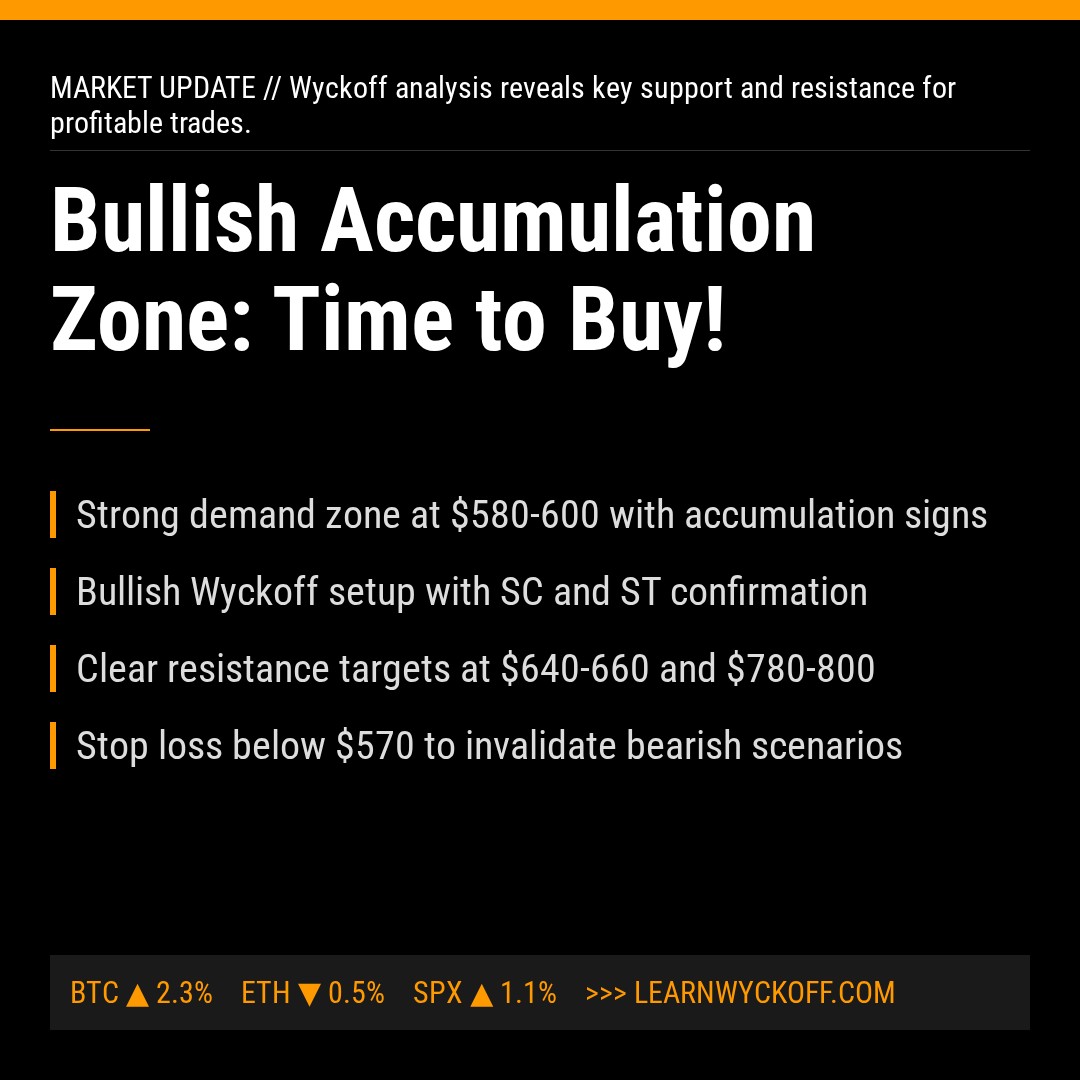
- 4. Current Intent: Smart money is likely constructing an accumulation range (e.g., $580-650). Their goal is to accumulate as many low-priced shares as possible in preparation for the next upward cycle. Public selling driven by fear provides this opportunity.
6. Support/Resistance Level Analysis & Trading Signals

- • Key Levels:
- • Primary Resistance (Supply Zone): $780-800. This is the starting platform for the early February panic selling and coincides with the 60-day MA, forming the first strong resistance for any future rally.
- • Secondary Resistance (Initial Supply): $640-660. A minor consolidation platform from the recent period (Feb 14th-22nd). A rebound here may encounter initial selling pressure from traders breaking even.
- • Key Support (Demand Zone) / Accumulation Range: $580-600. Defined jointly by the February 5th panic low (608) and the February 23rd test low (596). Clear signs of smart money activity have emerged in this zone.
- • Final Support: Below $570. A break below this zone would invalidate the accumulation structure, potentially leading the market to seek lower ground.
- • Comprehensive Wyckoff Trading Signals:
- • Primary Signal: Bullish / Seeking Long Opportunities. The market has shown a Selling Climax (SC) and subsequent Secondary Test (ST), with signs of demand absorption during the test, aligning with the Wyckoff "Spring" or post-"Shakeout" long setup.
- • Operational Recommendations:
- 1. Entry Zone: $580-600. Consider establishing long positions in batches.
- 2. Stop Loss: Strictly set below $570. A break below invalidates the accumulation hypothesis, requiring immediate exit.
- 3. Initial Target: $640-660 (Secondary Resistance). If the rebound breaks through this level with volume, a move towards the $780-800 zone can be anticipated.
- • Future Validation Points (Signals to Watch):
- 1. Demand Follow-Through: When price rebounds from the support zone, consecutive high-volume bullish candles are needed to indicate sustained and strong demand.
- 2. Successful Resistance Break: Price needs to break above and hold the $640-660 zone with volume (at least above recent average).
- 3. Confirmation of Supply Exhaustion: Any pullback towards $580-600 should be low-volume and brief, not accompanied by high-volume breaks below.
- 4. Invalidation Signal: If price breaks below $570 with high volume, it indicates supply is not yet exhausted, invalidating the accumulation judgment. Shift to观望 (observation) or follow the new downtrend.
Disclaimer: This report is a quantitative analysis based on historical data and Wyckoff theory. All conclusions are derived from data analysis and do not constitute any investment advice. The market carries risks, and investment requires caution. Traders should consider their own risk tolerance and continuously monitor the market to validate or revise analytical viewpoints.
Thank you for your attention! Daily Wyckoff Volume-Price market analysis is published punctually at 8:00 AM before the market opens. Your comments and shares are greatly appreciated. Your recognition is crucial. Let's work together to see the market signals clearly.
Member discussion: