Wyckoff Volume-Price Analysis Report: Product Code 513060

Analysis Date Range: 2025-12-26 to 2026-02-24
Report Generation Date: 2026-02-24


1. Trend Analysis and Market Phase Identification

As of February 24, 2026, the underlying asset 513060 had an opening price of 0.64, a closing price of 0.63, a 5-day moving average (MA) of 0.64, a 10-day MA of 0.63, a 20-day MA of 0.63, a daily change of -0.79%, a weekly change of -0.79%, a monthly change of 0.16%, a quarterly change of 7.38%, and an annual change of 7.38%.

513060 Price Trend Analysis Chart, including closing price and multiple moving averages
  • MA Alignment and Price Structure: During the data period, the product's price experienced a clear "decline-rebound-retracement" structure. From a continuous decline at the end of December (0.608→0.583), to a strong rebound in early January (January 5 to 14, 0.586→0.679), followed by high-level consolidation and a gradual retracement to 0.626. The moving averages (MAs) are arranged in a bearish pattern, and the current price (0.626) has fallen below all major moving averages (MA_5D: 0.637, MA_20D: 0.634, MA_60D: 0.633), indicating that the medium- to long-term downtrend has not been effectively reversed. During the rebound, the price briefly rose above the short-term MAs but failed to cause the long-term MAs to turn upward.
  • Market Phase Inference: Based on Wyckoff principles and price action:
    • Late December 2025: Prices declined on low volume, with volatility dropping to extremely low levels (data support in Section 3), consistent with characteristics of a Final Accumulation area or the End of Panic Selling, indicating dried-up market liquidity.
    • Early January 2026: A massive bullish candlestick rebound appeared (January 5, +5.83%, volume/14-day average ratio reached 2.30). This is a typical Sign of Strength (SOS), signaling a potential market transition from the accumulation phase to the initial stages of a Markup phase.
    • Mid-to-late January 2026 to Present: After rebounding to the 0.679 high, signs of distribution on high volume appeared (e.g., January 13) followed by high-volume declines (e.g., January 15). The price failed to break through higher resistance, instead retracing and breaking below the rebound trendline. This aligns with characteristics of a Distribution phase, where smart money distributes shares acquired earlier to late buyers at relatively high rebound levels. The current price is testing the support area of the previous rebound.

2. Volume-Price Relationship and Supply-Demand Dynamics

As of February 24, 2026, the underlying asset 513060 had an opening price of 0.64, a closing price of 0.63, a volume of 873,375,200, a daily change of -0.79%, a volume of 873,375,200, a 7-day average volume of 1,137,934,679.29, and a 7-day volume ratio of 0.77.

513060 Volume-Price Relationship Line Chart and Historical Ranking Analysis
  • Key Day Analysis:
    • High-Volume Advance (Demand Dominated): 2026-01-05 was a key day. The price rose 5.83%, with volume reaching 2.08 billion, which was 2.30 times the 14-day average volume (historical rank: 18th highest). This is a clear signal of demand overwhelming supply, confirming the intervention of large-scale buying.
    • High-Volume Stagnation/Decline (Supply Dominated): 2026-01-13 and 2026-01-15 are typical. On January 13, the price rose 1.53% on massive volume of 2.47 billion (2.01 times the 14-day average), a mismatch between the gain and volume indicating expanding supply. On January 15, the price fell -1.33% on volume of 1.31 billion (0.91 times the 14-day average), but the price broke below the previous day's low, confirming supply began to dominate.
    • Low-Volume Decline (Lack of Demand): 2026-01-22, the price fell slightly by -0.31%, with volume only 616 million, which was 0.38 times the 14-day average (historical rank: 20th lowest), showing severe absence of demand during the decline and insufficient buying interest.
    • Extremely Low Volume (Liquidity Drying Up): 2025-12-26, the price was flat, with volume only 252 million. Multiple volume ratios hit near-decade lows (e.g., VOLUME_AVG_60D_RATIO=0.168, rank: 4th lowest), marking a potential stage of selling pressure exhaustion.
  • Supply-Demand Transition Points: From the data, 2026-01-05 is a clear supply-demand transition point with a massive influx of demand. 2026-01-15 is another transition point where supply regained dominance, interrupting the upward trend.

3. Volatility and Market Sentiment

As of February 24, 2026, the underlying asset 513060 had an opening price of 0.64, a 7-day intraday volatility of 0.27, a 7-day intraday volatility ratio of 0.97, a 7-day historical volatility of 0.28, a 7-day historical volatility ratio of 0.89, and an RSI of 46.27.

513060 Historical Volatility Analysis Chart and Historical Ranking Data
  • Volatility Levels and Changes:
    • Panic/Depressed Period (End of 2025): Short-term volatility compressed to extremely low levels. For example, the 7-day Parkinson volatility on 2025-12-30 was only 0.143 (historical rank: 5th lowest), and the 7-day historical volatility was only 0.114 (historical rank: 8th lowest). Volatility ratios (e.g., PARKINSON_RATIO_7D_60D=0.555) were also at low levels, indicating extreme market sentiment suppression and directional confusion.
    • Trend Initiation and Acceleration Period (Early January 2026): Volatility expanded rapidly. On January 5, the 7-day historical volatility jumped to 0.483, and its ratio to the 60-day volatility (HIS_VOLA_RATIO_7D_60D) reached 1.40, showing a sharp spike in short-term volatility sentiment accompanying the trend initiation.
    • Current State: Recent volatility has retraced but remains above the lows of late December. For example, the latest 7-day historical volatility is 0.278, with a ratio to the 60-day volatility (HIS_VOLA_RATIO_7D_60D) of 0.92, indicating market sentiment has cooled from January's excitement but has not returned to the extreme depression of late December.
  • RSI Sentiment Indicator: The RSI_14 touched the oversold region at 28.13 on December 31, coinciding with the price low. It then rebounded to a high of 69.77 on January 14, nearing overbought. The current RSI is 46.27, in a neutral-to-weak zone, reflecting fading upward momentum but not entering extreme oversold territory.

4. Relative Strength and Momentum Performance

  • Momentum Cycle Analysis:
    • Short-Term Momentum: WTD_RETURN (Weekly Return) has been mostly negative recently, indicating weak short-term momentum.
    • Mid-Term Momentum: MTD_RETURN (Monthly Return) has sharply retreated from its mid-January high of 16.47% to the current 0.16%, indicating nearly all the gains from the one-month rebound have been surrendered, and mid-term upward momentum has exhausted.
    • Long-Term Momentum: The YTD (Year-to-Date) return is 7.38%, but the main contribution came from the January rebound. February overall performance has been sideways consolidation with a slight weak bias.
  • Comprehensive Judgment: Both short-term and mid-term momentum for the product have weakened. The strong rebound in January failed to establish sustained upward momentum, and it is currently in a consolidation or declining phase following momentum decay.

5. Large Investor (Smart Money) Behavior Identification

Based on extreme historical ranking data for volume-price and volatility, we can clearly identify the operational trajectory of large investors:

  1. 1. Ceasing Selling and Initial Accumulation (End of 2025): As prices declined to low levels, both volume and volatility hit multi-year extremes (e.g., MIN_VOLUME_AVG_60D_RATIO rank: 4th lowest, MIN_PARKINSON_VOL_7D rank: 5th lowest). This indicates large-scale selling had ceased, the market was dominated by sporadic retail selling, and liquidity dried up. Smart money may have conducted covert initial accumulation in this zone without causing significant price fluctuations.
  2. 2. Active Buying and Uplift (Early January 2026): The massive bullish candlestick on January 5 is a classic display of smart money behavior. The volume ratio reached historically high levels (WEEK_MAX_VOLUME_AVG_7D_RATIO rank: 4th highest), indicating this was organized, large-scale demand entry aimed at rapidly pushing prices away from the cost zone and attracting market follow-through.
  3. 3. High-Level Distribution and Testing (Mid-to-Late January 2026): After the price rebounded to the 0.66-0.68 range, high-volume stagnation appeared. This was followed by high-volume declines on dates like January 15 and 19. This fits the distribution characteristic: smart money utilized optimistic market sentiment to distribute shares bought in early January to chasing buyers at relatively high levels. Subsequent low-volume declines (e.g., January 22) can be seen as a test of the market's pressure-bearing capacity after distribution.
  4. 4. Current Intent: The price has retraced to a key support area (see Section 6). Smart money is likely observing two points: first, whether panic selling re-emerges to provide cheaper筹码; second, whether new demand can enter at this support level. Current volume is relatively moderate, indicating they are in a watchful or slow accumulation state, not engaging in aggressive long/short operations.

6. Support/Resistance Level Analysis and Trading Signals

513060 Support and Resistance Level Analysis Chart and Trading Signals
  • Key Support Levels:
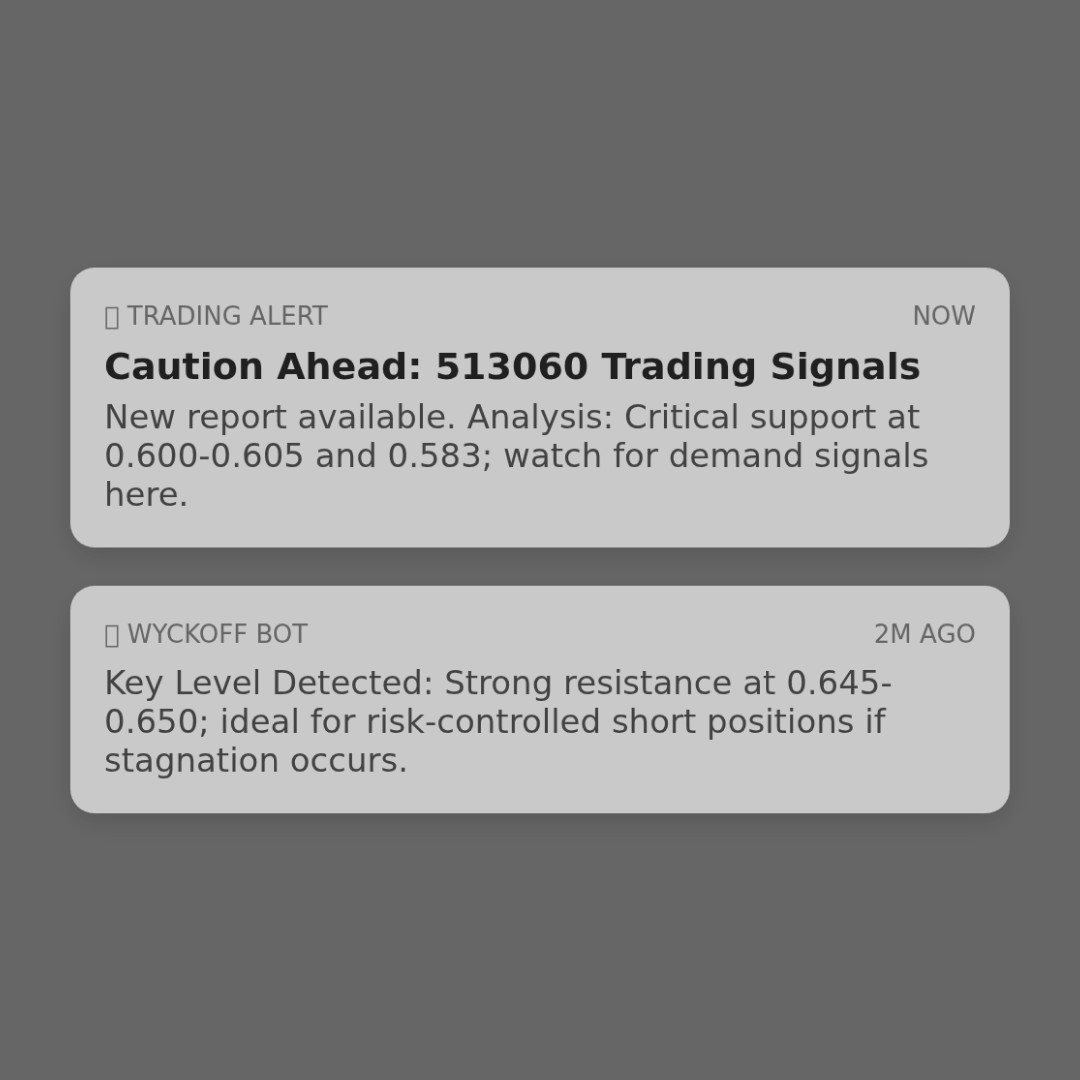
    • S1: 0.605 – 0.600 Area: The lows on February 2 and 3, 2026, also the lower boundary of the recent consolidation range. A decisive break below this area could initiate a new downtrend.
    • S2: 0.583 Area: The panic low on December 31, 2025, is an important psychological and historical support level.
  • Key Resistance Levels:
    • R1: 0.645 – 0.650 Area: Recent multiple rebound highs (e.g., January 28, February 10), also the current cluster area for short-term moving averages, constituting a strong recent resistance.
    • R2: 0.679 Area: The highest point of the rebound on January 14, 2026, is the upper edge of the main distribution area, serving as strong resistance.
  • Comprehensive Trading Signals and Operational Recommendations:
    • Dominant Signal: Neutral to Bearish/Cautious. The market is in a retracement phase following distribution, with no clear return of demand, and the price structure is weak.
    • Operational Recommendations:
      1. 1. Bears/Cautious Investors: Advised to wait and watch. If the price rebounds to the R1 (0.645-0.650) resistance area and shows candlestick patterns of low volume or high-volume stagnation, it could be considered a risk-controlled opportunity to test short positions, with a stop-loss set above 0.655.
      2. 2. Bulls/Looking for Rebound: Should not blindly buy the dip. Need to wait for signs of demand emergence: price near the S1 (0.600-0.605) or S2 (0.583) support levels, showing Wyckoff buying structures (such as Spring or Jump Across the Creek) characterized by "high-volume stabilization after a decline" or "low volume followed by renewed high-volume advance". Maintain patience until such signals appear.
    • Future Validation Points:
      • Bearish Validation: Price breaking below 0.600 on high volume with weak rebounds would confirm supply dominance again, opening up downside potential.
      • Bullish Validation: Price breaking through and holding above 0.650 on high volume, with pullbacks holding, could indicate new demand entry, potentially easing or reversing the downtrend.

Conclusion Reiteration: Product 513060, after experiencing extreme depression in late 2025 and a strong rebound led by smart money in early January 2026, is currently in a retracement and consolidation phase following distribution at high rebound levels. The supply-demand balance has tilted back towards supply, and the short-term trend has weakened. Investors should focus on the outcome of the battle between bulls and bears at the 0.600-0.605 support area and the 0.645-0.650 resistance area. Operations should be based on clear Wyckoff volume-price event signals, avoiding frequent trading in directionless consolidation. The current market exhibits明显的 band characteristics dominated by large investors, making it crucial to follow their capital intent rather than price表象.


Disclaimer: This report/analysis content is solely market analysis and research based on publicly available information and does not constitute any investment advice or operational guidance. The author strives for objectivity and fairness but makes no guarantees regarding accuracy or completeness. Markets involve risks; investments require caution. Any investment actions based on this report are taken at your own risk.


Thank you for your attention! Wyckoff Volume-Price Market Interpretations are released daily at 8:00 AM before the market opens. Your comments and shares are sincerely welcomed and highly valued. Let's work together to see the market signals.