Understood. As a quantitative trading researcher proficient in the Wyckoff Method, I will draft an in-depth quantitative analysis report for product code 399989 based on the data you provided. The report will strictly adhere to the six analytical dimensions you requested. All conclusions will be derived from the data and conform to Wyckoff's principles of volume and price action.
Product Code: 399989 Quantitative Analysis Report
Analysis Period: 2025-12-26 to 2026-02-24
1. Trend Analysis and Market Phase Identification
As of 2026-02-24, the underlying asset 399989 has an open price of 7101.72, a close price of 7026.45, a 5-day moving average (MA) of 7138.36, a 10-day MA of 7114.00, a 20-day MA of 7187.14, with daily change of 0.08%, weekly change of 0.08%, monthly change of -0.83%, quarterly change of 3.94%, and annual change of 3.94%.

- • Moving Average Alignment and Price Structure:
- • Previous Phase (Early January): The price initiated an uptrend from 6760.06 points (2025-12-31), breaking through all short-to-medium-term moving averages (MA_5D, MA_10D, MA_20D, MA_30D) on strong volume, forming a typical short-term bullish alignment. The price reached an interim high of 7776.04 points on 2026-01-14.
- • Current Phase (Late February): The price has now fallen below all short-term moving averages (MA_5D, MA_10D) and continues to trade below the MA_20D and MA_30D. MA_5D (7138.36) has crossed below MA_20D (7187.14) and MA_30D (7274.59), and MA_10D (7114.00) is also below MA_20D. The price structure shows a pattern of lower highs and lower lows (from 7776 → 7680 → 7410 → 7026). Comprehensive judgment indicates the market has shifted from a short-term uptrend to a clear short-term bearish alignment, with the long-term MA_60D (7066.88) acting as the final line of defense.
- • Market Phase Identification (Wyckoff Framework):
The data reveals a complete Wyckoff cycle sequence:- 1. End of Accumulation and Markup: From late December 2025 to early January 2026, after a narrow-range consolidation at low levels (6760-6910 range), a massive (11.18B, up 89.3% from the previous day) long bullish candlestick broke out on January 5th. This is a classic "Spring" and "Jump across the creek" signal, confirming the completion of accumulation and entry into the markup phase.
- 2. Distribution: The markup climaxed in mid-January (13th-15th), accompanied by record-breaking trading volume and turnover (historical ranking data shows the volume ranked 2nd and 5th highest on those days). However, at the extreme high (7776.04), high-volume stagnation and high-volume decline appeared (Jan 15th: volume 23.85B, second highest in a decade, yet the price fell -1.22%). This aligns with the classic characteristics of the Wyckoff Distribution phase: large-scale supply is absorbed by the market at the top.
- 3. Markdown: Starting January 16th, the price began breaking below key moving average supports. Although volume contracted somewhat, it remained at elevated levels, indicating sustained supply dominance, marking entry into the Markdown phase. Recently, the price has found some respite around the 7000-point level and is testing the MA_60D long-term support.
2. Volume-Price Relationship and Supply-Demand Dynamics
As of 2026-02-24, the underlying asset 399989 has an open price of 7101.72, a close price of 7026.45, trading volume of 785,982,400, daily change of 0.08%, volume of 785,982,400, 7-day average volume of 685,580,239.86, and a 7-day volume ratio of 1.15.

- • Key Session Analysis:
- • Demand-Dominated Session (2026-01-05): Volume surged 89.3% to 11.18B, price soared 4.91%, with VOLUME_AVG_7D_RATIO as high as 1.87 (20th highest in the past decade). This is a clear, powerful signal of demand entering the market, marking a trend reversal.
- • Supply-Dominated Session (2026-01-15): Volume hit the second-highest level in a decade (23.85B), yet the price closed down -1.22%. VOLUME_AVG_60D_RATIO was as high as 3.48 (5th highest in the past decade), indicating massive turnover at a high price level with an inability to advance, showing supply (selling) completely overwhelmed demand. This is a classic distribution signal.
- • Panic/Shakeout Sessions (2026-01-16, 2026-02-02): Prices fell -2.48% and -2.16% respectively on high volume (16.83B, 7.96B), characteristic of Panic Selling during the post-distribution markdown phase.
- • Lack-of-Demand Sessions (Recent): From February 11th to 13th, 2026, prices declined consecutively on significantly reduced volume relative to the prior period (VOLUME_AVG_21D_RATIO dropped to as low as 0.467, 3rd lowest in the past decade). This shows downward momentum is waning, but demand remains unwilling to enter, presenting a pattern of declining on low volume.
- • Supply-Demand Pattern Summary:
The market experienced a clear supply-demand shift: Demand completely dominated from late December to early January → Intense supply-demand struggle at the mid-January top, with supply ultimately winning → Supply continued to dominate from late January through February → Currently (late February), supply pressure appears to be easing (volume contraction), but demand has yet to materialize.
3. Volatility and Market Sentiment
As of 2026-02-24, the underlying asset 399989 has an open price of 7101.72, a 7-day intraday volatility of 0.14, a 7-day intraday volatility ratio of 0.73, a 7-day historical volatility of 0.15, a 7-day historical volatility ratio of 0.61, and an RSI of 42.90.

- • Volatility Levels:
- • During the January markup and subsequent markdown, both short-term historical volatility (HIS_VOLA_7D) and Parkinson volatility (PARKINSON_VOL_7D) peaked (0.384, 0.276), indicating a mix of euphoria and panic.
- • Current (2026-02-24): Volatility has significantly contracted. HIS_VOLA_7D is 0.154, and PARKINSON_VOL_7D is 0.139, both having retreated to levels seen before the early-January rally. Notably, PARKINSON_RATIO_7D_30D has dropped to 0.653, indicating short-term intraday volatility has contracted substantially relative to medium-term volatility.
- • Market Sentiment (RSI):
- • At the January peak, the RSI_14 touched a high of 78.85 (14th highest in the past decade), showing the market was in an extremely overbought state, providing technical confirmation for the trend reversal.
- • Current (2026-02-24): RSI_14 is 42.90, having moved out of the oversold zone (below 30), now in a neutral-to-weak range. Market sentiment has recovered from panic but remains cautious.
4. Relative Strength and Momentum Performance
- • Momentum Trends:
- • Short-Term Momentum (WTD, MTD): Extremely strong in early to mid-January (MTD_RETURN peaked at 15.03%), but has now turned completely negative (MTD_RETURN -0.83%, the marginal 0.08% gain in WTD_RETURN lacks trend significance), indicating weak short-term momentum.
- • Medium-to-Long-Term Momentum: The YTD return is 3.94%, but QTD and TTM_12 returns (3.94%, -1.53%) have weakened. Looking further out, TTM_24 and TTM_36 returns (-1.20%, -34.04%) are significantly negative, indicating very weak medium-to-long-term momentum. The January rally was merely a strong counter-trend bounce within a longer-term downtrend.
5. Large Investor ("Smart Money") Behavior Identification
Based on Wyckoff principles and volume-price analysis, the operational path of large investors is clearly discernible:
- 1. Accumulation at the Bottom (Late 2025): Amidst declining prices and market pessimism, smart money quietly accumulated positions at low levels (around 6760 points), preparing for the early January markup.
- 2. Markup and Distribution (January 2026): After the massive volume markup on January 5th attracted market followers, smart money conducted large-scale, organized distribution within the high price range of 7500-7800 points. The record-breaking turnover and volume in the historical rankings, along with high-volume stagnation/decline at highs, are clear evidence of them "selling stocks to the public."
- 3. Current Behavior: Following the completion of major distribution, prices entered the markdown phase. The recent sharp contraction in volume (VOLUME_AVG_21D_RATIO reaching the 3rd lowest in the past decade) indicates that large-scale active supply (smart money selling) has temporarily ceased. The market has entered a "natural markdown" phase dominated by existing capital games and retail stop-loss selling. Smart money is currently in a wait-and-see mode, awaiting a price decline to their recognized next accumulation zone.
6. Support/Resistance Level Analysis and Trading Signals

- • Key Price Levels:
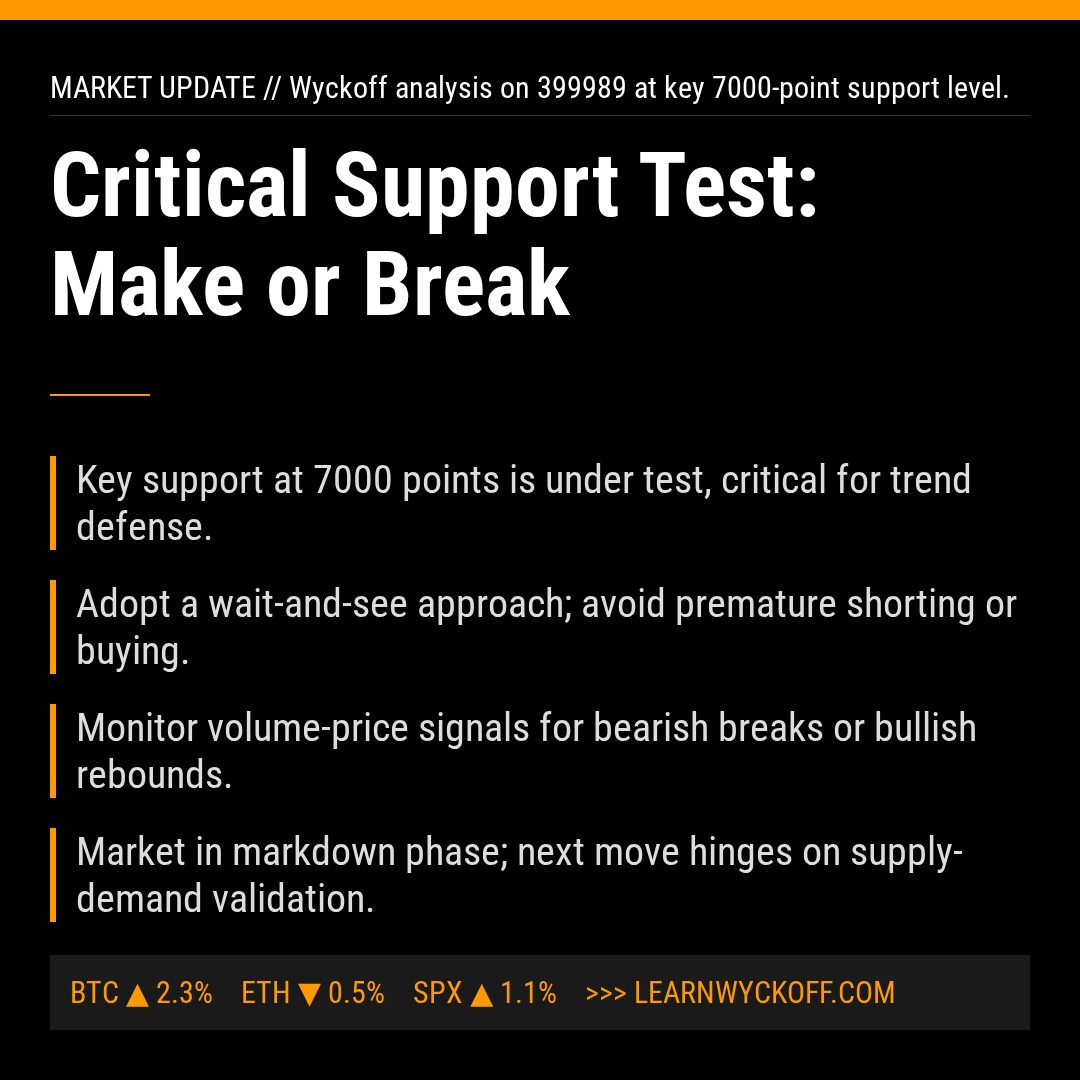
- • Strong Support: ~7000 points / MA_60D (7067 points). This is the target for the current downtrend and the last line of defense for the long-term trendline. A high-volume break below this level would open new downside space.
- • Secondary Support: Previous low ~6930 points (2026-02-02).
- • Strong Resistance: ~7400-7500 points. This is the upper edge of the dense trading zone formed in late January and is also where the MA_20D and MA_30D currently reside, constituting strong resistance.
- • Secondary Resistance: ~7200 points (near the recent rebound high and MA_10D).
- • Wyckoff Integrated Trading Signal and Operational Recommendations:
- • Current Market Phase: Markdown phase following distribution, testing long-term key support.
- • Core Signal: Adopt a wait-and-see approach and prepare to capture potential secondary reactions or new accumulation signals. Chasing the short side at this level is not recommended (volatility contraction, weakening downside momentum), and bottom-fishing is even less advisable (no demand signals present).
- • Operational Recommendations:
- 1. Bearish/Short Holding Scenario: If the price breaks below the 7000/7060 key support on high volume (e.g., single-day decline exceeding -1.5% and VOLUME_AVG_7D_RATIO > 1.2), then the downtrend is likely to continue, and a light position following could be considered. Set stops above 7400 points.
- 2. Bullish/Search for Rebound Opportunity Scenario: Watch for "oversold bounce" signals near the 7000-point level. The ideal scenario is: after testing 7000 points, a "low-volume decline" (exhaustion of supply) or a "high-volume small candlestick halting the decline" (tentative demand entry) appears, followed by a high-volume bullish candlestick (volume at least 50% higher than the previous day) reclaiming the 7100-point level. This could signal the start of a short-term rebound, targeting 7200-7300. Be sure to set stops below 6950 points.
- 3. Neutral/Wait-and-See Scenario: If the price continues to oscillate without volume between 7000-7200 points, maintain a wait-and-see stance, awaiting clearer supply-demand breakout signals.
- • Future Validation Points:
- • Bearish Validation: The closing price remains below 7000 points for three consecutive sessions, with rebounds unable to reclaim the 7100-point level.
- • Bullish Validation: The "demand manifestation" volume-price structure described above appears at the key support level, accompanied by a bullish divergence in RSI_14.
- • Early Signal for Potential Trend Reversal (Accumulation): Requires observation of price oscillating repeatedly within a certain range (e.g., 6900-7100) and the emergence of Wyckoff buying structures such as a "Spring" or "Jump across the ice." This will require confirmation from data over the coming weeks.
Conclusion Restated:
After experiencing a classic "Accumulation-Markup-Distribution" cycle led by smart money, 399989 has now entered the markdown phase following distribution. The market is testing the key 7000-point support, but the demand side has yet to demonstrate strong willingness to enter. Traders are advised to exercise high caution, primarily adopting a wait-and-see approach, and strictly plan their next steps based on the volume-price signals outlined above, rather than on subjective predictions. The market is currently at a critical juncture, and the next significant directional choice is imminent.
Disclaimer: This report/interpretation is solely market analysis and research based on publicly available information and does not constitute any investment advice or operational guidance. The author strives for objectivity and fairness in the content but makes no guarantees regarding its accuracy or completeness. The market carries risks; investment requires caution. Any investment actions taken based on this report are at the investor's own risk.
Thank you for your attention! Wyckoff Volume-Price Market Interpretations are released daily at 8:00 AM before the market opens. Your comments and shares are sincerely appreciated; your recognition is paramount. Let's work together to see the market signals clearly.
Member discussion: