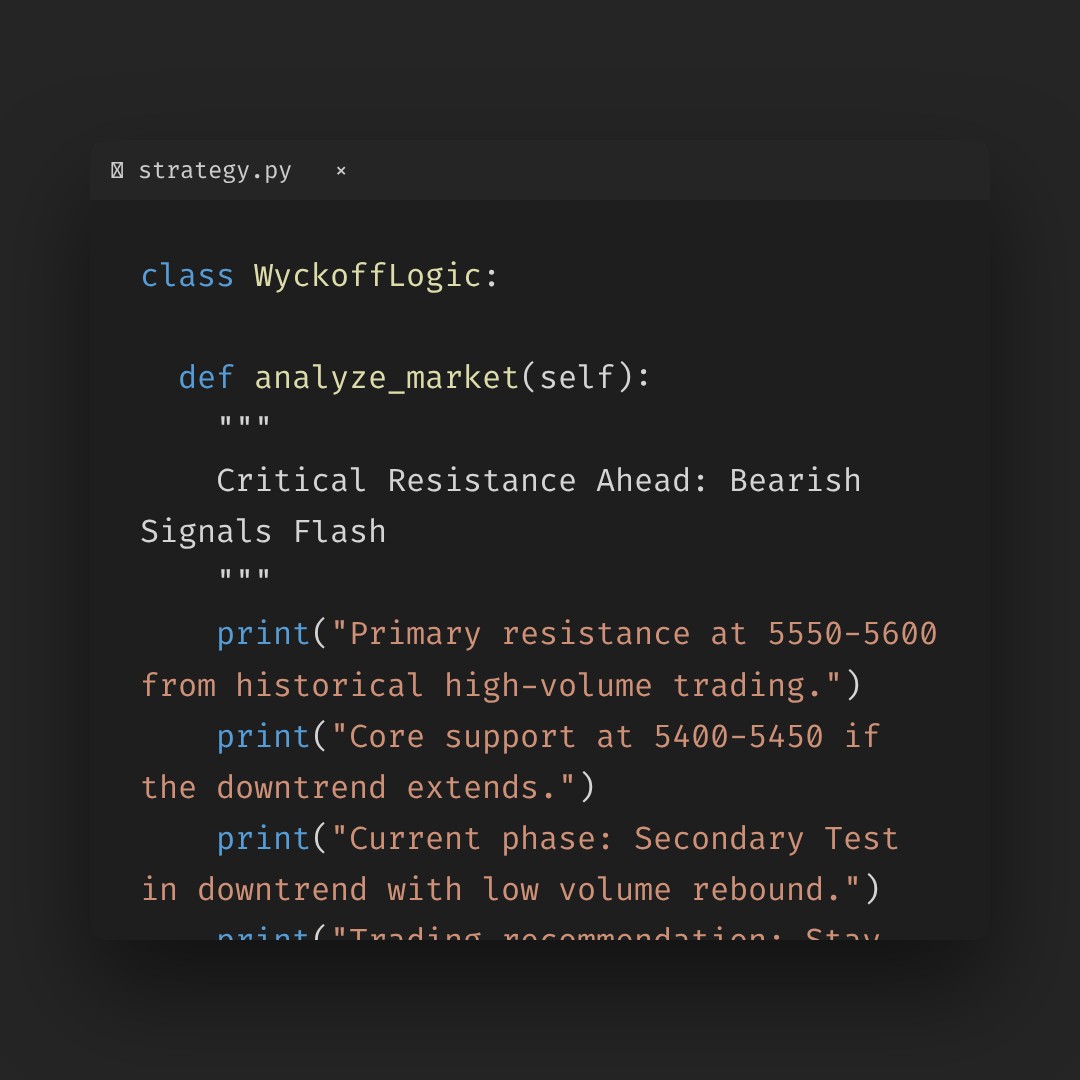
Wyckoff Quantitative Analysis Report: Product 000989.SH
Analysis Period: 2025-12-26 to 2026-02-24
Report Generation Time: 2026-02-24
1. Trend Analysis and Market Phase Identification
As of February 24, 2026, for the subject 000989.SH: Opening Price 5596.08, Closing Price 5548.94, 5-Day Moving Average (MA) 5567.39, 10-Day MA 5534.70, 20-Day MA 5590.53. Daily Change 0.29%, Weekly Change 0.29%, Monthly Change 0.98%, Quarterly Change -0.79%, Year-to-Date Change -0.79%.

- • Moving Average Alignment and Trend Status:
At the beginning of the analysis period (late December to early January), the price (CLOSE) consistently traded above all major moving averages (MA_5D to MA_60D), displaying a typical bullish alignment, indicating the market was in an uptrend. A fundamental shift in trend occurred starting January 13th. The price broke down successively through the MA_5D, MA_10D, and MA_20D during a high-volume sell-off. By the end of the analysis period, MA_5D (5567.39) had been consecutively positioned below MA_20D (5590.53) and MA_30D (5619.30), forming a bearish alignment in the short-term moving average system, confirming the end of the intermediate-term uptrend and the beginning of a correction phase. The MA_60D (5525.78), serving as the long-term trend line, is currently still providing support. - • Market Phase Inference (Based on Wyckoff Principles):
- • Distribution Phase (Distribution, early to mid-January): Price reached a new wave high (5736-5756 points) on January 9th-12th, but was followed by a high-volume, long red candle sell-off on January 13th (-1.47%, with trading volume ranking 5th highest in nearly a decade). This pattern of "new highs immediately overwhelmed by overwhelming supply" aligns with the "distribution" characteristics in Wyckoff theory, signaling large-investor-led distribution of holdings.
- • Markdown Phase (Markdown, late January to early February): Following the confirmation of distribution, the market entered the markdown phase. The price declined from around 5750 points to 5390 points on February 2nd. Although there were rebounds during this period, successive highs were lower (January 19th, 23rd, 26th), presenting a standard downtrend.
- • Potential Secondary Test Phase (Secondary Test, mid to late February): After hitting a low on February 2nd, the price rebounded. However, when it reached the 5550-5600 zone, trading volume significantly contracted (VOLUME_AVG_30D_RATIO < 0.7), indicating weak demand. On February 24th, the price rose slightly but closed near its intraday low, currently conducting a "Secondary Test" on the previously broken key support level (the 5550-5600 platform), to confirm whether this zone has transformed from support into effective resistance.
2. Price-Volume Relationship and Supply-Demand Dynamics
As of February 24, 2026, for the subject 000989.SH: Opening Price 5596.08, Closing Price 5548.94, Trading Volume 3143605300, Daily Change 0.29%, Trading Volume 3143605300, 7-Day Average Volume 3221445385.71, 7-Day Volume Ratio 0.98.

- • Key Price-Volume Signals:
- 1. Supply-Dominated Top Signal (January 13-14): On January 13th, price fell sharply by -1.47%, with trading volume (7.0 billion shares) and turnover (140.0 billion CNY, ranking 5th highest in nearly a decade) massively expanding. The following day (January 14th) saw continued high-volume decline, with turnover hitting the 3rd highest (144.5 billion CNY) in nearly a decade. This two-day "high-volume decline" clearly revealed a concentrated outbreak and overwhelming dominance of market supply (selling pressure), constituting the core supply-demand signal for trend reversal.
- 2. Demand-Deficient Rebound (January 19th and February rebounds): On January 19th, price rebounded +1.02%, but trading volume (VOLUME_AVG_14D_RATIO=0.86) was below the recent average, qualifying as a "low-volume rebound" with insufficient follow-through demand. During the rebound cycle from February 3rd to 10th, trading volume consistently remained below various period averages (VOLUME_AVG_30D_RATIO all below 0.8), further confirming weak demand.
- 3. Supply Exhaustion at Downtrend End (February 13th): On February 13th, price declined -0.57%, but trading volume (VOLUME_AVG_30D_RATIO=0.63) dropped to a phase low, while volatility contracted significantly (HIS_VOLA_RATIO_7D_60D=0.57). This indicates that as the price fell, active selling supply was drying up, suggesting the market may be nearing the end of the short-term downtrend.
- • Supply-Demand Power Shift Conclusion:
The dominant market force underwent a decisive shift on January 13th, transitioning from demand-driven advance to supply-driven decline. Subsequent rebounds failed due to insufficient demand. Recent volume contraction to extremely low levels suggests a temporary weak equilibrium between bulls and bears, with the market poised to choose a new direction.
3. Volatility and Market Sentiment
As of February 24, 2026, for the subject 000989.SH: Opening Price 5596.08, 7-Day Intraday Volatility 0.10, 7-Day Intraday Volatility Ratio 0.76, 7-Day Historical Volatility 0.09, 7-Day Historical Volatility Ratio 0.52, RSI 47.60.

- • Volatility Extremes and Sentiment Shift:
- 1. Panic Selling Point: On January 13th, short-term historical volatility (HIS_VOLA_7D=0.181) spiked sharply. Its ratio to the 60-day volatility (HIS_VOLA_RATIO_7D_60D) reached 1.26, while the Parkinson volatility ratio (PARKINSON_RATIO_7D_60D) reached 1.10. The abnormal expansion in volatility precisely coincided with the high-volume sell-off day, marking a rapid shift in market sentiment from greed to panic.
- 2. Sentiment Cooling and Range-Bound Activity: Entering February, despite ongoing price declines, short-term volatility (HIS_VOLA_7D) continuously retreated, with its ratios to longer-term volatility all falling below 1. By February 24th, HIS_VOLA_RATIO_7D_60D was only 0.60, indicating that market panic sentiment had been fully released, giving way to a state of low sentiment and wait-and-see attitude.
- • RSI Confirmation:
The RSI_14 indicator reached the upper edge of the overbought zone (71.07) on January 9th, then declined rapidly after forming a bearish divergence with the price. At the downtrend low on February 2nd, RSI dropped to 30.93 in the oversold zone, confirming the extreme pessimism in sentiment. The current RSI (47.60) has recovered to a neutral-weak zone, consistent with the low-volume, range-bound price action.
4. Relative Strength and Momentum Performance
- • Comprehensive Momentum Weakening:
- • Short-Term Momentum: WTD_RETURN (Weekly Return) turned negative multiple times during the analysis period, remaining particularly weak post-distribution. MTD_RETURN (Monthly Return) declined from a high of +2.83% in mid-January to +0.98% by late February, indicating significant decay in upward momentum.
- • Intermediate-Term Momentum: Both QTD_RETURN (Quarterly Return) and YTD (Year-to-Date Return) fell into negative territory in early February (minimum -3.62%), confirming the intermediate-term correction pattern.
- • Long-Term Context: TTM_24 (24-Month Return) remains high at +29.35%, indicating this correction is occurring after a prolonged, strong advance, typical of a mid-cycle correction within a long-term uptrend.
5. Large Investor ("Smart Money") Behavior Identification
- • Behavior Inference:
- 1. High-Level Distribution (Distribution): The critical window for large investor distribution was January 12th to 14th. Prices failed to sustain new highs and instead experienced record-high-volume declines. This clearly indicates "smart money" was utilizing market optimism and price strength for large-scale distribution. Buy orders were unable to absorb the massive sell orders, leaving supply in complete control.
- 2. Watchful Waiting and Testing During the Decline: Throughout the subsequent decline, overall trading volume showed a contracting trend, especially with severely insufficient volume during the February rebound. This suggests large investors were not eager to buy the dip or engineer a rebound during the decline but were in a wait-and-see mode. The low-volume stagnation in late February as prices recovered to former support (now resistance) levels is typical "smart money" behavior testing remaining selling pressure and the strength of follow-on buying interest.
6. Support/Resistance Level Analysis and Trading Signals

- • Key Price Levels:
- • Primary Resistance Zone: 5550 - 5600. This is the high-volume trading range from late January to early February and also the former key support platform. The closing price on February 24th (5548.94) is precisely at the lower edge of this zone. Recapturing and consolidating above this zone is the first technical signal for the market to regain strength.
- • Core Support Zone: 5400 - 5450. This is the low zone of the February decline wave (February 2nd, 3rd, 6th). If the current Secondary Test fails and prices decline further, this zone will be key to testing whether the decline will extend.
- • Long-Term Trend Support: MA_60D (approximately 5525 points) and the January low at 5537 points. Price is currently contesting this area; a decisive break below would open the door for further downside exploration.
- • Comprehensive Wyckoff Events and Trading Signals:
- • Current Phase: The market is in a "downtrend following distribution, undergoing a Secondary Test (ST) of the breakdown level."
- • Trading Signal: Cautiously Bearish / Side-lined. Given the primary trend has turned downward, and the current rebound lacks volume and faces strong resistance, risk management should be prioritized.
- • Operational Recommendations:
- • Bearish Strategy (Aggressive): If price encounters resistance and reverses in the 5550-5600 zone, accompanied by expanding volume, it could be considered an opportunity for shorting or reducing long positions. An initial stop-loss can be set above 5600 points.
- • Wait-and-See Strategy (Conservative): Advise staying on the sidelines, awaiting clearer signs of a supply-demand reversal. A genuine long opportunity requires waiting for "accumulation" characteristics to appear, such as "high-volume, downside-exhaustion bullish candles" or an "Automatic Rally (AR) following a Selling Climax (SC)" at support levels.
- • Future Validation Points:
- 1. Bearish Confirmation: If price fails to break the 5550-5600 resistance zone and breaks below 5500 points and the MA_60D with increased volume, the downtrend will continue, with the next target at 5400-5450.
- 2. Bullish Reversal Signal: If price breaks through and solidly holds above 5600 points with significant volume (VOLUME_AVG_30D_RATIO > 1.2), accompanied by short-term moving averages (MA_5D/MA_10D) turning upward and forming a golden cross, it would indicate the Secondary Test has failed, demand has returned, and the market may resume its advance. Until such signals appear, treat all rallies as rebounds.
Disclaimer: This report/analysis is solely market analysis and research based on publicly available information and does not constitute any investment advice or operational guidance. The author strives for objectivity and fairness but makes no guarantees regarding accuracy or completeness. The market carries risks; investing requires caution. Any investment actions based on this report are undertaken at your own risk.
Thank You for Your Attention! Wyckoff Price-Volume Market Interpretations are released daily at 8:00 AM before market open. Your comments and shares are greatly appreciated. Your recognition is vital. Let's work together to see the market signals clearly.
Member discussion: