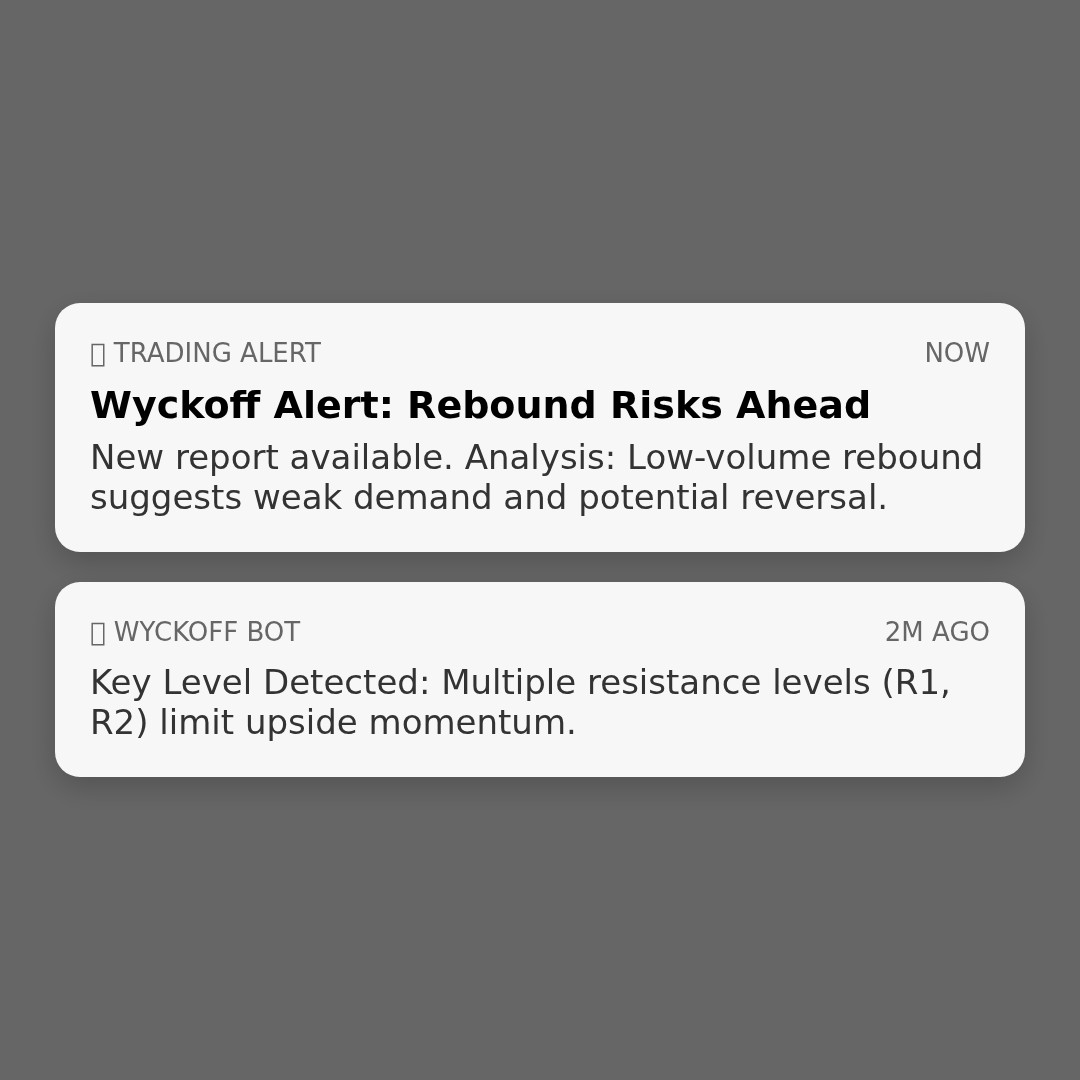
Wyckoff Method Quantitative Analysis Report: 000987.SH

Product Code: 000987.SH
Analysis Period: 2025-12-26 to 2026-02-24
Report Generation Date: 2026-02-24
Core Conclusion: The underlying asset experienced a typical "Distribution-Panic Selling" cycle in late January 2026. The current price (as of Feb 24) is in a technical rebound following the panic decline, but the weak volume suggests significant demand has not yet entered the market. The market may be entering an early stage of "Re-accumulation" or "Secondary Test." It is recommended to maintain a cautious stance, either by observing from the sidelines or considering prudent reduction on rallies, until clear signals of demand entry (such as a breakout above key resistance with high volume) emerge.


1. Trend Analysis & Market Phase Identification

As of 2026-02-24, for 000987.SH: Open 5812.37, Close 5854.21, 5-day MA 5719.11, 10-day MA 5652.15, 20-day MA 5751.77, Daily Change 3.51%, Weekly Change 3.51%, Monthly Change -1.07%, Quarterly Change 16.84%, Year-to-Date Change 16.84%

000987.SH Price Trend Analysis Chart, including closing price and multiple moving averages
  • Moving Average Alignment & Price Relationship:
    • Strong Uptrend Period (2025-12-26 to 2026-01-29): Throughout January, the price consistently traded above the MA_5D, with MA_5D > MA_10D > MA_20D > MA_30D > MA_60D, forming a perfect bullish alignment. Prices repeatedly made new highs, driving all moving averages to diverge upwards.
    • Trend Reversal & Breakdown (2026-01-30 to 2026-02-06): The sharp declines on Jan 30 (-5.24%) and Feb 2 (-7.21%) caused the price to break below the MA_5D, MA_10D, and MA_20D successively. As of Feb 24, although the price (5854.21) has rebounded above the MA_5D (5719.11) and MA_10D (5652.15), it remains below the MA_20D (5751.77). Furthermore, the MA_5D has formed a death cross with both the MA_10D and MA_20D. The bullish alignment has been completely broken; short-term moving averages are now coiling sideways, indicating the market has entered a non-trending or consolidating repair phase.
  • Market Phase Identification (Based on Wyckoff):
    • Distribution Phase (Distribution): During the period 2026-01-23 to 2026-01-29, after reaching a new all-time high (Jan 29 open 6283.66, historical rank #1), the price exhibited violent fluctuations alongside an extremely overbought RSI (historical rank #2), with trading volume setting a new record high (Jan 29, 437.25B). These are classic signs of "Distribution," where smart money distributes shares to the public chasing the rally at record highs amid euphoric sentiment.
    • Panic Selling Phase (Panic Selling): From 2026-01-30 to 2026-02-05, the price experienced a cliff-like decline (maximum single-day drop of -7.21%, historical rank #6), accompanied by extremely high volatility (7-day historical volatility ranking #10-16 historically) and huge volume (Feb 2 trading volume ranking #11 historically). This marks panic selling by the public. Wyckoff's "Panic Selling Climax" (PSY) likely manifested on Jan 30 and Feb 2 consecutively.
    • Automatic Rally & Secondary Test (Automatic Rally & Secondary Test): From 2026-02-06 to 2026-02-24, the price rebounded from the low (5506.78 on Feb 5). However, this rally (up approximately 6.3% from the low as of Feb 24) has been on significantly diminished volume (VOLUME_AVG_30D_RATIO only 0.78) and has failed to effectively reclaim the key MA_20D. This aligns with the Wyckoff concepts of the "Automatic Rally" (AR) following panic selling and a potential "Secondary Test" (ST), indicating the current phase is one of testing and repairing the preceding decline.

2. Volume-Price Relationship & Supply-Demand Dynamics

As of 2026-02-24, for 000987.SH: Open 5812.37, Close 5854.21, Volume 10572722700, Daily Change 3.51%, Volume 10572722700, 7-day Avg Volume 10140768828.57, 7-day Volume Ratio 1.04

000987.SH Volume-Price Relationship Line Chart with Historical Ranking Analysis
  • Demand-Dominated Period (Uptrend Wave):
    • 2026-01-06: Price advanced +3.81% on expanding volume to 13.5B (VOLUME_AVG_7D_RATIO 1.46), presenting a classic case of "price advance on expanding volume," indicating strong demand.
    • 2026-01-26 & 01-28: Price rose +2.65% and +4.49% respectively, with volume remaining high (17.0B, 18.4B). This represents acceleration at the end of the uptrend but already contains inherent risk.
  • Supply-Dominated Period (Distribution & Decline):
    • 2026-01-29: Price rose a mere +0.88%, but volume exploded to 22.6B (VOLUME_AVG_30D_RATIO 1.92, historically the largest trading value). This is a classic sign of "increased volume with stagnant price," indicating immense supply (selling pressure) at the historical high, with demand unable to easily push prices higher. This is a key distribution signal.
    • 2026-01-30 & 02-02: Price plummeted -5.24% and -7.21% respectively on massive volume (17.7B, 14.7B). This is "high-volume暴跌 (plunge)," indicating a flood of panic selling (supply). Combined with the preceding day's high-volume stagnation at the peak, this completes the "Distribution-Decline" chain.
  • Insufficient Demand Period (Current Rebound):
    • From 2026-02-06 to Present: The price has rebounded post-decline, but volume has noticeably contracted. For example, on Feb 24, the price rose +3.51% on volume of only 10.6B (VOLUME_AVG_30D_RATIO 0.78). This constitutes a "low-volume rebound," suggesting the rally is primarily driven by short covering or minor buying, while substantial institutional demand (smart money) is not actively participating. This is the critical weakness of the current rebound.

3. Volatility & Market Sentiment

As of 2026-02-24, for 000987.SH: Open 5812.37, 7-day Intraday Volatility 0.26, 7-day Intraday Volatility Ratio 0.71, 7-day Historical Volatility 0.40, 7-day Historical Volatility Ratio 0.60, RSI 58.10

000987.SH Historical Volatility Analysis Chart with Historical Ranking Data
  • Volatility Extremes:
    • Volatility Surge: During the decline phase, all volatility metrics spiked. HIS_VOLA_7D reached 0.864 on Feb 3 (historical rank #10), and HIS_VOLA_RATIO_7D_30D reached 1.908 on Feb 3 (historical rank #9). This clearly quantifies the market panic and volatility "spike."
    • Volatility Contraction: Recently, short-term volatility has retreated from extreme highs. PARKINSON_VOL_7D has decreased from above 0.47 in early February to 0.261 on Feb 24, and volatility ratios have also dropped significantly (HIS_VOLA_RATIO_7D_30D down to 0.82). This indicates the market has transitioned from a "panicked" state to a "calm" or "watchful" state.
  • Sentiment Indicator (RSI):
    • Extreme Overbought: In late January, RSI_14 remained consistently above 80, peaking at 87.55 on Jan 29 (historical rank #2), signaling intense sentiment overheating and overbought conditions.
    • Rapid Cooling: Following the price plunge, RSI swiftly fell from overbought territory to near oversold levels (RSI 49.70 on Feb 2). The current RSI (58.10) is in a neutral-to-bullish zone, reflecting the rebound's repair of sentiment, but not overheating.

4. Relative Strength & Momentum Performance

  • Momentum Analysis:
    • • In terms of returns, the asset exhibited very strong short- and medium-term momentum in January (MTD_RETURN peaked at +24.64% on Jan 29; QTD/YTD data follow the same logic due to the time window). However, the decline in February completely reversed January's gains, turning MTD_RETURN negative (-1.07%). This indicates the short-term upward momentum has been thoroughly broken.
    • • The current WTD_RETURN of +3.51% represents only a single-week rebound momentum, significantly weaker than the weekly gains seen in January and lacking sustainability.
  • Comprehensive Assessment: The asset has lost its medium-term upward momentum, currently retaining only short-term corrective momentum following an oversold condition. Momentum indicators confirm the conclusions from volume-price and trend analysis: the primary uptrend has concluded; the current activity is a weak rebound following a decline.

5. Large Investor (Smart Money) Behavior Identification

  • Late January Distribution (Distribution): Against the triple backdrop of record-high volume, price, and RSI, large investors successfully executed distribution. The record-breaking volume on Jan 29 is key to identifying this behavior.
  • Early February Silence/Watchfulness: Following the panic decline, despite the price rebound, volume has not expanded significantly. This indicates large investors are not conducting large-scale "Accumulation" at these levels. Smart money may perceive the price has not yet fallen to its ideal "value zone," or is waiting for the market structure to stabilize further. The current low-volume rebound can be interpreted as smart money being "temporarily sidelined" or "patiently waiting."
  • Future Behavior Forecast: The next step is to observe whether smart money will conduct "Tests" or begin "Accumulation" near key support levels (e.g., around the previous panic lows). The emergence of low-volume, narrow-range consolidation or high-volume stabilization candlestick patterns would signal their potential entry.

6. Support/Resistance Level Analysis & Trading Signals

000987.SH Support & Resistance Analysis Chart with Trading Signals
  • Key Levels:
    • Resistance Levels:
      1. 1. R1 (~5920-5960): The area around the Feb 12 high (5889) and the Jan 27 close/low (5924-5851), representing a convergence zone of recent rebound highs and a previous decline consolidation platform.
      2. 2. R2 (~6100-6200): The dense trading range formed on Jan 28-30 and the all-time high region. This is the core strong resistance and is unlikely to be broken without substantial volume support.
    • Support Levels:
      1. 1. S1 (~5650-5700): The area around the current MA_10D and the lows from Feb 10 and 13, serving as a lifeline for the short-term rebound.
      2. 2. S2 (~5480-5510): The panic low area from Feb 2 and Feb 5. This is the core strong support. A breach below this level would signal a resumption of the downtrend.
  • Synthesized Wyckoff Events & Trading Signals:
    • Current Event Sequence: Panic Selling (PSY) → Automatic Rally (AR) → (Potential) Secondary Test (ST). The market is currently post-AR, potentially forming an ST.
    • Trading Signal: Neutral/Cautiously Bearish on the Rebound.
      • Bullish Signal Absent: Lacks evidence of demand via a high-volume breakout above key resistance.
      • Bearish Risk Remains: The rebound is low-volume and faces multiple resistance levels, making it vulnerable to reversal.
  • Operational Recommendations:
    • Current Holders (Long Positions): Should view this rebound as an opportunity to reduce or adjust positions. Consider partial reduction if the price approaches the R1 resistance (5920-5960) and shows signs of weakness (e.g., long upper shadow). A stop-loss can be set below S1 (5650).
    • Cash Holders/Observers: It is recommended to maintain a wait-and-see stance. Avoid chasing the current low-volume rebound.
    • Potential Long Builders: Need to wait for clearer demand entry signals. An ideal scenario would be: after a pullback to near the S2 (5500) support, the emergence of Wyckoff bullish structures such as a "Spring" or "Jump Across the Creek," i.e., a brief, low-volume drop below support followed by a swift recovery on expanding volume. This would represent a potential long-term entry opportunity.
  • Future Confirmation Points:
    1. 1. Confirmation of Bearish View/Rebound End: Price fails to break above R1 resistance and breaks below S1 (5650) support on expanding volume.
    2. 2. Confirmation of Bullish View/Accumulation Start: Price exhibits significant "high-volume stabilization" or "low-volume, narrow-range consolidation" in the S2 (5500) or lower region, followed by an advance on expanding volume that breaks above a short-term downtrend line.

Disclaimer: This report/analysis is solely market analysis and research based on publicly available information and does not constitute any investment advice or operational guidance. The author strives for objectivity and impartiality but makes no guarantees regarding accuracy or completeness. The market carries risks; investment requires caution. Any investment actions based on this report are undertaken at your own risk.


Thank you for your attention! Daily Wyckoff volume-price market analysis is published promptly before the market opens at 8:00. We appreciate your comments and shares; your recognition is paramount. Let's work together to see the market signals clearly.