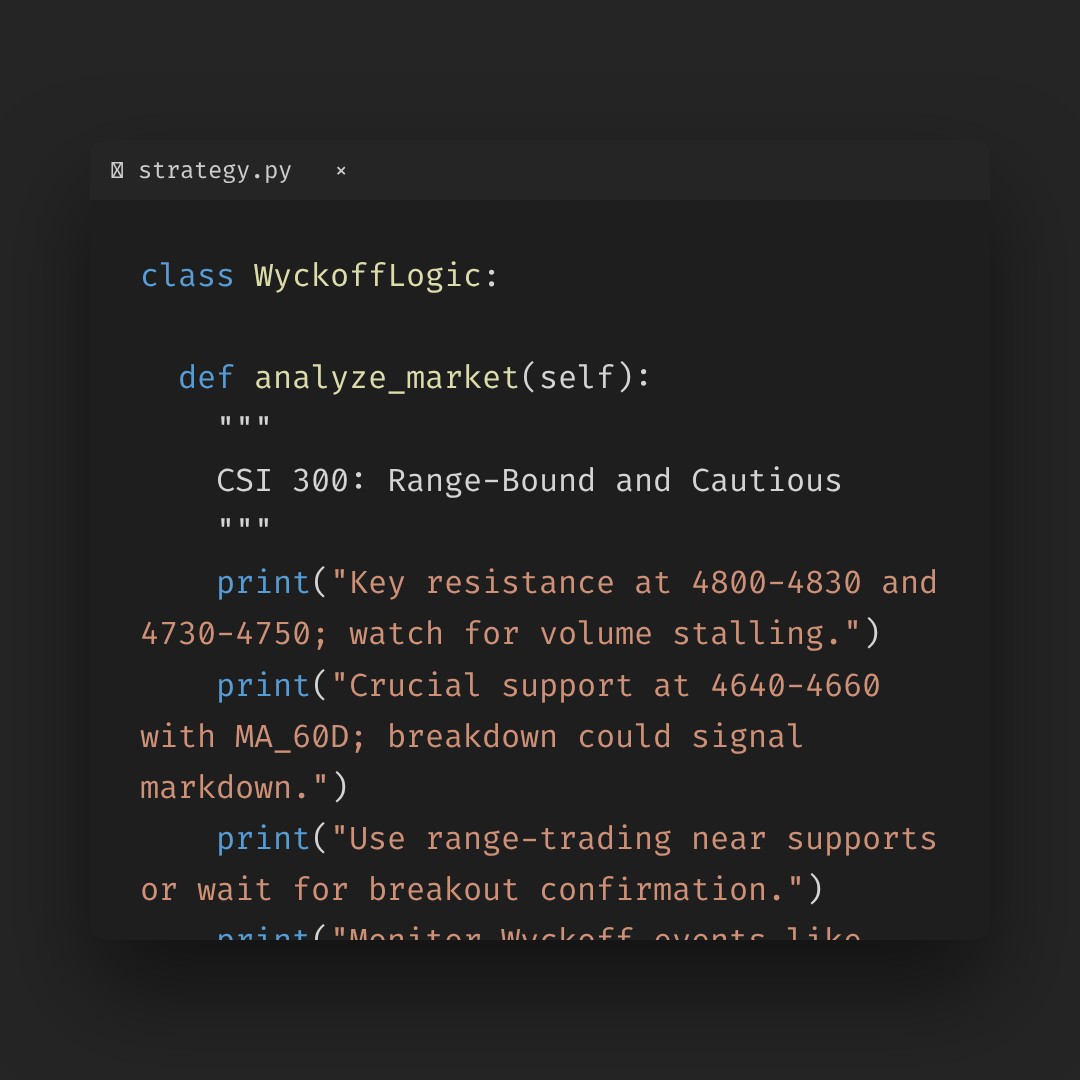
CSI 300 Index (000300.SH) Wyckoff Quantitative Analysis Report

Analysis Date Range: 2025-12-26 to 2026-02-24
Report Generation Date: 2026-02-24


1. Trend Analysis and Market Phase Identification

As of 2026-02-24, for the underlying asset 000300.SH: Open Price 4727.30, Close Price 4707.54, 5-Day Moving Average (MA_5D) 4707.43, 10-Day Moving Average (MA_10D) 4681.59, 20-Day Moving Average (MA_20D) 4700.47, Daily Change 1.01%, Weekly Change 1.01%, Monthly Change 0.03%, Quarterly Change 1.68%, Year-to-Date Change 1.68%.

000300.SH Price Trend Analysis Chart, including closing price and multiple moving averages

Based on the alignment of price with moving averages (MA) and price action, the market is transitioning from a Markup phase into a potential Distribution or Re-accumulation range.

  • MA Alignment and Price Relationship:
    • • As of 2026-02-24, the price (4707.54) is oscillating narrowly near the MA_5D (4707.43) and MA_10D (4681.59), but remains significantly above the MA_20D (4700.47), MA_30D (4718.91), and MA_60D (4644.32). Overall, the short- to medium-term MAs are still above the longer-term MAs, presenting a bullish alignment pattern.
    • • A critical signal emerged between 2026-01-06 and 01-08, where the price (4790.69) deviated sharply from all MAs, indicating clear overbought conditions. Subsequently, the price corrected and repeatedly tested the MA_20D and MA_30D, showing waning upward momentum. The failure of the price to effectively break above the January high again indicates significant supply overhead.
  • Wyckoff Market Phase Inference:
    • Preliminary Advance & Markup Phase: The movement from 2025-12-26 to 2026-01-06, where the price rose consecutively with increasing volume (VOLUME_AVG_7D_RATIO > 1.3), breaking through previous consolidation levels, aligns with the characteristics of a Markup phase.
    • Distribution Phase Signals: The price action from mid-late January to early February is key. After making a high, multiple instances of high-volume stalling or decline occurred (e.g., 01-14, 01-16, 01-28), accompanied by lower highs (4802.60 -> 4795.93 -> 4770.96). This fits the Wyckoff characteristic of "supply beginning to overpower demand" in the early stages of Distribution. The market's failure to generate a new upward breakout suggests that large investors may be distributing holdings in this area.

2. Volume-Price Relationship and Supply-Demand Dynamics

As of 2026-02-24, for the underlying asset 000300.SH: Open Price 4727.30, Close Price 4707.54, Volume 21848889000, Daily Change 1.01%, Volume 21848889000, 7-Day Average Volume 19931808571.43, 7-Day Volume Ratio 1.10.

000300.SH Volume-Price Relationship Line Chart and Historical Ranking Analysis

The data clearly reveals a dramatic shift in supply-demand forces, transitioning from demand dominance to intense multi-directional contention.

  • Demand-Dominant Phase:
    • 2026-01-05 to 01-06: Exhibited a classic Sign of Strength (SOS). On January 5th, a 1.90% gain occurred on volume of 23.41B, 1.38 times the 7-day average (VOLUME_AVG_7D_RATIO). On January 6th, a 1.55% gain was accompanied by a surge in volume to 29.70B, 1.73 times the 14-day average (ranking as the 11th highest weekly volume in the past decade), indicating strong buying demand pushing the price higher.
  • Supply Emergence and Contention Phase:
    • 2026-01-14: Exhibited a high-volume decline. The price fell 0.40%, but volume skyrocketed to 36.50B (ranking as the 10th highest weekly volume in the past decade), with turnover at 8913B (ranking 4th in the past decade). A high-volume decline at elevated prices is a strong signal of supply emergence (akin to a Selling Climax or Distribution).
    • 2026-01-28 to 01-29: Exhibited high-volume stalling. On January 28th, the price gained a mere 0.26% on volume of 38.23B (ranked 8th in the past decade). On January 29th, a 0.76% gain occurred on volume of 41.55B (ranking as the 4th highest weekly volume in the past decade). Limited price appreciation on massive volume indicates significant selling pressure (supply) at relatively high levels, with buying (demand) struggling to easily push prices higher.
    • Volume Trend: AVERAGE_VOLUME_14D and AVERAGE_VOLUME_21D reached historically extreme levels in late January and early February (e.g., AVERAGE_VOLUME_21D on 2026-02-04 was the highest in the past decade). Extremely high average volume levels often accompany significant turning points.
  • Recent Supply-Demand Balance: Since mid-February, volume has contracted significantly (VOLUME_AVG_14D_RATIO fell to 0.60 at one point, ranking as the 19th lowest in the past decade), and price fluctuations have narrowed. This indicates the market has entered a brief Equilibrium or Re-accumulation range following intense contention, awaiting directional selection.

3. Volatility and Market Sentiment

As of 2026-02-24, for the underlying asset 000300.SH: Open Price 4727.30, 7-Day Intraday Volatility 0.08, 7-Day Volatility Volume Ratio 0.64, 7-Day Historical Volatility 0.18, 7-Day Historical Volatility Volume Ratio 0.91, RSI 51.67.

000300.SH Historical Volatility Analysis Chart and Historical Ranking Data

Volatility data corroborates the market's transition from a trending rally to a high-volatility contention phase and its recent move towards calm.

  • Volatility Expansion (Panic/Contention Signal):
    • • During the high-price consolidation in late January and the decline in early February, short-term volatility expanded significantly. For example, on 2026-02-05, HIS_VOLA_7D rose to 0.229, and its ratio to HIS_VOLA_14D (HIS_VOLA_RATIO_7D_14D) reached 1.448 (ranking 3rd highest in the past decade), while PARKINSON_VOL_7D was also elevated (0.181). This aligns with the typical pattern of "short-term volatility far exceeding medium-term volatility," indicating tense market sentiment, significant buyer-seller divergence, and heightened activity from large capital.
  • Volatility Contraction (Balance Signal):
    • • By the analysis date (2026-02-24), short-term volatility has contracted notably. PARKINSON_VOL_7D fell to 0.085, and PARKINSON_RATIO_7D_14D was 0.639 (ranking 11th lowest in the past decade). Concurrently, the ratio of HIS_VOLA_7D (0.183) to longer-period volatility has retreated from its earlier extreme highs. Volatility contraction often signals that the market is brewing for a new directional move.
  • RSI Sentiment Indicator:
    • • RSI_14 reached overbought territory (69.41) on January 6th, confirming extreme upward momentum. It subsequently touched oversold territory (37.93) during the decline on February 2nd, releasing selling pressure. The current RSI_14 reading of 51.67 is in the neutral zone, with sentiment neither extremely optimistic nor pessimistic, matching the sideways price pattern.

4. Relative Strength and Momentum Performance

Momentum indicators show short-term upward momentum has exhausted, with the market entering a correction and consolidation period.

  • Periodic Return Analysis:
    • Short-Term Momentum (WTD/MTD): As of February 24th, the week-to-date return (WTD_RETURN) is 1.01%, but the month-to-date return (MTD_RETURN) is only 0.03%. This indicates the market has essentially been range-bound since February, lacking significant upward or downward trending momentum.
    • Medium-Term Momentum (QTD/YTD): The quarter-to-date return (QTD_RETURN) is 1.68%, and the year-to-date return (YTD) is also 1.68%, significantly weaker than the peak in mid-January (MTD_RETURN had exceeded 3.4%). The momentum peak has likely occurred, and the market is currently in a weak rebound following a correction and consolidation.

5. Large Investor (Smart Money) Behavior Identification

Synthesizing volume-price data, volatility, and ranking data, the behavioral path of large investors can be inferred:

  1. 1. Accumulation Followed by Markup (Late December 2025 - Early January 2026): Large investors likely completed preliminary accumulation during the consolidation in late December, then rapidly marked up prices away from their cost base on January 5-6 through massive buying (demand). The high-volume rally in this phase is typical of smart money driving a trend.
  2. 2. Distribution at High Levels (Mid to Late January 2026): As prices approached the 4800-point area, sustained record-setting volume levels emerged (with multiple indicators for turnover, volume, and average volume entering the top 20 rankings of the past decade). However, prices stalled. This strongly suggests that large investors were capitalizing on market optimism and ample liquidity to distribute holdings at elevated prices (Distribution). The price bars on January 14th and January 28-29th are textbook cases of distribution behavior.
  3. 3. Creating Volatility and Testing (Early February 2026): The high-volume decline on February 2nd (-2.13%) can be viewed as a Test of market support, or possibly Panic Selling triggered during the distribution process. The subsequent market rebound lacked supporting volume, indicating new demand has not entered the market on a large scale.
  4. 4. Current Behavior (Observation/Rebalancing): Recent volume has contracted below normal levels, and volatility has converged. This suggests large investors have slowed their phased operations, leaving the market dominated by smaller capital, seeking equilibrium within a new trading range established by the prior distribution.

6. Support/Resistance Level Analysis and Trading Signals

000300.SH Support and Resistance Level Analysis Chart and Trading Signals
  • Key Resistance Levels:
    • R1: The 4800-4830 Zone. This is the area of the rebound highs reached in January 2026 and a clear supply zone (distribution zone). Any volume-price behavior during rallies to this zone (e.g., high-volume stalling) will be a critical observation point.
    • R2: The 4730-4750 Zone. This area has recently resisted multiple rallies and serves as a secondary near-term resistance.
  • Key Support Levels:
    • S1: The 4640-4660 Zone. This area provided support for multiple decline lows in February 2026 and is also where the MA_60D (long-term trend line) currently resides. This zone is crucial.
    • S2: The 4600-4620 Zone. This is the breakout point from early January and the upper boundary of the December consolidation platform, representing a stronger support area.
  • Integrated Trading Signals and Operational Recommendations:
    • Primary Assessment: The market is in a range-bound oscillation following a Distribution phase. Until there is a confirmed, high-volume breakout above 4830 points, excessive optimism about the upside is unwarranted.
    • Operational Recommendation: Neutral to slightly bearish, adopt a wait-and-see or range-trading strategy.
      • Aggressive Strategy (Range Trading): Near the S1 support zone (4640-4660), combined with signs of low-volume stabilization (e.g., small-bodied candlesticks, long lower shadows), one might consider light positions for a bounce, targeting the R2 zone (4730-4750), with a stop-loss set below S2 (4600).
      • Conservative Strategy (Breakout Following): Maintain a wait-and-see approach. If the price breaks below the S1 (4640) support on high volume, it would signal confirmation that distribution is complete and a Markdown phase has begun, potentially justifying a follow-on short position, targeting S2. Conversely, if the price breaks above R1 (4830) with extremely high volume (approaching January levels), it could negate the distribution hypothesis, potentially initiating a new uptrend, at which point a long position might be considered.
    • Future Validation Points:
      1. 1. Bearish Validation Point: During a price rally to the R1 or R2 zone, observe increased volume without a new price high (UT/UTAD) or the formation of long upper shadows, followed by a reversal downward.
      2. 2. Bullish Validation Point: During a price pullback to the S1 or S2 zone, observe a high-volume bullish candlestick rebound following extremely low volume (a Spring or LPS), indicating exhausted supply and returning demand.
      3. 3. Directional Confirmation Point: A high-volume breakout above the R1 resistance zone or below the S1 support zone will indicate the primary direction for the next phase.

Conclusion Restated: Based on Wyckoff volume-price principles, after experiencing a smart-money-driven, demand-fueled rally in early January, the CSI 300 Index exhibited clear stalling under historically high volume in mid-to-late January, strongly pointing to distribution by large investors. The market has now entered a post-distribution equilibrium range with unclear short-term direction. Traders should focus on the defense of the 4640-4660 support zone and the supply strength at the 4800-4830 resistance zone, waiting for the market to provide a new directional signal. Until clear Wyckoff events occur at key levels, caution is advised, avoiding chasing rallies or selling into declines.


Disclaimer: This report/interpretation is solely for market analysis and research based on publicly available information and does not constitute any investment advice or operational guidance. The author strives for objectivity and fairness in the content but makes no guarantees regarding its accuracy or completeness. The market carries risks, and investment requires caution. Any investment actions taken based on this report are undertaken at one's own risk.


Thank you for your attention! Wyckoff Volume-Price market analysis is published daily at 8:00 AM before the market opens. We kindly request your comments and shares; your recognition is crucial. Let's work together to see the market signals clearly.