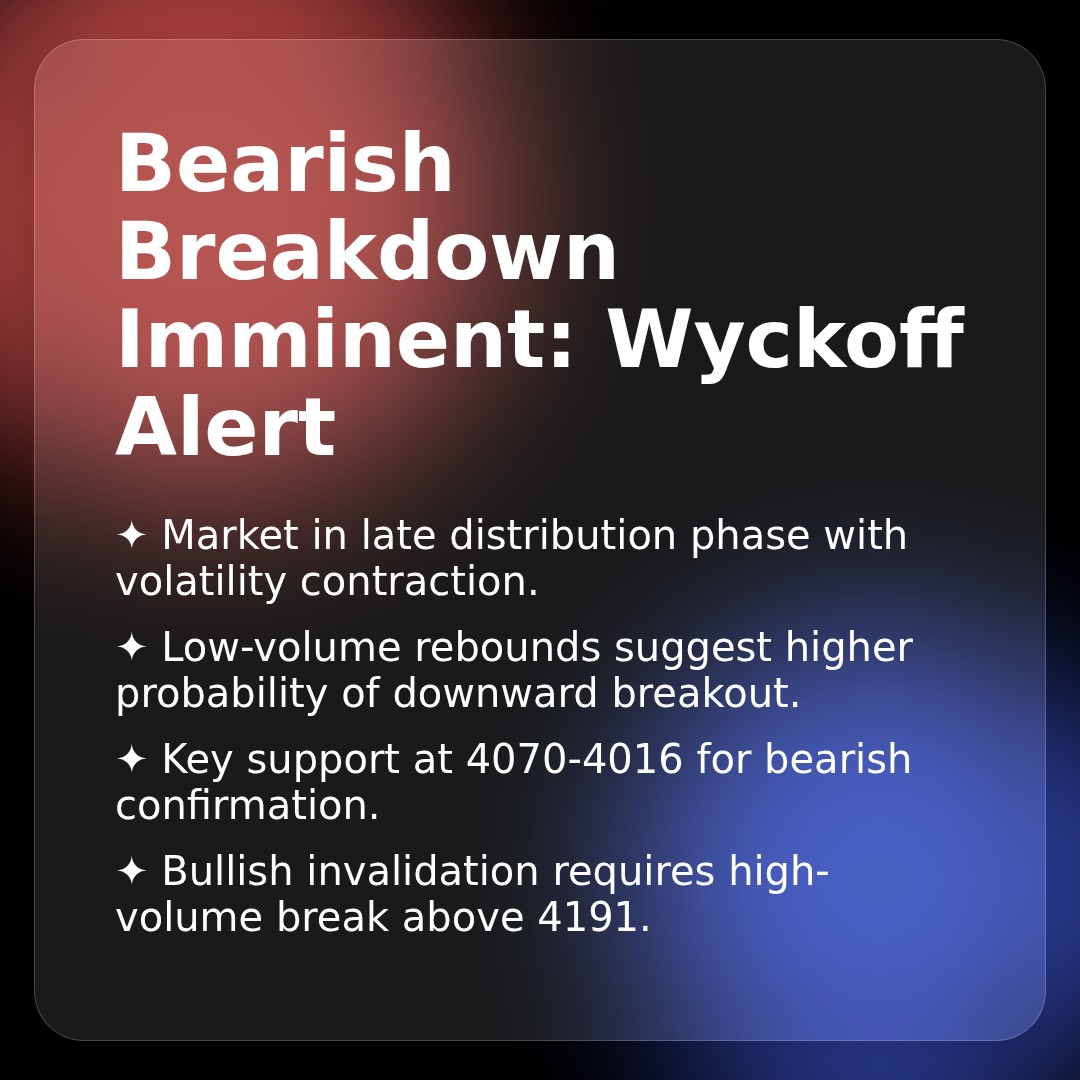
Quantitative Analysis Report: 000001.SH (Shanghai Composite Index)

Report Date: 2026-02-24
Analysis Period: 2025-12-26 to 2026-02-24 (Approximately 2 months)
Analyst: Quantitative Trading Researcher (Wyckoff Method)

I. Trend Analysis & Market Phase Identification

As of 2026-02-24, the underlying asset 000001.SH data: Open 4129.13, Close 4117.41, MA_5D 4119.91, MA_10D 4092.67, MA_20D 4111.49, Daily Change 0.87%, Weekly Change 0.87%, Monthly Change -0.01%, Quarterly Change 3.74%, Year-to-Date Change 3.74%.

Price Trend Analysis Chart for 000001.SH, including closing price and multiple moving averages
  1. 1. Price-Moving Average Relationship & Alignment:
    • Current Status (2026-02-24): The closing price 4117.41 is slightly below the MA_5D (4119.91), but above the MA_10D (4092.67), MA_20D (4111.49), MA_30D (4109.02), and MA_60D (4004.45).
    • Moving Average Alignment: Exhibits a pattern of loosening short-term bullish alignment but solid mid-to-long-term bullish alignment. The MA_5D shows signs of turning downward and is converging with the MA_10D and MA_20D; however, all moving averages remain significantly above the MA_60D, indicating that the foundation of the mid-term uptrend remains, but short-term adjustment pressure exists.
    • Moving Average Crossover Signals: Between January 5th and January 12th, the MA_5D successively crossed above the MA_20D, MA_30D, and MA_60D, forming a clear bullish golden cross, confirming the uptrend that began in late December. Currently, the spacing between MA_5D and MA_10D/MA_20D is narrowing, with no new significant crossover signals at present.
  2. 2. Market Phase Inference (Based on Wyckoff Theory):
    • Phase One (Accumulation/Basing): From December 26th to 31st, 2025, prices consolidated within a narrow range of 3957-3983 on moderate volume. The RSI_14 ranged between 60-61, indicating a healthy, slightly overbought condition. This can be viewed as the preparatory phase before this rally.
    • Phase Two (Markup/Trend): From January 5th to 12th, 2026, prices broke out on increased volume, surging rapidly from 4023 to 4165. Volume expanded significantly during this period (historical ranking data shows that volume on January 12th, 13th, and 14th all entered the Top 20 over the past decade), representing a typical demand-dominated markup phase.
    • Phase Three (Distribution/Consolidation): The market has a high probability of having entered a distribution phase since January 13th. Key evidence:
      • High-volume Stalling/Decline at Highs: On January 13th (volume 86.8B, ranking 12th in the past decade) and 14th (volume 95.3B, ranking 6th in the past decade), the index closed lower after making a high of 4190, forming the classic distribution characteristic of "high volume without price advance."
      • Sideways Consolidation at High Levels: After January 14th, prices consolidated in a wide range between 4079 and 4170 for over a month, failing to effectively breach the January highs again.
      • Volume Receding from Extreme Highs: Since February, volume has gradually contracted. The VOLUME_AVG_14D_RATIO has dropped from over 1.5 in mid-January to the current 0.87, indicating diminished interest from large buyers. Historical ranking data shows that the highest average volumes occurred from late January to early February and have now receded.
    • Conclusion: The market is most likely in a "distribution phase following an uptrend." Large capital conducted significant distribution during the climactic rally in January. Prices are currently consolidating at high levels, preparing for the next directional move.

II. Volume-Price Relationship & Supply-Demand Dynamics

As of 2026-02-24, the underlying asset 000001.SH data: Open 4129.13, Close 4117.41, Volume 56632224900, Daily Change 0.87%, Volume 56632224900, AVG_VOLUME_7D 54022006485.71, VOLUME_RATIO_7D 1.05.

Volume-Price Relationship Line Chart and Historical Ranking Analysis for 000001.SH
  1. 1. Key Day Analysis:
    • Demand-Dominated Days (High-Volume Advance):
      • 2026-01-06: Gain of 1.50%, volume 70.2B, VOLUME_AVG_14D_RATIO as high as 1.36, a strong demand-driven breakout day.
      • 2026-01-12: Gain of 1.09%, volume 83.9B (ranking 15th in the past decade), VOLUME_AVG_14D_RATIO of 1.47. This was the Climax Day of the rally wave, typically accompanied by the final buying or initial distribution by large investors.
    • Supply-Dominated Days (High-Volume Stalling/Decline):
      • 2026-01-13: Decline of -0.64%, volume 86.8B (ranking 12th in the past decade). This is a clear distribution signal day. High-volume decline indicates supply completely overwhelmed demand.
      • 2026-01-14: Decline of -0.31%, volume 95.3B (ranking 6th in the past decade), further confirming massive supply influx and a shift in market sentiment from greed to divergence.
      • 2026-02-02: Decline of -2.48%, volume 73.3B, VOLUME_AVG_7D_RATIO of 0.91. While the absolute volume is not extreme, the large decline suggests an episode of Panic Selling, testing lower support.
    • Insufficient Demand Days (Low-Volume Rebound):
      • 2026-02-24 (Current Day): Gain of 0.87%, volume 56.6B, VOLUME_AVG_14D_RATIO of 0.87. The price rebounded on volume below the 14-day average, showing insufficient rebound demand and weak follow-through buying interest.
  2. 2. Supply-Demand Dynamics Summary:
    • Climactic January Rally: Demand was extremely strong (high volume with price advance), but the end showed high-volume stalling, foreshadowing the covert entry of supply.
    • Mid-to-Late January to Present: Supply dominated in the 4160-4190 area, successfully suppressing prices. Subsequent rebounds during consolidation have consistently shown low-volume characteristics (e.g., Feb 10th, 11th, 12th, 24th), indicating limited new demand and reliance on existing capital. The current supply-demand landscape favors a "supply-controlled equilibrium," but demand is waning.

III. Volatility & Market Sentiment

As of 2026-02-24, the underlying asset 000001.SH data: Open 4129.13, PARKINSON_VOLA_7D 0.09, PARKINSON_VOLA_RATIO_7D_14D 0.72, HIS_VOLA_7D 0.16, HIS_VOLA_RATIO_7D_14D 0.80, RSI 54.18.

Historical Volatility Analysis Chart and Historical Ranking Data for 000001.SH
  1. 1. Volatility Levels & Changes:
    • Historical Volatility (HIS_VOLA): HIS_VOLA_7D surged from 0.045 to above 0.127 during the January rally, peaking at 0.269 (2026-02-09) during the early February panic sell-off. The current HIS_VOLA_7D (0.161) remains significantly higher than early January lows but has retreated from the extreme peak.
    • Volatility Ratio Anomalies: Indicators like HIS_VOLA_RATIO_7D_14D and _7D_21D reached historically high levels (ranking in the Top 15 historically) in early February (Feb 3rd to 9th), indicating intense short-term volatility amplification and unstable, panicked market sentiment. This ratio has since declined from its peak, showing some easing of panic.
    • Parkinson Intraday Volatility: Similar to historical volatility, it peaked during Feb 2nd-6th (0.170) and has now significantly converged to 0.087, indicating narrowing intraday movements and the market entering a Volatility Contraction state, often a precursor to a significant directional move.
  2. 2. Market Sentiment (RSI):
    • • On January 12th, the RSI_14 reached 81.40 (ranking 17th in the past decade), entering a severely overbought zone, providing momentum-based evidence for the exhaustion of the uptrend.
    • • Following the price correction, the RSI bottomed at 39.85 on February 2nd, nearing oversold territory.
    • • The current RSI_14 is 54.18, in a neutral-to-strong region, indicating market sentiment has normalized from extremes and is building energy for the next directional move.

IV. Relative Strength & Momentum Performance

  1. 1. Periodic Return Analysis:
    • Short-term Momentum (WTD/MTD): Weekly return 0.87%, Month-to-Date return -0.01%, showing short-term momentum has nearly vanished, with the market in a sideways state.
    • Mid-term Momentum (QTD/YTD): Quarter-to-Date / Year-to-Date return 3.74%. Mid-term momentum remains positive, but the primary growth came from the early January surge. The sideways action since January 12th has consumed mid-term momentum.
    • Momentum Verification Conclusion: Momentum analysis aligns with trend and volume-price conclusions—short-term upward momentum has exhausted, the mid-term trend has flattened significantly though not reversed, and the market lacks a directional driver.

V. Large Investor ("Smart Money") Behavior Identification

Based on data from the above four dimensions, the operational path of large investors can be inferred:

  1. 1. Distribution: This is the core behavior. From January 12th to 14th, amid historically significant volume (Top 20 in the past decade), prices stalled and declined. This is the classic "climactic distribution" behavior in Wyckoff theory. Smart money utilized the euphoric market sentiment and high liquidity to conduct large-scale distribution in the 4160-4190 zone. Historical ranking data (concentration of indicators like high price, close price, volume in mid-early January) provides strong corroborating evidence.
  2. 2. Test & Shakeout: The high-volume plunge on February 2nd (-2.48%) can be interpreted as a test of the lower boundary support of the distribution range, or potentially a shakeout to flush out weak holders who followed the trend into the January highs. The swift rebound after the plunge indicates capital was absorbed at lower levels, but not with sufficient force to initiate a new trend.
  3. 3. Current Intent: After completing the primary distribution, smart money is likely now in a "Observation and Control" state. By creating range-bound volatility (e.g., the low-volume rebound on Feb 24th), they maintain market activity to attract remaining buyers, while possibly conducting secondary distribution at the upper bounds of the range. The sustained contraction in volume (VOLUME_AVG_14D_RATIO < 1) indicates their active buying interest is extremely low.

Answers to Key Questions:

  • Who was buying during the mid-January high volume? Primarily sentiment-driven public buyers (retail, trend followers) and some late-to-the-party institutions.
  • Who was selling? Early-entering "smart money" and large institutional investors.
  • Who is currently on the sidelines due to low volume? Smart money is observing post-distribution, waiting for better re-entry or shorting opportunities; new capital is hesitant to enter due to the lack of a clear trend.

VI. Support/Resistance Level Analysis & Trading Signals

Support and Resistance Level Analysis Chart and Trading Signals for 000001.SH
  1. 1. Key Price Levels:
    • Primary Resistance Zone: 4165 - 4191 (Core distribution zone formed by the January 12th high and January 14th high).
    • Secondary Resistance Zone: 4140 - 4158 (Upper boundary formed by multiple rebound highs from late January to early February).
    • Primary Support Zone: 4070 - 4016 (Lower boundary of the February consolidation range and the February 2nd panic low).
    • Secondary Support / Current Pivot Point: 4112 - 4114 (Dense closing price area from January 15th, 19th, 20th, also near the current Feb 24th close).
  2. 2. Integrated Trading Signal & Operational Recommendations:
    • Wyckoff Event Judgment: The market is in the "late stage of the distribution phase," forming a Trading Range. Price movement is narrowing within the range (volatility contraction) on declining volume, typical of a "Dull" state, foreshadowing an imminent directional choice.
    • Directional Signal: Given that distribution occurred at highs and rebounds have been consistently low-volume, the probability of a downward breakout is higher than an upward one. An upward breakout would require significantly increased volume (at least VOLUME_AVG_14D_RATIO > 1.2) and a sustained move above 4191. A downward breakout confirmation would be a high-volume break below the 4070-4016 support zone.
    • Operational Recommendations:
      • Strategic Bias: Cautiously bearish, looking for rebound-to-sell opportunities.
      • Specific Plan:
        • Entry Zone: Consider establishing a short position when price rebounds into the 4140-4160 resistance zone and shows signs of stalling and declining volume on the 15-minute or hourly chart.
        • Stop Loss: Place above 4191 (upper boundary of the primary distribution zone).
        • Targets: First target at the lower range boundary 4070-4080; if broken with volume, second target near 4016.
      • Alternative Scenario & Risk Control: If price breaks above 4191 with strong volume, the bearish logic above is invalidated. Shift to observation or trend-following long positions.

Future Validation Points:

  1. 1. Bearish Validation: Price fails to hold sustainably above 4150 and subsequently breaks below the dense transaction support band of 4114-4112 with volume (VOLUME_AVG_14D_RATIO > 1.1).
  2. 2. Bullish Invalidation: Price breaks above 4191 without significant volume increase, or finds strong support near 4070 accompanied by a marked increase in volume (a sign of renewed demand).

Disclaimer: This report/interpretation is solely for market analysis and research based on publicly available information and does not constitute any investment advice or operational guidance. The author strives for objectivity and impartiality but makes no guarantees regarding accuracy or completeness. The market carries risks; investing requires caution. Any investment actions based on this report are undertaken at your own risk.


Thank you for your attention! Wyckoff Volume-Price Market Analysis is released daily at 8:00 AM before the market opens. Your comments and shares are greatly appreciated. Let's work together to see the market signals clearly.