All right. As a quantitative trading researcher proficient in the Wyckoff Method, I will author a comprehensive, in-depth quantitative analysis report for you based on the provided XLB data. All conclusions are strictly derived from the data and adhere to Wyckoff's principles of volume and price.
Wyckoff Method Quantitative Analysis Report: XLB
Symbol: XLB
Analysis Period: 2025-11-10 to 2026-01-09
Report Generation Time: 2026-01-10
1. Trend Analysis & Market Phase Identification
As of 2026-01-09, the underlying asset XLB opened at 47.59, closed at 48.26, with moving averages: MA_5D 46.88, MA_10D 46.32, MA_20D 45.75. Daily change: 1.60%, Weekly change: 4.64%, Monthly change: 6.42%, Quarterly change: 6.42%, Yearly change: 6.42%.

Key Data Derivation:
- • Before the Crash (2025-11-10 to 2025-11-20): Price (closing price fell from 86.63 to 84.46) consistently traded below all major moving averages (MA_5D to MA_60D), exhibiting a typical bearish alignment. The price center of gravity shifted lower, with successively lower highs and lows, indicating the market was in a clear downtrend.
- • Structural Break (2025-11-21): An extreme price event occurred, with the closing price plummeting to 43.175 on that day. This event caused a structural downward shift in all moving average systems.
- • After the Crash (2025-11-24 to 2026-01-09): Price oscillated within a narrow range of 43-48. Short-term moving averages (MA_5D, MA_10D) began to flatten and curve upward, while the long-term moving average (MA_60D) continued its rapid descent.
- • Current Pattern (2026-01-09): Price (48.26) has moved above MA_5D (46.876) and MA_10D (46.315) but remains below MA_20D (45.7465). MA_5D recently crossed above MA_10D, forming a short-term golden cross signal.
Wyckoff Phase Assessment:
The data clearly shows a "Panic Selling" event, marking the potential end of a long-term downtrend. The price action following the crash is key:
- 1. Panic Selling (PS, 2025-11-21): Price plummeted vertically by a nearly unprecedented magnitude (-48.88%) on enormous volume (ranked 16th highest in the past decade), a classic panic event.
- 2. Automatic Rally (AR, 2025-11-25): Following the panic, price rebounded swiftly to 44.445.
- 3. Secondary Test / Accumulation Range Formation (ST/Accumulation, 2025-11-26 to 2026-01-02): Price retreated and underwent over a month of narrow, low-volatility consolidation between 42.35-45.15 with contracting volume. This is a typical characteristic of the Accumulation Phase - smart money quietly accumulating positions at low levels.
- 4. Breakout Attempt (Sign of Strength, starting 2026-01-05): Price broke out above the upper boundary of the consolidation range (45.15) on increased volume, short-term moving averages formed a golden cross, and the RSI moved out of oversold territory. This suggests accumulation may be nearing completion, and the market is attempting to enter the early stage of a new uptrend.
Conclusion: Following a historic panic sell-off, the market has entered a narrow accumulation phase lasting over a month. The current technical pattern indicates that the accumulation phase may be nearing its end, with price attempting to break out upwards, potentially initiating a new upward cycle.
2. Volume-Price Relationship & Supply-Demand Dynamics
As of 2026-01-09, the underlying asset XLB opened at 47.59, closed at 48.26, volume 11,748,617, daily change 1.60%, volume 11,748,617, 7-day average volume 14,347,934.29, 7-day volume ratio 0.82.

Key Data Derivation:
- • Panic Day (2025-11-21):
VOLUME20,989,598 (16th highest in the past decade),PCT_CHANGE-48.88% (largest single-day drop in the past decade),VOLUME_AVG_60D_RATIOreached 3.11. A massive-volume crash, the extreme manifestation of supply (selling). However, the closing price (43.175) was above the intraday low (42.3525) accompanied by huge volume, aligning with the Wyckoff characteristic of "Panic Selling" implying underlying demand (smart money buying). - • Absorption After Panic (2025-11-24 to 2025-11-28): Volume remained significantly above the long-term average (
VOLUME_AVG_60D_RATIObetween 1.36 and 2.67), while price rose modestly (from 43.26 to 44.70). This indicates that demand began actively absorbing panic-induced supply at the panic lows. - • Accumulation Range (2025-12-01 to 2025-12-31): Volume contracted notably, with
VOLUME_AVG_60D_RATIOmostly between 1.0-1.8, and price volatility narrowed. This is typical low-volume, trendless consolidation, suggesting large-scale selling has ceased, with buyer and seller forces reaching temporary equilibrium as smart money patiently accumulates. - • Breakout Signals (2026-01-02 and onwards):
- • 2026-01-02: Volume surged 216% (
VOLUME_GROWTH),VOLUME_AVG_60D_RATIOreached 2.08, price increased 1.70%. Rising on increased volume, demand beginning to dominate. - • 2026-01-05 to 2026-01-09: Continuously exhibited a healthy volume-price structure of "rising price on increased volume, price adjustment on decreased volume". For example, January 6th saw a 1.98% gain on high volume, January 7th a -1.73% pullback on lower volume, and January 8th-9th rising again on increased volume.
- • 2026-01-02: Volume surged 216% (
Wyckoff Supply-Demand Assessment:
- 1. 2025-11-21: Supply Climax, followed by demand intervention.
- 2. 2025-11-24 to 2025-12-31: Supply-Demand Equilibrium (Accumulation). Contracting volume indicates reduced floating supply; price rejecting new lows indicates demand providing support at key levels.
- 3. 2026-01-02 to Present: Demand Beginning to Outpace Supply. The breakout from the consolidation range on high volume is a clear signal of strengthening demand and waning supply.
Conclusion: A clear reversal in the supply-demand relationship has occurred. Transitioning from extreme supply dominance (panic selling), to supply-demand balance (accumulation), and recently evolving into demand beginning to dominate the market. The massive volume on breakout days suggests substantial buying interest is entering the market.
3. Volatility & Market Sentiment
As of 2026-01-09, the underlying asset XLB opened at 47.59, 7-day intraday volatility 0.21, 7-day intraday volatility ratio 1.45, 7-day historical volatility 0.28, 7-day historical volatility ratio 1.34, RSI 43.64.

Key Data Derivation:
- • Volatility Peak:
HIS_VOLA_7Dreached 4.8697 on 2025-11-26 (3rd highest in the past decade).HIS_VOLA_RATIO_7D_60D(short-term/long-term volatility ratio) reached 2.9334 on 2025-12-02 (highest in the past decade). This confirms that the panic event triggered an extreme, structural spike in volatility. - • Volatility Contraction: Entering December, volatilities across horizons (
HIS_VOLA_7D,PARKINSON_VOL_7D) contracted and declined rapidly and consistently.HIS_VOLA_7Dfell from the peak of 4.87 to the 0.06-0.27 range. This indicates market sentiment shifted rapidly from extreme panic to calmness and hesitation, a typical characteristic of the accumulation phase. - • Current Volatility: As of 2026-01-09,
HIS_VOLA_7Dis 0.2789,PARKINSON_VOL_7Dis 0.2082. Having receded from extreme values, it remains significantly above pre-panic normal levels (approx. 0.15 on 2025-11-10), suggesting the market is still in a recovery phase but sentiment has stabilized. - • RSI Sentiment Indicator: RSI_14 dropped to 6.53 the day after the panic (2025-11-24) (lowest in the past decade), indicating the market fell into deep oversold conditions. Subsequently, within the accumulation range, RSI hovered at extremely low levels between 10-20 for an extended period. Currently, RSI has recovered to 43.64, having exited the oversold zone and entered neutral-to-strong territory, corroborating the price increase.
Conclusion: Market sentiment has completed the evolution from "extreme panic -> calm hesitation -> initial optimism." Volatility has contracted from historical highs, and RSI has recovered from historical lows, jointly validating the formation of a market sentiment bottom and the initiation of a recovery process. The current volatility level provides room for trending action.
4. Relative Strength & Momentum Performance
Key Data Derivation:
- • Long-Term Momentum:
TTM_12,TTM_24,TTM_36are all deeply negative (-42.66% to -40.33%), indicating extremely weak long-term momentum, consistent with the technical damage from the panic sell-off. - • Short-Term Momentum Reversal:
MTD_RETURN(6.42%),QTD_RETURN(6.42%),YTD(6.42%) have all turned positive, and the values are identical, indicating a significant, uniform upward turn in short-term momentum since early January 2026. - • Momentum-Price Confirmation: The timing of the positive short-term returns perfectly aligns with the price breakout from the accumulation range and the short-term moving average golden cross, forming a multi-factor bullish resonance signal across price, moving averages, and momentum indicators.
Conclusion: Although long-term momentum remains weak, short-term momentum has clearly turned upward and resonates powerfully with the price breakout behavior. This strengthens the assessment that a阶段性 bottom has been established and a new upward momentum has initiated.
5. Large Investor (Smart Money) Behavior Identification
Based on Wyckoff events and volume-price data, inferences regarding smart money behavior are as follows:
- • 2025-11-21 (Panic Selling Day): Retail and leveraged funds engaged in panic selling (supply) during the extreme decline. However, the massive volume and closing price above the intraday low strongly suggest large investors were actively accumulating positions on a large scale at the lows, capitalizing on the panic sentiment (demand). This is classic smart money accumulation behavior during a "Panic Selling" event.
- • 2025-11-24 to 2025-12-31 (Accumulation Range): Volume contracted, and price fluctuated narrowly. Smart money behavior shifted from "active sweeping" to "patient testing and accumulation at lows." They tested market selling pressure and support by gently pushing prices up and down, continuing to collect筹码 at the range bottom while avoiding triggering a rapid price rise.
- • 2026-01-02 to Present (Breakout Phase): Volume increased again, propelling price higher. This suggests smart money strategy may be transitioning from "stealth accumulation" to "active propulsion." The high-volume bullish candles on January 2nd and January 5th likely represent "breakout buying" by smart money at the key resistance level (former upper boundary of the consolidation range), aimed at attracting trend followers and confirming the uptrend.
Core Assessment: Large investors orchestrated the market reversal following this panic event. Their operational chain is clear: massive accumulation on the panic day -> patient collection during the accumulation range -> recent high-volume breakout to guide the trend. Their intent is to establish new long positions from a structural low point.
6. Support/Resistance Level Analysis & Trading Signals

Key Price Levels:
- • Primary Support Zone: 42.35 - 43.17. This is the initial low area following the panic sell-off and the absolute bottom of the accumulation range. This zone is the key defensive line for assessing accumulation failure and a return to downtrend.
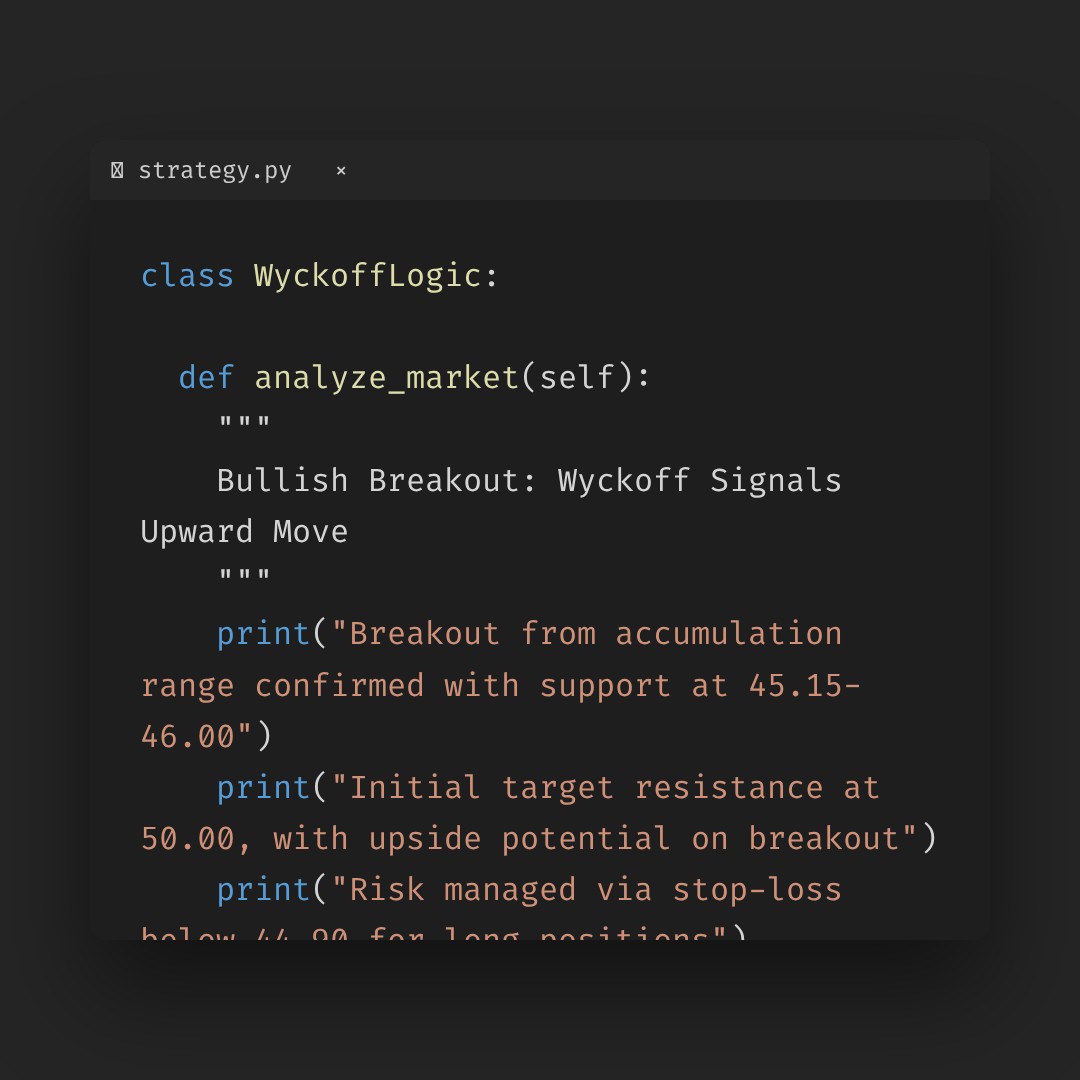
- • Secondary Support / Breakout Confirmation Level: 45.15 - 46.00. This was the upper boundary of the prior accumulation range, recently broken by bullish candles. This area has now transformed into important support; holding above it on a pullback indicates strength.
- • Immediate Resistance: 48.29 (2026-01-09 high). Breaking this level would open upside space.
- • Next Key Resistance: 50.00 (psychological level and potential technical resistance).
Comprehensive Wyckoff Event Trading Signal:
The market has completed the classic bottoming process of "Panic Selling -> Automatic Rally -> Secondary Test/Accumulation" and has shown the strong signal (SOS) of "Breaking out of the accumulation range."
- • Primary Trend Signal: Bullish. Market structure suggests a significant intermediate-term bottom is forming.
- • Operational Recommendations:
- 1. Aggressive Strategy: Consider establishing partial long positions when price stabilizes above 46.50 (recent minor platform high).
- 2. Conservative Strategy: Wait for a pullback to the 45.50-46.00 area (post-breakout support zone), entering upon observing signs of a low-volume halt in the decline.
- 3. Stop-Loss Placement: Stop-loss for all long positions should be placed below the bottom of the accumulation range, suggested at 44.90 (below the recent pullback low of 45.00).
- 4. Target Outlook: Initial target can be set towards 50.00. If broken and held above 50, higher technical resistance levels can be considered.
Future Validation Points (Require Close Monitoring):
- • Confirmation Signals: Price maintains above the 46.00 support and breaks the 48.29 resistance on increased volume. Volume should remain active during up days (
VOLUME_AVG_7D_RATIO > 1.2). - • Invalidation Signals: Price falls back below 45.00 on increased volume, especially breaking the 44.90 support level. This would signal a failed breakout, potentially leading the market back into accumulation consolidation or testing lower supports, necessitating a reassessment of market structure.
Disclaimer: All content in this report is based on quantitative analysis and theoretical derivation using the provided historical data and does not constitute specific investment advice. Financial markets carry risks, and past performance is not indicative of future results. Investors should make independent judgments and exercise caution in their decisions.
Thank you for your attention! Wyckoff volume-price market insights are released daily at 8:00 before market open. Please feel free to comment and share; your recognition is vital. Let's see the market signals together.
Member discussion: