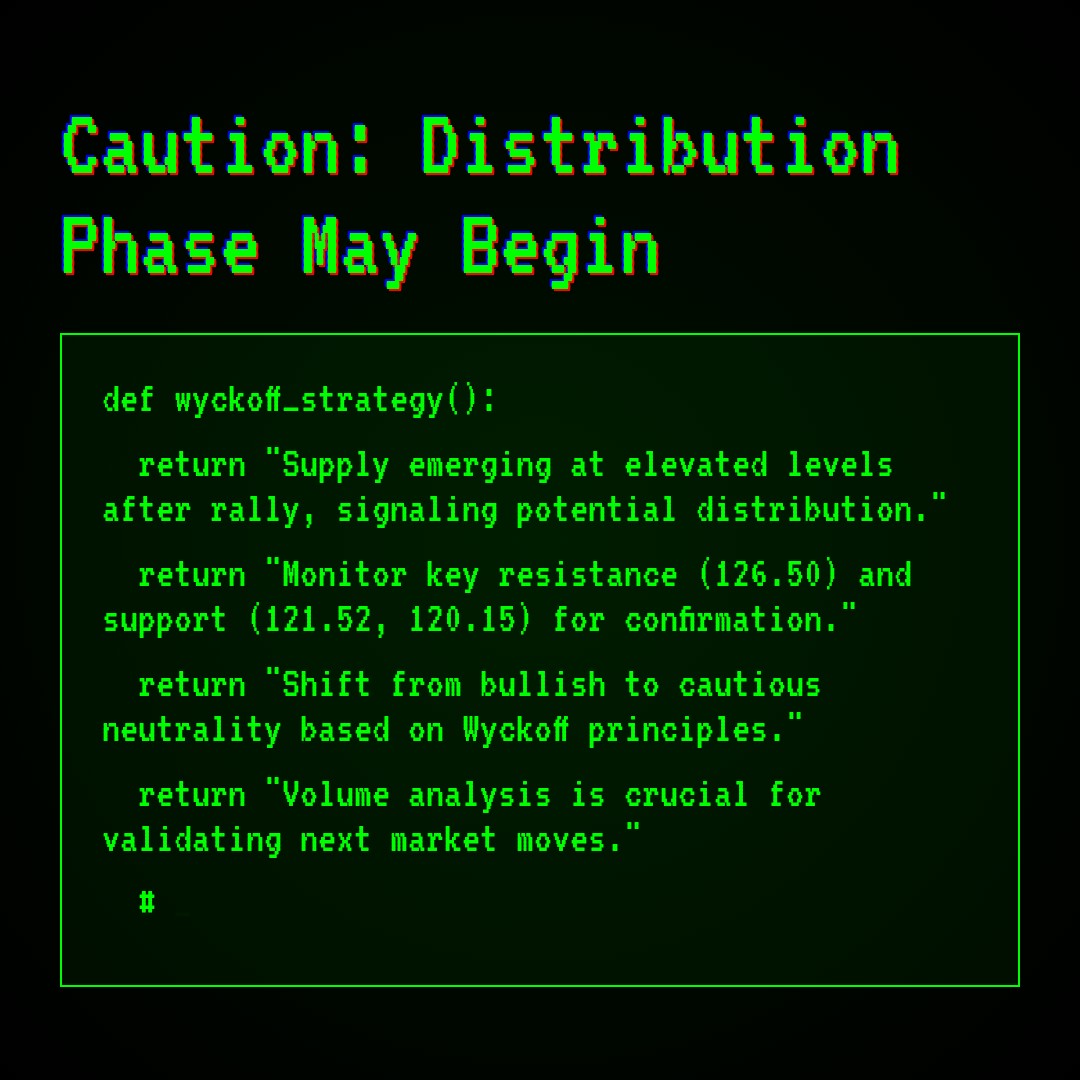
Understood. As a quantitative trading researcher proficient in the Wyckoff Method, I will provide a comprehensive quantitative analysis report on XBI based on the data you supplied. The report will strictly adhere to the six-dimensional framework, with all conclusions derived from data and consistent with Wyckoff's principles of price and volume.
Wyckoff Quantitative Analysis Report: XBI
Product Code: XBI (SPDR S&P Biotech ETF)
Analysis Date Range: 2025-11-10 to 2026-01-09
Core Thesis: The market is currently in a consolidation phase following a mid-term uptrend, showing preliminary signs of supply beginning to dominate. Recent record-breaking volume events reveal traces of activity by large institutional investors ("smart money"). The market faces a directional decision in the near term, and caution is warranted regarding potential distribution activity.
1. Trend Analysis & Market Phase Identification
As of 2026-01-09, the subject XBI has an opening price of 125.20, a closing price of 124.50, a 5-day moving average (MA) of 122.78, a 10-day MA of 123.22, a 20-day MA of 123.02, a daily change of 0.64%, a weekly change of 2.45%, a monthly change of 2.11%, a quarterly change of 2.11%, and a yearly change of 2.11%.

- • Moving Average Alignment & Price Relationship: As of 2026-01-09, the price (124.50) is above all major moving averages (MA_5D: 122.78, MA_10D: 123.22, MA_20D: 123.02, MA_30D: 122.65, MA_60D: 116.91), exhibiting a typical bullish alignment and confirming that the intermediate-term uptrend remains intact. However, the short-term MA_5D is beginning to flatten and shows a slight downward inflection, with its divergence from the price narrowing, suggesting that short-term upward momentum is waning.
- • Inferred Market Phase: Based on price action and the moving average system, the market is currently in the "late stage of an uptrend" or the "early phase of a distribution stage." Since late November 2025, the price rallied strongly from around the 110 level to near 126.5, completing a clear "Markup" phase. After reaching the 126.5 high in late December 2025, the price entered a high-level consolidation range between 124 and 126.5. During this period, several instances of high-volume stagnation on advances and low-volume bounces occurred, aligning with the early characteristics of a "Distribution" phase in Wyckoff theory. A decisive breakdown has not yet occurred, therefore it is judged as a transitional period for a potential trend reversal.
2. Price-Volume Relationship & Supply-Demand Dynamics
As of 2026-01-09, the subject XBI has an opening price of 125.20, a closing price of 124.50, a volume of 9,878,484, a daily change of 0.64%, a volume of 9,878,484, a 7-day average volume of 11,214,846.14, and a 7-day volume ratio of 0.88.

- • Demand-Dominated Key Days:
- • 2025-11-11: Strong advance on high volume (gain of 3.56%, volume 13.74M, 127% of 14-day average), effectively breaking through the previous consolidation range, confirming robust demand.
- • 2026-01-07: Surge on massive volume (gain of 3.55%, volume 19.35M, 237% of 7-day average), setting a recent high, indicating concentrated demand release.
- • Supply-Dominated Key Days:
- • **2025-12-02: **Massive volume decline (loss of 1.16%, volume 22.05M). The day's trading value ranked as the 2nd highest in the past decade. This is a clear signal of panic selling, showing a large influx of supply. However, the price was quickly bid up in the following days, indicating stronger demand absorbing the selling pressure, constituting a successful "Shakeout" or test.
- • 2025-12-31 / 2026-01-02 / 2026-01-05: Consecutive instances of "low-volume decline," with volume below various period averages, suggesting limited active selling pressure during the decline, more due to a lack of buying interest.
- • **2026-01-08: Stagnation/decline on high volume (loss of 2.15%, volume 14.91M, 147% of 7-day average). Following the massive bullish candle of the previous day, the failure to advance further combined with a high-volume bearish close is a classic signal of supply overwhelming demand.
- • Current State (2026-01-09): The price rose slightly (0.64%), but volume (9.88M) shrank significantly, only 88% of the 7-day average. This is a bearish signal known as an "Upthrust After Distribution," indicating insufficient follow-through buying (demand). The advance is driven by inertia or small capital flows, while supply is accumulating stealthily.
3. Volatility & Market Sentiment
As of 2026-01-09, the subject XBI has an opening price of 125.20, a 7-day intraday volatility of 0.28, a 7-day intraday volatility ratio of 1.18, a 7-day historical volatility of 0.35, a 7-day historical volatility ratio of 1.07, and an RSI of 56.36.

- • Volatility Level: The current 7-day historical volatility (0.354) is significantly higher than the 30-day (0.289) and 60-day (0.293) volatilities. The 7-day Parkinson volatility (0.285) is also above its long-term average. This indicates heightened short-term market tension and increased price swings, typically seen near trend endings or turning points.
- • Volatility Ratios:
HIS_VOLA_RATIO_7D_60Dis 1.21, andPARKINSON_RATIO_7D_60Dis 1.16, both greater than 1, confirming the abnormal short-term volatility expansion. This aligns with the sharp price movements and massive volume seen recently (Jan 7-8), reflecting a market sentiment intertwined with excitement and hesitation. - • RSI Sentiment Indicator: The RSI_14 is currently 56.36, in a neutral-to-strong zone, having retreated from its peak on Jan 7 (62.14). Throughout the analysis period, the RSI did not enter extreme overbought territory (>80), peaking at 76.60 on Nov 26. This suggests the rally was not driven by extreme sentiment bubbles, but short-term momentum has begun to decay.
4. Relative Strength & Momentum Performance
- • Periodic Momentum: YTD (2.11%), QTD (2.11%), and MTD (2.11%) returns are all positive, indicating short-term momentum remains upward. WTD_RETURN (2.45%) is also positive, but primarily contributed by the massive bullish candle on Jan 7. Compared to the QTD_RETURN of approximately 23% in Q4 2025, the current momentum intensity has significantly slowed.
- • Momentum Validation: The short-term momentum (WTD) aligns with the price making a new swing high (Jan 7), confirming the presence of buying power. However, the failure of momentum to persist (turning negative on Jan 8) validates the "supply emergence" conclusion from the price-volume analysis, casting doubt on the sustainability of the upward momentum.
5. Large Investor ("Smart Money") Behavior Identification
- • **Accumulation/Shakeout: **The massive volume decline on 2025-12-02, with trading value ranking 2nd highest in the past decade, is a classic manifestation of smart money behavior. This likely represents large capital accumulating positions by exploiting market panic or conducting a mid-rally shakeout to wash out weak holders. The subsequent rapid rebound confirmed the strength of demand.
- • **Demand Surge Confirmation: **The massive volume advance on 2026-01-07 (trading value ranking 5th highest in the past decade) is a clear signal of smart money actively buying and driving the price breakout. This represents a concentrated expression of professional capital's optimism about the market outlook.
- • **Distribution Suspicion: **The "high-volume stagnation" on 2026-01-08 is a key warning signal. Smart money may be utilizing the previous day's market euphoria to distribute shares to the public chasing the rally at elevated prices. The "low-volume advance" on Jan 9 further supports this hypothesis—smart money buying interest is declining, and the market is being led by retail funds.
- • Intent Inference: Smart money completed accumulation/panic absorption during the early December 2025 shakeout and initiated a strong markup push on Jan 7, 2026. Currently, at elevated price levels, their behavior pattern may be shifting from "active pushing" to "high-level distribution or观望."
6. Support/Resistance Level Analysis & Trading Signals

- • Key Resistance Levels (Supply Zones):
- • R1: 126.43 - 126.50: A strong resistance zone formed by recent rally highs (2025-12-22, 2026-01-07). A breakout above this zone requires accompanying high volume; otherwise, it confirms the distribution structure.
- • R2: 123.00 - 124.00: The upper boundary of the recent consolidation range and a psychological level, serving as short-term resistance.
- • Key Support Levels (Demand Zones):
- • S1: 121.52: The recent pullback low (2026-01-02), also near the 30-day MA.
- • S2: 120.15: The low on 2026-01-05. A break below this level would破坏 the short-term upward structure.
- • S3: 116.65 - 118.46: The high-volume成交 area from mid-to-late December 2025 and the region containing the 60-day MA, representing significant intermediate-term support.
- • Comprehensive Wyckoff Trading Signals:
- • Current Signal: Cautiously Bearish / Neutral. Preliminary signals of "supply beginning to dominate demand" have emerged (high-volume stagnation + low-volume advance). This marks the potential beginning of a "distribution structure."
- • Tactical Recommendations:
- 1. Bullish Strategy: Advise neutrality. Avoid chasing the rally unless the price breaks above the 126.50 resistance with strong volume (at least above the 7-day average).
- 2. Bearish Strategy: Monitor actively. If a subsequent "Secondary Test" occurs—a bounce towards the 126.50 or 123-124 area accompanied by low volume or another instance of high-volume stagnation—it could be considered an opportunity for a试探 short position. Initial stops should be placed above the recent high (e.g., 126.60).
- 3. Key Validation Points: Observe how price tests the S1 (121.52) and S2 (120.15) support levels. A break below S2 accompanied by expanding volume would confirm supply has taken full control, establishing the distribution phase and opening up下行空间. Conversely, if support is found at S1 or S2, followed by吸筹 signals like a "Spring" or "Selling Climax" with萎缩 volume, the uptrend may resume.
Conclusion Summary:
Based on Wyckoff price-volume principle analysis, XBI is in a high-level consolidation state following a strong intermediate-term rally. Rare, decade-high volume events reveal deep participation by large investors. The latest data shows supply beginning to emerge at elevated levels (Jan 8 high-volume stagnation), while demand跟进 is weak (Jan 9 low-volume advance), constituting an early warning for a potential transition from "Markup" to "Distribution." Investors are advised to shift from an积极 bullish stance to cautious neutrality. Close attention should be paid to the results of price-volume tests at the key resistance and support levels mentioned above to confirm the primary direction of the next phase. The market is poised to deliver a clearer directional signal.
Disclaimer: This report/analysis is solely for market analysis and research based on publicly available information and does not constitute any investment advice or operational guidance. The author strives for objectivity and impartiality but makes no guarantees regarding accuracy or completeness. Markets involve risks; investing requires caution. Any investment actions taken based on this report are undertaken at one's own risk.
Thank you for your attention! Wyckoff Price-Volume Market Analysis is published daily before the market opens at 8:00. Your comments and shares are greatly appreciated and crucial. Let's work together to see the market signals clearly.
Member discussion: