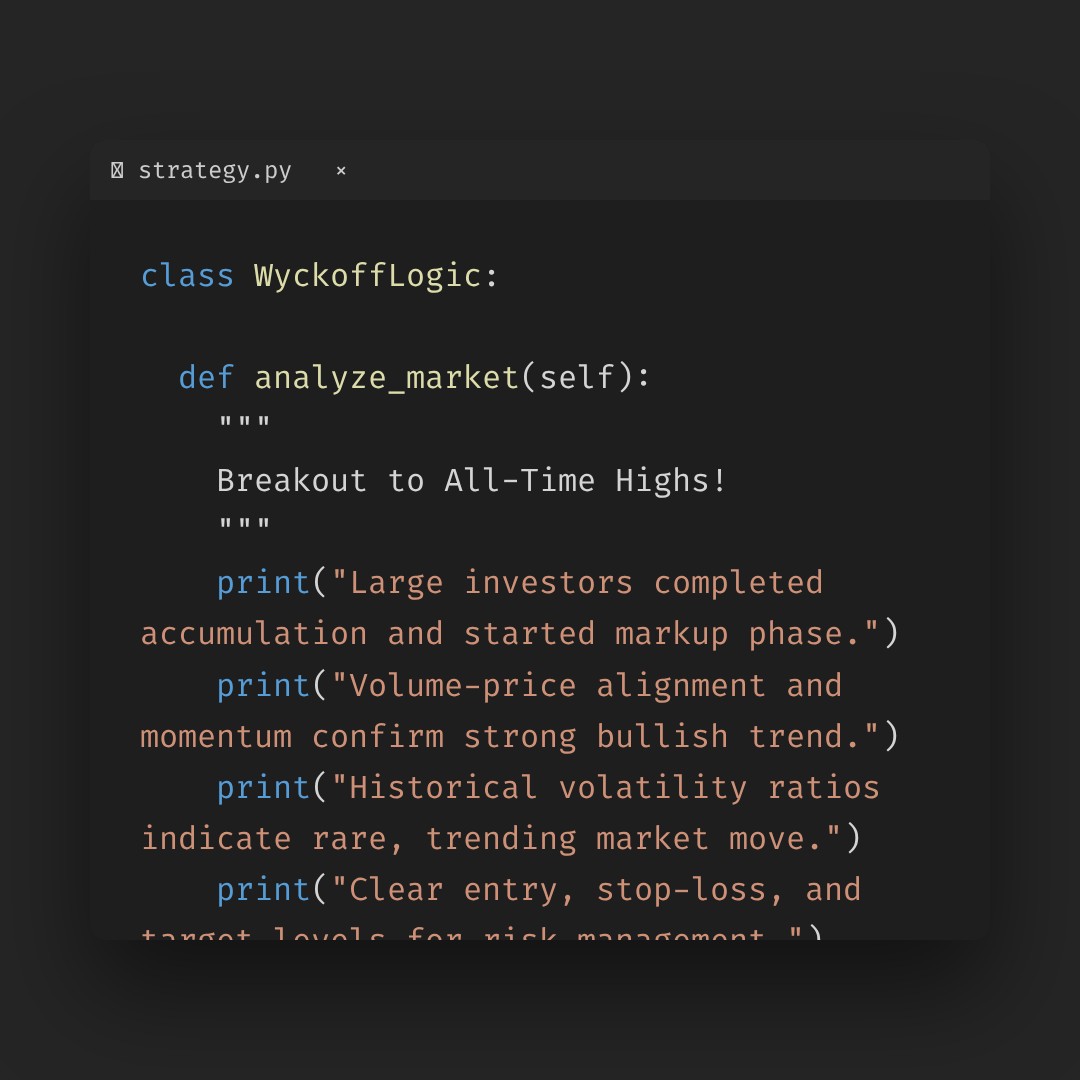
VCR Quantitative Analysis Report (Based on the Wyckoff Method)
Product Code: VCR
Analysis Date Range: 2025-11-10 to 2026-01-09
Report Generation Time: 2026-01-10
1. Trend Analysis and Market Phase Identification
As of January 9, 2026, the underlying asset VCR had an opening price of 408.40, a closing price of 412.70, a 5-day moving average of 400.30, a 10-day moving average of 399.72, a 20-day moving average of 400.04, a daily change of +1.15%, a weekly change of +5.37%, a monthly change of +4.77%, a quarterly change of +4.77%, and a yearly change of +4.77%.

Data Derivation and Phenomenon Observation:
- • Trend Transition Period (2025-11-13 to 2025-11-20): The price (CLOSE) rapidly declined from 393.89 to 362.96, a drop of -7.85%. During this period, the price successively broke below all moving averages (MA_5D to MA_60D), forming a typical bearish alignment. This marked the market's transition from a relatively balanced or uptrend phase into a clear downtrend.
- • Consolidation and Bottoming Period (2025-11-21 to 2025-12-29): The price oscillated widely between 362.96 and 403.80. Short-term moving averages (MA_5D, MA_10D) intertwined around the price, while long-term moving averages (MA_20D, MA_30D, MA_60D) began to flatten and gradually converge. During this phase, price attempted to rebound but was repeatedly rejected by the descending MA_20D, indicating intense struggle between supply and demand.
- • Trend Reversal and Confirmation Period (2025-12-30 to 2026-01-09): The price initiated a strong rebound from the low of 398.53. Starting from January 6, 2026, the price has continuously and significantly remained above all major moving averages, forming a bullish alignment (CLOSE > MA_5D > MA_10D > MA_20D > MA_30D > MA_60D). The MA_5D crossed above the MA_20D in early January (a "Golden Cross"), and the MA_10D subsequently crossed above the MA_20D, confirming the shift in short- and medium-term momentum.
Wyckoff Phase Inference:
Integrating price action and the moving average system, the market has undergone a complete Wyckoff cycle during the analysis period: Post-distribution decline (mid-November) -> Panic Selling (around Nov 20) -> Automatic Rally and Secondary Test (late Nov to Dec) -> Accumulation (Dec consolidation) -> Markup (early Jan). Currently (as of 2026-01-09), it is in the early stage of the Markup phase, with price attempting to break away from the prior accumulation range.
2. Volume-Price Relationship and Supply-Demand Dynamics
As of January 9, 2026, the underlying asset VCR had an opening price of 408.40, a closing price of 412.70, a daily volume of 45,702, a daily change of +1.15%, a daily volume of 45,702, a 7-day average volume of 48,416.86, and a 7-day volume ratio of 0.94.

Key Days and Supply-Demand Shift Analysis:
- 1. Supply-Driven Panic Selling (2025-11-20): Price fell -1.69%, while volume surged to 75,815, the third-highest in the analysis period. The
VOLUME_AVG_7D_RATIOfor that day was as high as 1.93, andVOLUME_GROWTHwas 16.70%. This is a classic Panic Selling event, where supply was released in an extreme manner. Combined with historical rankings, theAVERAGE_VOLUME_60Drank was the 12th lowest that day, indicating this massive selling occurred against a backdrop of long-term low activity, enhancing its significance. - 2. Emerging Demand and Accumulation Signal (2025-11-24): Price rebounded +1.36%, with volume exploding to 105,645, the highest in the analysis period.
VOLUME_AVG_7D_RATIOreached 2.03, andVOLUME_GROWTHsoared to 114.13%. A high-volume surge following a panic low is a classic signal of "smart money" entering to accumulate, marking the beginning of demand taking control of the market after supply exhaustion. - 3. Demand Validation During the Uptrend (2026-01-05 to 2026-01-09): During the price advance, volume exhibited a healthy "price rising on increasing volume" pattern. Notably on January 9, price rose +1.15% on volume of 45,702 (
VOLUME_AVG_7D_RATIO0.94,VOLUME_AVG_30D_RATIO1.24), indicating sustained and moderately expanding demand pushing the price above the upper boundary of the previous consolidation range.
Conclusion: A fundamental shift in the supply-demand relationship has occurred. The massive supply from the earlier period (November) has been absorbed by stronger subsequent demand (late November, early January). The current advance is effectively supported by volume, with supply-demand dynamics leaning demand-dominated.
3. Volatility and Market Sentiment
As of January 9, 2026, the underlying asset VCR had an opening price of 408.40, a 7-day intraday volatility of 0.19, a 7-day intraday volatility ratio of 1.52, a 7-day historical volatility of 0.21, a 7-day historical volatility ratio of 1.22, and an RSI of 66.21.

Volatility Analysis:
- • Panic Peak: On the panic selling day of November 20, the ratio of
PARKINSON_VOL_7D(0.2246) toPARKINSON_VOL_30D(0.1735),PARKINSON_RATIO_7D_30D, reached 1.29, whileHIS_VOLA_RATIO_7D_30Dwas 0.59. This shows intraday volatility expanded abnormally while historical volatility converged, characteristic of event-driven panic. - • Volatility Convergence and Sentiment Recovery: From late December to early January, all volatility indicators (
PARKINSON_VOL_*D,HIS_VOLA_*D) declined systematically, with short-term volatility falling faster. As of January 9,PARKINSON_RATIO_7D_14Dwas 1.515 (historically ranked 7th highest), indicating short-term volatility has again expanded significantly relative to medium-term. However, combined with the context of rising prices, this is more likely to signal trend acceleration rather than panic. - • RSI Sentiment Indicator: RSI_14 touched the oversold region at 30.37 on November 20, confirming extreme pessimism. It subsequently recovered during consolidation, reaching 66.21 on January 9, which is within the strong zone but not yet overbought (>70), suggesting room for further upward momentum.
Conclusion: The market has recovered from the panic sentiment of November. The current volatility structure suggests a trending market is developing, with sentiment leaning optimistic but not extreme.
4. Relative Strength and Momentum Performance
Momentum Analysis:
- • Extremely Strong Short-Term Momentum:
WTD_RETURN(week-to-date as of Jan 9) was as high as +5.37%, andMTD_RETURN(month-to-date for January) is +4.77%, indicating very strong short-term upward momentum. - • Positive Shift in Medium-Term Momentum:
QTD_RETURN(quarter-to-date) is +4.77%, successfully reversing the downtrend from Q4 2025 (QTD was -0.56% as of Dec 31). - • Robust Long-Term Momentum:
YTD(year-to-date) andTTM_36(three-year trailing) returns are +4.77% and +82.80% respectively, indicating the underlying asset's long-term fundamentals and trend remain solid.
Conclusion: Short-term momentum is in an explosive state, medium-term momentum has completed the critical switch from negative to positive, and long-term momentum remains strong. The momentum indicators form a triple bullish resonance signal alongside the price breakout and volume-price relationship.
5. Large Investor ("Smart Money") Behavior Identification
Based on Wyckoff principles and the data above, the operational path of large investors is clearly discernible:
- 1. Absorption During Panic (Mid to Late November 2025): During the high-volume plunge from Nov 13-20, massive selling pressure emerged. Wyckoff theory posits that such "Panic Selling," in the absence of subsequent negative catalysts, is often exploited by large investors for passive accumulation. The "high-volume surge" on November 24 confirmed this action, indicating their successful absorption of panic-driven supply.
- 2. Testing and Accumulation During Consolidation (December 2025): The price consolidated at relatively high levels on diminished volume in December (e.g., significantly lower volume on Dec 24, 26). This is typical Testing and re-accumulation behavior. Large investors, by controlling price swings, test selling pressure after the rally and continue to collect hesitant supply from retail participants. Low volume indicates limited supply and increased control.
- 3. Markup and Breaking Away from Cost Base (Early January 2026): The volume-backed advance since January, especially accompanied by all moving averages forming a bullish alignment, is a clear signal of large investors pushing the price higher (Markup). The objective is to move price rapidly away from their accumulation cost zone, creating room for potential subsequent actions (e.g., distribution). The record high on January 9 (opening, closing, and high prices all setting decade-long weekly highs) is a direct manifestation of this driving force.
6. Support/Resistance Level Analysis and Integrated Trading Signals
Key Price Levels:
- • Major Resistance (Breached): The 402.00 - 404.00 zone. This area was a dense cluster of highs from multiple rebounds in December 2025 and was breached on high volume on 2026-01-08 (close 408.02). Post-breakout, this zone transforms into key support.
- • Next Resistance Level: 413.01 (the historical weekly high set on 2026-01-09). Price has touched this level for the first time, making it the immediate near-term resistance.
- • Core Support Levels:
- • Primary Support: 398.00 - 402.00 (prior breakout zone and cluster of short-term moving averages).
- • Secondary Support: 390.00 - 393.00 (convergence zone of MA_30D and MA_60D, also the mid-point of the December consolidation range).
- • Strong Support: 375.00 - 380.00 (the consolidation platform following the November 2025 panic low).
Integrated Wyckoff Trading Signal:
- • Signal Nature: Bullish.
- • Market Phase: Currently in the early stage of Markup.
- • Core Logic: Large investors have completed panic absorption (SOW) and consolidation accumulation, and have begun pushing prices higher (markup). Volume-price alignment is favorable, momentum is strong, and volatility indicates trending characteristics.
Operational Suggestions and Validation Points:
- 1. Potential Entry/Add-on Zone: Consider a pullback to the Primary Support zone (398-402), coupled with signs of low-volume stabilization (e.g., single-day volume dropping below 30,000 with a small bullish/bearish candlestick), as a favorable risk-reward entry point.
- 2. Stop-Loss Level: Place below the Secondary Support zone (390.00) (e.g., at 388.00). A price decline below this area would imply a failed breakout, requiring re-evaluation of the bullish thesis.
- 3. Initial Price Target: The preliminary target can be set towards the new all-time high zone (420+), observing volume-price behavior during the advance.
- 4. Future Key Validation Points:
- • Healthy Bullish Signals: Subsequent advancing days should maintain a rhythm of "rising price on increasing volume, falling price on decreasing volume." Any retest of key support (e.g., 402) should see a swift rebound.
- • Risk Warning Signals: Be alert if price shows signs of "high-volume stagnation" or "high-volume long upper shadow candlesticks" at current or higher levels (single-day volume >50,000 with minimal gain or a close lower). This could indicate large investors may be initiating Distribution. Particularly if
RSI_14remains persistently above 70 while exhibiting such volume-price divergence, it would be a strong signal to reduce exposure.
Historical Ranking Data Strengthens Conclusion: The current price (open, close, high/low) setting decade-long weekly highs, coinciding with historically high volatility ratios, is not coincidental. This statistically confirms the current market move possesses rarity and trend characteristics, further supporting the core judgment of a "smart money-driven uptrend breaking away from normal consolidation."
Disclaimer: This report/analysis is solely market analysis and research based on publicly available information and does not constitute any investment advice or operational guidance. The author strives for objectivity and fairness but makes no guarantees regarding the accuracy or completeness of the content. The market carries risks; investment requires caution. Any investment actions taken based on this report are undertaken at your own risk.
Thank you for your attention! Wyckoff Volume-Price Market Analysis is published daily at 8:00 AM, before market open. Please leave comments and share; your recognition is vital. Let's work together to see the market signals clearly.
Member discussion: