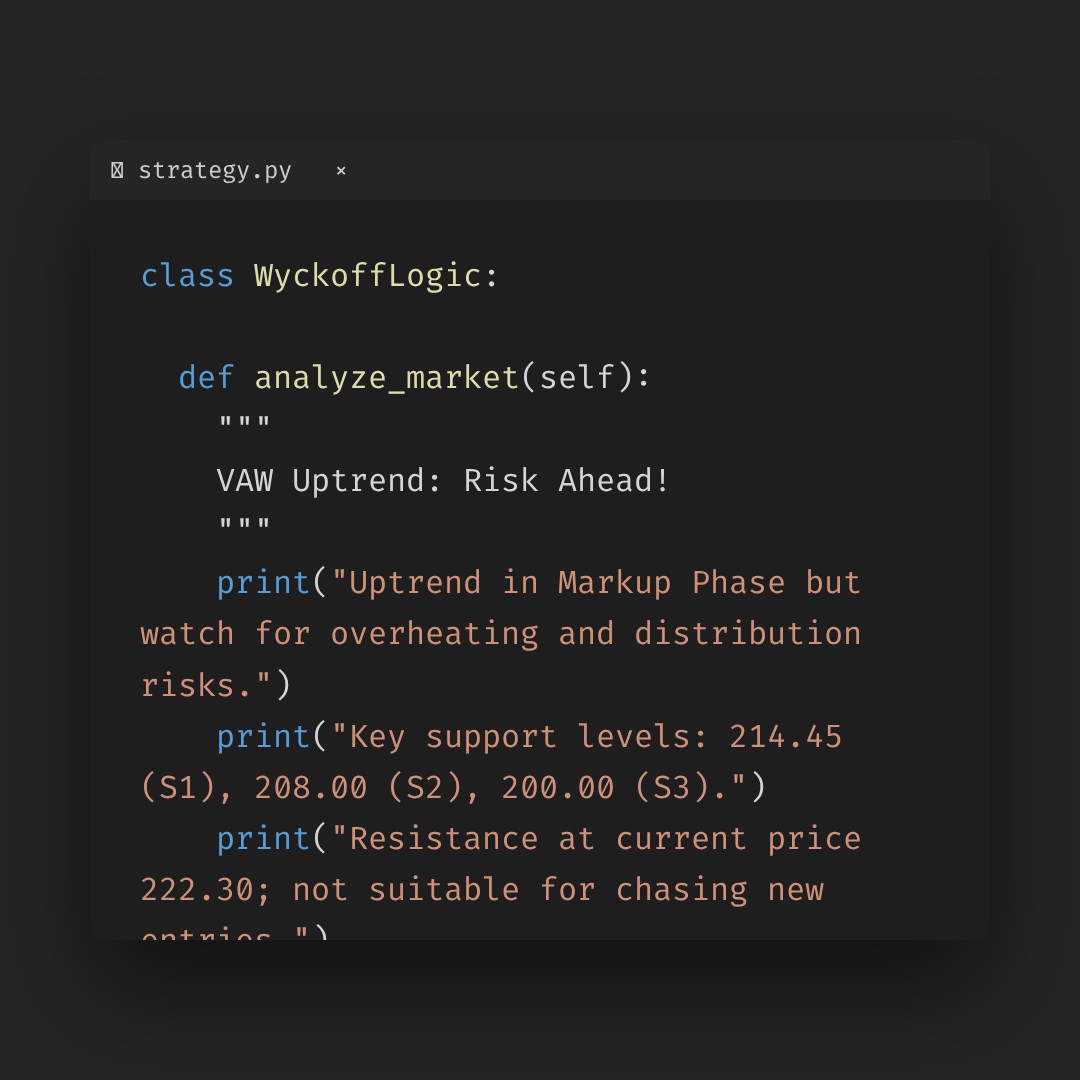
As per your instructions. As a quantitative trading researcher proficient in the Wyckoff Method, I will compose a comprehensive and in-depth quantitative analysis report based on the VAW data you provided (from 2025-11-10 to 2026-01-09) and the historical ranking metrics.
VAW Quantitative Analysis Report (Based on the Wyckoff Method)
Product Code: VAW
Analysis Date Range: 2025-11-10 to 2026-01-09
Report Generation Date: 2026-01-10
1. Trend Analysis and Market Phase Identification
As of January 09, 2026, the underlying asset VAW had an opening price of 218.62, a closing price of 222.30, a 5-day moving average (MA) of 215.27, a 10-day MA of 212.53, a 20-day MA of 209.79, a daily change of +1.96%, a weekly change of +5.39%, a monthly change of +7.11%, a quarterly change of +7.11%, and a year-to-date change of +7.11%.

- • Moving Average Alignment Analysis:
- • Current State (2026-01-09): Closing Price
222.30> MA_5D215.27> MA_10D212.53> MA_20D209.79> MA_30D206.90> MA_60D202.40. This presents a standard bullish alignment, indicating the market is in a strong uptrend. - • Evolution Process:
- • Decline Phase (2025-11-10 ~ 2025-11-20): The price remained below all major moving averages, with the MAs in a bearish alignment (MA_5D < MA_20D < MA_60D), indicating a clear downtrend.
- • Reversal and Recovery (2025-11-21 ~ 2025-11-26): The price rebounded strongly on November 21st (+2.20%) and rose consecutively, successively breaking above the MA_5D, MA_10D, MA_20D, and MA_30D. The MA_5D crossed above the MA_10D on November 24th, signaling a short-term reversal.
- • Bullish Alignment Established (2025-12-01 ~): Entering December, price pullbacks did not make new lows, finding support at the MA_20D. The MA_5D and MA_10D stabilized above the MA_20D and MA_30D, solidifying and continuing the bullish alignment to the present.
- • Current State (2026-01-09): Closing Price
- • Market Phase Inference (Based on Wyckoff Theory):
- 1. Accumulation Phase: The data clearly shows this phase. The timeframe is mid to late November 2025. It is characterized by price oscillation within the 192.70-199.72 range, accompanied by several significant high-volume declines (e.g., November 17th) and high-volume advances (e.g., November 19th). This divergence in price and volume (increased volume on declines and advances) is typical of large investors conducting "shaking out" and "accumulation" at relatively low levels.
- 2. Markup Phase (Uptrend): Starting from late November 2025 and continuing to the present. After breaking above the upper boundary of the previous trading range (~200) and all major moving averages, the price entered a smooth upward channel. Although there were pullbacks (e.g., early December), they found support at key moving averages (MA_20D), and volume contracted during these pullbacks, consistent with the characteristic "test of demand" within an uptrend.
2. Volume-Price Relationship and Supply-Demand Dynamics
As of January 09, 2026, the underlying asset VAW had an opening price of 218.62, a closing price of 222.30, volume of 85848, a daily change of +1.96%, volume of 85848, a 7-day average volume of 61065.43, and a 7-day volume ratio of 1.41.

- • Key Day Identification and Supply-Demand Force Analysis:
- • Key Days during Accumulation:
- • 2025-11-17: Price fell sharply (-1.58%), with volume surging 68.4% (
VOLUME_GROWTH). The volume ratio (VOLUME_AVG_7D_RATIO) was as high as 1.29. This is a classic signal of "panic selling" or "terminal shakeout." The Wyckoff principle posits that this represents the final concentrated release of supply (selling), often engineered by large investors to flush out weak holders. - • 2025-11-19: Price increased slightly (+0.40%), but volume surged 46.8%, with the volume ratio reaching an astonishing 2.04. The occurrence of high-volume stabilization near the shakeout low is strong evidence of "accumulation," indicating that large buying interest began actively intervening, with demand overwhelming supply.
- • 2025-11-17: Price fell sharply (-1.58%), with volume surging 68.4% (
- • Key Days during the Uptrend:
- • 2025-11-24: Price rebounded from the low, advancing (+0.67%) on high volume (+161.2%). The volume ratio (
VOLUME_AVG_14D_RATIO) reached 3.07, confirming demand dominance and a clear intent to break out. - • 2026-01-06 & 2026-01-09: High-volume advances continued within the uptrend. Particularly on 01-09, the price rose 1.96% with volume growth of 72.9% and a volume ratio (
VOLUME_AVG_7D_RATIO) of 1.41. This shows upward momentum remains strong. However, combined with historical rankings (see below), caution is warranted for potential new supply appearing at high levels.
- • 2025-11-24: Price rebounded from the low, advancing (+0.67%) on high volume (+161.2%). The volume ratio (
- • Pullback Phase Characteristics: During pullbacks in early December and on January 7th, volume contracted significantly (e.g., 12-03
VOLUME_AVG_7D_RATIOwas 0.53; 01-07 saw high volume but it was part of a correction within an advance), indicating limited supply during the decline, characteristic of healthy technical corrections.
- • Key Days during Accumulation:
- • Supply-Demand Conclusion: The market's supply-demand relationship fundamentally reversed in mid to late November. Supply was exhausted during panic selling, and demand has consistently dominated during accumulation and the subsequent uptrend. The current uptrend is driven by robust demand.
3. Volatility and Market Sentiment
As of January 09, 2026, the underlying asset VAW had an opening price of 218.62, a 7-day intraday volatility of 0.20, a 7-day intraday volatility ratio of 1.50, a 7-day historical volatility of 0.28, a 7-day historical volatility ratio of 1.27, and an RSI of 72.75.

- • Volatility Levels and Changes:
- • Panic and Reversal Period (Mid to Late November): Both Parkinson volatility (
PARKINSON_VOL_7D) and historical volatility (HIS_VOLA_7D) were at relatively high levels. Meanwhile, the ratio of short-term to medium-term volatility (e.g.,PARKINSON_RATIO_7D_14D) fluctuated around 1.0, indicating emotional but not extreme volatility. - • Sentiment Low Point and Accumulation Confirmation (Late December): Historical ranking data shows that on 2025-12-29/30, several Parkinson volatility ratios reached nearly decade-long extreme lows (e.g.,
PARKINSON_RATIO_7D_14Dranked 7th lowest,PARKINSON_VOL_7Dranked 20th lowest). Extreme volatility contraction often precedes a trend initiation, corresponding to the "lull" or quiet period at the end of the Accumulation phase in Wyckoff theory, where market sentiment shifts from panic to numbness, building energy for the subsequent advance. - • Current Acceleration Period (Early January): Volatility expanded rapidly. As of 01-09,
PARKINSON_RATIO_7D_14Dsurged to 1.50, ranking 14th highest in the past decade. Short-term volatility significantly exceeded medium-term volatility, indicating heightened market sentiment and the trend entering an acceleration phase, which also implies increased volatility risk.
- • Panic and Reversal Period (Mid to Late November): Both Parkinson volatility (
- • RSI Overbought/Oversold Validation:
- • At the November low, RSI_14 touched a low of 34.26 (11-20), approaching the oversold zone, validating the release of downward momentum.
- • The current RSI_14 is 72.75, having entered the overbought region, corroborating the phenomenon of surging volatility and indicating that short-term market sentiment may be overheating.
4. Relative Strength and Momentum Performance
- • Analysis of Returns Across Timeframes:
- • Extremely Strong Short-Term Momentum: The weekly return (
WTD_RETURN) reached +5.39%, and the monthly return (MTD_RETURN) is +7.11%. - • Strong Medium to Long-Term Trend: The quarterly return (
QTD_RETURN) and year-to-date return (YTD) are both +7.11%, indicating that VAW has maintained strong, one-directional upward momentum since the start of the quarter/year.
- • Extremely Strong Short-Term Momentum: The weekly return (
- • Momentum Conclusion: Momentum indicators across all timeframes point in the same direction—a robust uptrend. The explosive growth in short-term momentum aligns with the trend's acceleration phase.
5. Identification of Large Investor (Smart Money) Behavior
- • Accumulation Behavior: Within the trading range in mid to late November, large investors successfully accumulated a significant amount of shares at relatively low cost through a combination of engineering "high-volume panic declines" (shakeouts) and "high-volume stabilization/advances." The extremely low volatility ratio rankings in the historical data appearing at the end of this phase are a classic signal that smart money has completed accumulation and the market is poised to choose a direction.
- • Markup Behavior: After breaking through key resistance levels (200, the moving average system), price advances were accompanied by stable volume support. Pullbacks during this phase showed contracting volume, indicating smart money was methodically marking up the price without rushing to distribute.
- • Current Intent Assessment (Distribution Risk): The current price is at an all-time high (historical rank #1), accompanied by extremely high short-term volatility ratios (rank #14) and an overbought RSI. Although the price advance on 01-09 was still on high volume, it is now crucial to be highly alert to whether the market is entering the early stages of "Distribution." Smart money may be leveraging market euphoria for organized, phased profit-taking. The key verification point will be the appearance of candlesticks showing "high-volume stalling" or "high-volume long upper shadows."
6. Support/Resistance Level Analysis and Trading Signals

- • Key Support Levels:
- • S1 (Recent Dynamic Support): Around 214.45 (the low on 2026-01-07), also near the MA_5D area.
- • S2 (Primary Trend Support): Around 208.00 (the high from mid-December 2025, now a converted support level, close to MA_20D).
- • S3 (Bull-Bear Demarcation Line): The psychological 200.00 level and the upper boundary of the previous trading range, also where the MA_60D resides.
- • Key Resistance Levels:
- • R1: The current price of 222.30 itself constitutes psychological resistance. There is no historical price reference above, making it trend-based resistance.
- • Synthesized Wyckoff Events and Trading Signals:
- • Current Market State: Clearly in a Markup Phase (Uptrend), but has entered an accelerating and potentially overheating stage. Risk of entering the final "Distribution" phase of the trend must be guarded against.
- • Operational Recommendations:
- • For Investors Holding Long Positions: May continue to hold, but should tightly trail their stop-loss above S1 (214.45). Closely monitor any candlestick showing high single-day volume (Volume Ratio >1.5) but price closing flat or declining. This would be a potential distribution warning signal and a timing cue to reduce position.
- • For Investors Seeking New Entries: The current price level is not suitable for chasing. The risk-reward ratio is unfavorable. Patiently await one of the following two Wyckoff-style opportunities:
- 1. Healthy Pullback Entry: Wait for a price pullback to the vicinity of S2 (208.00), accompanied by a low-volume stabilization signal. Consider light long positions then, with a stop-loss set below 200.00.
- 2. Reversal Opportunity after Failed Breakout/Distribution Confirmation: If a clear "Distribution" structure emerges in the future (e.g., high-level consolidation followed by a high-volume breakdown below key support), shift focus to seeking shorting opportunities.
- • Future Validation Points:
- 1. Validation for Uptrend Continuation: After consolidating above support levels S1 or S2, can the price again exhibit the healthy volume-price structure of "low-volume pullback + high-volume advance"?
- 2. Signals Confirming Distribution Risk: Price at high levels (e.g., above 220) shows single-day or consecutive days of "high-volume stalling" (high volume, price unable to make new highs or closes with long upper shadows), followed by a break below the short-term uptrend line or S1 support.
Disclaimer: The content of this report/interpretation is solely market analysis and research based on publicly available information and does not constitute any investment advice or operational guidance. The author strives for objectivity and fairness but makes no guarantees regarding its accuracy or completeness. Markets involve risks; investments require caution. Any investment actions based on this report are taken at one's own risk.
Thank you for your attention! Daily Wyckoff Volume-Price Market Analysis is released punctually at 8:00 AM before the market opens. We sincerely appreciate your comments and shares; your recognition is vital. Let's work together to perceive market signals.
Member discussion: