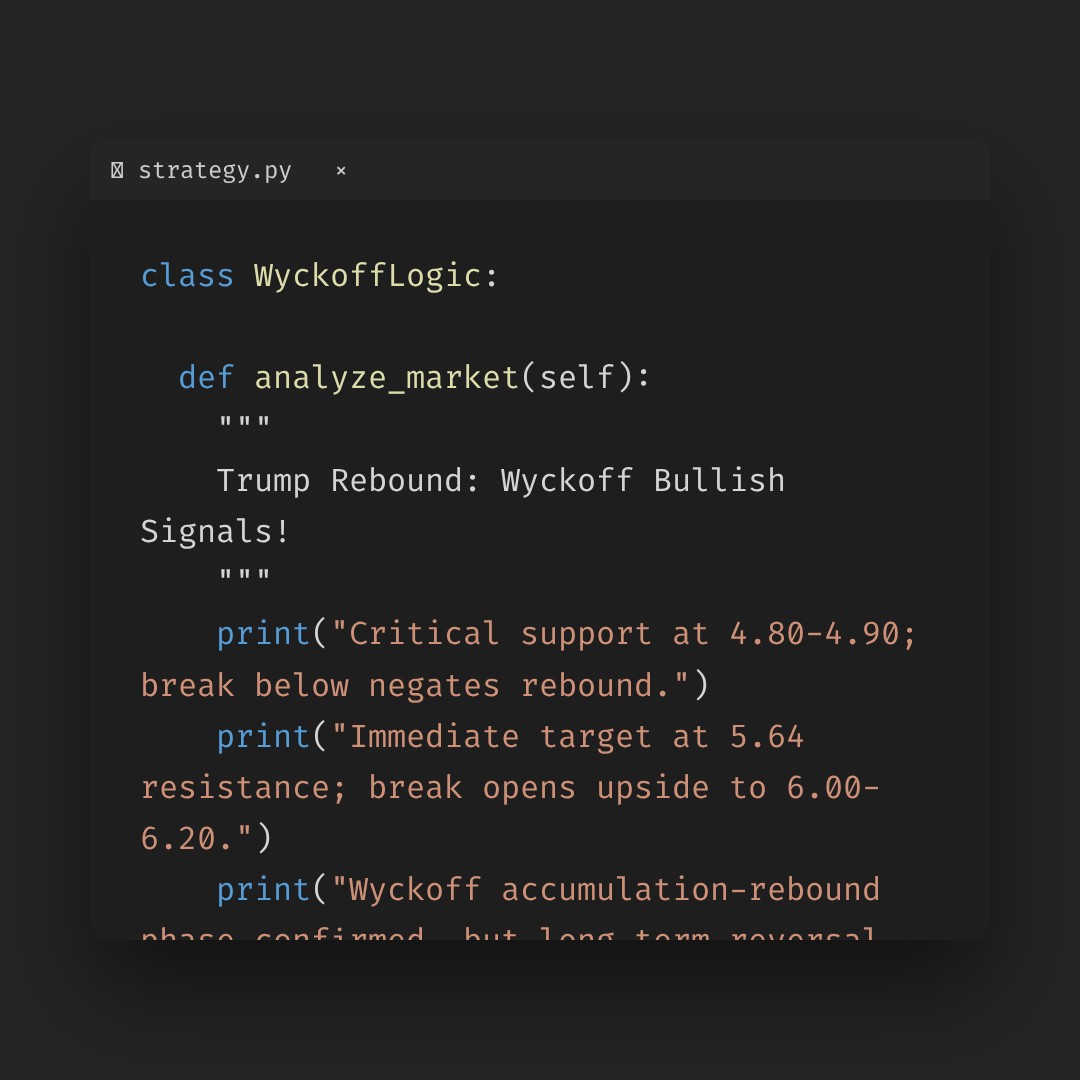
Wyckoff Quantitative Analysis Report: TRUMPUSDT

Product Code: TRUMPUSDT
Analysis Date Range: 2025-11-10 to 2026-01-09
Report Generation Time: 2026-01-10


1. Trend Analysis and Market Phase Identification

As of January 09, 2026, the underlying asset TRUMPUSDT had an open price of 5.36, a close price of 5.44, a 5-day moving average (MA) of 5.45, a 10-day MA of 5.22, a 20-day MA of 5.09, with a daily change of +1.49%, a weekly change of +7.68%, a monthly change of +13.29%, a quarterly change of +13.29%, and a yearly change of +13.29%.

TRUMPUSDT Price Trend Analysis Chart, including closing price and multiple moving averages
  • Moving Average Array Analysis:
    • Long-Term Trend (Bearish): As of 2026-01-09, the closing price (5.439) remains significantly below the 60-day MA (5.844), confirming that the long-term downtrend has not reversed.
    • Medium-to-Short-Term Trend (Turning Point and Repair): The price has moved above the 5-day (5.449) and 10-day MAs (5.216), but is below the 20-day (5.088) and 30-day MAs (5.190). The 5-day MA has crossed above the 10-day, 20-day, and 30-day MAs, forming a "short-term golden cross." This marks a temporary halt in the unilateral downtrend that began in mid-November 2025, indicating entry into a corrective rebound phase.
    • Key Moving Average Crosses: During the analysis period, the 5-day MA crossed below the 20-day MA on 2025-12-29, forming a death cross and accelerating the bottoming process. Currently, the 5-day MA has crossed back above the 20-day MA (occurring around 2026-01-07), which is the most significant trend reversal signal recently.
  • Market Phase Inference (Based on Wyckoff Theory):
    • Distribution Phase (2025-11-10 to 2025-11-11): After peaking at 9.571, the price recorded the 7th highest single-day gain (15.36%) in nearly a decade and the 7th highest volume increase (332.59%) on November 10th. However, the following day saw a sharp decline (-11.16%) on high volume, constituting a classic "UTAD" (Upthrust After Distribution) and "Reversal Day," signaling large investors distributing holdings at historical highs.
    • Markdown and Panic Phase (2025-11-12 to 2025-12-31): Price declined continuously from 8.876 to 4.801 (a cumulative drop of 45.9%), accompanied by shrinking volume and intermittent high-volume sell-offs. During this period, the RSI_14 hit a low of 27.28 (on 2025-12-24, ranking 20th lowest in nearly a decade), indicating market sentiment reached extreme oversold conditions.
    • Accumulation Phase (2026-01-01 to Present): Price stabilized and rebounded after the 4.801 low. The initial rebound was accompanied by abnormally high volume (e.g., volume increased 176.49% on 2026-01-03, ranking 19th highest in nearly a decade). Volatility indicators (see below) show the market awakening from extreme lethargy. Combined with price-volume behavior, the current phase is the rebound following the "Preliminary Support (PS)" and "Secondary Test (ST)" stages within the Wyckoff accumulation model, where large investors may be conducting organized buying at low levels.

2. Volume-Price Relationship and Supply-Demand Dynamics

As of January 09, 2026, the underlying asset TRUMPUSDT had an open price of 5.36, a close price of 5.44, volume of 2,489,090.12, a daily change of +1.49%, volume of 2,489,090.12, a 7-day average volume of 5,494,002.76, and a 7-day volume ratio of 0.45.

TRUMPUSDT Volume-Price Relationship Line Chart and Historical Ranking Analysis
  • Key Supply-Demand Transition Days:
    1. 1. Supply-Dominated Day (Distribution Signal): 2025-11-11, price fell sharply (-11.16%). Although volume halved compared to the previous day, the trading value remained substantial (113 million). Furthermore, the 7-day/30-day historical volatility ratio (1.514) reached the 15th highest level in nearly a decade, indicating overwhelming supply emerging in a highly volatile environment.
    2. 2. Demand Exhaustion Day: 2025-11-15, volume plummeted to 2.84 million (VOLUME_AVG_7D_RATIO was only 0.256, indicating extremely thin trading), while price rose slightly, showing extremely weak demand during the decline.
    3. 3. Panic Selling Day (Possibly Accompanied by Accumulation): 2025-12-01, price fell -4.63%, but volume surged 326.87% (ranking 8th highest in nearly a decade), forming a "panic sell-off." The subsequent trading days did not create new lows, which could be seen as accumulation occurring after the "panic sell-off."
    4. 4. Demand Entry Day: 2026-01-03, price rose 4.18% on high volume, with volume reaching 8.67 million (VOLUME_AVG_14D_RATIO was as high as 5.837, ranking 4th highest in nearly a decade), clearly indicating strong demand entering the market and changing the prior pattern of declining prices on low volume.
  • Recent Supply-Demand Structure:
    • Demand Strengthening: Starting from 2026-01-01, multiple consecutive trading days showed a healthy pattern of "rising price with increasing volume." Especially from 01-03 to 01-05, the VOLUME_AVG_21D_RATIO ranked in the Top 13 for three consecutive days in nearly a decade, confirming that the demand is not sporadic buying but organized, sustained participation.
    • Supply Test: On 2026-01-06 and 01-07, there were low-volume pullbacks (volume decreased by 35.5% and 19.0% respectively) with slight price declines, indicating limited supply pressure and market reluctance to sell. The subsequent price increases (01-08, 01-09) occurred on moderate volume, representing a healthy rebound after a "supply test."

3. Volatility and Market Sentiment

As of January 09, 2026, the underlying asset TRUMPUSDT had an open price of 5.36, a 7-day intraday volatility of 0.70, a 7-day intraday volatility ratio of 1.30, a 7-day historical volatility of 0.52, a 7-day historical volatility ratio of 1.21, and an RSI of 54.83.

TRUMPUSDT Parkinson Volatility Analysis Chart and Historical Ranking Data
  • Volatility Levels and Market State:
    • Extreme Compression Period (Accumulation Characteristic): In late December 2025, various volatility metrics dropped to historical extremes. For example:
      • MIN_HIS_VOLA_60D reached 0.523 on 2026-01-09, setting a new near-decade low (Rank 1).
      • MIN_PARKINSON_VOL_60D reached 0.535 on the same day, also setting a new near-decade low (Rank 1).
      • • Short-term volatility was also at extremely low levels (MIN_PARKINSON_VOL_7D was 0.302 on 2025-12-31, Rank 4). Extreme volatility compression often precedes significant trend changes, aligning with the "period of quietude" characteristic of the late accumulation phase in Wyckoff theory.
    • Volatility Expansion (Trend Initiation): Entering January 2026, short-term volatility expanded rapidly. PARKINSON_RATIO_7D_30D reached 1.566 on 01-06 (near-decade Rank 14), and PARKINSON_RATIO_7D_60D reached 1.110 on 01-05 (near-decade Rank 17), indicating a sharp increase in market activity and price volatility, signaling trend initiation.
  • Market Sentiment (RSI):
    • From Overbought to Oversold: The RSI_14 dropped from 64.51 on 2025-11-10 (near-decade Rank 12, nearing overbought) to 28.30 on 2025-12-24 (near-decade Rank 20, deeply oversold), completing a full sentiment cycle.
    • Sentiment Recovery: The current RSI_14 is 54.83, having rebounded strongly from the oversold zone to a neutral-to-strong region. This indicates market sentiment is recovering from pessimism, providing an emotional foundation for continued rebound.

4. Relative Strength and Momentum Performance

  • Momentum Analysis:
    • Extremely Weak Long-Term Momentum: As of the end of the analysis period, QTD_RETURN is -33.32%, MTD_RETURN is -33.32%, indicating the asset is in deep weakness on quarterly and monthly scales.
    • Significantly Strengthened Short-Term Momentum: WTD_RETURN (Weekly Return) is +7.68%, YTD (Year-to-Date) Return is +13.29%. A significant divergence has emerged between short-term and long-term momentum, which is an important signal for a potential phase reversal in trend.
    • Conclusion: The momentum structure shows the market is climbing out of the "momentum abyss" of a prolonged decline. Short-term rebound momentum is strong, but it has not yet reversed the long-term downtrend. This is a typical "oversold rebound" momentum pattern.

5. Large Investor (Smart Money) Behavior Identification

Integrating the above dimensions clearly outlines the operational path of large investors:

  1. 1. Distribution at Highs (Early November 2025): Utilized the historically significant high-volume surge on November 10th to create frenzy, then reversed to sell the next day, completing distribution.
  2. 2. Allowing Decline and Observation (Mid-November to December 2025): Did not show large-scale, sustained accumulation during the decline, manifested as continuous low-volume declines and intermittent high-volume plunges (e.g., December 1st), aiming to flush out weak holders and test true support.
  3. 3. Stealth Accumulation at Lows (Late December 2025): Began organized, inconspicuous accumulation when the price dropped to the 4.8-5.0 range, market volatility hit near-decade record lows, and trading was extremely thin. Volume did not show abnormal spikes during this phase, but price refused to decline further.
  4. 4. Lift and Test (Early January 2026): Starting January 1st, began pushing prices higher with significant volume (multiple days' volume ratios ranked near historical highs) to move away from the accumulation zone. Subsequently conducted low-volume pullbacks (January 6-7) to test selling pressure, and upon finding scant supply, continued to drive prices higher. This behavior aligns with the lifting phase following a "Shakeout."

6. Support/Resistance Level Analysis and Trading Signals

TRUMPUSDT Support and Resistance Level Analysis Chart and Trading Signals
  • Key Levels:
    • Strong Support Levels:
      1. 1. S1: 4.80 - 4.90: The bottom range formed in late December 2025, also the starting point of this rebound. Breaking below this zone would negate the current rebound structure.
      2. 2. S2: 5.25 - 5.30: The first consolidation platform during the recent rebound (around 2026-01-04), also the current location of the 10-day MA, providing dynamic support.
    • Key Resistance Levels:
      1. 1. R1: 5.64: The high point of the current rebound wave (2026-01-03). A break above this level would open further upside space.
      2. 2. R2: 6.00 - 6.20: The high-volume consolidation zone from late November 2025, also near the 60-day MA (currently 5.84), where strong selling pressure is expected.
      3. 3. R3: 7.20 - 7.50: The consolidation platform from mid-November 2025, serving as a strong medium-to-long-term resistance.
  • Comprehensive Trading Signals and Operational Suggestions:
    • Overall Assessment: The market has confirmed a transition from the "Panic Markdown" phase into the "Accumulation-Rebound" phase. The short-term technical structure is bullish, but a long-term trend reversal requires more evidence (e.g., a decisive break above the 60-day MA).
    • Signal: Cautiously Bullish / Rebound Continuation. Key Wyckoff events (Panic Sell-off → Automatic Rally → Secondary Test → High-Volume Rise) have appeared.
    • Operational Suggestions:
      1. 1. Aggressive Strategy (For Existing Positions): Raise the stop-loss level to 5.00 (below the upper edge of the accumulation range). The initial target is R1: 5.64. If broken with volume, then target R2: 6.00-6.20.
      2. 2. Conservative Strategy (Seeking Entry): Wait for a price pullback near the S2: 5.25-5.30 support zone. Enter upon observing low-volume stabilization or renewed high-volume increase. Set stop-loss below 5.00.
      3. 3. Exit/Watch Signal: If the price shows high-volume stagnation (single-day or consecutive days with long upper shadows at highs, and volume ratios re-enter historical high rankings) when approaching R2: 6.00-6.20, treat it as a potential distribution signal and consider reducing or exiting positions.
    • Future Validation Points:
      1. 1. Positive Validation: Whether the price can break above R1: 5.64 with moderate, not excessive, volume, indicating well-controlled supply.
      2. 2. Negative Validation: If the price quickly falls back and breaks below the S1: 4.80-4.90 support zone, accompanied by increased volume, it would indicate the current rebound has failed, and the market may enter a new downtrend.

Disclaimer: This report is based on quantitative analysis of historical data and does not constitute any investment advice. Financial markets carry risks; please make decisions cautiously.


Thank you for your attention! Wyckoff volume-price market insights are published daily at 8:00 AM before the market opens. Please feel free to leave comments and share; your recognition is crucial. Let's work together to see the market signals clearly.