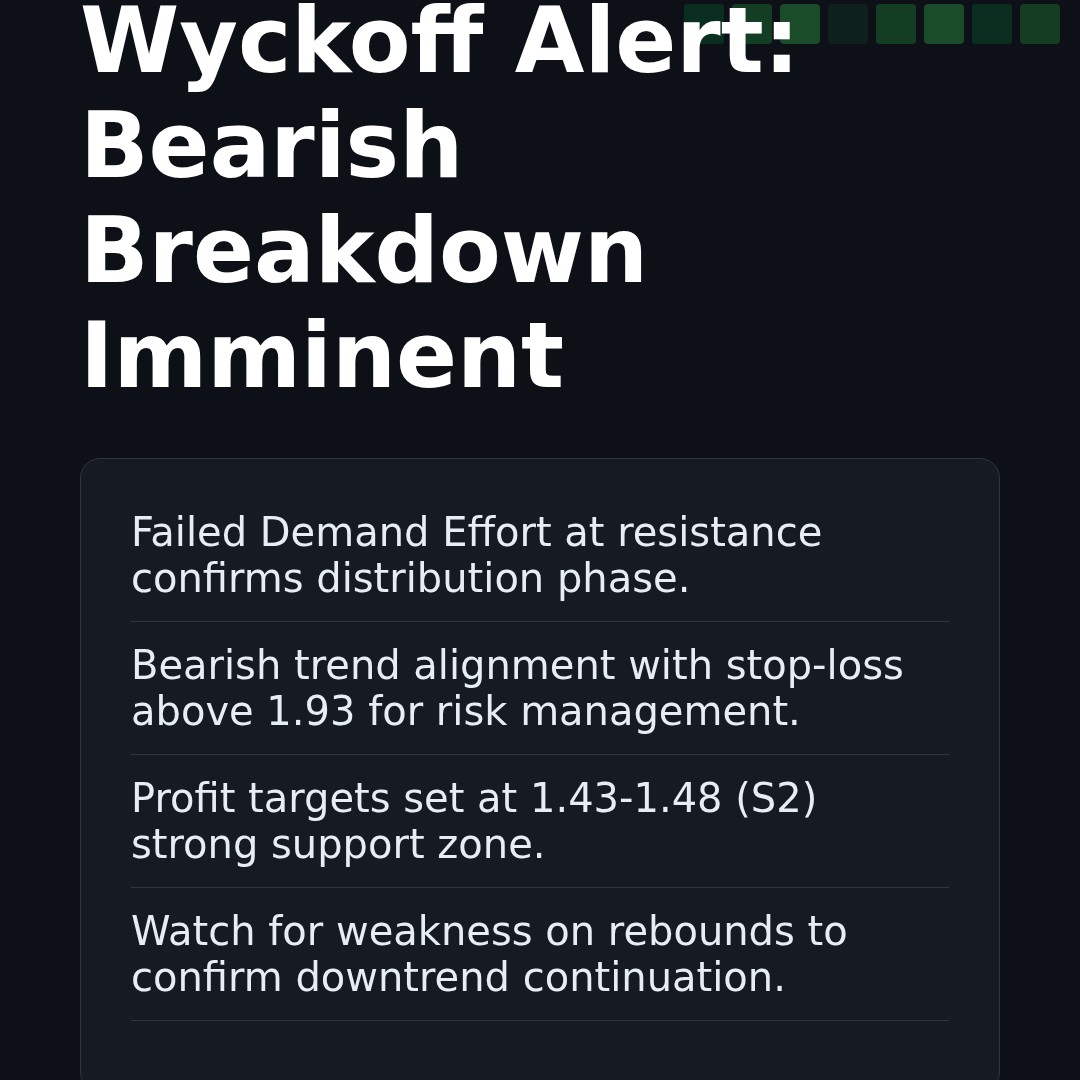
As a quantitative trading researcher proficient in the Wyckoff Method, I will compose a comprehensive and in-depth quantitative analysis report for you based on the provided TONUSDT data and historical ranking indicators.


TONUSDT Quantitative Analysis Report (Based on the Wyckoff Method)

Product Code: TONUSDT
Analysis Date Range: 2025-11-10 to 2026-01-09
Report Generation Date: 2026-01-10

Executive Summary:
Based on the analysis of price and volume data over the past two months (from November 2025 to early January 2026), TONUSDT showed signs of consolidation and basing in the 1.43-1.55 zone in mid-to-late December, following a deep decline from the November highs (approximately -30%). However, a rebound at the beginning of 2026 encountered a "high-volume bearish engulfing breakdown" on January 9th after testing the 1.90-1.93 resistance zone. Integrating trend alignment, volatility changes, and historical extreme data, current signals strongly indicate: Large investors are distributing holdings using the year-end/New Year liquidity-driven rebound, and the market may restart its downtrend to test the previous low support zone.


Dimension 1: Trend Analysis & Market Phase Identification

As of 2026-01-09, the subject TONUSDT had an opening price of 1.86, a closing price of 1.74, a 5-day MA of 1.88, a 10-day MA of 1.80, a 20-day MA of 1.67, a daily change of -6.39%, a weekly change of -3.33%, a monthly change of 5.00%, a quarterly change of 5.00%, and a yearly change of 5.00%.

TONUSDT Price Trend Analysis Chart, including closing price and multiple moving averages
  1. 1. Moving Average Alignment & Trend:
    • Current State (2026-01-09): Price (1.742) is below all major moving averages (MA_5D: 1.8786, MA_10D: 1.8023, MA_20D: 1.6657, MA_30D: 1.6277, MA_60D: 1.6562). It exhibits a standard "bearish alignment" (MA_5D < MA_10D < MA_20D < MA_60D).
    • Dynamic Evolution:
      • Decline Phase (Mid-November to Mid-December 2025): Price consistently traded below all MAs, with perfect bearish alignment. MA_60D acted as a long-term downtrend line, providing significant resistance.
      • Consolidation/Basing Phase (Mid-to-Late December 2025): Price oscillated within the 1.43-1.65 range. Short-term MAs (MA_5D, MA_10D) began to flatten and intertwine, frequently interacting with the price but remaining suppressed by MA_20D/MA_30D.
      • Rebound/Test Phase (Early January 2026): Price rebounded sharply, briefly breaking above and closing above all short-term MAs (MA_5D, MA_10D, MA_20D), even forming a short-term bullish alignment from Jan 4-6. Critical Point: Price failed to effectively challenge the convergence zone of MA_30D/MA_60D (~1.66) and subsequently swiftly lost all short-term MA support post-rebound.
  2. 2. Market Phase Judgment (Wyckoff Framework):
    • Previous Phase (December 2025): Price repeatedly tested the 1.43-1.55 zone. Volume expanded towards the end of the decline (e.g., Dec 18), followed by a low-volume rebound (late Dec). This partially aligns with Wyckoff "Accumulation Phase" characteristics (Selling Climax SC / Secondary Test ST). Historical ranking data corroborates this: the lowest, closing, and opening prices during this period reached near-decade lows (ranking 1st-4th).
    • Current Phase (2026-01-09): A high-volume plunge from the early-January rebound high (~1.90) completely erased the prior week's gains and breached key short-term support (1.65-1.60). This strongly suggests the market phase may have transitioned from "Accumulation" or "Rebound Test" to "Decline after Distribution" or "Re-accumulation Test". Combined with the failure to sustain gains after the massive bullish volume bar on Jan 2nd (historically high volume), the evidence leans towards interpreting this as "Distribution" behavior.

Dimension 2: Price-Volume Relationship & Supply-Demand Dynamics

As of 2026-01-09, the subject TONUSDT had an opening price of 1.86, a closing price of 1.74, a volume of 8598596.28, a daily change of -6.39%, a volume of 8598596.28, a 7-day average volume of 6906425.51, and a 7-day volume ratio of 1.25.

TONUSDT Price-Volume Relationship Line Chart and Historical Ranking Analysis
  1. 1. Key Day Analysis:
    • Supply-Dominated Day (2026-01-09): Price fell sharply by -6.39% on a volume of 8.60M, with volume ratios relative to the 7-day/14-day averages reaching 1.25 and 1.33 respectively, characteristic of "high-volume decline". This indicates supply (selling) overwhelmingly dominated demand (buying) at this price level, a strong bearish signal.
    • Demand Test Day (2026-01-02): Price surged +6.38% on a volume of 12.73M, with volume ratios relative to 14-day/21-day averages hitting historical extremes (ranking 20th), and volume growth of +220.43% (ranking 11th). This shows massive buying pressure entered. However, the subsequent failure to continue higher, instead plateauing and declining, suggests this immense volume may have been used by smart money for Distribution, rather than sustained accumulation.
    • Selling Climax Days (2025-11-20 & 2025-12-18): Declines of -9.49% and -2.38% respectively, accompanied by significant volume spikes (VOLUME_AVG_14D_RATIO > 1.35). This aligns with panic characteristics at the end of a decline, potentially marking a clearing of short-term selling pressure.
    • No-Demand Rebound (Late December 2025): During the rebound from Dec 21-27, volumes were generally below their respective period averages (VOLUME_AVG_*D_RATIO < 1), indicating a lack of supporting demand, characteristic of a "technical rebound" or "dead cat bounce".
  2. 2. Supply-Demand Conclusion:
    • • The market experienced a phase from supply exhaustion (Selling Climax) to attempted demand entry in December.
    • • Entering January, near the key resistance zone (1.90-1.93), a classic Wyckoff event of "Effort vs. Result" occurred: massive buying effort (Jan 2) failed to drive prices to new sustained highs, instead inviting stronger supply (Jan 9), leading to a significant price retracement. The market is currently dominated by supply.

Dimension 3: Volatility & Market Sentiment

As of 2026-01-09, the subject TONUSDT had an opening price of 1.86, a 7-day intraday volatility of 0.58, a 7-day intraday volatility ratio of 0.87, a 7-day historical volatility of 0.57, a 7-day historical volatility ratio of 0.87, and an RSI of 53.35.

TONUSDT Historical Volatility Analysis Chart and Historical Ranking Data
  1. 1. Volatility Analysis:
    • High Historical Period: From late November to early December 2025, the 60-day Parkinson Volatility (PARKINSON_VOL_60D) remained persistently at near-decade highs (ranking 1st-20th), while Historical Volatility (HIS_VOLA_60D) was also elevated (ranking 14th-20th). This corresponds to the primary decline phase and the initial violent consolidation at the base, indicating panic and unstable market sentiment.
    • Current State: As of 2026-01-09, PARKINSON_VOL_60D has retreated to 0.663 but remains elevated. Short-term volatility (PARKINSON_VOL_7D) is 0.582, lower than medium-to-long-term levels (PARKINSON_RATIO_7D_60D=0.878), indicating short-term volatility is contracting, but the overall market remains in a high-volatility environment. The sharp decline on January 9th did not trigger a spike in short-term volatility, possibly suggesting the sell-off was "orderly" or "anticipated".
  2. 2. Sentiment Indicator (RSI):
    • Overbought Warning: From January 3-6, 2026, RSI_14 consistently exceeded 70 for multiple days, with its weekly maximum (71.85) reaching the 4th highest historical rank in nearly a decade. This clearly identified extreme overbought conditions at the rebound top, providing technical justification for the subsequent correction.
    • Current Sentiment: RSI_14 has rapidly retreated from overbought territory to 53.35, returning to a neutral-to-weak range, indicating bullish sentiment has been quickly reversed.

Dimension 4: Relative Strength & Momentum Performance

  1. 1. Period Returns:
    • Short-Term Momentum Turns Negative: WTD_RETURN (Weekly Return) is -3.33%, and MTD_RETURN (Monthly Return) has narrowed to +5.00%. The sharp decline on January 9th completely eroded the gains from earlier in the week and turned short-term momentum negative.
    • Absolute Weakness in Medium/Long-Term: QTD_RETURN (Quarter-to-Date Return) is -21.03%, YTD (Year-to-Date) is -61.15%, and TTM_12 (Trailing Twelve Months) is -66.50%. The data unequivocally indicates TONUSDT is in a long-term downtrend, with any rebounds occurring within the broader downward channel.
  2. 2. Momentum Conclusion:
    • • The early-January rebound generated strong short-term positive momentum, but this momentum exhausted at key resistance and reversed swiftly. Medium-to-long-term momentum remains extremely weak, limiting the height and sustainability of any rally.

Dimension 5: Large Investor (Smart Money) Behavior Identification

Synthesizing the above dimensions, inferences about smart money behavior are as follows:

  1. 1. Distribution: This is the core judgment. The near-decade-level massive bullish volume bar on January 2nd (historical ranks 11th and 20th), combined with the subsequent failure to make new highs and rapid price decline, aligns with the Wyckoff characteristic of "Supply Coming In". Smart money likely utilized the year-end/New Year market sentiment and liquidity to distribute holdings accumulated at lower levels in December to retail traders chasing the rally in the 1.90-1.93 zone.
  2. 2. Shakeout? The high-volume decline on January 9th can be interpreted as smart money actively suppressing the price post-distribution to shake out weak longs who entered in the 1.65-1.75 range, creating space for the next phase of operation (whether further decline or renewed accumulation). Current data better supports this being a "shakeout" within a downtrend continuation.
  3. 3. Behavioral Consistency: From potential tentative accumulation (or absorbing panic selling) at December lows, to rapid distribution leveraging the January rebound, to the current price suppression, there are traces of planned, phased operation by large capital.

Dimension 6: Support/Resistance Level Analysis & Trading Signals

TONUSDT Support and Resistance Level Analysis Chart with Trading Signals
  1. 1. Key Price Levels:
    • Resistance (R1): 1.90-1.93 Zone — The early-January rebound highs and the core area of the recent distribution activity. Strong resistance.
    • Resistance (R2): 1.78-1.82 Zone — The opening price area from Jan 8-9, now serving as initial resistance for any bounce.
    • Support (S1): 1.65-1.60 Zone — The upper boundary of the late-December consolidation platform and the level breached on Jan 9, now a key pivot area (resistance-turned-support).
    • Support (S2): 1.43-1.48 Zone — The historic low zone established in December (multiple price indicators ranked 1st-4th in nearly a decade), representing the ultimate strong support.
  2. 2. Integrated Trading Signals:
    • Primary View: Bearish. Market structure shows a "Failed Demand Effort" distribution signal at key resistance, and the trend has reverted to a bearish alignment.
    • Operational Recommendations:
      • Aggressive Strategy: Consider initiating a light short position if price rallies to the 1.78-1.82 (R2) zone and shows signs of rejection. Set stop-loss above 1.90 (R1).
      • Conservative Strategy: Wait for price to show weakness on a rebound, confirming failure to reclaim 1.65 (S1), or for another high-volume decline below the Jan 9 low (1.728), then follow the established downtrend.
      • Stop-Loss Level: The ultimate stop-loss for any short position should be placed above 1.93, as a breach of this level would negate the current distribution structure.
      • Profit Targets: Initial target towards 1.55-1.50, with the final target being a test of the 1.43-1.48 (S2) strong support zone.
    • Long Opportunity: Consider a contrarian long position only if clear "Secondary Test" signals emerge in the 1.43-1.48 (S2) zone (e.g., low-volume, narrow-range consolidation; re-testing lows without breaking them), accompanied by significantly contracting volume. No such signal is currently present.
  3. 3. Future Validation Points:
    • Confirming Bearish View: Price sustains below 1.65 (S1), and rebounds fail to reclaim this level on high volume. Followed by low-volume grinding declines or another high-volume breakdown.
    • Invalidating Bearish View: Price stabilizes quickly near current levels and "on high volume" reclaims 1.65 (S1), subsequently challenging the 1.78-1.82 (R2) zone. This would suggest the Jan 9 decline was a shakeout, not the start of a post-distribution decline.
    • Major Risk Point: If price breaks above 1.93 (R1) on high volume with strength, a complete re-assessment of the market phase would be necessary, potentially pointing to a larger-scale reversal.

End of Report
Disclaimer:
All conclusions in this report are derived from the provided historical data and quantitative models, for reference only, and do not constitute any investment advice. The market carries risks, and decisions should be made with caution.


Thank you for your attention! Wyckoff price-volume market analysis is released daily at 8:00 before market open. Your comments and shares are greatly appreciated; your recognition is crucial. Let us work together to see the market signals clearly.