As a quantitative trading researcher proficient in the Wyckoff Method, I will prepare a comprehensive and in-depth quantitative analysis report based on the .SPX data and historical ranking indicators you have provided.

Wyckoff Volume-Price Analysis Report for .SPX

Product Code: .SPX
Analysis Date Range: 2025-11-10 to 2026-01-09
Report Generation Date: 2026-01-10


I. Trend Analysis & Market Phase Identification

As of January 9, 2026, the underlying asset .SPX had an opening price of 6927.83 and a closing price of 6966.28. Key moving averages: 5-day MA at 6909.55, 10-day MA at 6905.72, 20-day MA at 6870.40. The daily return was +0.65%, weekly return +1.57%, monthly return +1.76%, quarterly return +1.76%, annual return +1.76%.

.SPX Price Trend Analysis Chart, including closing price and multiple moving averages
  1. 1. Trend Structure: As of 2026-01-09, the closing price (6966.28) is above all major moving averages. The price structure and moving averages exhibit a clear bullish alignment: MA_5D (6909.55) > MA_10D (6905.72) > MA_20D (6870.40) > MA_30D (6858.06) > MA_60D (6800.31). This indicates the market is in a robust uptrend.
  2. 2. Moving Average Dynamics & Market Phase Evolution:
    • Panic and Accumulation Phase (Mid to Late November 2025): Between 2025-11-13 and 2025-11-20, prices experienced consecutive significant declines. During this period, the MA_5D briefly fell below the MA_20D (e.g., on 11-18), forming a notable downtrend wave (from approximately 6850 points to 6538 points). According to Wyckoff theory, this aligns with the characteristics of "panic selling," creating conditions for the subsequent "accumulation phase."
    • Markup Phase (Late November 2025 to Present): Starting from 2025-11-24, prices initiated a strong rebound. The MA_5D quickly crossed above the MA_10D and MA_20D, leading all moving averages into a bullish alignment. Entering December, prices steadily rose while finding support at the MA_5D and MA_10D, consecutively reaching new all-time highs in late December and early January 2026 (according to historical ranking data, the closing price on 2026-01-09 is the 1st highest in the past decade). The market is currently in a definite markup phase.
  3. 3. Current Key Observation: Despite the upward trend, since 2025-12-22, the process of making new highs has been accompanied by multiple intraday pullbacks (upper shadows), such as on 2026-01-07 (opened high, closed low, forming a negative candlestick). This suggests that selling pressure is beginning to emerge in the all-time high region.

II. Volume-Price Relationship & Supply-Demand Dynamics

As of January 9, 2026, the underlying asset .SPX had an opening price of 6927.83, a closing price of 6966.28, volume of 2,955,896,508, daily return of +0.65%, volume of 2,955,896,508, 7-day average volume of 2,761,229,242.00, 7-day volume ratio of 1.07.

.SPX Volume-Price Relationship Line Chart and Historical Ranking Analysis
  1. 1. Panic Selling & Demand Intervention:
    • Supply-Driven Decline: On 2025-11-13, the price fell sharply by -1.66%, volume surged to 34.03B, with a volume growth rate (VOLUME_GROWTH) of +15% and a 7-day average volume ratio (VOLUME_AVG_7D_RATIO) of 1.01, indicating panic selling (massive supply emergence). Subsequently, on 11-20, another high-volume day (37.33B, growth rate +18.45%) saw a plunge of -1.56%, confirming supply dominance.
    • Demand Counterattack: The key turning point occurred on 2025-11-21 and 11-24. On 11-21, the price rebounded +0.98% on amplified volume of 40.22B (growth rate +7.74%). More importantly, on 11-24, the price surged +1.55% with volume further expanding to 44.78B, a volume growth rate of +11.32%. These two days constitute what Wyckoff theory terms "heavy absorption following panic selling," indicating large buyers actively accumulating at panic lows, with demand beginning to overpower supply.
  2. 2. Record-Breaking Volume & Distribution Warning:
    • Abnormally High Volume Day: On 2025-12-19, volume reached 68.31B, setting a near-decade record high (HISTORY_RANK: 1). Its 7-day, 14-day, and 21-day average volume ratios were as high as 2.06, 2.16, and 2.14, ranking 14th, 12th, and 20th respectively over the past decade. This represents extremely abnormal volume expansion.
    • Early Signs of Divergence: However, the price only increased +0.88% that day, showing significant high volume with stalled price advance. According to Wyckoff theory, in the late stages of an uptrend, especially near all-time highs, this is a classic signal of "supply appearing" or "initial distribution," i.e., "smart money" may be distributing holdings by leveraging market enthusiasm at high levels.
  3. 3. Current Supply-Demand Status: On 2026-01-09, the price closed at a new all-time high with a +0.65% gain, but volume (29.56B) was relatively subdued. The volume growth rate was -7.6%, and its ratios to the 7-day and 14-day average volumes (1.07, 1.07) are not high. This indicates that at the new high, demand did not correspondingly expand, suggesting a potential "volume-price divergence." The advance is driven more by market inertia or a reluctance to sell rather than strong new buying pressure.

III. Volatility & Market Sentiment

As of January 9, 2026, the underlying asset .SPX had an opening price of 6927.83, a 7-day intraday volatility (PARKINSON_VOL_7D) of 0.08 with a 7-day ratio of 1.21, a 7-day historical volatility (HIS_VOLA_7D) of 0.10 with a 7-day ratio of 1.13, and an RSI of 61.74.

.SPX Historical Volatility Analysis Chart and Historical Ranking Data
  1. 1. Volatility Changes: During the panic decline in mid-November, both the Parkinson Intraday Volatility (PARKINSON_VOL_7D) and Realized Historical Volatility (HIS_VOLA_7D) spiked significantly. For example, on 11-20, the 7-day/60-day Parkinson ratio reached 1.78, showing short-term panic far exceeding long-term averages.
  2. 2. Current Sentiment: Entering January 2026, various volatility indicators have significantly converged. On 2026-01-09, the 7-day/14-day Parkinson ratio is 1.21, and the 7-day/14-day historical volatility ratio is 1.13. While volatility has slightly increased, it remains within a healthy range without extreme expansion. This suggests market sentiment has recovered from panic, shifting towards relative calmness or even optimism.
  3. 3. RSI Status: The RSI_14 dropped to 34.89 (approaching oversold) during the November panic, then fluctuated upward. The current value is 61.74, in a neutral-to-strong zone, not yet entering overbought territory (>70). This indicates, from a momentum perspective, the uptrend still has room, and sentiment is not overheated.

IV. Relative Strength & Momentum Performance

  1. 1. Absolute Momentum: As of 2026-01-09, recent momentum is strong: WTD_RETURN (Week-to-Date) is +1.57%, MTD_RETURN (Month-to-Date) +1.76%, QTD_RETURN (Quarter-to-Date) +1.76%. Both short and medium-term momentum are positive.
  2. 2. Long-term Momentum: Longer-cycle YTD (Year-to-Date) return is +1.76%, while TTM_36 (Trailing 36 Months) return is as high as +78.99%, indicating an extremely strong long-term uptrend.
  3. 3. Conclusion: Multi-cycle momentum indicators corroborate the current rising price trend. Both short and long-term momentum are positive, providing evidence for market strength.

V. Large Investor (Smart Money) Behavior Identification

  1. 1. Accumulation During Panic: The volume-price action from November 20 to 24, 2025, particularly the high-volume rebound at lows, clearly reveals the "accumulation" behavior pattern of large investors during panic.
  2. 2. Signs of Distribution at Highs: The record-high volume with stalled advance on December 19, 2025, is a key signal for identifying large investor behavior. Against the backdrop of prices reaching new highs at the time and optimistic market sentiment, massive turnover failed to propel prices significantly higher. This highly aligns with the characteristics of the Wyckoff "distribution" phase, suggesting "smart money" may have been conducting reverse distribution by leveraging market buying.
  3. 3. Current Behavior Inference: At the absolute all-time high on 2026-01-09, the relatively moderate volume that did not set a new high indicates large investors are not showing strong chase-buying willingness at this level, possibly shifting to a watchful stance or mild distribution. The market advance is driven more by retail investors or passive funds, with institutional capital becoming cautious.

VI. Support/Resistance Level Analysis & Trading Signals

.SPX Support and Resistance Level Analysis Chart with Trading Signals
  1. 1. Key Support Levels:
    • S1: The 6900-point area. This is near the closing prices of 2026-01-07 and 08, also a recent minor consolidation platform. A break below would damage the short-term uptrend structure.
    • S2: The 6845-6858 area. This is the dense trading zone from late December 2025 to early January 2026, coinciding with the MA_20D and MA_30D, serving as significant medium-term support.
    • S3: The 6750 area. The low point of the mid-December 2025 correction, close to the MA_60D long-term moving average, representing strong support.
  2. 2. Key Resistance Levels:
    • R1: 6978.36 (Current All-Time High). The highest price reached on 2026-01-09, serving as immediate, psychological resistance.
    • Higher Targets: Upon a decisive break above 6978 points, the next technical resistance would be the psychological 7000-point level.
  3. 3. Comprehensive Trading Signals & Operational Recommendations:
    • Comprehensive Judgment (Wyckoff Event-Driven): The market is in the late stage of a long-term uptrend. A complete chain of "panic - accumulation - markup - signs of high-level distribution" has emerged. The current price at all-time highs shows signs of weakening demand (advancing on low volume), warranting vigilance that the uptrend may be entering its final distribution phase or facing a correction.
    • • **Current Signal: Cautiously bullish, but prepared for correction risk at any time. Not recommended to chase highs for new long positions at this level.
    • Operational Recommendations:
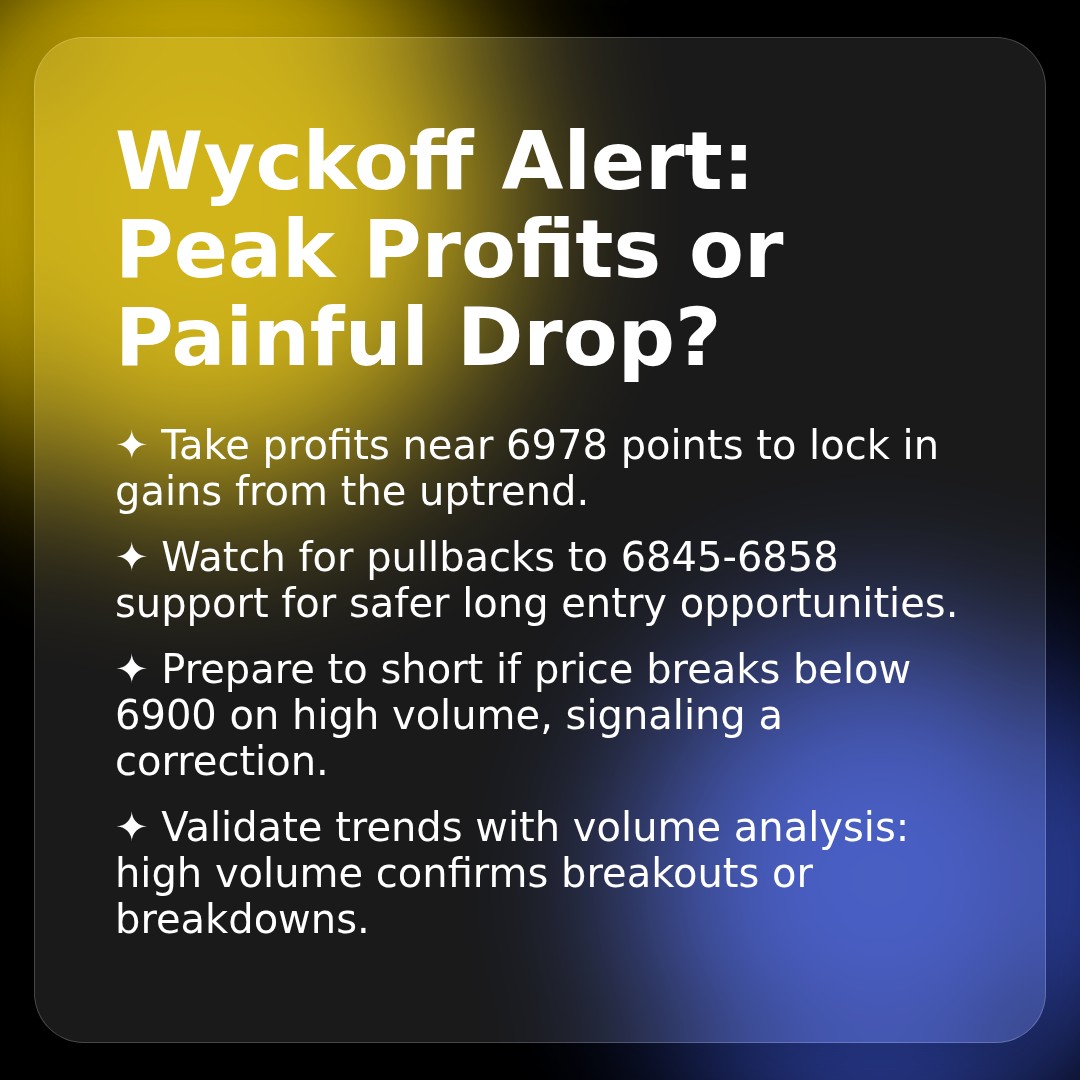
      • For Existing Long Positions: Consider taking partial profits in batches near or above the 6978-point level. Move stop-loss levels up to below 6900 points.
      • Potential Long Entry Opportunity: Wait for a price pullback to the S2 support zone (6845-6858) and observe whether demand signals such as low-volume stabilization or renewed high-volume advance appear. This would be a safer entry point.
      • Short Signal: If the price breaks below 6900 points (S1) on high volume, it would confirm a short-term trend reversal, allowing consideration for light short positions targeting the S2 area.
    • Future Validation Points:
      1. 1. Upside Validation: If the price can break through and hold firmly above 6978 points in the coming sessions with strong volume (volume ratio > 1.3), it would indicate renewed demand dominance, allowing an upward revision of bullish targets beyond 7000 points.
      2. 2. Downside Validation: If the price lingers below 6978 points with shrinking volume, followed by a high-volume break below 6900 points, it would largely confirm successful distribution at highs, initiating a correction towards S2 or even S3. Close observation of volume characteristics during the decline is crucial; if the decline is on high volume, the correction could intensify.

Disclaimer: All conclusions in this report are derived from the provided historical data and Wyckoff volume-price principles and do not constitute any investment advice. Financial markets carry risks. Investment decisions should be made based on individual circumstances, and consultation with a professional advisor is recommended.


Thank you for your attention! Daily Wyckoff volume-price market interpretation is released promptly at 8:00 AM before market open. Please feel free to comment and share; your recognition is crucial. Let's work together to see the market signals clearly.