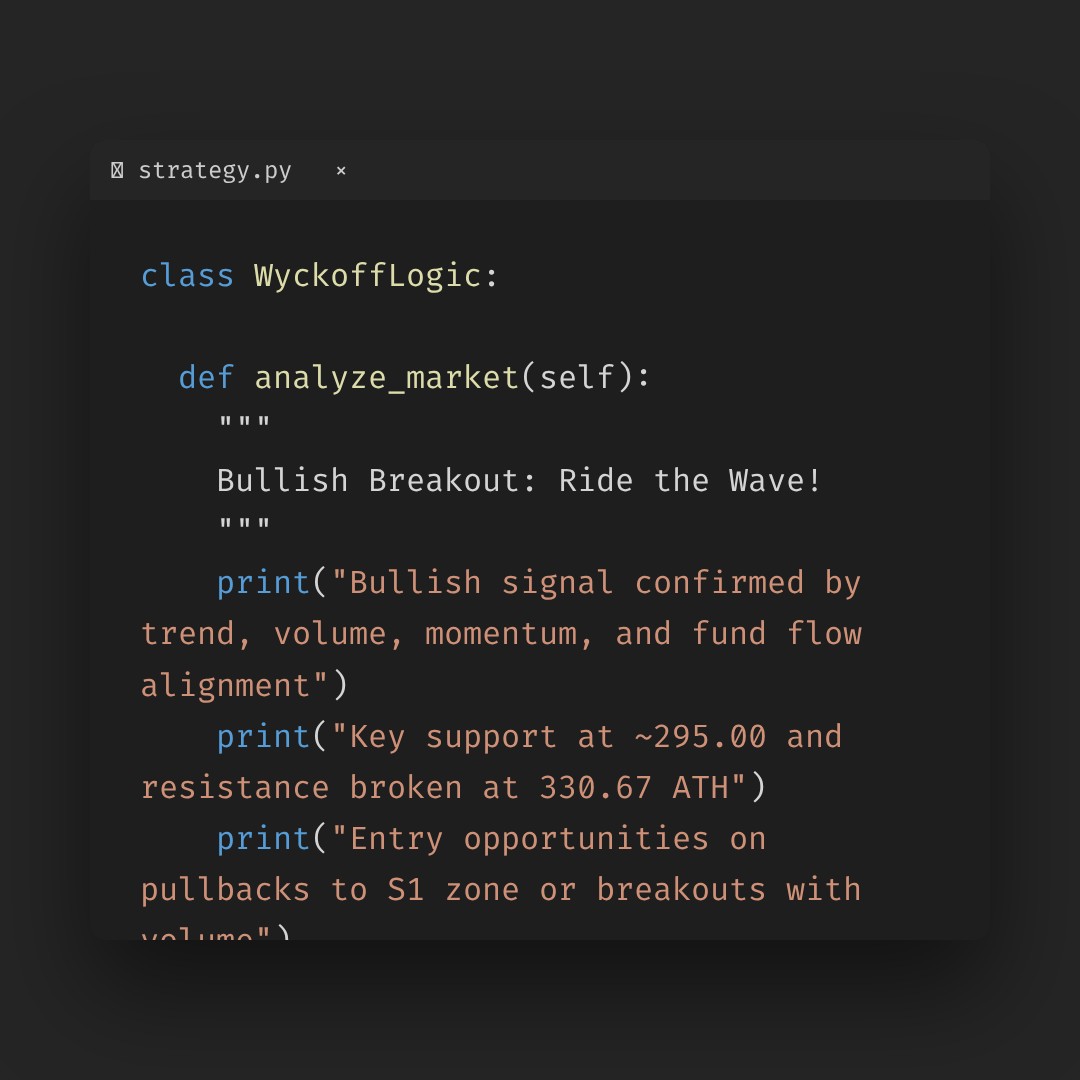
Okay, in accordance with your instructions. As a quantitative trading researcher proficient in the Wyckoff Method, I will compose a comprehensive and in-depth quantitative analysis report based on the SOXX historical data and ranking metrics you provided.
SOXX Quantitative Analysis Report
Analysis Date Range: 2025-11-10 to 2026-01-09 (Data ends on the trading day before the "Target Day")
Report Generation Time: 2026-01-10
Analyst: Wyckoff Quantitative Researcher
I. Trend Analysis & Market Phase Identification
As of January 9, 2026, the underlying asset SOXX opened at 322.80, closed at 328.78, with moving averages as follows: 5-day MA at 320.91, 10-day MA at 312.81, 20-day MA at 306.93. The daily price change was +2.88%, weekly change +4.81%, monthly change +9.17%, quarterly change +9.17%, and yearly change +9.17%.

- 1. Moving Average Alignment: As of the target day (2026-01-09), the price closed at 328.78, decisively above all key moving averages (MA_5D: 320.91, MA_10D: 312.81, MA_20D: 306.93, MA_30D: 305.33, MA_60D: 298.83), forming a typical bullish alignment pattern. The medium-to-long-term moving averages (MA_30D/MA_60D) are in a steady uptrend, indicating the primary trend is upward.
- 2. Trend Structure & Market Phase:
- • Mid-November Sharp Correction: During the period from 2025-11-13 to 2025-11-21, SOXX experienced a rapid decline, dropping from around 289 to a low of 268.1, accompanied by significantly increased volume (multiple days exceeding 10 million). According to Wyckoff theory, this aligns with the characteristics of "Panic Selling" – indiscriminate, emotional selling triggered by sudden events after a long-term uptrend, typically absorbed by large investors.
- • V-shaped Reversal & Recovery: After the panic, the price rebounded strongly on November 24 (+4.38%) and subsequently broke through previous highs with consecutive gains on December 2-3. This process can be interpreted as an "Automatic Rally" followed by a "Secondary Test", confirming the validity of the panic low and marking the beginning of the accumulation phase.
- • Breakout & Trend Resumption: Entering January 2026, the price set consecutive new highs (peak of 329.15 on 2026-01-06, peak of 330.67 on 2026-01-09), and the moving average system realigned into a bullish pattern. This indicates the market has successfully transitioned from the accumulation phase to the markup phase. The current price is within an uptrend channel, continually testing and breaking through historical resistance levels.
Conclusion: The primary market trend is upward, and the market is currently in a markup phase in the short term. A clear and severe accumulation process (panic selling → automatic rally → secondary test) occurred earlier (November 2025), providing a solid foundation for the current uptrend.
II. Volume-Price Relationship & Supply-Demand Dynamics
As of January 9, 2026, the underlying asset SOXX opened at 322.80, closed at 328.78, with a volume of 7,472,285, representing a daily price change of +2.88%. The 7-day average volume is 5,695,755.43, resulting in a 7-day volume ratio of 1.31.

- 1. Supply-Dominated Events (High Volume Decline):
- • 2025-12-12: The price dropped sharply by -4.78%, with volume surging to 13.81 million (
VOLUME_AVG_30D_RATIO=2.13,VOLUME_GROWTH=+112.36%). The turnover amount reached the third highest level in nearly a decade (HISTORY_RANK: 3). This is a typical distribution signal, indicating a massive influx of supply at high levels that demand could not absorb, leading to a rapid price decline. - • 2025-11-20: The price plummeted by -4.80% on a volume of 13.40 million (
VOLUME_AVG_30D_RATIO=1.84). Combined with the low-volume rebound the previous day, this constitutes a "Sign of Weakness," a key supply day during the decline.
- • 2025-12-12: The price dropped sharply by -4.78%, with volume surging to 13.81 million (
- 2. Demand-Dominated Events (High Volume Advance):
- • 2026-01-09 (Day before target day): The price rose +2.88% on a volume of 7.47 million (
VOLUME_AVG_14D_RATIO=1.59). This represents a strong recovery from the previous day's decline, with volume significantly above the recent average, showing demand has regained dominance as buyers actively enter the market to push prices higher. - • 2025-11-24: Following the panic decline, the price rebounded strongly by +4.38% on a volume of 6.42 million (
VOLUME_AVG_14D_RATIO=0.75, but the absolute value is notable). This is the "Automatic Rally," initially showing demand returning. - • 2026-01-02: On the first trading day of the new year, the price gapped up significantly by +4.16% on a volume of 8.49 million (
VOLUME_AVG_30D_RATIO=1.47), a clear signal of strong demand.
- • 2026-01-09 (Day before target day): The price rose +2.88% on a volume of 7.47 million (
- 3. Supply-Demand Transition Points:
- • 2025-12-17 to 2025-12-19: After the high-volume plunge on December 12, the market declined on reduced volume and then advanced on increased volume on December 19 (
VOLUME_AVG_14D_RATIO=0.87), confirming the halt of the decline and renewed demand participation.
- • 2025-12-17 to 2025-12-19: After the high-volume plunge on December 12, the market declined on reduced volume and then advanced on increased volume on December 19 (
Conclusion: The supply-demand relationship completed a full transition during the analysis period: from overwhelming supply dominance (panic, distribution) → supply-demand balance (accumulation, testing) → demand dominance (markup). The most recent trading day indicates demand remains strong, but vigilance is needed for the reappearance of high-volume stalling or decline similar to the level seen on December 12.
III. Volatility & Market Sentiment
As of January 9, 2026, the underlying asset SOXX opened at 322.80, with the following metrics: 7-day intraday volatility 0.24, 7-day intraday volatility ratio 1.24, 7-day historical volatility 0.45, 7-day historical volatility ratio 1.34, RSI 65.22.

- 1. Volatility Levels:
- • During the panic decline in late November, short-term volatility reached extreme values (
HIS_VOLA_7Dreached 0.574 on 11-24,PARKINSON_VOL_7Dreached 0.518 on 11-24), significantly higher than medium-to-long-term volatility (PARKINSON_RATIO_7D_60Dreached as high as 1.74 and 1.93 on 11-20 and 11-21, respectively), indicating market sentiment was in extreme panic. Historical rankings show thatPARKINSON_RATIO_7D_60Dduring this period ranked among extreme values of the past decade. - • From late December to early January, volatility significantly contracted (
PARKINSON_VOL_7Ddecreased to 0.16-0.24,PARKINSON_RATIO_7D_60Ddropped to 0.49 on 12-30, the 5th lowest in nearly a decade), indicating market sentiment shifted from panic to calm and optimistic, supporting healthy trend progression.
- • During the panic decline in late November, short-term volatility reached extreme values (
- 2. Overbought/Oversold Status (RSI):
- • At the panic low in November,
RSI_14touched a low of 36.84, entering the oversold region. - • Currently (2026-01-09),
RSI_14is at 65.22, within the strong zone but not in extreme overbought territory (>70), indicating healthy upward momentum with room for further gains.
- • At the panic low in November,
Conclusion: Market sentiment has completed the transition from "extreme panic" to "optimistic calm." The current low short-term volatility and healthy RSI reading support the continuation of the uptrend. Abnormal expansion of volatility again would serve as an early warning signal that the trend might face challenges.
IV. Relative Strength & Momentum Performance
- 1. Return Analysis:
- • Strong Short-Term Momentum:
MTD_RETURN(January-to-date) is +9.17%,WTD_RETURN(week-to-date) is +4.81%, indicating extremely strong short-term upward momentum. - • Mid-Term Momentum Recovery:
QTD_RETURN(quarter-to-date) is +9.17%, having fully recovered from the mid-December decline.YTD(year-to-date) is equal toQTD. - • Exceptional Long-Term Momentum:
TTM_36(36-month return) stands impressively high at +146.91%, highlighting the underlying asset's long-term bull market characteristics.
- • Strong Short-Term Momentum:
- 2. Momentum & Trend Confirmation: The strong short-term momentum (
WTD_RETURN,MTD_RETURN) aligns with the current demand-dominated volume-price relationship and the bullishly aligned trend, forming a bullish resonance of "trend-volume-price-momentum".
Conclusion: SOXX demonstrates positive or strong momentum across all timeframes, with particularly powerful short-term momentum, consistent with the assessment of an uptrend.
V. Large Investor (Smart Money) Behavior Identification
- 1. Accumulation Behavior (Mid-to-late November 2025):
- • Scenario: Price plummeted from above 300 to 268, accompanied by several days of massive volume (>10 million). Historical data shows turnover amounts on November 20 and 21 ranked as the 7th and 4th highest in nearly a decade, respectively.
- • Inference: During panic selling by retail investors (high-volume plunge), large investors actively absorbed shares at low levels. This aligns with the typical Wyckoff characteristic of "smart money" accumulation during the "panic selling" phase.
- 2. Shakeout & Re-accumulation (Mid-December 2025):
- • Scenario: The record-breaking high-volume plunge (distribution) on December 12, followed by low-volume minor declines over the next few days, and a recovery on increased volume on December 19.
- • Inference: The plunge on December 12 may have involved profit-taking by some positions and the exit of weak bulls. The subsequent low volume and swift recovery suggest large investors did not exit on a large scale; instead, they may have conducted secondary buying (re-accumulation) at relatively lower levels, flushing out weak holders.
- 3. Markup & Position Holding (Early January 2026):
- • Scenario: Entering 2026, prices experienced consecutive gap-up advances on high volume, continually setting new all-time highs.
- • Inference: Large investors are the primary driving force behind this uptrend. Historical rankings confirm that in the week before the target day, the highest price, closing price, opening price, and lowest price all set new records for the past decade. This is typically beyond the scope of retail investor behavior, indicating institutional funds are actively allocating and pushing prices higher.
Conclusion: Large investor behavior during the analysis period is clear: Accumulation at the panic bottom in November → Shakeout and consolidation of holdings during the December volatility → Initiation of a new strong markup phase in January. The market is currently in their markup phase.
VI. Support/Resistance Level Analysis & Trading Signals

- 1. Key Support Levels:
- • S1: 316.40 - 319.58 Zone (The trading range of the candlestick on 2026-01-08). This is a recent consolidation platform within the uptrend, also near the 10-day moving average.
- • S2: 306.00 - 309.40 Zone (The dense area of highs from December 2025). This area, a former strong resistance, has now converted to strong support and is near the 20-day and 30-day moving averages.
- • Primary Support: ~295.00 Zone (The lower boundary of the December 2025 accumulation range). This level is the last line of defense for bulls.
- 2. Key Resistance Levels:
- • R1: 330.67 (The all-time high set on 2026-01-09, ranking #1 in nearly a decade).
- • Upside Targets: With the price setting new all-time highs, there is no clear technical resistance above. Targets can be referenced from channel upper bounds or percentage extensions.
- 3. Comprehensive Trading Signal & Recommendations:
- • Signal Nature: Bullish. Four dimensions – trend, volume-price, momentum, and fund flow behavior – all point to the bullish direction.
- • Operational Recommendations:
- • Current Holders: Continue holding. Move the stop-loss level up to below S2 (306.00) to protect the majority of profits.
- • Observers / Those Looking to Add: Consider initiating positions in batches when the price pulls back to the S1 zone (316-320) and shows signs of low-volume stabilization (e.g., long lower shadow, small real body candlesticks).
- • Aggressive Traders: If the price breaks above R1 (330.67) with volume (
VOLUME_AVG_7D_RATIO > 1.1), it can be seen as a trend acceleration signal, allowing for small-position entries, with a stop-loss set below the low of the entry candlestick.
- • Risks & Future Validation Points:
- • Primary Risk: The appearance of a single-day, high-volume (especially with record-high turnover) long bearish candlestick similar to 2025-12-12 would constitute a strong distribution warning and is the primary signal for position reduction.
- • Trend Break Signal: If the price closes decisively below S2 (306.00) accompanied by increased volume, it may indicate an interruption of the uptrend, necessitating a defensive shift.
- • Validation Point: Over the next 1-2 weeks, the price should maintain around current highs or continue advancing. Pullbacks should show healthy volume contraction (
VOLUME_AVG_XD_RATIO < 0.9). If advances persist on shrinking volume, beware of potential demand exhaustion.
Disclaimer: This report is generated based on the provided historical data and quantitative models. All conclusions are derived from data analysis and do not constitute any investment advice. Financial markets involve risks; invest cautiously. The "inferences" in the report are probabilistic interpretations of market participant behavior based on Wyckoff principles, not definitive factual descriptions.
Thank you for your attention! Wyckoff Volume-Price Market Insights are published daily at 8:00 AM before the market opens. We kindly ask for your comments and shares; your recognition is crucial. Let's work together to see the market signals clearly.
Member discussion: