SOLUSDT Quantitative Analysis Report (Based on the Wyckoff Method)
Product Code: SOLUSDT
Analysis Date Range: 2025-11-10 to 2026-01-09
Report Generation Date: 2026-01-10
1. Trend Analysis and Market Phase Identification
As of 2026-01-09, the underlying asset SOLUSDT has an open price of 138.37, a close price of 135.54, a 5-day moving average (MA) of 137.57, a 10-day MA of 133.01, a 20-day MA of 128.50, a daily change of -2.05%, a weekly change of 2.46%, a monthly change of 8.74%, a quarterly change of 8.74%, and an annual change of 8.74%.

- • Moving Average Arrangement and Trend Judgment: As of 2026-01-09, the price (135.54) is below the short-term MA_5D (137.57) but above the MA_10D (133.01), MA_20D (128.50), and MA_30D (128.79). The long-term MA_60D (133.57) is below the price but above the medium and short-term MAs, indicating that the long-term downtrend has not been completely reversed, but signs of stabilization are emerging in the medium to short term. The moving average system shows local convergence and repair, transitioning from a clear bearish arrangement (MA_5D < MA_20D < MA_60D) in the earlier period (November 2025) to the current mixed arrangement. This suggests that the downtrend may be nearing its end, and the market is transitioning from a "Decline" phase to an "Accumulation" or "Preliminary Rally" phase.
- • Price Action and Market Phase: Since the high of 170.48 on 2025-11-10, the price experienced a smooth decline, bottoming at 119.71 on 2025-12-25. During mid-to-late December (December 18th to 31st), the price fluctuated repeatedly within the 119-130 range, forming a clear Trading Range. Entering January 2026, the price broke above this range with volume and attempted to challenge higher levels. This series of actions conforms to the classic evolutionary path in Wyckoff theory: "Decline - Accumulation - Markup". The current market is at a critical juncture, transitioning from the late stage of accumulation to the initial stage of markup.
2. Volume-Price Relationship and Supply-Demand Dynamics
As of 2026-01-09, the underlying asset SOLUSDT has an open price of 138.37, a close price of 135.54, volume of 3590549.45, daily change of -2.05%, volume of 3590549.45, 7-day average volume of 2684080.37, and a 7-day volume ratio of 1.34.

- • Supply-Demand Signals at the End of the Decline:
- • Selling Climax: On 2025-11-13, the price fell sharply by 5.66% with a 30.9% increase in volume, and the
VOLUME_AVG_7D_RATIOwas as high as 1.46. Subsequently, on November 14th and 17th, declines occurred on high volume (VOLUME_AVG_7D_RATIOof 1.55 and 1.32, respectively), characteristics consistent with a selling climax, indicating concentrated supply release in the short term. - • Supply Exhaustion and Demand Testing: During the low-level consolidation in late December, a positive signal of "decline on low volume" appeared. For example, on 2025-12-24, the price fell 1.19% with a 34.20% drop in volume, and the
VOLUME_AVG_7D_RATIOwas only 0.52; on 12-25, the price fell 2.02% with only a 13.26% slight increase in volume. This indicates that active selling (supply) had significantly diminished at the key support area (~120). - • Demand Emergence: Immediately after, on 2025-12-26, the price rose on high volume by 1.83% after a decline, with volume surging 82.94% (
VOLUME_AVG_7D_RATIOof 1.49). This was a clear signal of demand making its first significant entry at low levels.
- • Selling Climax: On 2025-11-13, the price fell sharply by 5.66% with a 30.9% increase in volume, and the
- • Supply-Demand Signals in the Breakout Phase:
- • On 2026-01-02, the price surged 9.49% with stable volume growth of 0.31% and a
VOLUME_AVG_7D_RATIOof 1.57. This marked demand taking complete control of the market, initiating a breakout from the previous accumulation range. - • During the rally in early January, volume was maintained at medium-to-high levels (
VOLUME_AVG_7D_RATIOgenerally > 1), showing a healthy pattern of "rising on increasing volume". This indicates the rally was driven by genuine demand, not a short-lived rebound fueled by short covering.
- • On 2026-01-02, the price surged 9.49% with stable volume growth of 0.31% and a
3. Volatility and Market Sentiment
As of 2026-01-09, the underlying asset SOLUSDT has an open price of 138.37, a 7-day intraday volatility of 0.50, a 7-day intraday volatility ratio of 1.01, a 7-day historical volatility of 0.43, a 7-day historical volatility ratio of 1.12, and an RSI of 55.35.

- • Volatility at Historically Extreme Lows, Brewing for a Change: Historical ranking data shows recent volatility hitting multi-year lows.
HIS_VOLA_14Dreached 0.3298 on 2026-01-04, the 3rd lowest in nearly ten years;PARKINSON_VOL_14Dwas 0.4331 on 2026-01-02, also the 3rd lowest in nearly ten years. The 21-day and 30-day historical volatilities are also among the top 5 historical lows (e.g.,HIS_VOLA_30Dwas 0.4152 on 2026-01-04, ranking 1st). Extremely low volatility typically signals highly suppressed market sentiment and exhausted trend momentum, often a precursor to a potential trend reversal or acceleration. - • Resonance of Volatility and Price Breakout: While prices rose in early January, short-term volatility (
HIS_VOLA_7D) increased moderately from around 0.26 to the 0.43-0.45 range. However, medium-to-long-term volatility (14D, 21D, 30D) remains at historical lows. This indicates the new uptrend has not yet triggered widespread panic or euphoria, representing a relatively healthy "rally with moderate volatility expansion." - • RSI Oversold Rebound: RSI_14 touched or fell below the 30 oversold line multiple times from late November to December 2025 (e.g., 27.54 on Dec 17), confirming extreme pessimism. Subsequently, RSI rebounded into the 55-66 range in early January 2026. Currently (01-09), it stands at 55.35, having left the oversold zone but not yet entering overbought territory, leaving room for further gains.
4. Relative Strength and Momentum Performance
- • Momentum Turning from Weak to Strong: Short-term momentum has improved significantly.
WTD_RETURNwas +2.46% in the first week of January (as of 01-09), whereas it was mostly negative in previous weeks.MTD_RETURN(for January so far) is +8.74%, whileQTD_RETURNremains at -40.23%. This indicates that although the medium-to-long-term weak structure has not fundamentally changed, short-term momentum has clearly turned positive, validating the price breakout and volume-price improvement signals. - • Endogenous Momentum Recovery: After breaking above the low-level consolidation range, the price has closed above key moving averages (MA_20D, MA_30D) for several consecutive days, showing that internal momentum is gathering, laying the foundation to challenge longer-term moving averages (MA_60D).
5. Large Investor ("Smart Money") Behavior Identification
- • Clear Accumulation Behavior: Combining volume-price and volatility analysis, the behavioral path of large investors is clear:
- 1. Distribution and Panic Phase (November 2025): Prices fell sharply from highs on high volume. Smart money may have completed some distribution and used market panic for observation.
- 2. Accumulation Phase (Mid-to-late December 2025): Within the narrow 119-130 range, volume contracted sharply during price declines (
VOLUME_AVG_7D_RATIOoften below 0.5), while it increased noticeably during rallies (e.g., 12-26). This aligns with the Wyckoff characteristics of accumulation following a "Shakeout" and "Test" — smart money continuously absorbed筹码 sold by retail investors in panic during the low-volatility environment, while testing overhead supply with minor rallies. - 3. Launch Phase (Early January 2026): Marked by the high-volume, strong bullish candlestick on 2026-01-02, resembling a "Jump across the Creek", smart money concluded accumulation and began driving the price away from their cost zone. Subsequent gains were accompanied by stable volume, indicating they remained in control and were not rushing to distribute.
- • Current Intent: Smart money is currently in the phase of pushing prices higher, attracting market attention, and testing higher resistance levels. The extremely low implied volatility provides them an opportunity to establish directional positions at low cost.
6. Support/Resistance Level Analysis and Trading Signals

- • Key Support Levels:
- • Primary Support: 119.00 - 123.00. This is the lower boundary of the accumulation range formed in December 2025 and an area dense with multiple price lows, possessing strong support significance. Any pullback should not effectively break below this zone.
- • Secondary Support: 130.00 - 133.00. The recently broken upper boundary of the range, which has now transformed into significant support. It is also where MA_30D and MA_60D converge.
- • Key Resistance Levels:
- • Near-term Resistance: 142.00 - 145.00. Corresponds to the area of rally highs during the decline in late November 2025 (Nov 18th, Dec 4th).
- • Medium-term Resistance: 154.00 - 160.00. Corresponds to the initial platform area at the beginning of the decline in mid-November 2025.
- • Comprehensive Wyckoff Events and Trading Signals:
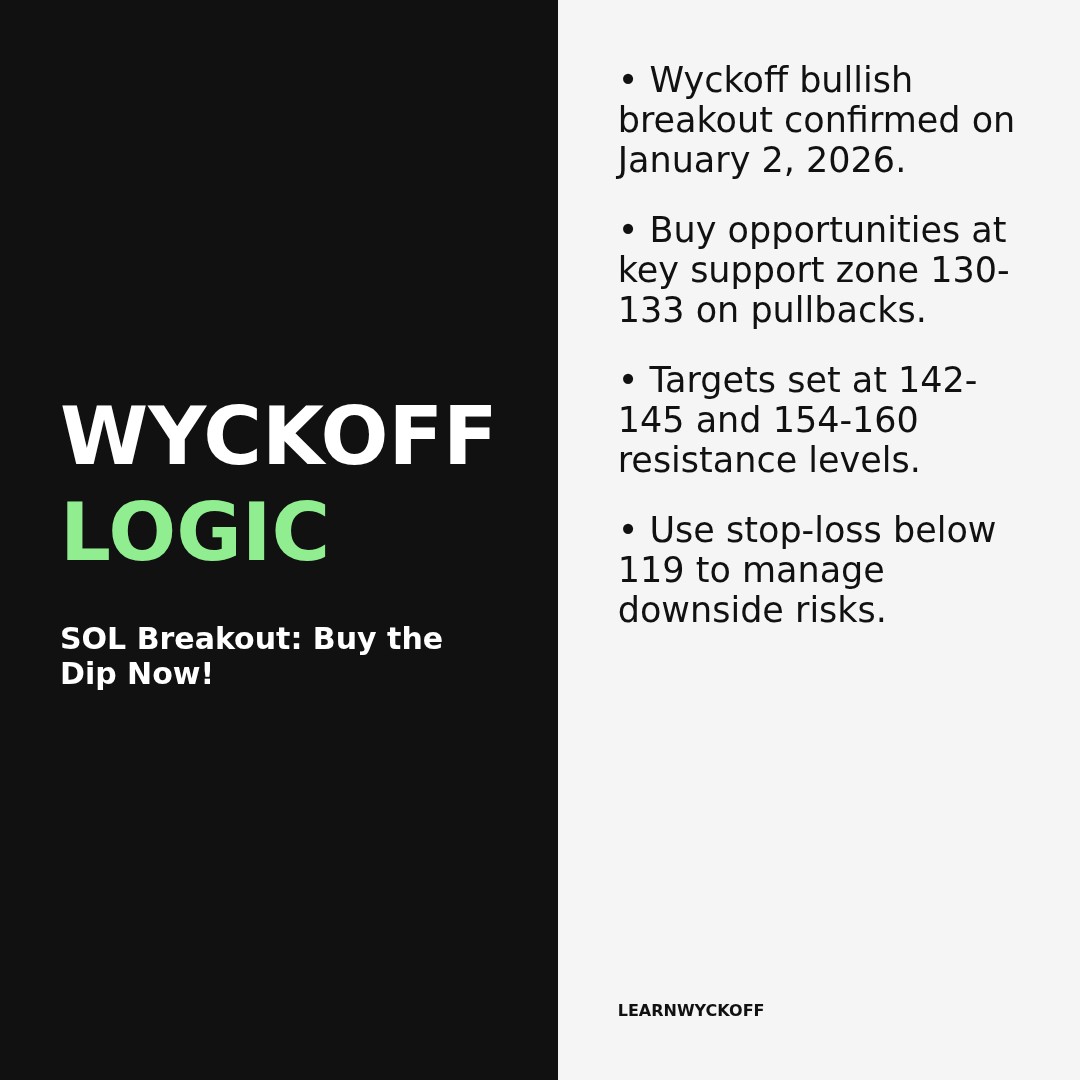
- • Signal Nature: Bullish. The market has completed a typical accumulation process (AR-BC), and a bullish confirmation signal (SOS) — the "Jump across the Creek" (breakout from the trading range) — appeared on 2026-01-02.
- • Operational Recommendations:
- • Long Strategy: Consider establishing long positions in batches when the price pulls back to the 130-133 support zone and shows signs of stabilization (e.g., appearance of a lower timeframe bullish Pinbar, low-volume retest of support).
- • Stop-Loss Placement: Initial stop-loss should be placed below the lower boundary of the accumulation range at 119.00 to account for potential deep pullbacks or accumulation failure. As the price rises, the stop-loss can be trailed up to below the breakout level of 130.00.
- • Target Outlook: The first target is the 142-145 resistance zone. If broken with volume, the second target can be set towards the 154-160 area.
- • Future Validation Points / Risk Warnings:
- 1. Demand Sustainability Validation: Subsequent rallies must continue to be accompanied by moderately increasing volume. Be alert for signs of demand exhaustion or returning supply, such as "rising on low volume" or "high-volume stagnation" (e.g., a daily gain less than 0.5% but with
VOLUME_AVG_7D_RATIO> 1.5). - 2. Support Validity Validation: The price should not close below the 130 support level again; otherwise, the validity of the breakout is questionable, and a return to consolidation is possible.
- 3. Volatility Anomaly Warning: If short-term volatility (
HIS_VOLA_7D) spikes rapidly above 0.8 while the price forms a strong reversal candlestick, it may signal short-term overheating or a potential trend change.
- 1. Demand Sustainability Validation: Subsequent rallies must continue to be accompanied by moderately increasing volume. Be alert for signs of demand exhaustion or returning supply, such as "rising on low volume" or "high-volume stagnation" (e.g., a daily gain less than 0.5% but with
Summary Conclusion: Based on Wyckoff volume-price principles, SOLUSDT has shown clear trend reversal signals in early January 2026, following a period of panic selling and low-level accumulation from November to December 2025. The current market is in the early stages of a markup phase led by large investors. Historically extreme low volatility provides room for trend development. Operationally, a strategy of buying on pullbacks is recommended, with strict stop-losses set below 119, while closely monitoring the health of the volume-price relationship during the uptrend.
Disclaimer: This report/interpretation is solely market analysis and research based on publicly available information and does not constitute any investment advice or operational guidance. The author strives for objectivity and fairness but makes no guarantees regarding accuracy or completeness. Markets involve risks; investment requires caution. Any investment actions taken based on this report are at your own risk.
Thank you for your attention! Wyckoff Volume-Price Market Interpretation is published daily at 8:00 AM before the market opens. Your comments and shares are greatly appreciated. Your recognition is crucial. Let's work together to see the market signals clearly.
Member discussion: