PPH Quantitative Analysis Report: Deep Market Insights Based on the Wyckoff Method
Product Code: PPH
Analysis Date Range: November 10, 2025 - January 9, 2026
Report Generation Date: January 10, 2026
Report Generated By: Wyckoff Quantitative Research Department
Executive Summary
Based on a detailed analysis of price-volume data over the past two months (November 10, 2025, to January 9, 2026), combined with historical ranking metrics from the past decade, we believe PPH is currently in the mid-to-late stages of a Distribution phase near a critical resistance level, following a major uptrend. The market has undergone a complete cycle from accelerated rallying and extreme overbought conditions (RSI reaching decade highs) to high-volume stagnation and consolidation at elevated prices. The current price has retreated after reaching a new all-time high (107.28) and is testing a key support zone. The behavior patterns of large investors (smart money) show signs of increasing supply at highs, while short-term demand has failed to follow through effectively. Traders should exercise heightened caution, leaning towards defensive strategies and awaiting clear signals of a new supply-demand equilibrium near critical support levels.
1. Trend Analysis & Market Phase Identification
As of January 9, 2026, the underlying asset PPH had an open price of 106.10, a close price of 105.23, with moving averages MA_5D at 104.67, MA_10D at 104.30, MA_20D at 102.93. The daily change was -0.26%, weekly change +1.46%, monthly change +2.00%, quarterly change +2.00%, and yearly change +2.00%.

- • Moving Average Alignment Analysis: Throughout the analysis period, the price (CLOSE) consistently traded above all key moving averages (MA_5D, MA_10D, MA_20D, MA_30D, MA_60D). The MA_60D steadily rose from 90.51 at the start to 98.49 at the period's end, with the MA_5D and MA_20D mostly maintaining a bullish alignment. This defines the primary long-term trend as upward.
- • Market Phase Identification: Price action reveals distinct Wyckoff cycle phases:
- 1. Acceleration/Upswing Phase (Nov 11, 2025 - Nov 25, 2025): The price rallied sharply, driven by significantly increased volume (e.g., VOLUME_GROWTH +23.97% on Nov 11), rising from 95.56 to 103.21. This is the Markup phase of the uptrend.
- 2. Initial Distribution/Consolidation Phase (Nov 26, 2025 - Dec 24, 2025): After reaching highs of 103.56-103.25, the price entered a wide-ranging consolidation. This period featured high-volume stagnation or decline (e.g., Dec 1, where volume hit an 18-month high while the price fell -1.38%) and several rallies on diminishing volume. This aligns with the initial characteristics of a Distribution Range in Wyckoff theory—where large investors distribute holdings amidst strong demand.
- 3. Secondary Test and Breakout to New High (Dec 24, 2025 - Jan 7, 2026): Following a brief year-end pullback, the price rallied again in early January 2026, setting a new all-time high of 107.28 (Jan 7). However, the volume intensity (VOLUME_AVG_60D_RATIO ~1.19) during this advance was significantly weaker than during the November primary up-leg. This constitutes a potential classic Upthrust After Distribution/Sign of Weakness (UTAD/SOW) signal: a price breakout to new highs unconfirmed by demand (volume), indicating waning upward momentum.
- 4. Current Phase (Jan 8, 2026 - Jan 9, 2026): The price has retreated from the all-time high and is currently testing the short-term moving average (MA_5D=104.67) and the upper boundary of the previous consolidation platform. The market is at a critical juncture, either confirming distribution or seeking new support.
2. Price-Volume Relationship & Supply-Demand Dynamics
As of January 9, 2026, the underlying asset PPH had an open price of 106.10, close price 105.23, volume 229692, daily change -0.26%, 7-day average volume 521342.57, and 7-day volume ratio 0.44.

- • Demand-Dominated Events (Strength Signals):
- • November 11, 2025:
PCT_CHANGE+2.76%,VOLUME_GROWTH+23.97%,VOLUME_AVG_30D_RATIO0.41. A strong breakout on high volume, with demand fully in control. - • November 21 & 25, 2025: Following prior adjustments, rallies occurred on increased volume (VOLUME_AVG_60D_RATIO > 0.8), indicating demand re-entering at key levels.
- • November 11, 2025:
- • Supply-Dominated Events (Warning Signals):
- • December 1, 2025: A key day.
PCT_CHANGE-1.38%, butVOLUMEreached 993,863, 1.71 times the past 60-day average volume (VOLUME_AVG_60D_RATIO), and marked the 18th highest trading volume in nearly 18 months. This is significant high-volume decline, indicating substantial supply entering the market that demand could not absorb. - • December 29, 2025: An extremely critical day.
PCT_CHANGE-0.49%,VOLUMEsurged to 1,011,083, 1.84 times the past 60-day average volume, marking the 15th highest trading volume in nearly 15 months. Massive volume with limited decline suggests large buy orders may have absorbed selling pressure at specific price levels, but it unequivocally confirms the presence of substantial supply in this zone. - • January 5-9, 2026: As the price retreated from highs, volume remained elevated (average
VOLUME_AVG_60D_RATIO>1.5) while the price continued to fall, indicating sustained selling pressure and receding demand.
- • December 1, 2025: A key day.
- • Insufficient Demand Events (Weakness Signals):
- • December 8-9, 2025: During price declines, volume contracted significantly (
VOLUME_AVG_60D_RATIO0.60, 0.35), suggesting no panic selling but also a lack of aggressive buying. - • January 8-9, 2026: Price declined with volume receding relative to previous days (
VOLUME_AVG_60D_RATIO0.63, 0.51), exhibiting a low-volume, creeping decline pattern, indicating tepid demand interest.
- • December 8-9, 2025: During price declines, volume contracted significantly (
Supply-Demand Summary: The market displayed a clear, healthy "price rising on increasing volume" demand-driven pattern in November. Entering December, the pattern shifted multiple times to "price falling on increasing volume" or "price stagnating/slightly rising on massive volume", indicating supply dominance. Particularly, the massive volume in late December and early January, combined with the price's inability to sustain new highs, strongly suggests distribution activity. Currently, supply clearly holds the upper hand. Demand needs to prove it can effectively absorb selling pressure at key support levels (e.g., the 102.5-103 zone).
3. Volatility & Market Sentiment
As of January 9, 2026, the underlying asset PPH had an open price of 106.10, 7-day intraday Parkinson volatility 0.18, 7-day volatility-volume ratio 1.36, 7-day historical volatility 0.19, 7-day historical volatility-volume ratio 1.31, RSI 63.76.

- • Volatility Levels: Recent short-term volatility (
HIS_VOLA_7D) has remained at moderately high levels of 0.18-0.19, above the medium-to-long-term volatility (HIS_VOLA_60D~0.177), with a ratio (HIS_VOLA_RATIO_7D_60D) of 1.05-1.31. Expanding short-term volatility indicates increased market disagreement and unstable sentiment at elevated prices. - • Intraday Volatility: Parkinson volatility (
PARKINSON_VOL_7D) has rapidly climbed from lows around 0.07 in late December to the current 0.178, indicating significantly amplified intraday volatility—a common phenomenon near the end of a trend or at turning points. - • Overbought/Oversold (RSI):
- • Historical Extreme Levels: Historical ranking data shows the RSI_14 reached 80.92 on November 25, 2025, the second-highest level in the past decade; 80.54 on November 26 was the third highest. This marked a rare state of extreme overbought market sentiment.
- • Current Status: The RSI has retreated from extreme highs to the current 63.76, moving out of overbought territory but remaining in a relatively strong zone. Sentiment has cooled from euphoria to relative rationality but has not entered oversold territory.
- • Sentiment Synthesis: The market has transitioned from extreme optimism (record RSI in late November) to current optimism tinged with caution. The expansion of volatility and the RSI's retreat from extremes align with the high-price, high-volume consolidation behavior, collectively pointing to waning trend momentum and a shift in market sentiment.
4. Relative Strength & Momentum Performance
- • Momentum Trend:
- • Short-Term Momentum Weakening:
WTD_RETURNis +1.46%, primarily driven by gains early in the week, but momentum weakened in the latter half.MTD_RETURNis +2.00%; year-to-date performance is acceptable but has retraced nearly 2% from the January 7 high. - • Medium-to-Long-Term Momentum Still Upward but Slowing:
YTD+1.99%,TTM_36+34.14%, indicating the inertia of the long-term uptrend persists. However, the recent momentum high (Jan 7) was not confirmed by volume, revealing a divergence between momentum and volume strength, casting doubt on the sustainability of the advance.
- • Short-Term Momentum Weakening:
- • Relative Strength Validation: Momentum data validates the conclusions from price-volume analysis: the upward long-term trend provides a bullish backdrop, but the short-term momentum exhaustion and price-volume divergence serve as leading signals that the trend may face a阶段性 correction or transition.
5. Large Investor (Smart Money) Behavior Identification
Synthesizing the above dimensions, we infer the operational intent of large investors as follows:
- 1. Distribution at Highs: During the rapid price ascent in late November, amid extreme euphoria (RSI reaching decade-highs), high-volume stagnation occurred (e.g., Nov 26, 28). This is typical behavior of smart money distributing holdings by capitalizing on strong retail demand. Historical rankings show multiple appearances of "Weekly Highest Open/Close Prices" in November, creating an ideal high-price environment for distribution.
- 2. Utilizing Rallies for Continued Distribution/Demand Testing: During the rallies in December and early January, particularly when the new all-time high of 107.28 was reached, volume strength was noticeably lacking. Smart money likely used the optimism surrounding the technical breakout to complete final distribution or test demand strength at higher levels. The outcome proved that demand at the new high could not absorb the selling pressure.
- 3. Current Behavior: Support Zone Testing & Absorption Observation: The price has retreated to the 102-104 zone, a previous area of concentrated trading (also the upper boundary of the December consolidation range). Smart money is now testing the strength of demand in this zone. The critical question is: when the price falls to this area, will we see:
- • Exhaustion of supply and a strong demand-driven rebound (Spring): Manifested as low-volume, narrow-range consolidation followed by a high-volume advance.
- • Weak demand and persistent supply (Sign of Weakness): Manifested as feeble rebounds followed by continued high-volume breakdowns.
Currently, based on the low-volume, creeping decline on Jan 8-9, the demand side remains on the sidelines, with no clear signals of smart money aggressively entering.
Conclusion: The primary behavior pattern of smart money over the past two months has been distribution, leveraging the uptrend and sentiment peaks. Currently, they are in an observation and testing phase, awaiting clear supply-demand signals from the market at key price levels to decide the next step: further distribution or beginning preparations (accumulation) for the next cycle.
6. Support/Resistance Level Analysis & Trading Signals

- • Key Resistance Levels (Supply Zones):
- • R1: 106.74 - 107.28: The recent all-time high zone, which has proven to contain substantial supply. Any rally approaching this zone will face significant selling pressure.
- • R2: 105.50 - 106.10: The secondary high zone formed from Jan 7-9, the starting point of the recent decline, constituting short-term resistance.
- • Key Support Levels (Demand Test Zones):
- • S1: 102.43 - 103.06: The confluence zone of multiple swing lows from December 2025 to early January 2026, coinciding with the Jan 5 low. This is the most critical observation zone currently. A high-volume breakdown below this level would confirm a breakdown from the distribution range, potentially initiating a deeper correction.
- • S2: 100.00 - 101.00: A zone of multiple trading concentration areas from December 2025 and a psychological level, representing stronger support.
- • Synthesized Wyckoff Events & Trading Signals:
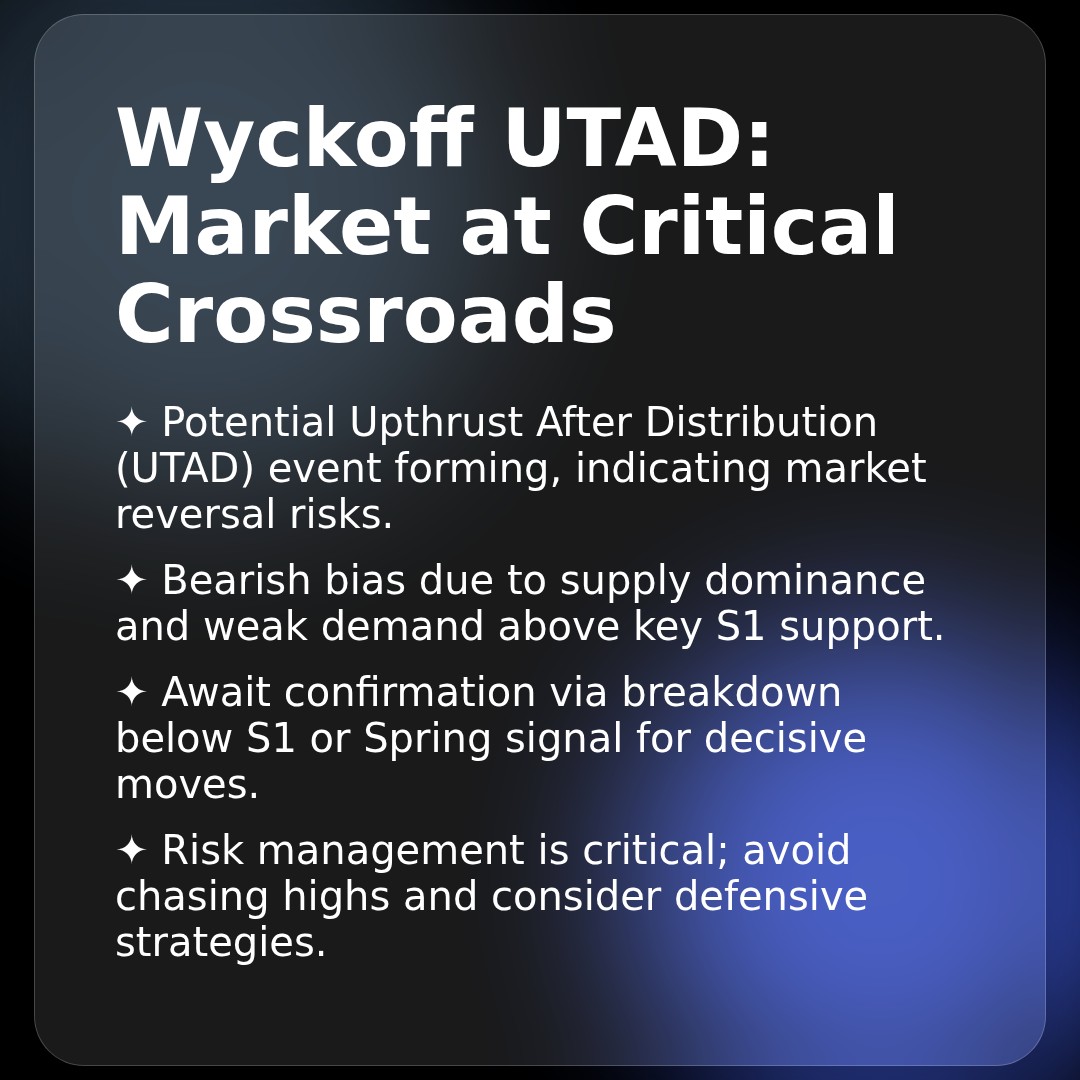
- • Primary Event: A potential "Upthrust After Distribution (UTAD)" event is forming (retreat following the 107.28 high). Confirmation awaits the result of the test on the lower boundary of the distribution range (S1).
- • Current Signal: Bearish/Watchful. Market structure indicates supply dominance and insufficient demand. Price is above key support but showing weak rebound attempts.
- • Operational Recommendations:
- 1. Bearish/Defensive Strategy: Investors with low risk tolerance should consider reducing positions or hedging. Aggressive traders may consider light short positions if the price rallies near R2 (105.5-106.1) and shows signs of stagnation, with a stop-loss set above 107.30.
- 2. Bullish/Watchful Strategy: Potential bulls should remain patient and strictly avoid chasing highs. Consider small positions for a rebound only upon observing the following signals:
- • Scenario A (Bullish): After the price declines to the S1 (102.43-103.06) zone, clear signs of low-volume stabilization appear (single-day volume below the 60-day average), followed by a high-volume bullish candle reclaiming this zone. This could be a Spring (shakeout) signal. An entry point could be on the breakout of the high-volume bullish candle, with a stop-loss set below the low of that candle.
- • Scenario B (Bearish): The price breaks down below the S1 support band on high volume (VOLUME_AVG_60D_RATIO >1.2). This would confirm completion of distribution and entry into a decline phase. Firmly avoid long trades and may consider following the trend.
- • Future Confirmation Points:
- • Bullish Confirmation: The appearance of the aforementioned "Scenario A" Spring signal at the S1 or S2 support levels.
- • Bearish Confirmation: A high-volume breakdown below the S1 support band, with subsequent failed rallies to reclaim it.
- • Neutral/Continuation of Consolidation Confirmation: The price continues to consolidate in a narrow range with low volume between S1 and R2, accompanied by contracting volatility.
Disclaimer: This report is based on historical data and quantitative model analysis and does not constitute any investment advice. Markets involve risks; invest with caution. All conclusions are based on data as of the report generation date, and future market conditions may change unpredictably.
Thank you for your attention! Daily Wyckoff Price-Volume Market Insights are published promptly at 8:00 AM before the market opens. Your comments and shares are greatly appreciated. Your recognition is crucial. Let's continue to see the market signals together.
Member discussion: