Understood. As a quantitative trading researcher well-versed in the Wyckoff Method, I will compose a comprehensive and in-depth quantitative analysis report based on the provided PEPEUSDT data.


PEPEUSDT Quantitative Analysis Report (Wyckoff Framework)

Product Code: PEPEUSDT
Analysis Period: 2025-11-10 to 2026-01-09
Report Generation Date: 2026-01-10

1. Trend Analysis and Market Phase Identification

As of January 9, 2026, the subject PEPEUSDT has an opening price of 0.00, a closing price of 0.00, 5-day moving average of 0.00, 10-day moving average of 0.00, 20-day moving average of 0.00, daily change of 0.16%, weekly change of 1.33%, monthly change of 51.12%, quarterly change of 51.12%, and annual change of 51.12%.

PEPEUSDT Price Trend Analysis Chart, including closing price and multiple moving averages
  • Moving Average Alignment and Trend Structure:
    1. 1. Long-term Decline and Bottom Formation (2025-11-10 to 2025-12-31): During this period, the price remained below all major moving averages (MA_5D, MA_10D, MA_20D, MA_30D, MA_60D), forming a typical bearish alignment. The price fell from 0.00000621 to 0.00000403, a decline of 35.1%. The continuously declining MA_60D confirmed the long-term bear market structure. In the final phase, the short-term moving averages (MA_5D, MA_10D) began to flatten and coil, with price fluctuations narrowing, indicating entry into a bottom consolidation stage.
    2. 2. Violent Reversal and Trend Transition (2026-01-01 to 2026-01-09): At the beginning of 2026, a V-shaped reversal occurred in the price. On 2026-01-04, the price (0.00000718) decisively broke above all short and medium-term moving averages. By the end of the analysis period (2026-01-09), the order was MA_5D (0.00000671) > MA_10D (0.00000587) > MA_20D (0.00000496) > MA_30D (0.00000471), forming a preliminary short-to-medium-term bullish alignment, although the price had retreated below the MA_5D. The MA_60D was still declining, indicating that the long-term trend transition was not yet fully confirmed.
  • Inferred Market Phase (Wyckoff Perspective):
    Based on price action and moving average evolution, the market experienced a complete cycle of "Decline -> Accumulation -> Markup -> Distribution/Reaction" during the analysis period.
    1. 1. Decline and Initial Accumulation (2025-11 to 2025-12): Continuous decline accompanied by diminishing volume (most VOLUME_AVG_*D_RATIO values below 1), consistent with Wyckoff characteristics of a downtrend. In the final phase (late December), extremely low volume appeared (historical ranking data: MIN_7-day average trading volume ranked 1st and 2nd), and volatility also dropped to very low levels (MIN_7-day volatility historical ranking 2nd). This is a classic sign of oversold conditions and selling exhaustion, likely accompanied by quiet accumulation by large investors at the bottom.
    2. 2. Completion of Accumulation and Breakout Rally (2026-01-01 to 2026-01-04): Consecutive high-volume rallies occurred on January 1st and 2nd (see Volume-Price Analysis). This was a strong breakout from the bottom accumulation zone, marking the market's entry into the "Markup" phase. During this period, the RSI quickly entered the overbought zone (RSI_14 was 82.15 on 2026-01-04, historical ranking 16th), indicating fervent buying sentiment.
    3. 3. Distribution and Secondary Test (2026-01-05 to Present): After hitting a high (0.00000726), the price corrected. Volume receded from its peak but remained relatively high. On January 8th and 9th, the price found support near the first significant low formed after the initial surge (approximately 0.00000608). The market is currently in a Secondary Test of the breakout or an initial distribution phase.

2. Volume-Price Relationship and Supply-Demand Dynamics

As of January 9, 2026, the subject PEPEUSDT has an opening price of 0.00, a closing price of 0.00, volume of 12910647567554.00, daily change of 0.16%, volume of 12910647567554.00, 7-day average volume of 25362094977341.14, and 7-day volume ratio of 0.51.

PEPEUSDT Volume-Price Relationship Line Chart and Historical Ranking Analysis
  • Key Day Analysis (Extreme Values Reveal Smart Money Activity):
    1. 1. Demand-Driven Breakout (2026-01-01, 2026-01-02):
      • 2026-01-01: Price surged 22.08%, volume increased by 342.81% (historical ranking 6th). VOLUME_AVG_7D_RATIO was as high as 3.83 (historical ranking 15th). This is a clear sign of panic buying, indicating large-scale demand entering the market at the turn of the year, ending the prolonged downtrend.
      • 2026-01-02: Price continued to surge 22.15%, reaching an unprecedented volume of 4.51e13. The ratios VOLUME_AVG_7D/14D/21D/30D/60D_RATIO were 8.91, 8.38, 6.96, 6.03, 5.17 respectively, all achieving or nearing historical peak rankings (1st, 1st, 4th, 5th, 12th). This is the Breakout Confirmation Day. The enormous volume represents the "smart money" that had been accumulating previously aggressively driving the price up, attracting a large number of followers, and completely absorbing the supply.
    2. 2. Initial Signs of Supply Emergence (2026-01-05, 2026-01-08):
      • 2026-01-05: Price fell -2.51%, but volume remained huge (2.35e13, VOLUME_AVG_7D_RATIO 1.30). This was the first instance of high-volume stagnation/decline after the rally, indicating the beginning of supply appearing at relatively high levels.
      • 2026-01-08: Price dropped significantly -7.32%. Volume (1.56e13) decreased from the peak, but the VOLUME_AVG_30D_RATIO was still 1.41. This was a high-volume decline, confirming the presence of supply pressure and marking the entry into a correction phase.
    3. 3. Test and Demand Reaction (2026-01-09):
      • • Price increased slightly by 0.16%, with volume contracting further to 1.29e13 (VOLUME_AVG_7D_RATIO 0.51). This was a low-volume test of the low from the previous day's plunge (0.00000608). The volume contraction indicates that panic selling (supply) did not continue, but demand has not yet strongly returned, putting the market in a brief equilibrium.
  • Supply-Demand Dynamics Summary:
    The forces of supply and demand underwent a dramatic shift during the analysis period: from "long-term supply dominance -> explosive influx of demand (breakout) -> emergence of supply at high levels -> entering an adjustment phase of supply-demand struggle." The recent (Jan 8-9) volume-price relationship suggests that the initial wave of supply pressure may have temporarily ended, and the market is testing the strength of the remaining demand.

3. Volatility and Market Sentiment

As of January 9, 2026, the subject PEPEUSDT has an opening price of 0.00, 7-day intraday volatility of 1.26, 7-day intraday volatility ratio of 1.03, 7-day historical volatility of 1.47, 7-day historical volatility ratio of 0.85, and RSI of 61.83.

PEPEUSDT Parkinson Volatility Analysis Chart and Historical Ranking Data
  • Volatility Levels and Changes:
    1. 1. Low Volatility at the Bottom (December 2025): PARKINSON_VOL_7D and HIS_VOLA_7D dropped to extremely low levels in late December (historical ranking data: MIN_7-day intraday volatility and MIN_7-day volatility frequently appeared on rankings). This aligns with the characteristic of volatility contraction at market bottoms, storing energy for the subsequent breakout.
    2. 2. Volatility Explosion During Breakout (Early January 2026): Accompanying the price surge, all volatility indicators across timeframes (HIS_VOLA_7D/14D, PARKINSON_VOL_7D/14D) spiked rapidly. Particularly, ratio indicators like HIS_VOLA_RATIO_7D_60D and PARKINSON_RATIO_7D_14D reached historical highs between January 2-6 (historical ranking data: WEEK_MAX_PARKINSON_RATIO_7D_14D ranks 18th, 19th). This indicates that short-term volatility far exceeded long-term normal levels, pushing market sentiment into a state of extreme euphoria and uncertainty.
    3. 3. Volatility Recedes During Adjustment: As of January 9th, the 7-day historical volatility (HIS_VOLA_7D) had retreated from a high of 2.15 to 1.47. However, HIS_VOLA_RATIO_7D_60D remained at 1.23, indicating volatility is still above the long-term average, and market sentiment has not fully settled.
  • Market Sentiment (RSI):
    • • RSI_14 stayed within the weak range of 30-45 for most of December, confirming the downtrend.
    • • On 2026-01-04, RSI reached 82.15 (historical ranking 16th), entering a severely overbought zone, issuing a clear warning of short-term excessive sentiment and indicating high risk of a pullback.
    • • The current RSI (2026-01-09) is 61.83, having retreated from the overbought zone to a neutral-to-strong area, leaving room for subsequent price action.

4. Relative Strength and Momentum Performance

  • Return Analysis:
    • Extremely Weak Long-Term: Both YTD and TTM_12 were deeply negative (-70% to -80%) at the beginning of the analysis period, indicating extremely poor long-term momentum.
    • Violent Reversal in Short-Term Momentum: Entering 2026, MTD_RETURN peaked at +78.16% on January 4th. As of January 9th, MTD_RETURN remains at +51.12%, while WTD_RETURN (this week) is +1.33%. This indicates that short-term momentum has significantly weakened after the violent surge and has entered a consolidation phase.
    • • The momentum performance aligns with the conclusions from the trend and volume-price analysis: a strong but rapid short-term rally followed by exhaustion of momentum.

5. Large Investor (Smart Money) Behavior Identification

Based on Wyckoff principles and the aforementioned data analysis, the inferred path of large investor behavior is as follows:

  1. 1. Accumulation at the Bottom (Mid-to-Late December 2025): During the period of despair characterized by a gradual price decline, volume shrinking to multi-year lows, and extremely low volatility, large investors likely engaged in stealthy accumulation. This phase features "silent accumulation," with retail investors generally exiting.
  2. 2. Rally and Attracting Public Participation (2026-01-01 to 01-04): Launched a major offensive at a critical juncture (New Year), rapidly driving the price up with high-volume, strong bullish candles. The purpose of this behavior was clear:
    • Moving Away from Cost Basis: Quickly lift the price away from the bottom accumulation range.
    • Creating FOMO Sentiment: Extreme volume and gains attract public attention, inducing follow-on buying.
    • Supported by Historical Ranking Data: The extreme values seen in WEEK_MAX_VOLUME_AVG_7D_RATIO (rank 1st) and WEEK_MAX_PCT_CHANGE (ranks 15th, 16th) are quantitative evidence of this manipulative rally behavior.
  3. 3. Distribution and Churning at High Levels (2026-01-05 to Present): After reaching high levels, signs of high-volume stagnation and decline emerged. This suggests smart money may have begun distributing shares to the following public investors. The sharp drop on January 8th could be a concentrated "Shakeout" during the distribution process, aimed at flushing out weak longs and creating space for potential subsequent operations. The low-volume doji on January 9th can be viewed as an observation or test of support after a pause in distribution.

6. Support/Resistance Level Analysis and Comprehensive Trading Signals

  • Key Price Levels:
    • Primary Resistance (R1): 0.00000726 (High on 2026-01-04, peak of this rally).
    • Secondary Resistance (R2): 0.00000670 - 0.00000700 (Upper boundary of the consolidation zone formed from 2026-01-05 to 01-07).
    • Dynamic Resistance: MA_5D (approximately 0.00000671), where the price is currently below.
    • Key Support (S1): 0.00000608 (Low on 2026-01-08, currently being tested). A break below may target 0.00000594 (Low of the Jan 8th candle and the prior gap area).
    • Strong Support (S2): 0.00000405 - 0.00000456 (The breakout origin zone in early January 2026, also the upper boundary of the previous long-term consolidation zone).
    • Ultimate Support (S3): 0.00000363 (Low on 2025-12-18).
  • Comprehensive Wyckoff Events and Trading Signals:
    • Current Phase Judgment: The market is in a "Distribution/Reaction" sub-phase following the "Markup" phase. Smart money distribution behavior has emerged initially, but the process may be complex and repetitive.
    • Core Contradiction: The short-term surge has created substantial profit-taking pressure (supply), but the strength of the breakout and massive volume also indicate powerful new demand. The current phase is a battleground between bulls and bears at relatively high levels.
  • Operational Suggestions and Risk Control:
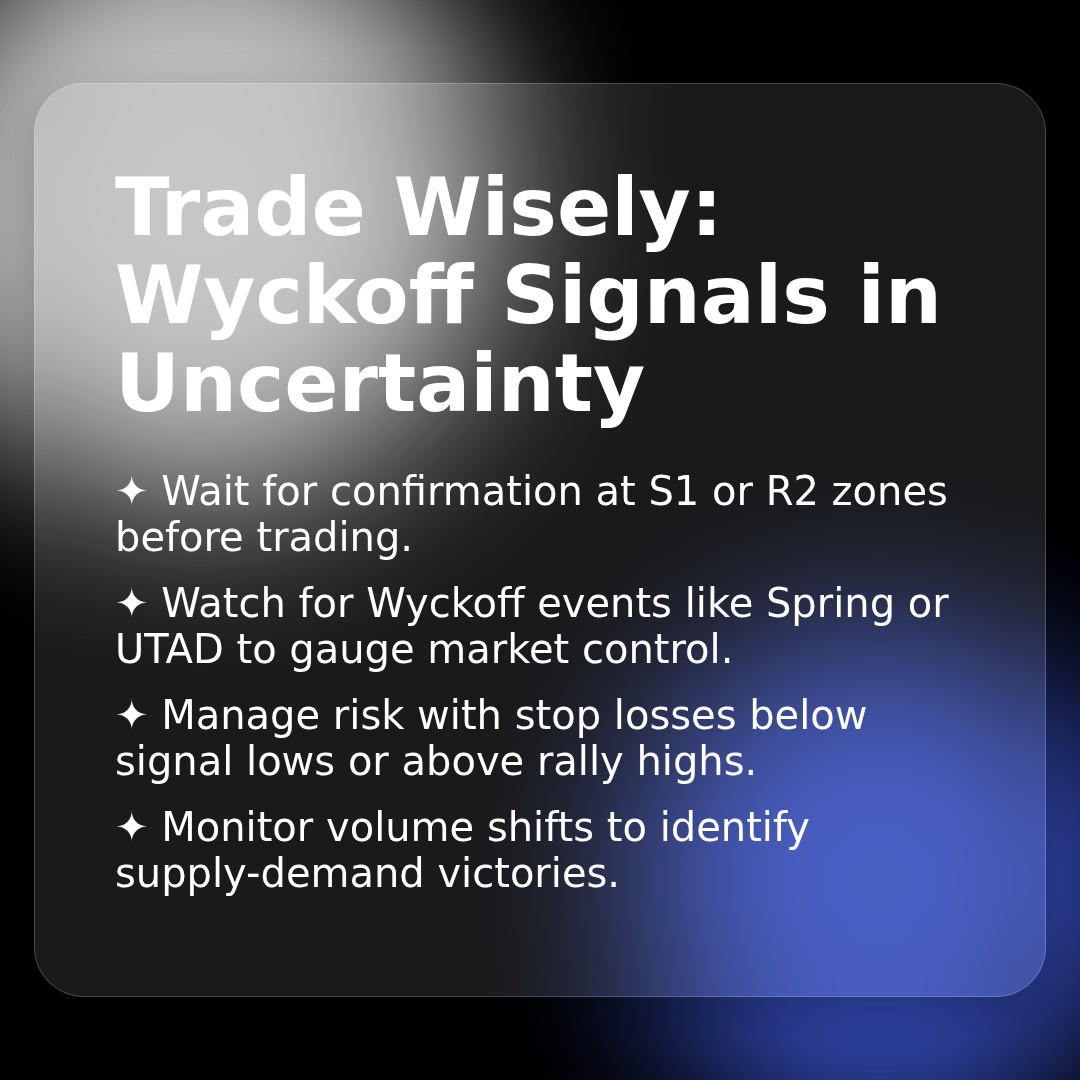
    1. 1. Long Strategy (Cautious):
      • Entry Condition: Price finds support in the S1 (0.00000608) or S2 (0.00000456) zones, accompanied by Wyckoff events showing "Demand in Control," such as: a "Spring" (quick recovery after breaching support), a "Strong Secondary Test" (significant volume contraction during the support test, indicating supply exhaustion), or a "Jump Across the Creek" (high-volume breakout from a recent consolidation zone).
      • Entry Point: Upon confirmation of the above signals.
      • Stop Loss: Below the low of the signal.
      • Target: Initial target R2 (0.00000670), then R1 (0.00000726) upon breakout.
    2. 2. Short Strategy (Following the Corrective Trend):
      • Entry Condition: Price rallies near R2 (0.00000670) or MA_5D, showing signs of renewed supply, such as high-volume stagnation candles (long upper wick) or the formation of a Weakness Secondary Test (UTAD).
      • Entry Point: Upon confirmation of the supply signal.
      • Stop Loss: Above the high of the rally.
      • Target: S1 (0.00000608), then the S2 zone upon breakdown.
    3. 3. Observation Strategy (Recommended): Currently at a critical juncture of bull-bear struggle with unclear direction. The safest strategy is to remain on the sidelines temporarily, waiting for the market to provide clearer signals of supply-demand victory near S1 or R2.
  • Future Validation Points:
    • Bullish Validation: Price forms a low-volume, narrow-range consolidation (VOLUME_AVG_7D_RATIO < 0.8) at S1 or higher, followed by a high-volume bullish candle breaking out of this consolidation, indicating demand has regained control.
    • Bearish Validation: Price rallies to the R2 zone but fails to break through, accompanied by increasing volume while price declines, or directly breaks below S1 support on high volume, indicating continued distribution and supply dominance, potentially resuming the downtrend.
    • Trend Failure Warning: If price breaks below S2 (0.00000456) on high volume, this high-volume-driven uptrend may be invalidated, and the market could revert to a bottom-seeking process.

Disclaimer: This report/analysis is solely market analysis and research based on publicly available information and does not constitute any investment advice or operational guidance. The author strives for objectivity and fairness but makes no guarantees regarding accuracy or completeness. Markets involve risks; investments require caution. Any investment actions based on this report are taken at one's own risk.


Thank you for your attention! Wyckoff Volume-Price Market Interpretations are released daily at 8:00 AM before the market opens. We kindly ask for your comments and shares; your recognition is vital. Let's work together to see the market signals clearly.