Understood. Following your instructions, I will conduct an in-depth quantitative analysis of META from the perspective of a quantitative trading researcher proficient in the Wyckoff Method.
META (Meta Platforms Inc.) Quantitative Analysis Report (Wyckoff Method Perspective)
Product Code: META
Analysis Date Range: 2025-11-10 to 2026-01-09
Report Generation Time: Generated based on data as of 2026-01-10
I. Trend Analysis and Market Phase Identification
As of January 9, 2026, the underlying asset META had an opening price of 645.44, a closing price of 653.06, a 5-day moving average (MA) of 652.91, a 10-day MA of 658.01, a 20-day MA of 656.55, a daily change of +1.08%, a weekly change of +0.41%, a monthly change of -1.07%, a quarterly change of -1.07%, and a yearly change of -1.07%.

- 1. Moving Average Alignment Analysis:
- • Initial State (Nov 10 - Nov 21): The price (CLOSE) remained consistently below all moving averages (MA_5D to MA_60D), with all MAs in a bearish alignment (MA_5D < MA_10D < MA_20D < MA_30D < MA_60D), confirming a clear downtrend.
- • Recent State (Late Dec - Jan 9): Following a rebound, the price entered a sideways consolidation. As of Jan 9, the price (653.06) fluctuated narrowly between the MA_5D (652.91) and MA_20D (656.55). The MA alignment has become complex: the MA_5D slightly crossed above the MA_20D but did not form a decisive golden cross; MA_10D (658.01) > MA_20D (656.55), but MA_20D remains below MA_60D (659.09). This indicates that the long-term downtrend (MA_20D < MA_60D) has not yet reversed, but short-term selling momentum has weakened, and the market has entered a consolidation phase.
- 2. Moving Average Crossover Signals:
- • Preliminary Golden Cross and Failure: During the rebound in early December, the MA_5D briefly crossed above the MA_20D, but failed to catalyze a reversal in price and longer-term trend. The subsequent price decline rendered this crossover signal invalid, representing a technical correction within a weak rebound.
- • Current Direction: The MA_5D and MA_20D are approaching each other again, with ambiguous direction. The MA_10D and MA_20D show signs of convergence. There is a lack of clear directional crossover signals, bullish or bearish.
- 3. Inferred Market Phase (Wyckoff Theory):
- • The decline in November 2025 was accompanied by expanding volume (e.g., Nov 12) and the RSI entering oversold territory (as low as 23.1), fitting the characteristics of "Panic Selling" or a "Selling Climax."
- • The subsequent rebound (Nov 24-25, Dec 4), accompanied by significantly higher volume, can be viewed as an "Automatic Rally."
- • Since mid-December, price has oscillated repeatedly within the672 range, with overall contracting volume and no clear directional bias in highs and lows. Coupled with the massive volume event on Dec 19 (the 6th highest in the past decade, with a trading value of $33B, detailed later), the current phase is highly suggestive of a "Re-accumulation" or "Weak Distribution" range. The market is digesting the prior massive volume, building energy to choose the next direction.
II. Volume-Price Relationship and Supply-Demand Dynamics
As of January 9, 2026, the underlying asset META had an opening price of 645.44, a closing price of 653.06, a volume of 11,429,599, a daily change of +1.08%, a volume of 11,429,599, a 7-day average volume of 11,272,929.14, and a 7-day volume ratio of 1.01.

- 1. Key Day Analysis:
- • High-Volume Decline (Supply Dominant):
- • 2025-11-12: Price fell sharply by -2.88%, with volume surging 84.1% (
VOLUME_GROWTH) sequentially, and aVOLUME_AVG_7D_RATIOof 1.03. This is a classic case of supply overwhelming demand. - • 2025-12-19: Extreme Event. Price declined modestly by -0.85%, but volume exploded to 49.98 million shares, with a trading value of $33 billion (6th highest historically). This represents massive volume on a slight decline, indicating that extremely strong supply (selling pressure) emerged at a relatively high level, met by equally massive demand. This was a decisive battle day between bullish and bearish forces.
- • 2025-11-12: Price fell sharply by -2.88%, with volume surging 84.1% (
- • High-Volume Advance (Demand Dominant):
- • 2025-11-24/25: Over two days, price cumulatively rose approximately 7%, with volume persistently elevated (
VOLUME_AVG_7D_RATIOat 1.10 and 1.16, respectively), indicating active demand entering the market. - • 2025-12-04: Price surged 3.43% on a volume of 29.87 million (
VOLUME_AVG_7D_RATIOas high as 1.89), providing strong demand validation for the rebound.
- • 2025-11-24/25: Over two days, price cumulatively rose approximately 7%, with volume persistently elevated (
- • Low-Volume Adjustment (Insufficient Demand/Exhausted Supply):
- • Late December 2025 to Early January 2026: Following the massive volume on Dec 19, volume contracted below the recent average on several trading days (e.g., Dec 23, 24, 26, with
VOLUME_AVG_7D_RATIObelow 0.5), while price volatility narrowed. This aligns with the low-volume behavior following a Wyckoff "Test" or "Shakeout," suggesting floating supply has diminished, but demand is also temporarily on the sidelines.
- • Late December 2025 to Early January 2026: Following the massive volume on Dec 19, volume contracted below the recent average on several trading days (e.g., Dec 23, 24, 26, with
- • High-Volume Decline (Supply Dominant):
- 2. Supply-Demand Strength Shift:
- • Supply dominated throughout the November decline. The rebound in late November confirmed the presence of demand.
- • The turning point was the massive volume on December 19. Despite the slight price decline, the enormous volume exchange implies a transfer of large positions. Since then, the market has entered a low-volume equilibrium state. Supply was released on the massive volume day, and demand has not yet initiated a new offensive. The current volume-price structure indicates the market is in a temporary supply-demand equilibrium zone, awaiting a new catalyst to break the balance.
III. Volatility and Market Sentiment
As of January 9, 2026, the underlying asset META had an opening price of 645.44, a 7-day intraday Parkinson Volatility of 0.24, a 7-day intraday volatility volume ratio of 1.15, a 7-day historical volatility of 0.23, a 7-day historical volatility volume ratio of 1.23, and an RSI of 49.10.

- 1. Volatility Levels and Changes:
- • Historical Volatility (HIS_VOLA): During the November decline, medium-to-long-term historical volatility (e.g.,
HIS_VOLA_30D) was elevated (0.51+). Recently, historical volatility across maturities has converged significantly.HIS_VOLA_14Ddecreased from 0.66 to 0.19, andHIS_VOLA_7Dis 0.23, indicating recovery from panic and a calming sentiment. - • Parkinson Intraday Volatility: Shows a similar converging trend.
PARKINSON_VOL_14Ddecreased from 0.36 to 0.21. - • Volatility Ratio Anomaly:
PARKINSON_RATIO_7D_14D(short-term / medium-term intraday volatility ratio) was at extremely low levels from late December to early January (e.g., 0.595 on Jan 2, historically the 8th lowest). This indicates that short-term volatility has contracted extremely, significantly below medium-term volatility, a classic precursor signal that the market is poised to choose a direction (a breakout).
- • Historical Volatility (HIS_VOLA): During the November decline, medium-to-long-term historical volatility (e.g.,
- 2. Overbought/Oversold Status (RSI):
- • The RSI_14 fell below 30 multiple times in mid-to-late November, reaching an extreme oversold level of 23.10 on November 20 (the 6th lowest in the past 10 years), confirming extreme pessimism and exhaustion of downward momentum, providing a technical foundation for the subsequent rebound.
- • The current RSI_14 is 49.10, in neutral territory, with neither overbought nor oversold pressure, consistent with the sideways price action.
IV. Relative Strength and Momentum Performance
- • Short-term Momentum (WTD_RETURN): Recently switching frequently between positive and negative (e.g., +0.41% on Jan 9), lacking persistence, aligning with the sideways pattern.
- • Medium-term Momentum (MTD/QTD_RETURN): Momentum turned positive in December (MTD peaked at +3.93%) but turned negative entering January (current QTD/YTD at -1.07%), indicating the rebound momentum around the year-end failed to sustain.
- • Conclusion: Following the deep decline in November and the rebound in December, both short-term and medium-term momentum for META have stalled. Its relative strength is more reflective of a correction from the prior oversold condition rather than the initiation of a new uptrend.
V. Large Investor ("Smart Money") Behavior Identification
Based on the multi-dimensional analysis of volume, price, and volatility above, inferences regarding smart money intent are as follows:
- 1. Mid-to-late November: The volume-backed halt of the decline and rebound during the sharp price drop and extreme RSI oversold condition likely involved smart money conducting initial, probing accumulation, aiming to absorb panic selling.
- 2. December 19 (Key Day): This is the most significant large investor behavior to watch. At a relatively high level after the rebound, volume reached a decade-level extreme while price declined only slightly. This strongly suggests a large-scale change of hands is occurring. From a Wyckoff perspective, this could be two scenarios:
- • Distribution: Funds that entered during the prior rebound (including some smart money) are distributing at high levels using the liquidity, transferring holdings to buyers chasing the rally.
- • Shakeout/Turnover within Re-accumulation: Larger-scale funds are conducting a "shakeout" near the upper boundary of the consolidation range, creating the illusion of massive selling pressure to flush out weak holders and complete large position establishment/adjustment. As this occurred after a rebound rather than during a decline, the suspicion of distribution is slightly higher than accumulation.
- 3. Late December to Present: Following the massive volume, trading activity contracted sharply, and price moved sideways in a narrow range. This indicates that for either the distributing or accumulating side, their primary objective (completing the large-volume exchange) has been preliminarily achieved, and the market has entered a resting and observation period. Smart money is likely assessing market reaction and awaiting the next catalytic event.
VI. Support/Resistance Level Analysis and Trading Signals

- 1. Key Price Levels:
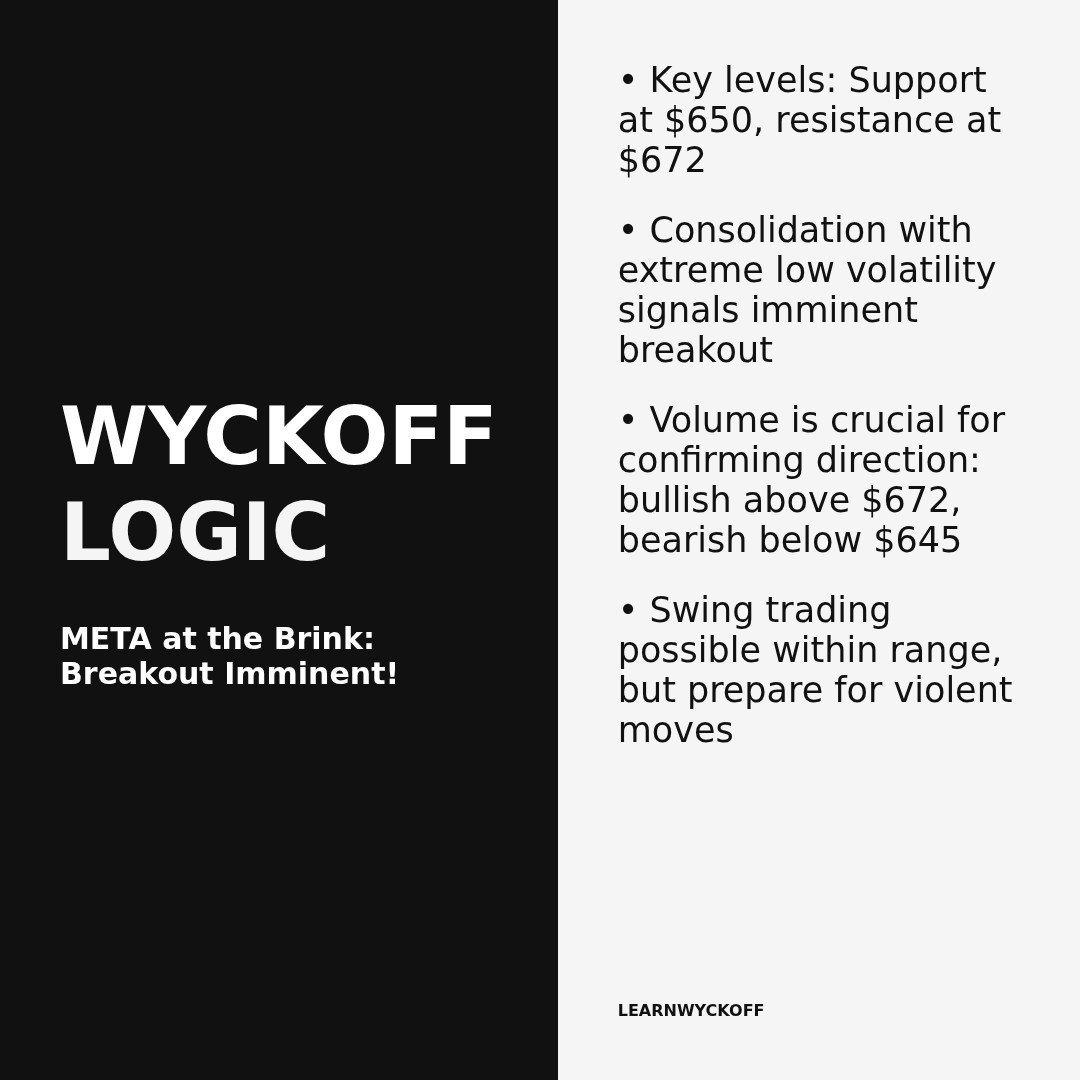
- • Primary Support Zone:650. This area represents the recent lower boundary of the consolidation range (lows on Jan 7-8) and a psychological support level below the 60-day MA (currently ~590.
- • Primary Resistance Zone:672. This area encompasses the December consolidation highs and previous rebound highs, as well as the convergence of the 20-day and 60-day MAs. A decisive breakout above this zone would be the first technical signal for a trend reversal to bullish.
- • Core Consolidation Range:672. The primary range in which the market is currently operating.
- 2. Comprehensive Trading Signals and Operational Recommendations:
- • Current Signal: Neutral / Watch. The market is in a consolidation period following a key massive-volume event, with no clear direction. Extreme volatility contraction suggests a breakout is imminent, but the direction needs confirmation via price action accompanied by volume.
- • Bullish Scenario & Operation:
- • Confirmation Point: Price breaks out and sustains above the $672 resistance zone on significant volume (
VOLUME_AVG_7D_RATIO> 1.2). This would suggest the massive volume on Dec 19 was more likely a shakeout rather than distribution, indicating smart money intent to move prices higher. - • Recommendation: If the above signal appears, consider entering on a pullback following the breakout. Initial stop-loss could be placed below the breakout day's low or below $665.
- • Confirmation Point: Price breaks out and sustains above the $672 resistance zone on significant volume (
- • Bearish Scenario & Operation:
- • Confirmation Point: Price breaks down below the $645 support zone on significant volume. This would confirm the massive volume on Dec 19 as effective distribution behavior, and the consolidation range as a bearish continuation pattern.
- • Recommendation: If the above signal appears, consider shorting or reducing holdings. Stop-loss could be placed above $655.
- • Near-term Strategy: Within the672 range, a swing trading strategy of selling near resistance and buying near support may be appropriate, but strict position sizing is crucial as breakouts following extreme low volatility are often violent. Key focus: monitor the volume energy on any breakout, as this is the ultimate evidence for judging smart money's true intent.
Disclaimer: This report/interpretation is solely market analysis and research based on publicly available information and does not constitute any investment advice or operational guidance. The author strives for objectivity and fairness but makes no guarantees regarding accuracy or completeness. Markets involve risks; investment requires caution. Any investment actions based on this report are taken at one's own risk.
Thank you for your attention! Wyckoff Volume-Price Market Interpretations are published daily at 8:00 AM before the market open. We kindly ask for your comments and shares—your recognition is crucial. Let us see the market signals together.
Member discussion: