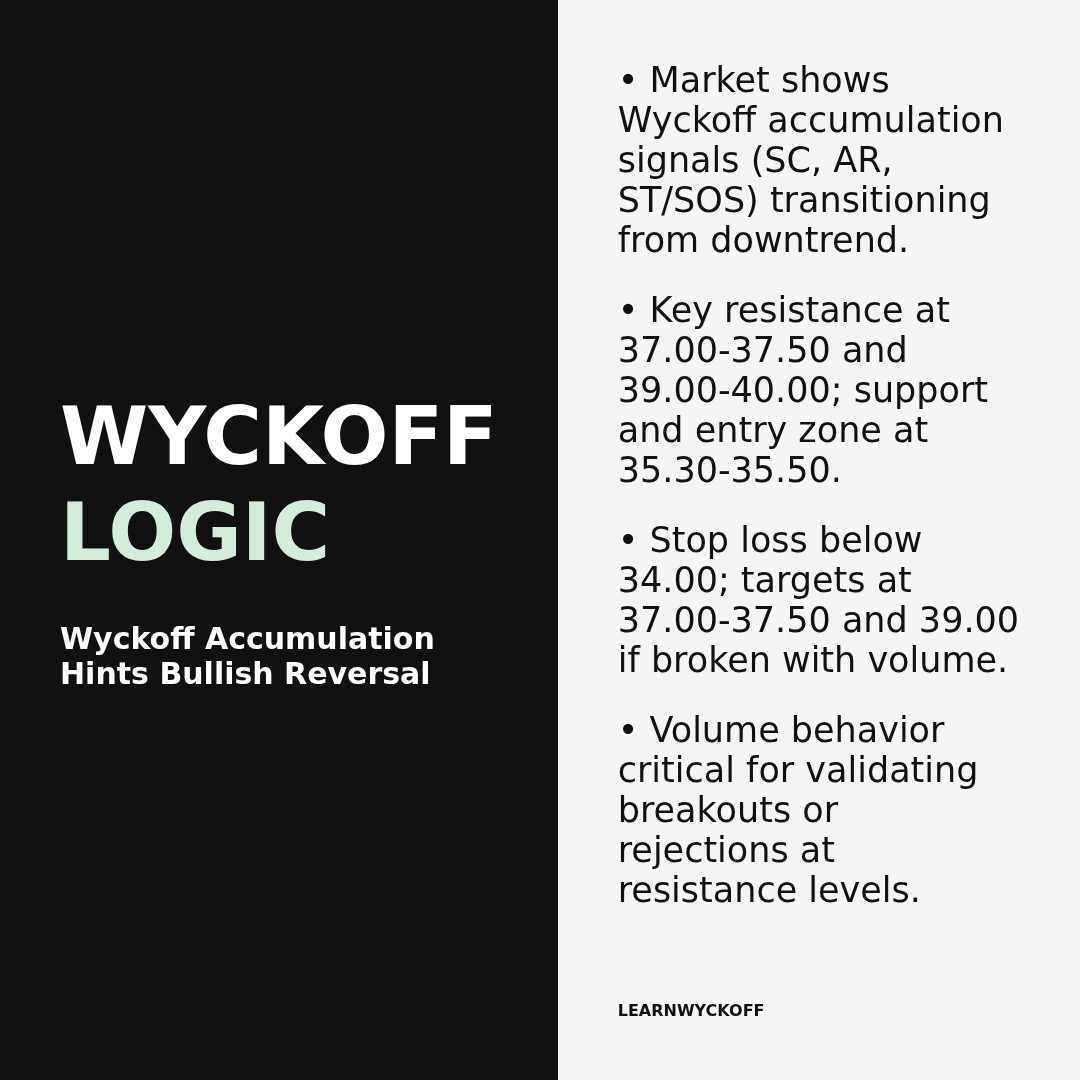
Okay, please review the Wyckoff quantitative analysis report for KWEB.

Wyckoff Quantitative Analysis Report for KWEB

Product Code: KWEB
Analysis Date Range: 2025-11-10 to 2026-01-09
Report Generation Time: 2026-01-10


1. Trend Analysis & Market Phase Identification

As of January 9, 2026, the underlying asset KWEB had an opening price of 35.95, a closing price of 35.83, a 5-day moving average of 35.97, a 10-day MA of 35.21, a 20-day MA of 35.67, a daily change of -0.25%, a weekly change of 0.56%, a monthly change of 5.23%, a quarterly change of 5.23%, and a yearly change of 5.23%.

KWEB Price Trend Analysis Chart, including closing price and multiple moving averages

Currently, the KWEB price (35.83) is below all major moving averages (MA_5D=35.97, MA_10D=35.21, MA_20D=35.67, MA_30D=36.28, MA_60D=37.77), exhibiting a classic bearish alignment pattern, confirming the market is in a primary downtrend.

However, dynamic analysis reveals a potential phase transition process:

  • Panic Selling Phase (2025-11-20 to 2025-12-22): Price fell rapidly from around 39.32 in mid-November to 34.76 on December 22nd, a drop of 11.6%. This period was accompanied by multiple high-volume plunges (e.g., Nov 20th, Dec 22nd), aligning with the Wyckoff characteristics of a "Selling Climax."
  • Automatic Rally Phase (2025-12-23 to 2025-12-31): Following the panic low, the market experienced a low-volume, narrow-range "Automatic Rally," with price consolidating between 34.05 and 34.83. Volume contracted sharply (VOLUME_AVG_7D_RATIO frequently below 0.7), indicating exhaustion of active selling pressure but not yet substantial demand entry.
  • Secondary Test & Demand Entry Phase (2026-01-02 to Present): At the start of the new year, price rebounded strongly on extremely high volume (Jan 2nd, Jan 5th). The price did not breach the previous low (34.05), and the advance occurred on high volume. This constitutes a "Successful Secondary Test" of the panic low and shows demand beginning to dominate the market. Price has reclaimed and is oscillating around the 5-day MA.

Conclusion: The market has likely concluded the "Panic Selling" phase and is in the early stages of an Accumulation phase. The long-term moving averages in bearish alignment constitute overhead resistance, but recent price-volume behavior shows supply exhaustion and initial demand attempts.

2. Price-Volume Relationship & Supply-Demand Dynamics

As of January 9, 2026, the underlying asset KWEB had an opening price of 35.95, a closing price of 35.83, volume of 17,028,083, a daily change of -0.25%, volume of 17,028,083, a 7-day average volume of 21,565,086.71, and a 7-day volume ratio of 0.79.

KWEB Price-Volume Relationship Line Chart and Historical Ranking Analysis

Analysis of key days reveals a dramatic shift in supply-demand forces:

  • Supply Dominance (Panic Selling): On 2025-12-22, price plunged -4.77% on a surge in volume (21.36M), 1.23x the 7-day average volume. This is classic panic selling, with significant supply flooding the market.
  • Supply Exhaustion (Automatic Rally): In subsequent trading days (Dec 23rd-31st), volume contracted persistently, with VOLUME_AVG_7D_RATIO generally below 0.7, dropping as low as 0.32 (Dec 26th). Price range narrowed, indicating selling pressure significantly eased post-panic low, but buyers remained on the sidelines.
  • Demand Dominance (Secondary Test/Demand Entry): On 2026-01-02, price surged 4.64% on volume soaring to 34.56M, 3.11x the 7-day average volume, marking an absolute high in recent history. This is not retail behavior but a clear signal of large-scale demand entry. Another high-volume advance on Jan 5th (40.77M, 3.14x avg. volume ratio) confirmed sustained demand.
  • Demand Follow-Through Weakens: In the last few trading days (Jan 7th, 8th, 9th), upward momentum weakened with pullbacks, and volume retreated to average levels. This represents a natural consolidation after the initial demand surge; the price-volume relationship during the pullback needs monitoring.

Conclusion: A fundamental shift in supply-demand dynamics occurred from late December to early January. The market transitioned from "Panic Selling (Supply Dominance)" to "Supply Exhaustion," and then to "Strong Demand Entry." The massive bullish candles in early January are decisive demand signals, suggesting smart money may have begun accumulating in this zone.

3. Volatility & Market Sentiment

As of January 9, 2026, the underlying asset KWEB had an opening price of 35.95, a 7-day Parkinson Volatility of 0.17, a 7-day Parkinson Volatility ratio of 1.27, a 7-day Historical Volatility of 0.43, a 7-day Historical Volatility ratio of 1.06, and an RSI of 47.60.

KWEB Parkinson Volatility Analysis Chart and Historical Ranking Data

Volatility data aligns closely with market sentiment inflection points:

  • Panic & Volatility Peak: Around the Dec 22nd panic selling day, both Historical Volatility (HIS_VOLA_7D: 0.38) and Parkinson Intraday Volatility (PARKINSON_VOL_7D: 0.15) were at recent highs.
  • Sentiment Freeze & Volatility Compression: Entering the Automatic Rally phase in late December, volatility contracted rapidly. Parkinson Intraday Volatility dropped to 0.099 on Dec 29th, with a HISTORY_RANK of 19 (within the lowest 20 over the past 10 years), indicating a shift from panic to extreme compression and watchfulness—a common pre-reversal characteristic.
  • Volatility Ratios Reveal Structural Change: In late December, ratios of short-term (7D) to longer-term (14D/21D/30D/60D) volatility (PARKINSON_RATIO and HIS_VOLA_RATIO) were mostly low, again confirming compression in the volatility structure.
  • Sentiment Recovery: The RSI_14 hit an extreme oversold level of 27.47 on Dec 31st, coinciding with the price low. It has now recovered to 47.60, moving out of the oversold zone, indicating improved sentiment.

Conclusion: Volatility data perfectly outlines the process of "Panic Release -> Sentiment Freeze (Extreme Volatility Compression) -> Sentiment Recovery." The extremely low historical rank of Parkinson volatility reinforces the judgment of this area as a potential significant market bottom.

4. Relative Strength & Momentum Performance

Momentum indicators show short-term momentum turning from negative to positive, but long-term pressure persists:

  • Short-Term Momentum Strengthens: Weekly return (WTD_RETURN) turned positive starting Jan 2nd, currently at +0.56%. Monthly (MTD_RETURN) and quarterly (QTD_RETURN) returns are both +5.23%, indicating the early January rally has established positive short and medium-term momentum.
  • Long-Term Weakness Not Yet Reversed: Despite the recent rebound, price remains significantly lower than the peak in early November 2025. The long-term moving average system (MA_30/60) still constitutes multiple layers of overhead resistance, meaning the long-term downtrend has not been formally reversed. The current rise should be viewed more as a powerful technical correction following the previous sharp decline.

Conclusion: Momentum has rebounded strongly from oversold conditions, improving short-term relative strength. However, sustained, high-volume breakouts above longer-period moving averages (e.g., MA_20, MA_30) are needed to confirm a true reversal of the intermediate-term momentum trend.

5. Large Investor (Smart Money) Behavior Identification

Based on Wyckoff principles and price-volume analysis, the operational intent of large investors is as follows:

  • Observation and Selective Absorption During Panic Selling (Late Dec 2025): The high-volume plunge on Dec 22nd was primarily panic selling by retail and weak hands. Smart money may have begun selective absorption during this process but not as a primary action.
  • Testing and Positioning During Automatic Rally (Late Dec 2025): The extreme volume contraction indicates large investors did not chase the rally but were testing whether selling pressure was truly exhausted, while possibly positioning for accumulation at low levels.
  • Concentrated Accumulation at Year Start (Jan 2nd & 5th, 2026): This is the most critical behavioral signal. The first trading day of the new year saw a historically large-volume advance, which cannot be attributed to retail or passive funds. This clearly indicates that after testing, large investors judged this area to be of high value and began active, concentrated accumulation. They utilized the year-start liquidity window and market hesitation to enter aggressively.
  • Current Behavior: The low-volume pullback over the past few days can be seen as a natural reaction post-accumulation, possibly to shake out short-term speculative followers from the rally, preparing for the next move.

Conclusion: The behavior pattern of large investors aligns with the typical Wyckoff "Accumulation Phase" characteristics: allowing the panic (SC) -> observing the automatic rally (AR) -> conducting a successful secondary test and beginning accumulation (ST & SOS). Current evidence strongly supports the judgment that smart money has initiated proactive buying and positioning in the 34-36 range.

6. Support/Resistance Level Analysis & Trading Signals

KWEB Support and Resistance Level Analysis Chart with Trading Signals

Key Price Levels:

  • Primary Support: 34.00 - 34.50. This zone witnessed the panic selling (Dec 22nd), multiple tests (Dec 29th, 31st), and was confirmed by the high-volume bullish candles in early January. It is a strong demand area and the last line of defense for bulls.
  • Initial Resistance: 37.00 - 37.50. Corresponds to the low of the consolidation platform from mid-December 2025 and the area near the Jan 5th high.
  • Core Resistance: 39.00 - 40.00. Corresponds to the starting platform of the November 2025 decline and the area around the MA_60, representing the long-term bull-bear divide.

Comprehensive Wyckoff Event Analysis:
Observed: Selling Climax (SC), Automatic Rally (AR), Successful Secondary Test/Sign of Strength (ST/SOS). Market structure is transitioning from downtrend to accumulation.

Final Trading Signal & Operational Suggestions:
Signal: Cautiously Bullish, Seeking Pullback Long Opportunities.
The market shows clear smart money accumulation signals, but significant overhead resistance exists; a trend reversal is not achieved in a single day.

Operational Suggestions:

  1. 1. Entry: Consider scaling into long positions in the 35.30 - 35.50 zone (near the recent breakout level and the Jan 7th low). It is preferable to enter during a price pullback accompanied by contracting volume.
  2. 2. Stop Loss: Strictly set below 34.00. A breach of this level would invalidate the accumulation premise and the bullish thesis.
  3. 3. Targets: First target 37.00 - 37.50. If broken with high volume, the second target can be set around 39.00 (MA_60 area).
  4. 4. Future Validation Points:
    • Bullish Validation: Price stabilizes above 35.50, and subsequent advances should be accompanied by a moderate increase in volume. Pullbacks should see significantly contracted volume.
    • Bearish Validation: Price fails to break the 37.00-37.50 resistance zone, turns downward, and breaches the 35.00 support. If this occurs, it suggests insufficient demand and a potential revisit of lows.
    • Key Observation: Any future attempts to test resistance at 37.00 and above must be scrutinized for price-volume behavior—is it a high-volume breakout or a rejection forming an "Upthrust After Distribution" (UTAD)? This will be crucial for determining whether accumulation has concluded and an advance may begin.

Disclaimer: This report/analysis is solely market analysis and research based on publicly available information and does not constitute any investment advice or operational guidance. The author strives for objectivity and fairness but makes no guarantees regarding accuracy or completeness. Markets involve risks; investment requires caution. Any investment actions taken based on this report are at your own risk.


Thank you for your attention! Wyckoff price-volume market analysis is published daily before the market opens at 8:00 AM. Your comments and shares are greatly appreciated. Your recognition is crucial. Let's work together to see the market signals clearly.