Quantitative Analysis Report on HSI Based on the Wyckoff Method
Product Code: HSI
Analysis Period: 2025-11-10 to 2026-01-09
Report Generation Date: 2026-01-09
Core Summary
Based on Wyckoff volume-price analysis of data from the past two months, HSI is currently in a critical phase of "Secondary Test" and "Re-Accumulation". After experiencing a decline from mid-to-late November 2025 to early December (Distribution and Panic Selling), the market established initial support around the 25,500 level in late December, followed by a significant attempt of demand inflow after the beginning of 2026. However, recent sessions (January 7-9) encountered strong supply around the 26,800 level, indicating resistance to the upward movement, suggesting that large investors may be engaging in partial distribution or rotation in this area. The market is currently at a critical juncture for the struggle between bulls and bears. The short-term directional bias depends on whether it can overcome the supply pressure above or hold the demand support below.
Six-Dimensional In-depth Analysis
1. Trend Analysis and Market Phase Identification
As of 2026-01-09, the underlying HSI: Open 26272.54, Close 26231.79, MA_5D 26400.88, MA_10D 26071.79, MA_20D 25826.18, Daily Return 0.32%, Weekly Return -0.41%, Monthly Return 2.35%, Quarterly Return 2.35%, Yearly Return 2.35%

- • Moving Average Alignment Analysis: At the end of the analysis period (2026-01-09), the short-term moving average (MA_5D: 26,401) has risen above the medium-term moving averages (MA_10D: 26,072; MA_20D: 25,826; MA_30D: 25,861), forming an early-stage bullish alignment. However, the price (26,232) remains below the long-term MA_60D (25,976), indicating that the long-term downtrend has not been completely reversed. This structure is typical of a market transitioning from a downtrend to a potential uptrend.
- • Moving Average Crossover Signals: Two key crossovers were observed:
- • Bearish Crossover: On 2025-11-17, MA_5D crossed below MA_20D, confirming the downtrend that began in mid-November.
- • Potential Bullish Crossover: Since 2026-01-02, MA_5D has been rising continuously and crossed above MA_20D around 01-07, issuing a preliminary signal for strengthening short-term momentum.
- • Market Phase Identification:
- • Phase 1 (Distribution and Decline): From 2025-11-13 to 12-09, price declined from a high of 27,088 to a low of 25,434, a drop of 6.1%, accompanied by multiple high-volume down days (e.g., 11-14, 11-21). This aligns with the characteristics of the "Distribution" and "Panic Selling" phases in Wyckoff theory.
- • Phase 2 (Preliminary Support and Automatic Rally): From 2025-12-10 to 12-31, the market oscillated repeatedly within the 25,400-26,000 range with contracting volume (VOLUME_AVG_30D_RATIO mostly below 0.9), indicating reduced selling pressure and the emergence of "Preliminary Support" and an "Automatic Rally".
- • Phase 3 (Secondary Test and Re-Accumulation): From 2026-01-02 to present, the market broke out of the consolidation range with a gap-up, high-volume surge. However, it recently (Jan 7-8) encountered resistance and pulled back around the 26,800 level, with price retesting the prior breakout zone (around 26,300) while volume remained elevated. The market is currently in the phase of a "Secondary Test" of the breakout's validity, which is also a critical observation period for large capital's "Re-Accumulation" or "Distribution".
2. Volume-Price Relationship and Supply-Demand Dynamics
As of 2026-01-09, the underlying HSI: Open 26272.54, Close 26231.79, Volume 245129966729, Daily Return 0.32%, Volume 245129966729, VOLUME_AVG_7D 225603973580.71, VOLUME_AVG_7D_RATIO 1.09

- • Key Volume-Price Signal Analysis:
- • Panic Selling and Initial Demand Appearance: On 2025-12-29, price fell 0.71% but volume surged 142.65% (
VOLUME_GROWTH), marking the second-highest daily volume growth rate in the past decade (HISTORY_RANK: 2). Such "High-volume decline" typically signals the "climax" of panic selling, but the enormous volume also hints at capital buying at the lows. The subsequent session (12-30) closed up 0.86%, confirming some demand entry. - • Strong Demand Intervention: On 2026-01-05, price was nearly flat (+0.03%) but volume exploded by 101.23% (
HISTORY_RANK: 16), withVOLUME_AVG_7D_RATIOreaching 1.80. This "High-volume stalling/consolidation" in a relatively low area after a prolonged decline is more likely interpreted as large-scale "Accumulation" rather than distribution. - • Rally Meeting Supply: From 2026-01-07 to 01-08, price declined for two consecutive sessions (-0.94%, -1.17%) while volume remained at historically high levels (
VOLUME_AVG_7D_RATIOat 1.43 and 1.22, respectively). This is a classic "High-volume decline", indicating strong supply pressure in the 26,700-26,800 zone, halting the upward momentum. - • Supply Weakening Test: On the latest trading day (2026-01-09), price gained a modest 0.32% with volume contracting 8.63% from the previous day but still above average (
VOLUME_AVG_7D_RATIOat 1.09). This "Low-volume rebound" suggests some weakening of supply and serves as a preliminary test of the prior day's high-volume decline, but demand is not yet strong enough.
- • Panic Selling and Initial Demand Appearance: On 2025-12-29, price fell 0.71% but volume surged 142.65% (
3. Volatility and Market Sentiment
As of 2026-01-09, the underlying HSI: Open 26272.54, PARKINSON_VOLA_7D 0.14, PARKINSON_RATIO_7D_14D 1.12, HIS_VOLA_7D 0.27, HIS_VOLA_RATIO_7D_14D 1.38, RSI 54.16

- • Volatility Level: The recent historical volatility (
HIS_VOLA_7D) surged from the low range of 0.10-0.13 in late December 2025 to the high range of 0.26-0.27 from January 7-9, 2026, indicating a sharp increase in market activity and uncertainty. - • Volatility Structure: The
HIS_VOLA_RATIO_7D_14Dindicator reached 1.38 on 2026-01-09, andPARKINSON_RATIO_7D_14Dwas 1.12. This indicates that short-term volatility is significantly higher than medium-term volatility, a phenomenon often seen in the early stages of a trend initiation or reversal, suggesting market sentiment has shifted from previous lethargy to activity and tension. - • Overbought/Oversold Status: RSI_14 oscillated upwards from the oversold low of 40.80 on 2025-12-09, reaching a recent high of 63.41 on 2026-01-06. It has since retraced to 54.16, residing in a neutral-to-strong zone with no extreme overbought or oversold pressure, leaving room for subsequent price direction selection.
4. Relative Strength and Momentum Performance
- • Short-term Momentum: WTD_RETURN is -0.41%, indicating a pullback within the week after encountering resistance.
- • Medium-term Momentum: MTD_RETURN is +2.35%, QTD_RETURN is +2.35% (as it is the start of the year), showing significant positive momentum generated by demand-driven moves since January.
- • Momentum Confirmation: The strong positive momentum (MTD) in early January is validated by the observed demand-dominant events such as "high-volume accumulation" and "gap-up rallies", confirming the effectiveness of the rebound. However, the weakening momentum in recent days also aligns with the supply pressure signals of "high-volume stalling/decline".
5. Large Investor (Smart Money) Behavior Identification
- • Accumulation Behavior: The high-volume decline in late December 2025 (12-29) and the high-volume advance in early January 2026 (01-05), combined with the market being at a relatively low level after the prior decline, strongly suggest that large investors are exploiting market panic and hesitation to "accumulate at lows". The volume levels reaching historical rankings highlight the scale and determination of such actions.
- • Distribution/Rotation Behavior: After the price rebounded to the 26,800 area (near the intermediate platform before the November 2025 decline), consecutive high-volume declines occurred (01-07, 01-08). This is not panic but "orderly supply release". Smart money may be taking partial profits (distribution) or rotating positions at this key resistance level to test the market's genuine absorbing capacity.
- • Current Intent: Overall, smart money established significant positions (accumulation) in the 25,500 area and propelled a rebound. The current struggle around the 26,800 level represents their critical action to "test" the overhead supply pressure and decide whether to continue pushing higher or need to retreat again for consolidation.
6. Support/Resistance Level Analysis and Trading Signals

- • Key Support Levels:
- • Primary Support: 25,500. The area tested multiple times in December 2025 without a decisive break, also the price zone where high-volume accumulation occurred. This is the most critical line of defense for bulls.
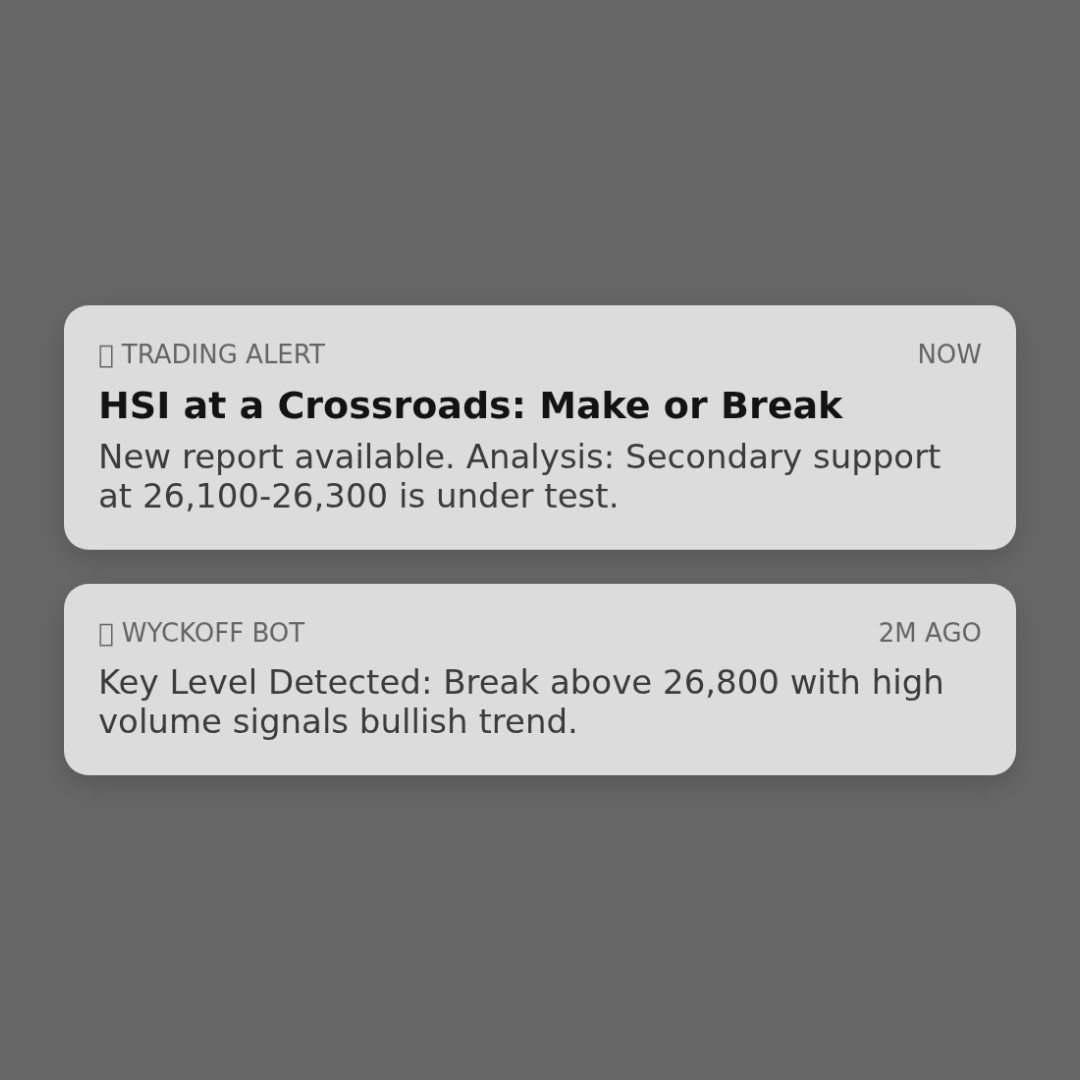
- • Secondary Support: 26,100 - 26,300. The upper boundary of the recent consolidation range and the starting point of the January 2026 breakout, also the area currently being tested by the price pullback.
- • Key Resistance Levels:
- • Primary Resistance: 26,700 - 26,800. The price zone of recent high-volume declines and a key pressure level along the descending trendline connecting the November 2025 highs.
- • Next Resistance: 27,000 - 27,100. The area of the November 2025 rebound highs.
- • Comprehensive Trading Signals and Operational Recommendations:
- • **Current Viewpoint: ** Cautious Wait-and-See, Awaiting Secondary Test Result. The market is at a critical equilibrium point between bulls and bears.
- • Bullish Scenario (Re-Accumulation Holds):
- • Entry Signal: Price finds support in the 26,100-26,300 zone (e.g., appearing as low-volume small bearish/bullish candles or a high-volume bullish candle), followed by a high-volume breakout and sustained move above 26,800.
- • Operational Suggestion: Consider entry upon breakout confirmation, with an initial stop-loss set below 25,900 (below the main accumulation zone).
- • Target Outlook: Towards 27,000 and above.
- • Bearish Scenario (Distribution or Failed Test):
- • Entry Signal: Price breaks below the 26,100 support on high volume, indicating a failed Secondary Test and renewed supply dominance.
- • Operational Suggestion: Consider entry after the breakdown, with a stop-loss set above 26,500.
- • Target Outlook: Towards a test of the 25,500 support.
- • Future Validation Points:
- 1. Demand Validation: Observe the price reaction around 26,300. Can a "low-volume decline" or "high-volume advance" appear to prove demand persists?
- 2. Supply Validation: Observe the relationship between volume and price change as price approaches the 26,800 level again. Will it be a "high-volume breakout" or another "high-volume stall"?
- 3. Structure Validation: Can MA_5D maintain its upward alignment above MA_20D? This relates to the health of the short-term trend structure.
Disclaimer: All conclusions in this report are derived based on the provided historical data and Wyckoff volume-price principles. They do not constitute any specific investment advice. Financial markets involve risks. Investors should make independent judgments and decisions cautiously based on their own circumstances.
Thank you for your attention! Wyckoff volume-price market insights are released daily before the market opens at 8:00. We sincerely appreciate your comments and shares. Your recognition is crucial. Let's work together to see the market signals.
Member discussion: