Quantitative Analysis Report: ETHUSDT

Product Code: ETHUSDT
Analysis Period: 2025-11-10 to 2026-01-09
Report Generation Date: 2026-01-10

1. Trend Analysis & Market Phase Identification

As of January 9, 2026, the subject ETHUSDT has an opening price of 3106.66, a closing price of 3072.40, a 5-day moving average of 3188.38, a 10-day moving average of 3114.40, a 20-day moving average of 3035.79, a daily change of -1.10%, a weekly change of -1.70%, a monthly change of 3.39%, a quarterly change of 3.39%, and an annual change of 3.39%.

ETHUSDT price trend analysis chart, including closing price and multiple moving averages
  1. 1. Price-Moving Average Relationship:
    • Bearish Alignment Confirmed: Throughout the analysis period, the CLOSE price has consistently remained below all moving averages (MA_5D, MA_10D, MA_20D, MA_30D, MA_60D), forming a standard bearish alignment. The continuous downward pressure from MA_60D indicates a solid medium-to-long-term downtrend.
    • Convergence and Divergence of MAs: From late December to early January, short-term moving averages (MA_5D, MA_10D) began to flatten and even formed a golden cross (around 2026-01-02), with the price attempting to break above them. However, medium-to-long-term moving averages (MA_20D and above) are still declining, and the price has consistently failed to decisively break above MA_30D. This indicates that the intermediate downtrend is not yet reversed, and the current rebound is likely a secondary rally within the broader downtrend.
  2. 2. Inferred Market Phase (Wyckoff Framework):
    • Primary Phase: At the beginning of the data period (early-mid November), the price fell rapidly from above 3600, breaking through all moving averages with exceptionally high volume (e.g., November 13th, 20th). This aligns with the characteristics of Panic Selling and an Automatic Rally, marking the acceleration phase of the transition from a "distribution" to a "markdown" trend.
    • Current Phase: From late November through December, the price experienced wide oscillations between 2700-3100, accompanied by repeated high-volume spikes (e.g., December 1st VOLUME_GROWTH reached 364.64%, ranking as the 11th highest in the last decade). This shows characteristics of Preliminary Support and Secondary Tests. The market is preliminarily judged to have entered an "Accumulation" phase. The rebound in early January, accompanied by relatively healthy volume, can be seen as an attempt at a "Jump" within the accumulation range, but it now faces a test of supply from the overhead resistance zone (previous high-volume trading area).

2. Volume-Price Relationship & Supply-Demand Dynamics

As of January 9, 2026, the subject ETHUSDT has an opening price of 3106.66, a closing price of 3072.40, a volume of 259300.56, a daily change of -1.10%, a volume of 259300.56, a 7-day average volume of 306541.28, and a 7-day volume ratio of 0.85.

ETHUSDT volume-price relationship line chart and historical ranking analysis
  1. 1. Key Day Analysis:
    • Supply-Dominated Declines:
      • 2025-11-13: Price plummeted -5.37% with volume (VOLUME) at 952k, a 72.12% increase from the previous day (VOLUME_GROWTH). VOLUME_AVG_7D_RATIO was as high as 1.75, indicating exceptionally high volume. This is a classic day of Sign of Weakness (SOW) characterized by panic selling.
      • 2025-11-20: Another sharp decline of -6.32% with volume at 913k. VOLUME_AVG_7D_RATIO was 1.27 and VOLUME_AVG_14D_RATIO was 1.45, showing continued high-volume selling and persistent supply pressure.
    • Demand Attempts and Insufficiency:
      • 2025-11-24 & 12-09: Rebounds exceeding 5% occurred with volumes of 715k and 604k respectively. VOLUME_AVG_*D_RATIO values were all greater than 1, indicating demand entering the market—characteristic of an Automatic Rally or a "Jump."
      • 2025-12-06 & 12-13: Prices saw minor gains or small rebounds, but volumes plunged to 159k and 136k respectively. VOLUME_AVG_7D_RATIO dropped to as low as 0.33 and 0.31, with VOLUME_AVG_14D_RATIO ranking as the 5th and 19th lowest in the last decade. This is typical Lack of Demand (LOD) or a Test on Low Volume, signaling a weak, unconvincing rebound.
    • Panic Selling and Potential Accumulation:
      • 2025-12-01: Price fell -6.43% with volume surging to 849k. VOLUME_GROWTH reached an extreme 364.64% (11th highest in the last decade). The occurrence of massive volume after a sustained decline fits the Panic Selling profile. According to Wyckoff theory, this often represents the public selling to large investors and is a component of accumulation.
  2. 2. Supply-Demand Transition Signals:
    • Supply Exhaustion Signals: In mid-to-late December, the volume accompanying declines (e.g., 12-15, 12-17) significantly shrank compared to the panic days in November (VOLUME_AVG_*D_RATIO mostly around 1.2 vs. >1.7 before). The presence of lower shadows also indicates weakening supply.
    • Demand Strengthening Signals: The rebound in early January 2026 (01-02 to 01-06) saw price increases accompanied by moderate volume expansion (VOLUME_AVG_14D_RATIO rising from 0.74 to 1.64). This healthy volume-price relationship suggests orderly demand is beginning to enter the market.

3. Volatility & Market Sentiment

As of January 9, 2026, the subject ETHUSDT has an opening price of 3106.66, a 7-day intraday volatility of 0.39, a 7-day intraday volatility volume ratio of 1.10, a 7-day historical volatility of 0.44, a 7-day historical volatility volume ratio of 1.18, and an RSI of 50.03.

ETHUSDTParkinson Volatility Analysis Chart and Historical Ranking Data
  1. 1. Volatility Levels and Changes:
    • Volatility Explosion During Panic: In mid-November, short-term volatility (HIS_VOLA_7D) peaked at around 0.965, far exceeding long-term volatility (HIS_VOLA_60D ~0.725). Ratios like HIS_VOLA_RATIO_7D_14D and _7D_21D were all above 1.2, reaching a high of 1.349 (on 12-09), indicating a sharp, panic-driven spike in short-term volatility.
    • Volatility Convergence and Sentiment Stabilization: From late December to early January, HIS_VOLA_7D rapidly declined to around 0.44. HIS_VOLA_RATIO_7D_14D hovered in the 1.0-1.2 range, and HIS_VOLA_RATIO_7D_30D even fell below 0.6 (reaching the 11th lowest in a decade on 01-01). This shows short-term volatility has significantly converged and is reverting towards its long-term mean. The market is recovering from panic, with sentiment cooling—a typical environment for trend transitions or consolidation.
  2. 2. Overbought/Oversold Status:
    • RSI_14 touched a low of 27.72 during the November sell-off, entering the oversold territory, corresponding with panic selling.
    • • Subsequently, RSI oscillated in the 30-50 range, indicating a weak balance. After the early January rebound, RSI rose to a peak of 68.68 (on 01-06), nearing but not breaching the 70 overbought threshold, before retracing to around 50. This suggests the rebound momentum has been partially released without reaching extreme overbought conditions.

4. Relative Strength & Momentum Performance

  1. 1. Momentum Trends:
    • Extremely Weak Medium-to-Long-Term Momentum: QTD_RETURN (quarter-to-date return) remained negative throughout the period, hitting a low of -33.27% and ending at -13.93%. YTD (year-to-date return) turned from positive to negative, ending at just 6.89%. This confirms the strong inertia of the medium-to-long-term downtrend.
    • Short-Term Momentum Strengthening: WTD_RETURN (week-to-date) and MTD_RETURN (month-to-date) turned positive in early January, reaching 3.39% and 10.94% respectively (as of January 9th). This indicates a significant improvement in short-term momentum, corroborating the price's break above short-term MAs and the improved volume-price relationship. This is a positive signal suggesting the market may be forming a bottom.

5. Large Investor ("Smart Money") Behavior Identification

Based on Wyckoff principles and the above data analysis, inferences regarding large investor intent are as follows:

  1. 1. Absorption During Panic Selling (Late Nov - Early Dec): When the price broke below 3000 and touched below 2800, there were record-breaking spikes in volume growth (e.g., December 1st). The public sold in panic, and the massive volume implies a counterparty absorbed all that selling. This is highly likely "Smart Money" establishing large-scale positions during the "Accumulation" phase. The subsequent narrow-range price oscillation and low-volume tests represent their efforts to control costs and test for remaining supply.
  2. 2. Orderly Buying on the Rise (Early Jan): The rebound starting January 2nd featured steadily rising prices accompanied by moderate, expanding volume. This differs from panic buying and resembles planned, sustained buying by institutional investors (Accumulation on the way up), aiming to lift the price away from their cost base without attracting excessive speculative followers.
  3. 3. Current Behavior Assessment: Smart Money has likely completed or is completing the main phase of accumulation (cost base roughly 2700-3000) and has begun attempting to push the price out of this zone (early January rise). The low-volume pullback on January 7-9 (VOLUME_AVG_7D_RATIO 0.85) can be interpreted as a "Back-up" or test of the breakout's validity, intended to shake out weak holders and confirm support. From a volume-price perspective, the pullback did not see significant supply emerge, indicating Smart Money is not distributing.

6. Support/Resistance Level Analysis & Trading Signals

ETHUSDT Support and Resistance Level Analysis Chart with Trading Signals
  1. 1. Key Levels:
    • Primary Support:
      • Lower Bound of Accumulation Range / Panic Low: 2700-2750. This is the strong support zone formed by multiple tests in late November and December, also representing the extreme point of panic selling.
      • Recent Demand Platform: 2950-3000. A high-density trading area from late December to early January, also where short-term MAs (MA_5D/10D) are converging.
    • Primary Resistance:
      • Recent Rebound High / Supply Zone: 3300-3350. The highs of January 6-7, also a pause point during the prior decline, containing overhead supply.
      • Intermediate Trend Strength Threshold: MA_30D (currently ~3037). A decisive break and hold above this level is the first key signal of strengthening market structure.
      • Strong Resistance / Trend Reversal Confirmation Level: 3500-3550. The high-density trading area at the start of the November decline, also the region around MA_60D. A breakout above this level would be needed to confirm a potential reversal of the medium-to-long-term downtrend.
  2. 2. Integrated Trading Signals & Recommendations:
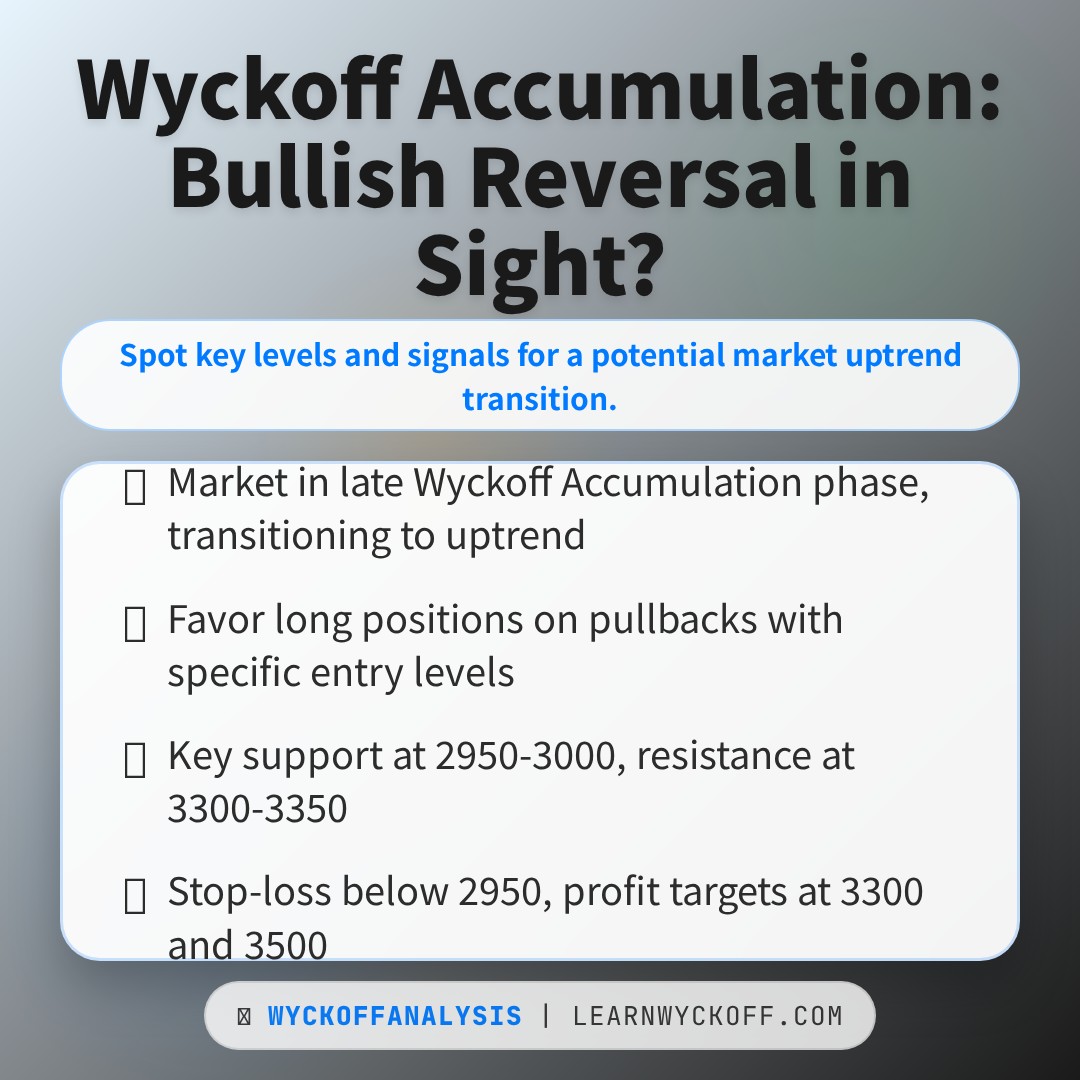
    • Core Assessment: The market is in the later stages of the Wyckoff Accumulation phase, attempting a transition towards an "uptrend." Large investors have completed low-level accumulation, short-term structure has strengthened, but the intermediate trend is not yet reversed.
    • Operational Recommendations:
      • Strategy Bias: Cautiously bullish, favoring long positions on pullbacks while awaiting breakout confirmations.
      • Long Entry Levels:
        1. 1. Aggressive (Buy on Pullback): Consider a light position if the price retraces to the 2980-3020 zone (near MA_30D and the previous platform) and shows signs of low-volume stabilization (e.g., single-day VOLUME_AVG_7D_RATIO < 0.8).
        2. 2. Conservative (Buy on Breakout): Enter on a pullback that holds after the price breaks and sustains above 3150 (the recent secondary high of the rebound) with expanding volume (VOLUME_AVG_7D_RATIO > 1.2).
      • Stop-Loss: Place below key support levels, such as 2950 or 2880.
      • Profit Targets: First target 3300, second target 3500.
      • Short Strategy: Not recommended to short against the potential trend in the absence of major negative catalysts. Consider short-term shorts only if the price rallies to the 3300-3350 strong resistance zone and shows clear signs of renewed supply with high-volume stagnation (single-day gain <1%, VOLUME_AVG_7D_RATIO > 1.5).
  3. 3. Future Validation Points:
    • Bullish View Needs Validation: The price must hold the 2950-3000 support zone and consistently demonstrate healthy volume-price dynamics ("volume expands on rallies, contracts on declines") in subsequent advances. Ultimately, a high-volume breakout above the 3300-3350 resistance is required.
    • Bullish View Invalidation Signal: A high-volume break below 2950, especially following extreme negative VOLUME_GROWTH (indicating initial selling pressure), would signify failed accumulation and likely lead to a renewed test of lower levels.

End of Report

Disclaimer: This report is derived entirely from quantitative analysis and theoretical interpretation of the provided historical data and does not constitute investment advice. Financial markets carry risks, and past performance is not indicative of future results. Please make independent decisions based on your own judgment.


Thank you for your attention! Wyckoff volume-price market analysis is published daily before the 8:00 AM market open. Your comments and shares are greatly appreciated and crucial. Let's work together to see the market signals clearly.