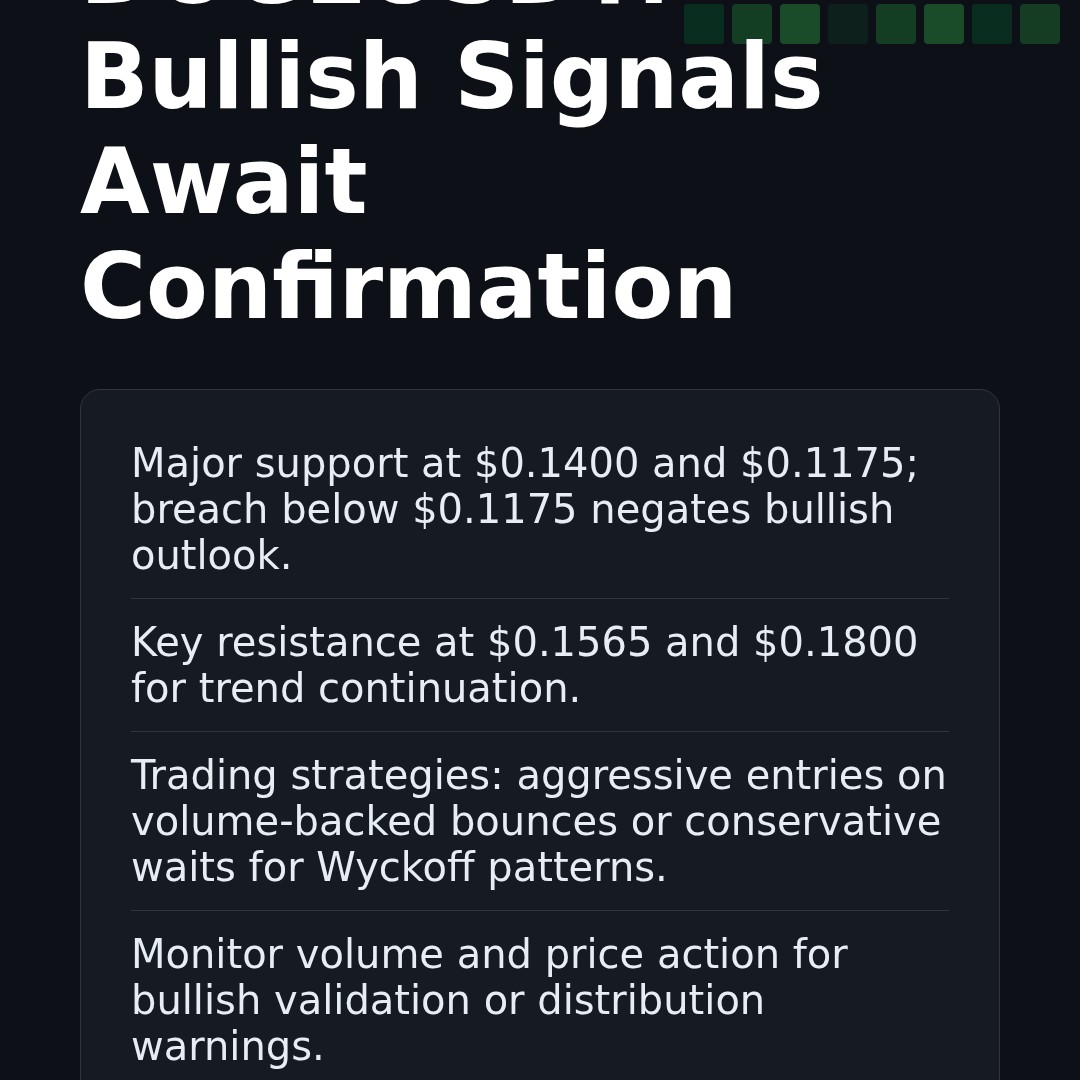
As a quantitative trading researcher proficient in the Wyckoff method, I will compile a comprehensive quantitative analysis report based on the DOGEUSDT historical data you provided (2025-11-10 to 2026-01-09), incorporating historical ranking indicators. All analyses are strictly based on the provided data and adhere to Wyckoff's principles of volume-price analysis.


DOGEUSDT Wyckoff Volume-Price Analysis Report

Product Code: DOGEUSDT
Analysis Date Range: 2025-11-10 to 2026-01-09
Report Generation Date: 2026-01-10

Core Summary: During the analysis period, DOGEUSDT experienced a downtrend that transitioned from a gradual decline to an accelerated bottom exploration (2025-11 to 2025-12), and showed clear potential "Accumulation" phase characteristics from the end of 2025 to the beginning of 2026. The data indicates that after establishing a low around $0.117, the market displayed the typical Wyckoff bottoming structure of Panic Selling (PSY) followed by a Large Volume Automatic Rally (AR). The current market may be in the process of a Secondary Test (ST) or Spring transitioning from the "Accumulation" to the "Markup" phase. Momentum has turned from negative to positive, but there are signs of weakening short-term demand, requiring close attention to the confirmation of key support levels. Overall View: Structural decline may have ended, a bullish structure is under construction, but more definitive re-entry signals are needed.


1. Trend Analysis and Market Phase Identification

As of 2026-01-09, the underlying asset DOGEUSDT has an opening price of 0.14, closing price of 0.14, 5-day moving average of 0.15, 10-day moving average of 0.14, 20-day moving average of 0.13, daily change of -1.53%, weekly change of -1.49%, monthly change of +18.98%, quarterly change of +18.98%, yearly change of +18.98%.

DOGEUSDT Price Trend Analysis Chart, including closing price and multiple moving averages
  1. 1. Moving Average Alignment and Trend:
    • Bearish Alignment Dominates: From 2025-11-10 to 2025-12-31, the price (CLOSE) consistently traded below all moving averages (MA_5D, MA_10D, MA_20D, MA_30D, MA_60D), showing a standard bearish alignment, confirming the medium-term downtrend. The MA_60D declined continuously from 0.221 to 0.147, and the MA_20D and MA_60D maintained a wide gap, indicating a significant downtrend level.
    • Trend Reversal Signal: Entering January 2026, the price consecutively broke above the MA_5D, MA_10D, and MA_20D. As of January 9th, MA_5D (0.148) > MA_10D (0.139) > MA_20D (0.133), forming an initial short-term bullish alignment pattern. However, the price remains below the MA_30D (0.133) and MA_60D (0.143), suggesting the trend reversal is in its early stages.
  2. 2. Price Action and Inferred Market Phase:
    • Decline and Distribution (2025-11 to Mid-December 2025): The price declined steadily from around $0.18. Although there were rebounds (e.g., November 18th), they consistently ended with high-volume declines (e.g., November 21st, -5.8%, volume 2.84B), consistent with the late "Distribution" or "Markdown" phase characteristics of Wyckoff theory, where supply continuously dominated the market.
    • Panic Selling (PSY - Late December 2025): The price accelerated its decline to a low of $0.11747 on 2025-12-31, with a daily drop of -4.77% and volume surging to 670M (VOLUME_AVG_7D_RATIO = 1.45). Combined with the preceding sustained decline, this low-volume spike can be preliminarily identified as panic selling.
    • Automatic Rally (AR - Early January 2026): Following the panic low, the market staged a massive, strong rally on 2026-01-02 (+11.87%, volume 2.24B, VOLUME_AVG_7D_RATIO = 3.88). This is a clear signal of large-scale, concentrated demand entering the market for the first time, marking the exhaustion of downward momentum.
    • Secondary Test and Potential Accumulation (2026-01-03 to present): After the high-volume rally, the price entered a volatile pullback phase. Recently (January 7-9), the price retreated, accompanied by significantly reduced volume (January 9th volume was 669M, VOLUME_AVG_7D_RATIO = 0.53). This aligns with the Wyckoff characteristic of a Secondary Test (ST) — the market retests the panic low area on low volume, checking if supply has been exhausted. The current market is highly likely in the later stages of the "Accumulation" phase.

2. Volume-Price Relationship and Supply-Demand Dynamics

As of 2026-01-09, the underlying asset DOGEUSDT has an opening price of 0.14, closing price of 0.14, volume 669110399.00, daily change -1.53%, volume 669110399.00, 7-day average volume 1254703869.57, 7-day volume ratio 0.53.

DOGEUSDT Volume-Price Relationship Line Chart and Historical Ranking Analysis
  1. 1. Supply-Driven Decline:
    • Key Evidence: On 2025-11-21, the price plummeted -5.80% to $0.14029, with volume surging to 2.835B (VOLUME_AVG_7D_RATIO = 2.06, VOLUME_GROWTH = +77%). This is a classic "high-volume decline," indicating extremely strong supply (selling pressure), placing the market in a state of panic or distribution.
    • Confirmation Signal: In subsequent trading days (Nov 22-30), the price consolidated in a narrow range at low levels, with volume rapidly shrinking (e.g., only 302M on Nov 29th), suggesting a temporary supply-demand balance after the massive release of supply.
  2. 2. Demand-Driven Reversal:
    • Key Evidence: On 2026-01-02, the price surged +11.87% on the second-highest volume of the analysis period, 2.240B (VOLUME_AVG_60D_RATIO = 2.41). This is a classic "high-volume breakout," indicating powerful demand (buying pressure) entering the market, successfully absorbing all supply and pushing prices higher. This is the strongest signal of a potential fundamental shift in market structure.
  3. 3. Demand Verification and Secondary Test:
    • Key Evidence: After the massive rally on January 2nd, the price declined on January 8th and 9th, with losses of -3.06% and -1.53%, respectively. However, volume shrank significantly (6.69B on Jan 9th, VOLUME_AVG_7D_RATIO = 0.53). This fits the pattern of a "low-volume pullback" or "low-volume test," suggesting supply did not expand during the price decline, indicating limited selling pressure. If the price subsequently stabilizes above a key support level (e.g., near the January 1st opening price of $0.117) and rallies again on high volume, it will confirm that demand remains in control.
  4. 4. Historical Ranking Data Integration:
    • • The data shows that on 2025-12-20, the volume growth rate was -71.02%, ranking 17th lowest in nearly a decade of history. This indicates an extreme contraction in volume (a period of apathy) at the end of the downtrend. According to Wyckoff principles, extreme volume contraction after a prolonged decline is often a precursor to trend exhaustion and an impending change, providing contextual support for the subsequent massive rally on January 2nd.

3. Volatility and Market Sentiment

As of 2026-01-09, the underlying asset DOGEUSDT has an opening price of 0.14, 7-day intraday volatility 0.71, 7-day intraday volatility ratio 1.04, 7-day historical volatility 0.51, 7-day historical volatility ratio 0.61, RSI 52.01.

DOGEUSDT Historical Volatility Analysis Chart and Historical Ranking Data
  1. 1. Volatility Extremes:
    • Panic Period: During the decline in late December 2025, the ratios of the 7-day historical volatility (HIS_VOLA_7D) and Parkinson volatility (PARKINSON_VOL_7D) to their long-term (60-day) averages (HIS_VOLA_RATIO_7D_60D, PARKINSON_RATIO_7D_60D) frequently approached or fell below 0.8, showing short-term volatility contracting relative to long-term averages. However, on the panic day (Dec 31), HIS_VOLA_7D (0.45) and its ratio to the 14-day volatility (HIS_VOLA_RATIO_7D_14D) dropped to 0.61, indicating a distorted volatility structure and suppressed market sentiment.
    • Reversal Period: During the rally on 2026-01-02, HIS_VOLA_RATIO_7D_14D surged to 1.29, and PARKINSON_RATIO_7D_14D rose to 1.19. Short-term volatility expanded sharply, far exceeding medium-term volatility, confirming the switch in market sentiment from extreme suppression to intense reversal.
  2. 2. Oversold Conditions and Sentiment Recovery:
    • • The RSI_14 indicator touched a low of 32.57 on 2025-12-31, entering oversold territory. It then rapidly recovered to 63.51 (January 4th) during the early January rally, showing a quick recovery in market sentiment. The current RSI is 52.01, in a neutral-to-strong zone, leaving room for potential further upside.

4. Relative Strength and Momentum Performance

  1. 1. Momentum Trend Reversal:
    • • At the beginning of the analysis period (2025-11-10), QTD_RETURN was -21.96%, YTD was -42.47%, indicating extremely weak medium-term momentum.
    • • Entering 2026, momentum experienced a V-shaped reversal. MTD_RETURN (January to date) reached +18.98%, and QTD_RETURN (this quarter) is also +18.98%. This shows that short-term and medium-term momentum has reversed from strongly negative to strongly positive, consistent with the "trend transition" conclusion derived from price and volume-price analysis.
    • WTD_RETURN (this week) is -1.49%, reflecting a healthy corrective digestion phase after the rapid rebound.

5. Large Investor (Smart Money) Behavior Identification

Based on the above volume-price, volatility, and momentum analysis, the operational intent of large investors can be inferred:

  1. 1. Accumulating During the "Panic Selling" in Late December 2025: During the high-volume selling by retail investors in panic (Dec 31), the substantial volume implied counterparty absorption. Combined with the subsequent massive rally, it can be inferred that Smart Money likely conducted proactive accumulation at the panic low levels.
  2. 2. Testing Demand During the "Massive Rally" in Early January 2026: The massive bullish candlestick on January 2nd not only demonstrated demand but could also represent Smart Money testing overhead supply pressure and quickly moving away from their cost base. This marks their transition from "covert accumulation" to "open testing and markup."
  3. 3. Observation and Control During the Current "Low-Volume Pullback": The recent low-volume pullback indicates that large investors are not aggressively distributing at these levels (supply has not expanded). They are likely observing the strength of support during the natural market pullback, awaiting a better opportunity for secondary accumulation or direct markup. This behavior aligns with the "Accumulation" phase characteristic—allowing a modest price retracement to test market stability after demand has proven itself.

6. Support/Resistance Level Analysis and Trading Signals

DOGEUSDT Support and Resistance Level Analysis Chart and Trading Signals
  1. 1. Key Price Levels:
    • Major Support Levels:
      • S1:0.1400 (Recent pullback low and January 8th low area). This is the area short-term bulls must defend.
      • S2: $0.1175 (The 2025-12-31 panic low). This is the ultimate support for the entire potential bottoming structure. A breach invalidates the bottoming hypothesis.
    • Major Resistance Levels:
      • R1:0.1565 (The high range from January 4-6, 2026). A decisive break above this area will confirm the continuation of the uptrend.
      • R2: $0.1800 (The lower boundary of the November 2025 consolidation platform).
  2. 2. Comprehensive Trading Signals:
    • Primary View: Cautiously Bullish, Awaiting Confirmation. The market structure shows positive bottom-building features (PSY, AR), but requires the completion of a healthy Secondary Test (ST).
    • Specific Operational Recommendations:
      • Aggressive Strategy: If price finds support in the S1 (0.1400) area and exhibits a bullish candlestick with expanding volume (VOLUME_AVG_7D_RATIO > 1.2), it could serve as a long entry signal. Initial stop-loss can be placed below S2 (0.1565).
      • Conservative Strategy: Wait for price to retest the S2 ($0.1175) support area with low volume (without making a new low), forming a bullish daily reversal pattern (e.g., hammer, bullish engulfing) accompanied by expanding volume. This is a high-probability Wyckoff "Spring" entry signal. Place stop-loss below the new low. Target is the same.
      • Observation/Exit Signal: If price breaks below S2 ($0.1175) on high volume, it indicates demand has failed and supply has regained market control. Abandon the bullish view, consider exiting, or turn to bearish strategies.
  3. 3. Future Validation Points:
    • Bullish Validation: After stabilizing near S1 or S2, a daily gain > 3% with a volume ratio (VOLUME_AVG_7D_RATIO) > 1.5 is needed to prove renewed demand.
    • Bearish Validation: If price rallies near R1 and shows clear high-volume stagnation or long upper shadows (large daily range but minimal closing gains), be alert to distribution risk and consider reducing positions.

---Disclaimer: This report is based on historical data analysis and does not constitute any investment advice. The cryptocurrency market is highly volatile and carries significant risk. Please make decisions based on your own risk tolerance and independent judgment.


Thank you for your attention! Wyckoff volume-price market analysis is published daily before the 8:00 AM market open. Please feel free to comment and share; your recognition is crucial. Let's see the market signals together.