Very well, in accordance with your instructions. Below is an in-depth quantitative analysis report, centered on the Wyckoff Method, based on the provided BTCUSDT data table and historical ranking metrics.


BTCUSDT Quantitative Analysis Report (Based on Wyckoff Method)

Product Code: BTCUSDT
Analysis Date Range: 2025-11-10 to 2026-01-09
Report Generation Time: 2026-01-10


1. Trend Analysis and Market Phase Identification

As of January 09, 2026, the underlying asset BTCUSDT has an opening price of 91100.00, a closing price of 90273.47, a 5-day moving average of 92320.31, a 10-day moving average of 90719.75, a 20-day moving average of 89282.76, a daily change of -0.91%, a weekly change of 0.31%, a monthly change of 3.00%, a quarterly change of 3.00%, and an annual change of 3.00%.

BTCUSDT Price Trend Analysis Chart, including closing price and multiple moving averages
  • Moving Average Alignment and Trend Structure:
    During the analysis period, BTC experienced a complete bear market decline and a weak rebound cycle. Starting from mid-November 2025, the price (CLOSE) successively broke below and consistently traded below all major moving averages (MA_5D to MA_60D), forming a typical bearish alignment, confirming the medium-term downtrend. The MA_60D (112,676 → 90,548) and MA_30D (108,932 → 89,101) continued their downward trajectory, defining a clear downward channel. Entering early January 2026, the price staged a rebound and briefly crossed above the MA_5D and MA_10D, but fell back below the MA_5D again on 2026-01-09. Currently, the MA_20D, MA_30D, and MA_60D still exhibit a bearish alignment with a downward direction, indicating that the market's bearish structure has not fundamentally changed.
  • Market Phase Inference (Wyckoff Perspective):
    1. 1. Panic Selling: From November 13 to November 21, 2025, the price plummeted from ~101,654 to ~85,129, accompanied by sharply increased volume (VOLUME_AVG_30D_RATIO peaking at 3.09), particularly with huge bearish candles on November 14 and November 21. This aligns with the characteristics of the "Panic Selling" phase in Wyckoff theory, where the public sells frantically out of fear.
    2. 2. Automatic Rally and Secondary Test: Following the panic, a technical rally occurred (November 23 to December 5), but the rebound high (~93,450) was significantly lower than the starting point of the previous decline. Furthermore, volume did not consistently expand during the rally (VOLUME_AVG_7D_RATIO mostly between 0.5-1.3), indicating weak demand. This qualifies as an "Automatic Rally." Subsequently, the price fell back to test support but did not make a new low, which can be viewed as an initial "Secondary Test" or an upper boundary test of a potential "reaccumulation range."
    3. 3. Re-test and Return of Supply: The rebound in early January 2026 failed to continue after touching 93,800 (2026-01-06), and the price turned down. This decline was accompanied by increased volume (e.g., on 2026-01-09, VOLUME_AVG_7D_RATIO was 0.98), indicating that supply re-emerged in the previous congestion zone (93,000-95,000). The market may be entering a new distribution phase or a continuation pattern within the downtrend.

2. Price-Volume Relationship and Supply-Demand Dynamics

As of January 09, 2026, the underlying asset BTCUSDT has an opening price of 91100.00, a closing price of 90273.47, a volume of 14626.74, a daily change of -0.91%, a volume of 14626.74, a 7-day average volume of 14930.04, and a 7-day volume ratio of 0.98.

BTCUSDT Price-Volume Relationship Line Chart and Historical Ranking Analysis
  • Key Day Price-Volume Analysis:
    • High-Volume Plunge (Supply Dominated): 2025-11-14 (drop of -5.11%, VOLUME_AVG_30D_RATIO=2.08) and 2025-11-21 (drop of -1.74%, VOLUME_AVG_30D_RATIO=2.90) are classic panic selling days. Massive volume on a decline indicates supply completely overwhelming demand. 2025-12-01 (drop of -4.51%, VOLUME_AVG_30D_RATIO=1.32) represents another wave of supply shock during the downtrend.
    • High-Volume Stalling/False Breakout (Supply Entry): 2026-01-06 (drop of -0.12%, VOLUME_AVG_14D_RATIO=1.59) saw the price close down at a rebound high while volume was at a recent peak, forming a high-volume stalling pattern. This is a clear signal of supply beginning to suppress the price.
    • Low-Volume Rebound (Insufficient Demand): During the entire rebound from December to early January, the volume ratios (VOLUME_AVG_*D_RATIO) for most up-days were generally below 1.5, often even below 1.0 (e.g., 2025-12-27, gain of 0.58%, VOLUME_AVG_7D_RATIO only 0.41). This indicates the rally lacked sufficient buying support and was fragile.
    • Recent Return of Supply: 2026-01-09 (drop of -0.91%, VOLUME_AVG_14D_RATIO=1.12) saw a price decline accompanied by a moderate increase in volume, which was above both the 7-day and 14-day average volume. This shows selling pressure increased again at the current level.
  • Supply-Demand Power Shift:
    The data indicates that supply has overwhelmingly dominated twice: during the panic period (November) and at the recent rebound high (January). Demand only appeared briefly during the oversold bounce after the panic and was weak (evidenced by price-volume divergence). Currently, the price's retreat from the rebound high accompanied by rising volume suggests the supply-demand balance is shifting again from the equilibrium/weak-demand state of the rebound period back to supply dominance.

3. Volatility and Market Sentiment

As of January 09, 2026, the underlying asset BTCUSDT has an opening price of 91100.00, a 7-day Parkinson volatility of 0.30, a 7-day Parkinson volatility ratio of 1.10, a 7-day historical volatility of 0.31, a 7-day historical volatility ratio of 1.23, and an RSI of 50.67.

BTCUSDT Historical Volatility Analysis Chart and Historical Ranking Data
  • Volatility Level and Changes:
    • • Historical volatility (HIS_VOLA) peaked during the November panic period (HIS_VOLA_7D reached 0.509 on November 15), then entered a sustained contraction channel lasting about a month and a half. By January 9, 2026, HIS_VOLA_7D (0.305) had dropped significantly below HIS_VOLA_30D (0.267) and HIS_VOLA_60D (0.384), forming an inversion (HIS_VOLA_RATIO_7D_60D=0.80). This typically means the market has calmed down from extreme panic, but volatility contraction often precedes a directional breakout.
    • • Parkinson intraday volatility (PARKINSON_VOL) shows a similar pattern. Recently, PARKINSON_VOL_7D (0.30) has been significantly lower than medium-to-long-term levels (PARKINSON_VOL_60D=0.41), indicating a narrowing of intraday price ranges and a market in a low-volatility equilibrium state. However, this equilibrium is being broken by the recent high-volume decline.
  • Market Sentiment Indicators:
    • • RSI_14 hit a low of 22.80 during the November panic (2025-11-22), entering the oversold zone. It then rose to a high of 65.44 during the rebound (2026-01-05) but did not reach a severe overbought condition (>70). The current RSI_14 is 50.67, in a neutral-to-weak position, offering neither the protection of oversold conditions nor the pressure of overbought conditions. This sentiment indicator does not provide strong support for either bulls or bears.

4. Relative Strength and Momentum Performance

  • Momentum Cycle Analysis:
    • • Short-term momentum (WTD_RETURN) turned positive in early January (2026-01-07 WTD_RETURN=4.24%), but the latest data (2026-01-09 WTD_RETURN=0.31%) shows this upward momentum has nearly exhausted.
    • • Medium-term momentum (MTD_RETURN) was negative for most of December, briefly turned positive in early January due to the rebound, but its latest value (2.99%) shows growth has stalled.
    • Key Conclusion: Momentum across all cycles does not show sustained strength. The rebound momentum from early January failed to effectively diffuse and maintain, indicating a lack of endogenous power to drive sustained price appreciation.

5. Large Investor ("Smart Money") Behavior Identification

Based on Wyckoff principles and data derivation:

  1. 1. Absorption During Panic: During the high-volume plunge in mid-to-late November (historical rankings show extreme volume growth), a significant amount of selling must have been absorbed by counterparties. Smart money likely conducted preliminary, scattered accumulation during the panic, but did not immediately drive prices higher, instead allowing the market to undergo prolonged low-level consolidation and testing.
  2. 2. Distribution/Suppression at Rebound Highs: When the price rebounded to around 93,800 in early January, high-volume stalling followed by a high-volume decline occurred. This strongly suggests that funds that entered at lower levels or capitulated positions were distributed in this area. Simultaneously, new short supply actively entered at this level. Smart money behavior shifted from "tentative accumulation" to "using the rebound for distribution or establishing short positions."
  3. 3. Current Intent: Against a backdrop of contracting volatility and calm sentiment, the price chose to break down below the recent consolidation range on increased volume. This indicates large investors may be inclined to guide the price towards a secondary test of lows or seek lower support to complete more thorough accumulation or continue the downtrend. A high-volume decline following a low-volume rebound is a classic initial signal of "shaking out" or "decline following distribution."

6. Support/Resistance Level Analysis and Trading Signals

BTCUSDT Support and Resistance Level Analysis Chart and Trading Signals
  • Key Price Levels:
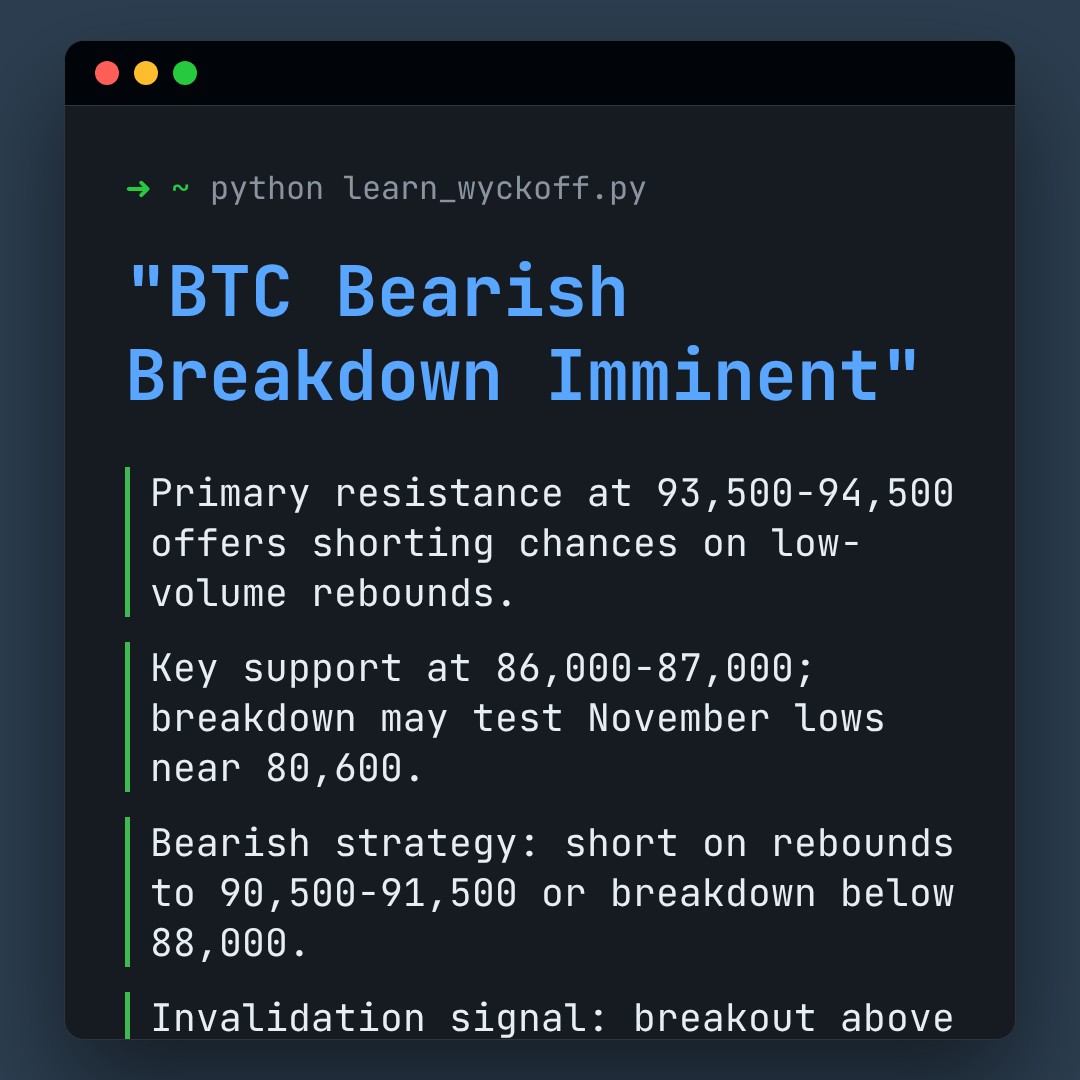
    • Primary Resistance Zone: 93,500 - 94,500. This is the early January rebound high (~93,800) and a previous area of repeated resistance (early December highs), also the current location of the MA_30D. Any low-volume behavior on a rebound to this zone presents a shorting opportunity.
    • Secondary Resistance: 90,500 - 91,500. The upper boundary of the recent consolidation range and the area where MA_5D/MA_10D are intertwined.
    • Key Support Zone: 86,000 - 87,000. The low area tested multiple times in December 2025 (e.g., the low of 86,806 on 2025-12-29). A breakdown here would open up space to test the November lows (~80,600).
    • Ultimate Support: 80,600 - 81,500. The low area formed during the November 2025 panic selling.
  • Integrated Wyckoff Trading Signals:
    • Current Market Positioning: The market is in the conclusion phase of a weak rebound within a bearish structure, with the supply-demand balance shifting from brief equilibrium back to supply dominance.
    • Signal Direction: Bearish/Skewed Bearish. Primary rationale: high-volume stalling at rebound highs followed by a high-volume decline; price falling back below short-term moving averages; momentum exhaustion; a downward move chosen after volatility contraction.
    • Operational Recommendations:
      1. 1. Short Strategy (Preferred): Consider establishing short positions when the price rebounds to the 90,500-91,500 resistance zone and exhibits price-volume divergence (rising price on shrinking volume or high-volume stalling). Alternatively, follow a clear breakdown below 88,000 (recent minor platform support). Initial stop-loss can be placed above the recent rebound high of 93,800 (e.g., 95,500).
      2. 2. Wait-and-See/Long Hedging Strategy: If the price falls to the key support zone of 86,000-87,000, closely observe for signs of stabilization: the appearance of clearly low-volume (VOLUME_AVG_7D_RATIO < 0.7) candles (e.g., long lower shadows) or a high-volume bullish engulfing candle. Until such signals appear, bottom-fishing is not advisable.
    • Future Validation Points:
      • Signals to Invalidate the Bearish View: Price breaks out and holds firmly above 95,500 on strong volume (VOLUME_AVG_7D_RATIO > 1.5), simultaneously causing the MA_20D to turn upward. This would indicate demand is strong enough to reverse the short-term trend.
      • Signals to Confirm Continuation of Decline: Price breaks below the 86,000 support level on high volume, with weak rebounds. This would confirm the start of a new downtrend leg, targeting the previous low of 80,600.

Integrated Conclusion:
Based on Wyckoff price-volume analysis, BTCUSDT has shown strong supply re-emerging at a key technical resistance zone (93,500-94,500) following a period of panic selling and a weak rebound. Cross-verification from volume, volatility, and momentum data indicates that market control is being handed back from the brief, weak demand side to the supply side. Large investors have shown signs of distribution or suppression intent at rebound highs. A bearish-skewed trading strategy is recommended, focusing on shorting opportunities at the upper resistance zone and monitoring the test results at lower key support levels. Within the current market structure, the risk of contrarian bottom-fishing is significantly higher than that of trend-following short positions.


Disclaimer: This report/analysis is solely for market analysis and research based on publicly available information and does not constitute any investment advice or operational guidance. The author strives for objectivity and fairness in the content but makes no guarantees regarding its accuracy or completeness. Markets involve risks; invest with caution. Any investment actions taken based on this report are at your own risk.


Thank you for your attention! Wyckoff price-volume market analysis is released daily at 8:00 before the market opens. Please feel free to leave comments and share. Your recognition is of utmost importance. Let's work together to see the market signals clearly.