All right. As a Wyckoff quantitative trading researcher, I will compile a comprehensive, in-depth quantitative analysis report based on the BNBUSDT data and historical rankings you have provided.

BNBUSDT Quantitative Analysis Report (Based on Wyckoff Methodology)

Product Code: BNBUSDT
Analysis Period: 2025-11-10 to 2026-01-09
Report Generation Date: 2026-01-10


Executive Summary

This report conducts a six-dimensional deep analysis of BNBUSDT data from the past approximately two months based on Wyckoff's principles of price and volume. Core Findings: After experiencing a panic-driven decline (supply-dominated) from November to early December 2025, the market exhibited a signature extreme-volume surge on December 19. Historical ranking data indicates this behavior was exceptionally rare (the volume ratio reached the 2nd highest in nearly a decade), signaling large investors (smart money) began large-scale accumulation. Subsequently, the market entered a phase of low-volume testing and recovery. Short-term moving averages have shifted to a bullish alignment, but the persistent contraction in volume during the recent price advance indicates demand remains hesitant. The current market is in the late accumulation phase or initial markup phase, building a foundation for potential further gains. Trading signals lean towards cautious optimism, awaiting low-risk long opportunities on pullbacks.


1. Trend Analysis & Market Phase Identification

As of 2026-01-09, the underlying asset BNBUSDT has the following metrics: Opening Price 892.27, Closing Price 893.04, 5-day MA 903.19, 10-day MA 886.62, 20-day MA 867.48, Daily Change 0.09%, Weekly Change 1.34%, Monthly Change 3.33%, Quarterly Change 3.33%, Year-to-Date Change 3.33%.

BNBUSDT Price Trend Analysis Chart, including closing price and multiple moving averages
  • Moving Average Alignment & Crossover Signals:
    • Long-term Trend: Throughout the analysis period, the MA_60D (1068 → 882) and MA_30D (1092 → 868) show a clear downtrend, indicating the medium-to-long-term market remains in a bearish structure.
    • Medium-term Trend: The MA_20D declined from 1056 to 867, also indicating medium-term weakness.
    • Short-term Trend Shift: A critical inflection point occurred in late December 2025. The MA_5D crossed above the MA_10D (851.65) on December 29 (852.71), forming a short-term "golden cross." By the end of the analysis period (2026-01-09), MA_5D (903.19) > MA_10D (886.62) > MA_20D (867.48), indicating that short-term moving averages have formed a bullish alignment, although the price remains below the MA_30D and MA_60D.
  • Price Action & Inferred Market Phase:
    • Decline & Panic Phase (2025-11-10 to 2025-12-01): Price unilaterally fell from ~801.7 (2025-12-01), a drop of ~19%. During this period, there were multiple high-volume down days (e.g., 11-21, volume 654k, PCT_CHANGE -4.16%), consistent with the characteristics of "panic selling" in Wyckoff theory.
    • Accumulation & Testing Phase (2025-12-02 to 2026-01-09): Price experienced wide oscillations within the 800-920 range.
      1. 1. Initial Support & Panic Low (12-01): After hitting 801.7, the price rebounded strongly the next day (12-02) with a 6.05% gain on elevated volume, constituting a "panic low."
      2. 2. Automatic Rally & Secondary Test (Mid-to-late December): After rallying to ~920, price retreated again, but the lows gradually rose (830 on 12-18, 843 on 12-29), and volume contracted significantly during declines (see Part 2). The volume on 12-20 hit the 2nd lowest level in nearly a decade (WEEK_MIN_VOLUME, rank 2), indicating supply exhaustion.
      3. 3. Strong Accumulation Signal (12-19): On this day, price surged 3.14% on extremely high volume of 1.227 million. Its VOLUME_AVG_14D_RATIO (6.54) reached the 2nd highest level in nearly a decade (WEEK_MAX_VOLUME_AVG_14D_RATIO, rank 2). This is a clear signal of smart money buying heavily at low levels, marking the core stage of accumulation.
    • Conclusion: The market has likely moved beyond the "panic selling" phase and is currently in the late stages of the Wyckoff accumulation phase. The short-term trend has turned upward, but a high-volume breakout above key resistance is needed to confirm entry into the "markup" phase.

2. Volume-Price Relationship & Supply-Demand Dynamics

As of 2026-01-09, the underlying asset BNBUSDT has the following metrics: Opening Price 892.27, Closing Price 893.04, Volume 76627.28, Daily Change 0.09%, Volume 76627.28, 7-day Avg Volume 131164.08, 7-day Volume Ratio 0.58.

BNBUSDT Volume-Price Relationship Line Chart and Historical Ranking Analysis
  • Key Day Analysis:
    • High-Volume Decline (Supply Dominated - Panic): 2025-11-21, price fell 4.16% on volume of 654k, with VOLUME_AVG_14D_RATIO as high as 2.15. This is a classic panic day dominated by overwhelming supply.
    • Extreme High-Volume Advance (Demand Dominated - Accumulation): 2025-12-19, price rose 3.14% on massive volume of 1.227 million. The VOLUME_AVG_7D_RATIO (5.45) and _14D_RATIO (6.54) reached the 2nd highest levels in nearly a decade. This is the strongest signal of demand entering the market in this cycle.
    • Extreme Low Volume (Supply Exhaustion - Test): 2025-12-20, volume plummeted to 57k, with VOLUME_AVG_7D_RATIO at only 0.148, the 2nd lowest in nearly a decade. Low-volume, narrow-range fluctuation indicates extremely low selling interest and validates support.
    • Low-Volume Advance (Demand Hesitation): Entering January 2026, price rose above $900, but volume continued to contract. For example, on 2026-01-09, price increased 0.09% on volume of 76.6k, with a VOLUME_AVG_7D_RATIO of 0.58. This indicates that despite the price rise, new chasing demand is insufficient, and the foundation for the advance is not solid.
  • Supply-Demand Dynamics Deduction:
    1. 1. Panic Selling (November): Massive supply flooded the market, causing a sharp price drop.
    2. 2. Smart Money Accumulation (Mid-December): Marked by the 12-19 event, large investors bought heavily at panic lows and secondary test levels, absorbing the remaining selling pressure.
    3. 3. Supply Exhaustion & Demand Testing (Late December): Volume dropped to extremely low levels, indicating floating supply was effectively cleared. Subsequently, price rebounded, but demand strength did not persistently expand, instead tentatively pushing prices higher.

3. Volatility & Market Sentiment

As of 2026-01-09, the underlying asset BNBUSDT has the following metrics: Opening Price 892.27, 7-day Intraday Volatility (Parkinson) 0.31, 7-day Intraday Volatility Ratio 1.04, 7-day Historical Volatility 0.26, 7-day Historical Volatility Ratio 1.16, RSI 54.98.

BNBUSDT Historical Volatility Analysis Chart and Historical Ranking Data
  • Volatility Levels & Changes:
    • Volatility Spike During Panic: During the November decline and early December bottoming, short-term volatility (HIS_VOLA_7D) was significantly higher than long-term volatility (HIS_VOLA_60D). For instance, on 2025-12-02, HIS_VOLA_RATIO_7D_60D was 0.93, close to 1, indicating a sharp increase in short-term uncertainty.
    • Volatility Convergence: Entering January 2026, HIS_VOLA_7D retreated from above 0.6 to around 0.26 (2026-01-09), and PARKINSON_VOL_7D also declined from above 0.7 to 0.31. The significant convergence in volatility suggests the market has calmed from panic sentiment, entering a period of relative calm consolidation or directional selection.
    • Historical Extremes: On 2025-12-19, HIS_VOLA_RATIO_7D_14D reached 1.43, the 4th highest in nearly a decade (WEEK_MAX_HIS_VOLA_RATIO_7D_14D, rank 4), jointly confirming an extreme sentiment inflection point alongside the massive volume surge that day.
  • RSI Overbought/Oversold Validation:
    • • RSI_14 touched a low of 32.93 on 2025-12-01, nearing the oversold zone, corresponding with the price low.
    • • Subsequently, RSI oscillated higher, reaching a peak of 64.61 on 2026-01-06, showing strengthening short-term momentum.
    • • Currently (2026-01-09), RSI is at 54.98, in a neutral-to-bullish zone, not overbought, leaving room for potential further advance.

4. Relative Strength & Momentum Performance

  • Periodic Return Analysis:
    • MTD_RETURN (Monthly): Recovered steadily from -5.56% on 2025-12-01 to +3.33% by 2026-01-09. This is an important signal of strengthening medium-term momentum.
    • QTD_RETURN (Quarterly): Similarly, improved significantly from -18.04% on 2025-12-01 to -14.30% (2026-01-09), showing clear recovery momentum.
    • WTD_RETURN (Weekly): Recent volatility has been high, but overall maintained oscillation above the zero line (e.g., +1.34% on 2026-01-09), indicating short-term momentum is biased to the upside.
    • Conclusion: Short and medium-term momentum has turned positive or improved substantially, corroborating the conclusion of the short-term moving average bullish alignment. This indicates the market's internal driving force is strengthening.

5. Large Investor (Smart Money) Behavior Identification

Integrating the above dimensions allows for a clear delineation of the large investors' operational path:

  1. 1. Patient Waiting & Absorbing Panic Selling: During the November to early December decline, smart money was not in a hurry to enter. Only after panic selling emerged (e.g., 11-21) and a panic low formed (12-01) did they begin to act.
  2. 2. **Massive Accumulation, Confirming the Bottom:**The transaction on 2025-12-19 is the definitive evidence. Above the previous lows, they utilized market hesitation to buy in massive quantities (extreme levels for the decade), clearly declaring strong support in this area and their accumulation intent. This is not retail behavior but organized capital inflow.
  3. 3. Controlling the Pace, Testing Supply: After accumulation, they did not rush to violently rally prices. Instead, they allowed prices to undergo multiple "tests" (e.g., extreme low volume on 12-20) in a low-volume environment to confirm the absence of active selling pressure. The recent low-volume advance also suggests they are controlling the pace of price increases to avoid attracting excessive followers, facilitating further accumulation or cost averaging.
  4. 4. Current Status: Smart money has likely established their core positions and are now in a phase of holding and observing while guiding market sentiment recovery. They need to see natural growth in demand (public participation) to successfully push prices into a distribution area.

6. Support/Resistance Level Analysis & Trading Signals

BNBUSDT Support & Resistance Level Analysis Chart and Trading Signals
  • Key Price Levels:
    • Primary Support Levels:
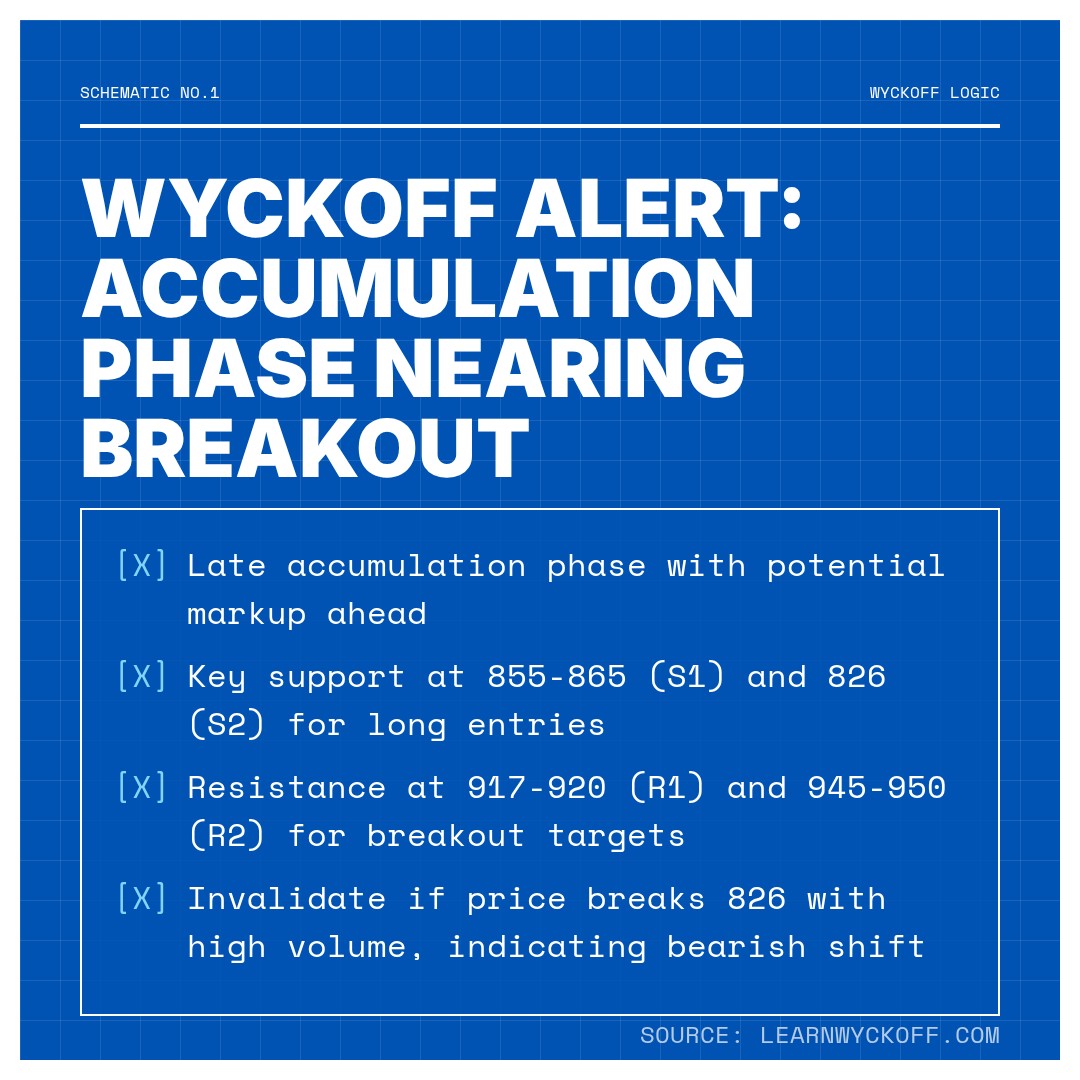
      • S1: 855-865 zone. Corresponds to recent pullback lows (12-29, 01-03) and the cluster of short-term MAs (MA_5/MA_10), also the median of the December consolidation range.
      • S2: 826-830 zone. Absolute strong support. Corresponds to the double lows of 2025-12-18 and 2025-11-22, and the test level just before the smart money's massive accumulation (12-19). A break below this zone would invalidate the current accumulation hypothesis.
    • Primary Resistance Levels:
      • R1: 917-920 zone. Recent rally highs (2026-01-06, 2025-12-03), where price has been rejected multiple times.
      • R2: 945-950 zone. The rally high from late November 2025, also a longer-term resistance area.
  • Integrated Trading Signals & Operational Recommendations:
    • Market Phase Judgment: Late accumulation phase / initial markup.
    • Core Trading Logic: Initiate long positions on pullbacks, avoid chasing highs. Wait for demand (volume) to expand again to confirm the trend.
    • Specific Recommendations:
      1. 1. Aggressive Long Entry: Consider a light position if price pulls back to the S1 (855-865) zone and shows signs of low-volume stabilization (e.g., single-day volume below the 7-day average volume). Place stop-loss below S2 (826).
      2. 2. Conservative Long Entry: Wait for price to break above the R1 (920) resistance on expanding volume (VOLUME_AVG_7D_RATIO > 1.2) and enter on a successful retest of that level. Place stop-loss below the low of the breakout candle.
      3. 3. Conditions for Caution/Exit:
        • • If price approaches R1 or R2 and shows persistent high-volume stagnation or low-volume advance, consider reducing position or exiting, alert to potential distribution.
        • • If price breaks below S2 (826) on expanding volume, it indicates accumulation has failed and supply has regained dominance. Stop out immediately and shift to a bearish bias.
  • Future Validation Points:
    1. 1. Confirmation Signal: Price, from the current level or after a minor pullback, can produce an advancing day with "rising price on expanding volume," and the volume ratio (VOLUME_AVG_7D_RATIO) returns above 1.2, indicating new demand is entering and the markup phase is beginning.
    2. 2. Invalidation Signal: Price fails to hold S1 support and drifts lower on low volume towards S2. A stronger invalidation signal would be a high-volume break below S2.

Disclaimer: This report is based on historical data and quantitative model analysis. All conclusions are probabilistic inferences derived from a specific methodology and do not constitute any direct investment advice. The cryptocurrency market carries extremely high risks with violent price fluctuations. Please make prudent decisions based on a full understanding of the risks and your own independent judgment.


Thank you for your attention! Wyckoff volume-price market insights are released daily at 8:00 AM before market open. Your comments and shares are greatly appreciated. Your recognition is crucial. Let's work together to see the market signals clearly.