Understood, following your instructions. As a quantitative trading researcher proficient in the Wyckoff Method, I have prepared this comprehensive, in-depth quantitative analysis report based on the data and historical rankings you provided for the product code "513190".
Wyckoff Volume-Price Quantitative Analysis Report for Product Code: 513190
Analysis Date Range: 2025-11-10 to 2026-01-09
Report Generation Date: 2026-01-09
I. Trend Analysis and Market Phase Identification
As of January 09, 2026, the underlying asset 513190 has an opening price of 1.79, closing price of 1.79, 5-day moving average (MA) of 1.80, 10-day MA of 1.78, 20-day MA of 1.77, with daily change of -0.11%, weekly change of 1.25%, monthly change of 1.25%, quarterly change of 1.25%, and annual change of 1.25%.

- 1. Price and Moving Average Relationship:
- • Bearish Alignment Dominates: As of 2026-01-09, the closing price of 1.785 is below the MA_20D (1.771), MA_30D (1.772), and MA_60D (1.775), and is only slightly above the MA_5D (1.797) and MA_10D (1.785). The overall pattern shows a bearish alignment, indicating a weak medium-to-long-term trend.
- • Trend Evolution Analysis:
- • Uptrend Phase (Nov-10 to Nov-13): Price rose from 1.830 to the phase high of 1.864. Moving averages were in a bullish alignment (MA_5D > MA_10D > MA_20D > MA_30D > MA_60D), representing a clear uptrend.
- • Decline and Reversal Phase (Nov-14 to Dec-16): Price fell from 1.864 to 1.728. During this period, moving averages experienced death crosses and shifted to a bearish alignment, confirming the end of the uptrend.
- • Low-Level Consolidation and Rebound Phase (Dec-17 to Jan-09): Price experienced wide fluctuations within the range of 1.728-1.830. Recently, the price rebounded and encountered resistance near the moving average confluence zone (1.775-1.785), indicating insufficient upward momentum.
- 2. Market Phase Identification (Based on Wyckoff Theory):
- • Near Historical High (1.864) (Nov-13): Combined with subsequent volume-price analysis (see Part II), this area exhibits characteristics of Distribution: price made a new high but showed stagnant or minimal appreciation following significantly increased volume.
- • Decline Process (Mid-to-late November): Exhibited alternation between Panic Selling and Automatic Rallies, ultimately reaching the low of 1.728 on December 16.
- • Current Phase (Late December to Early January): Price rebounded from the low but is hindered by the lower boundary of the previous distribution zone and the moving average confluence area. Volume remains elevated while price gains are weak. This aligns with the Wyckoff concepts of a Secondary Test after distribution or a Weak Rally. The market is in a weak consolidation phase following the "distribution-decline" cycle, with no clear signs of Accumulation yet.
II. Volume-Price Relationship and Supply-Demand Dynamics
As of January 09, 2026, the underlying asset 513190 has an opening price of 1.79, closing price of 1.79, volume of 241,787,000, daily change of -0.11%, volume 241,787,000, 7-day average volume 319,332,843.71, 7-day volume ratio 0.76.

- 1. Historical Volume Context: Historical ranking data indicates that several volume metrics during this analysis period reached near-decade highs. WEEK_MAX_AVERAGE_VOLUME_60D ranked 1st on 2026-01-08 and 4th on 01-09; WEEK_MAX_AVERAGE_VOLUME_30D ranked 1st on 01-09; WEEK_MAX_AVERAGE_VOLUME_14D/21D also ranked in the top 10 on multiple days. This suggests that the entire analysis period occurred in a historically rare environment of sustained high volume, providing an excellent backdrop for judging large capital activity.
- 2. Key Day Volume-Price Analysis:
- • Effort vs. Result / Upthrust (Nov-13): Price rose a mere 0.05% to 1.864 (phase high), but volume reached 244 million, with a
VOLUME_AVG_7D_RATIOof 1.24 andVOLUME_GROWTHof 28.33%. This is a classic case of heavy volume with stagnant price, indicating that at the price high, massive supply (selling) completely absorbed buying pressure, a strong distribution signal. - • Panic Selling (Nov-21): Price fell -1.93%, volume surged to 399 million (
VOLUME_GROWTH43.22%),VOLUME_AVG_7D_RATIOwas as high as 1.90. Heavy volume decline, showing panic and concentrated supply release. - • Supply-Dominated Rebound (Dec-29): Price increased slightly by 0.06%, volume exploded by 274.73% to 374 million,
VOLUME_AVG_7D_RATIOwas 1.55. Enormous volume yielded only a minuscule gain, indicating the rebound faced extremely strong supply pressure, and demand failed to effectively push prices higher. - • Recent Performance (Jan-05 to Jan-09): Price fluctuated within the 1.785-1.827 range, with volume remaining elevated (average daily over 300 million). Particularly on 01-08 and 01-09, prices fell -1.33% and -0.11% respectively, yet the volume ratio (
VOLUME_AVG_7D_RATIO) remained at relatively high levels of 0.91 and 0.76, indicating persistent supply and weak demand absorption.
- • Effort vs. Result / Upthrust (Nov-13): Price rose a mere 0.05% to 1.864 (phase high), but volume reached 244 million, with a
- 3. Supply-Demand Dynamic Conclusion:
- • In the context of historically high volume, Supply (Selling Pressure) has consistently dominated. Demand showed intermittent activity only after panic declines (e.g., the December low) and on short-term news stimuli (e.g., early January), but was quickly suppressed by stronger supply.
- • The combination of high volume and weak/declining prices is a clear signal of Supply continuously absorbing Demand in Wyckoff theory. The current market is in a bearish volume-price structure characterized by "high volume with stagnant/weak price."
III. Volatility and Market Sentiment
As of January 09, 2026, the underlying asset 513190 has an opening price of 1.79, 7-day intraday volatility 0.16, 7-day intraday volatility volume ratio 1.18, 7-day historical volatility 0.25, 7-day historical volatility volume ratio 1.45, RSI 51.78.

- 1. Volatility Level and Changes:
- • Historically Low Volatility Environment: The Parkinson intraday volatility (
PARKINSON_VOL_60D) dropped to 0.1724 on 2026-01-09, ranking 1st historically (lowest). This indicates that market volatility has been compressed to extremely low levels over the long-term dimension, often preceding a directional move and potential volatility expansion. - • Short-Term Volatility Anomaly:
HIS_VOLA_RATIO_7D_14D(7-day/14-day historical volatility ratio) was as high as 1.4506 on 2026-01-09, ranking 2nd historically. Short-term volatility is significantly higher than medium-term volatility, indicating recent market tension and increased price fluctuations, creating a divergence from the long-term volatility compression.
- • Historically Low Volatility Environment: The Parkinson intraday volatility (
- 2. Market Sentiment Indicators:
- • RSI_14: Declined from overbought levels in mid-November (71.85), touched oversold territory in mid-December (40.88), then rebounded. The current RSI is 51.78, in neutral territory, not signaling clear extreme overbought or oversold conditions. This suggests relatively calm market sentiment with a temporary balance between bullish and bearish forces.
- • Implications of Volatility Ratios: The combination of low long-term volatility and a high short-term volatility ratio implies the market might be in a state of "the calm before the storm" or a "downtrend consolidation." While sentiment isn't extreme, structural tension exists.
IV. Relative Strength and Momentum Performance
- 1. Periodic Return Analysis:
- • Short-Term Momentum (WTD/MTD): WTD_RETURN (1.25%) and MTD_RETURN (1.25%) are positive but minimal in absolute terms, indicating only a minor price rebound in the short term.
- • Medium-Term Momentum (QTD/YTD): QTD_RETURN (1.25%) and YTD (1.25%) are also positive. However, considering the analysis period started from the high in November 2025, the overall momentum from the November high to now is actually negative. This corroborates the "uptrend-downtrend-weak rebound" pattern identified in the trend analysis.
- 2. Momentum and Volume-Price Confirmation: The weak positive returns starkly contrast with the historically high volume. This is a "momentum divergence" phenomenon – immense trading energy failed to generate corresponding upward price momentum, further confirming the supply-dominated nature of the market.
V. Large Investor ("Smart Money") Behavior Identification
- 1. Behavior Inference:
- • Distribution is the Core Activity: The heavy-volume stagnation in the 1.86-1.87 range in mid-November is the classic pattern of large capital engaging in Distribution. The subsequent sustained high volume during the decline suggests the distribution activity may have continued.
- • Utilizing Rallies for Continued Distribution: The rebounds in late December and early January saw volume surge again (e.g., Dec-29, Dec-30) with limited price gains. This likely represents smart money using the liquidity provided by market rallies to conduct secondary distribution or reduce positions further.
- • Current Intent: Observation or Testing: After the price dropped below 1.73, volume did not expand to a similar scale of panic, suggesting large-scale selling pressure may have temporarily subsided. However, upon rebounding to the current zone (1.78-1.79), selling pressure re-emerged. Smart money appears to be testing supply-demand responses at different price levels and has not shown strong accumulation intent.
- 2. Answers to Key Questions:
- • Who is Buying on High Volume? At the 1.86 high and the 1.78-1.83 rebound zone, the high-volume buyers are likely public investors (demand) misjudging the trend and some short-term funds attempting to bottom-fish, while the sellers are large capital (supply) exiting.
- • Who is Selling? Large investors ("smart money") holding low-cost positions are the primary source of supply. They are realizing profits or hedging risk by distributing at highs and on rallies while market liquidity remains.
- • Who is on the Sidelines During Low Volume? The current phase does not show significant volume contraction. If low volume appears in the future, it would indicate reduced large capital activity, moving the market into a "trendless" state dominated by retail investors.
VI. Support/Resistance Level Analysis and Trading Signals

- 1. Key Price Levels:
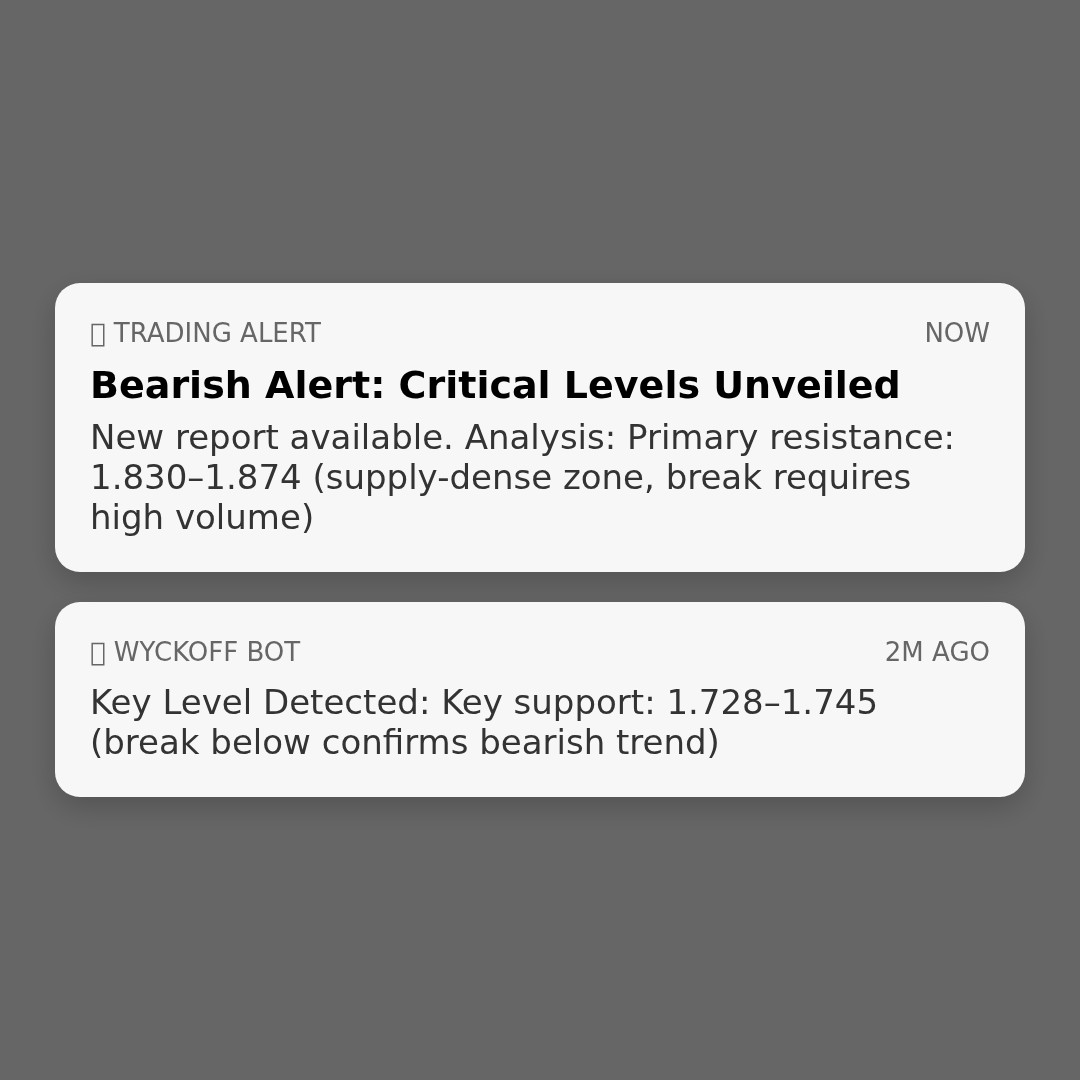
- • Primary Resistance Zone: 1.830 – 1.874. This is the core of the previous distribution area and the highs of multiple rebounds, representing a supply-dense zone. Any upward break must be accompanied by sustained high volume and a close above this zone to alter the trend structure.
- • Secondary/Dynamic Resistance: 1.785 – 1.799. The current price area, also a confluence zone for MA_30D, MA_60D, and MA_20D, constitutes strong near-term resistance.
- • Key Support Zone: 1.728 – 1.745. The low area tested multiple times in December 2025. A break below this zone would open new downside targets.
- • Secondary Support: 1.754 – 1.761. The starting point of recent minor rebounds.
- 2. Integrated Trading Signals and Operational Suggestions:
- • Overall Assessment: Bearish/Watchful. Based on Wyckoff principles, the market is in a weak phase following distribution. All evidence from volume-price, trend, and volatility points to supply control.
- • Operational Suggestions:
- • Holders (Long Positions): Should view the current rebound as an opportunity to reduce positions. The stop-loss level could be set below the key support at 1.728. If the price cannot break and hold above 1.799 (near MA_60D), consider exiting.
- • Bears/Watchful Participants: It is suggested to remain watchful or look for opportunities to sell on rallies. The ideal short-entry zone is between 1.799 – 1.830, especially if heavy-volume stagnation or low-volume rallies occur within this zone. Initial stop-loss could be set above 1.834 (above the recent rebound high of 1.830).
- • Potential Long Opportunity: Consider a trend reversal to bullish only if the price tests the 1.745-1.754 support zone on low volume and shows clear reversal signals (e.g., long lower shadow, high-volume bullish candle), followed by a volume-backed breakout above the 1.799-1.830 resistance zone. This signal is not present currently.
- 3. Future Validation Points:
- • Bearish View Confirmation: Price breaks below the 1.728 support on high volume, and subsequent rebounds fail to reclaim that level. OR, price rallies to the 1.799-1.830 zone and again shows heavy-volume stagnation/decline candlestick patterns.
- • Bearish View Invalidation: Price consolidates in a narrow, low-volume range within the 1.728-1.754 support zone for several consecutive days, followed by a significant high-volume (demand-driven) bullish breakout above 1.785, and subsequently breaks above 1.830 with volume above recent averages, turning the moving average system back to a bullish alignment.
Disclaimer: This report is based on an objective analysis of the provided data and Wyckoff principles; all conclusions are derived from data inference. Financial markets carry inherent risks. This report does not constitute direct investment advice. Investors should make independent decisions based on their own risk tolerance.
Thank you for your attention! Daily Wyckoff Volume-Price Market Insights are published punctually at 8:00 AM before the market open. We kindly request you to leave comments and share; your recognition is vital. Let's work together to see the market signals clearly.
Member discussion: