Received. As a quantitative trading researcher proficient in the Wyckoff Method, I will prepare an in-depth quantitative analysis report for the product 513060 based on the data you have provided.
Quantitative Analysis Report: Insights into Market Supply-Demand and Smart Money Behavior Based on Wyckoff Principles
Product Code: 513060
Analysis Period: 2025-11-10 to 2026-01-09
Report Generation Date: 2026-01-09
1. Trend Analysis and Market Phase Identification
As of January 9, 2026, the underlying asset 513060 had an opening price of 0.64, a closing price of 0.65, a 5-day moving average of 0.62, a 10-day moving average of 0.61, a 20-day moving average of 0.61, a daily change of +1.55%, a weekly return of +12.18%, a monthly return of +12.18%, a quarterly return of +12.18%, and an annual return of +12.18%.

Moving Average Alignment and Trend Structure:
- • Long-term Trend (Bearish Dominance): In the initial stage of the analysis period (Nov-Dec 2025), the price (CLOSE) consistently traded below all major moving averages (MA_5D/10D/20D/30D/60D), forming a standard bearish alignment. The MA_60D declined persistently from 0.702 to 0.650 by the end of December, confirming the long-term downtrend.
- • Trend Reversal Signal (Bearish to Bullish Transition): A structural change occurred in January 2026.
- • From 2026-01-05 to 2026-01-09, the price experienced five consecutive days of strong gains, successively breaking through the MA_5D, MA_10D, and MA_20D.
- • As of the analysis date 2026-01-09, the price (0.654) has stabilized above the MA_5D (0.621) and MA_10D (0.612), converging with the MA_20D (0.614). The 5-day MA has turned upward and crossed above the 20-day MA, forming an early "golden cross" signal. However, the price remains constrained by the MA_30D (0.625) and MA_60D (0.643), indicating lingering medium-term resistance overhead.
- • Wyckoff Market Phase Inference:
- • Distribution Phase: A swing high was formed on November 13, 2025 (CLOSE: 0.690), accompanied by a massive volume (2.37B) and price stagnation, followed by a high-volume decline (-1.16%) the next day, consistent with distribution characteristics.
- • Markdown Phase: From mid-November to late December, the price trended downward along the moving averages. Although there were rebound attempts (e.g., mid-to-late December), they lacked sufficient volume, defining a standard downtrend.
- • Panic Selling & Accumulation Phase: From December 29 to 31, 2025, the price experienced consecutive sharp declines to a low of 0.583, but trading volume contracted (notably, the trading volumes on Dec 25-26 ranked as the 3rd and 4th lowest in nearly a decade), suggesting panic selling (supply) was nearing exhaustion. Subsequently, on January 5, 2026, a powerful rebound commenced with the 4th highest 7-day volume ratio (2.84) in nearly a decade, rapidly pulling the price away from the lows. This is a classic Wyckoff event sequence: "Panic Selling" followed by an "Automatic Rally" accompanied by "Smart Money" accumulation. The market is currently in the later stages of the Accumulation Phase or a confirmation period following a Secondary Test after Preliminary Support.
2. Volume-Price Relationship and Supply-Demand Dynamics
As of January 9, 2026, the underlying asset 513060 had an opening price of 0.64, a closing price of 0.65, a trading volume of 1,770,481,900, a daily change of +1.55%, a 7-day average volume of 1,490,458,781.14, and a 7-day volume ratio of 1.19.

- • Exhaustion of Supply at the End of the Downtrend (Demand Signal): During the final wave of decline from December 29-31, 2025, the price dropped -2.55%, -1.33%, and -1.52% respectively. However, volume growth was weak and even contracted (VOLUME_GROWTH: +1.35%, -8.82%, -22.03%), showing a significant volume-price divergence. Particularly on December 25-26, volume ratios against various moving averages (VOLUME_AVG_*D_RATIO) fell to historically extreme lows (ranking in the top 10 lowest), indicating selling pressure (supply) had significantly diminished, providing a prerequisite for trend reversal.
- • Demand Dominance at the Start of the Rebound (Confirmation Signal): On January 5, 2026, the price surged 5.83% with a massive volume increase of 181.08% (historical rank 17), and a 7-day volume ratio as high as 2.84 (historical rank 4). This is a classic "high-volume advance," indicating strong buying pressure (demand) entering the market.
- • Health of Supply-Demand During the Rebound: From January 6-9, the price continued to rise. Although volume receded from the peak on the 5th, it remained significantly above various moving averages (the 14-day volume ratio on Jan 9 was 1.55). The volume-price action was healthy, with no clear signs of high-volume stagnation (supply entering). The slight gain with reduced volume on January 8 can be interpreted as a normal consolidation during an advance.
3. Volatility and Market Sentiment
As of January 9, 2026, the underlying asset 513060 had an opening price of 0.64, a 7-day intraday volatility of 0.30, a 7-day intraday volatility ratio of 1.31, a 7-day historical volatility of 0.47, a 7-day historical volatility ratio of 1.25, and an RSI of 62.35.

- • Volatility Compression and Sentiment Bottom: In the price low zone around late December 2025, various volatility metrics dropped to extremely low levels. For example, the 7-day Parkinson Volatility (0.143) on December 30 ranked as the 5th lowest in nearly a decade, and the 7-day/60-day volatility ratios were also at historical lows. This indicates severely depressed market sentiment and volatility convergence to an extreme, typically presaging an imminent trend change.
- • Volatility Expansion and Sentiment Shift: Entering January 2026, short-term volatility measures (HIS_VOLA_7D, PARKINSON_VOL_7D) spiked rapidly with the price rebound, far exceeding the medium-to-long-term volatility averages (HIS_VOLA_RATIO_7D_60D > 1.4). This sharp expansion in volatility, driven by upward price movement, reflects a swift shift in market sentiment from pessimism to optimism, with a significant increase in activity and attention.
- • RSI Confirms Sentiment Shift: The RSI_14 touched the oversold region at 28.13 on December 31, then quickly rose to 62.35 during the early January rebound, moving out of oversold territory into a strong zone. This validates the signals from price and volatility.
4. Relative Strength and Momentum Performance
- • Momentum Reversal Established: Short-term momentum is exceptionally strong. The weekly return (WTD_RETURN) reached +12.18%, and the monthly return (MTD_RETURN) since the year's start is +12.18%. This indicates the asset's relative strength has been outstanding in the recent market.
- • Medium-term Momentum Not Fully Reversed: Despite strong short-term performance, the quarterly return (QTD_RETURN) remains at -11.17%, showing that from a longer cycle perspective, the market is still in the process of recovering prior losses. A complete momentum reversal requires further price advances and a challenge of longer-term resistance levels.
5. Large Investor (Smart Money) Behavior Identification
- • Selling at Highs During Distribution: The massive volume at the high on November 13, 2025, suggests large investors were distributing shares at that time.
- • Observation and Testing at the End of the Decline: The extremely low-volume decline in late December indicates large investors did not engage in panic selling at the lows but remained on the sidelines, waiting for supply exhaustion.
- • Active Participation During Accumulation: The high volume on January 5, 2026, is the core signal. Following a prolonged decline, extreme volatility compression, and volume contraction to historic lows, a historically significant high-volume advance occurred. This cannot be attributed to retail investor behavior alone and clearly demonstrates large investors (smart money) identifying the bottom area and initiating large-scale, active buying (accumulation). The sustained high-volume advance in subsequent days further confirms their intention to build positions.
- • Behavior Characterization: In summary, large investors have completed a behavioral transition from "distribution" to "observation" to "active accumulation." The market is currently in the process of testing and confirming either the "Jump Across the Creek" or the "Last Point of Support" within the Accumulation Phase.
6. Support/Resistance Level Analysis and Trading Signals

- • Key Support Levels:
- • Primary Support: 0.583 (Low on 2025-12-31). This is the bottom formed by panic selling and the starting point of the accumulation zone.
- • Secondary Support: 0.617 - 0.623 (Closing area on 2026-01-05/06). This is the first platform after the high-volume rebound initiation, where significant demand should exist.
- • Key Resistance Levels:
- • Near-term Resistance: 0.664 - 0.670 (High area around 2025-11-20 and 2025-11-12).
- • Core Resistance: 0.690 (High on 2025-11-13, peak of the prior distribution area).
- • Moving Average Resistance: MA_30D (0.625) and MA_60D (0.643). The price needs to establish itself firmly above the 60-day MA to confirm a long-term trend reversal.
- • Comprehensive Wyckoff Trading Signals and Operational Suggestions:
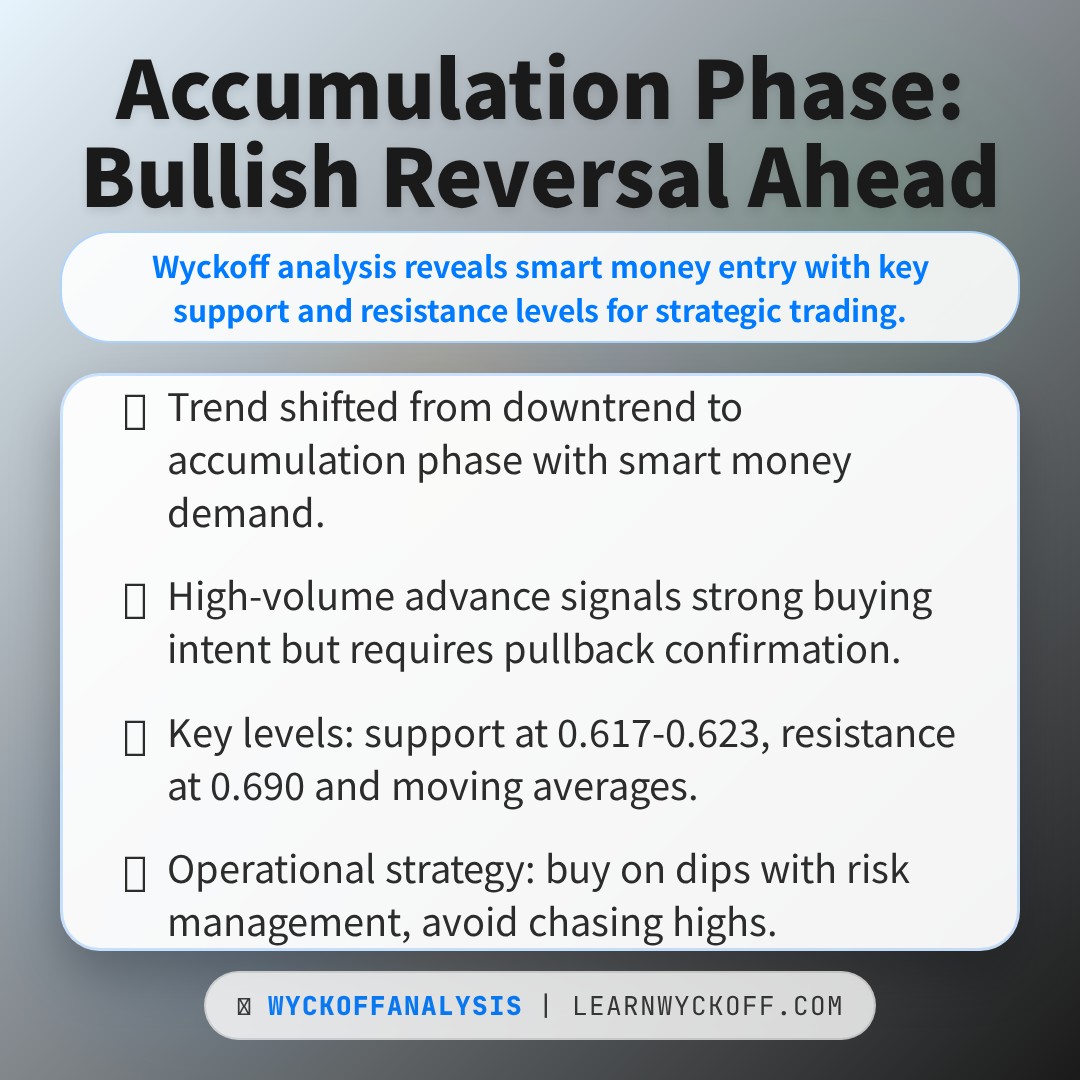
- • Overall Signal: Cautiously bullish, awaiting confirmation on a pullback before entry. Market structure has shifted from downtrend to bottoming/rebounding, with clear smart money entry signals.
- • Operational Suggestions:
- 1. Aggressive Strategy: If the price experiences a pullback, consider a partial position entry in the secondary support zone of 0.617-0.623, provided there are signs of low-volume stabilization (e.g., small-bodied candlesticks with significantly reduced volume). Set a stop loss below the primary support at 0.583.
- 2. Conservative Strategy: Wait for a Secondary Test of the recent breakout—i.e., a pullback followed by another high-volume advance that breaks above the high of 0.655 from January 9—before adding to positions. Alternatively, wait for the price to break through the core resistance at 0.690 on high volume, confirming the full development of the uptrend, and then follow.
- • Risk Warnings and Validation Points:
- • Bullish Risk: If the price cannot hold the 0.617 support and breaks below 0.600 on high volume, it would indicate a failed rebound, potentially invalidating the accumulation hypothesis, requiring reassessment.
- • Bearish Risk: If the price experiences a low-volume, shallow pullback to the aforementioned support levels before rising again, it would serve as strong confirmation of accumulation and the uptrend.
- • Trend Confirmation Point: Future observation should focus on whether the price can advance moderately and stabilize above the MA_60D (currently 0.643) without extreme volume spikes. This is a key validation point for the transition from a rebound to a bull trend.
Conclusion Summary
The data analysis of 513060 based on Wyckoff volume-price principles indicates:
- 1. Trend Has Shifted: The market has transitioned from a long-term downtrend, via "Panic Selling" and supply exhaustion in late December, into an "Accumulation" phase led by large investors.
- 2. Demand Has Taken Control: The historic high-volume advance in early January is the core Alpha signal, clearly revealing smart money's buying intent and powerful demand.
- 3. Currently at a Critical Juncture: The price faces resistance from medium-term moving averages and prior congestion zones. The market needs to confirm support strength and the sustainability of new demand through pullback tests.
- 4. Operationally, Actively Seek Long Opportunities: A strategy of "buying on dips" rather than "chasing highs" is recommended. Focus on volume-price behavior near key support levels, using Wyckoff events (e.g., a successful Secondary Test) as entry criteria.
Disclaimer: This report is based on historical data and quantitative models for analysis purposes. All conclusions are for research only and do not constitute any investment advice. Markets involve risks; investing requires caution.
Thank you for your attention! Wyckoff volume-price market analysis will be published daily before the market opens at 8:00 AM. Your comments and shares are sincerely appreciated and crucial. Let's work together to see the market signals clearly.
Member discussion: