Understood. Following your instructions, as a quantitative trading researcher proficient in the Wyckoff Method, I will compose a comprehensive and in-depth quantitative analysis report based on the provided data for product 399986 and its historical ranking data.
Wyckoff Quantitative Analysis Report
Product Code: 399986
Analysis Period: 2025-11-10 to 2026-01-09
Report Generation Date: 2026-01-09
1. Trend Analysis and Market Phase Identification
As of 2026-01-09, the underlying product 399986 had an opening price of 7494.70, a closing price of 7460.65, a 5-day moving average (MA) of 7570.34, a 10-day MA of 7570.64, a 20-day MA of 7561.19, a daily change of -0.43%, a weekly change of -1.87%, a monthly change of -1.87%, a quarterly change of -1.87%, and a yearly change of -1.87%.

- • MA Alignment and Price Position: As of 2026-01-09, the closing price of 7460.65 is below all key moving averages (MA_5D: 7570.34, MA_10D: 7570.64, MA_20D: 7561.19, MA_30D: 7618.67, MA_60D: 7666.47), presenting a clear bearish alignment pattern. The price has been trending downwards in a volatile manner since its high around 7870 in mid-November 2025. It is now significantly detached from the main cluster of moving averages, confirming a definite downtrend.
- • MA Crossover Signals: The MA_5D has been consistently running below the MA_20D, and the MA_5D, MA_10D, and MA_20D have all turned downwards, forming and diverging into a bearish alignment. This marks the intensification of medium-term downward momentum. Recently, the MA_20D has also begun to cross below the MA_60D, further confirming the weakening trend.
- • Inferred Market Phase: Based on Wyckoff theory and price action analysis:
- • Mid-November to early December 2025: Within the 7800-7900 range, the price showed multiple instances of increased volume with price stagnation (e.g., 11-21, 11-24) and high-volume declines (e.g., 11-17), consistent with characteristics of the Distribution phase.
- • Mid-December 2025 to present: The price broke below key support levels (7700, 7600), entering an accelerated decline. Recent sessions (2026-01-08/09) have shown high-volume declines, while intraday volatility (Parkinson) remains relatively high and the RSI has entered oversold territory, indicating market sentiment is nearing panic. Combined with the historical volume ranking data (see below), the current phase may be transitioning from Panic Selling towards an initial accumulation test, but this requires confirmation from subsequent price-volume behavior.
2. Volume-Price Relationship and Supply-Demand Dynamics
As of 2026-01-09, the underlying product 399986 had an opening price of 7494.70, a closing price of 7460.65, a volume of 3094723700, a daily change of -0.43%, a volume of 3094723700, a 7-day average volume of 3320837385.14, and a 7-day volume ratio of 0.93.

- • Key Day Analysis (Based on Wyckoff Volume-Price Principles):
- • Demand-Dominated Day: 2025-11-12, price increased by 0.48% with volume 149% higher than the 7-day average (
VOLUME_AVG_7D_RATIO=1.149), categorized as a high-volume rally, indicating strong short-term demand. - • Supply-Dominated Days:
- 1. High-Volume Stagnation/Decline: 2025-11-21, price fell by 1.04% with volume 130% higher than the 7-day average (
VOLUME_AVG_7D_RATIO=1.303). High-volume decline at a high level is a classic signal of supply overwhelming demand. - 2. Panic Selling: 2026-01-08, price fell by 0.92% with volume 99% higher than the 30-day average (
VOLUME_AVG_30D_RATIO=0.991). On 2026-01-09, price continued to decline by 0.43% with volume still significantly high at 95% of the 30-day average. Consecutive high-volume declines indicate sustained release of selling pressure, approaching panic conditions.
- 1. High-Volume Stagnation/Decline: 2025-11-21, price fell by 1.04% with volume 130% higher than the 7-day average (
- • Insufficient Demand Day: 2025-12-29, after consecutive days of decline, a rebound (+1.03%) occurred, but volume was only 93% of the 30-day average (
VOLUME_AVG_30D_RATIO=0.928), categorized as a low-volume rebound, indicating insufficient demand follow-through and an unstable foundation for the rebound.
- • Demand-Dominated Day: 2025-11-12, price increased by 0.48% with volume 149% higher than the 7-day average (
- • Abnormal Volume Analysis: The
VOLUME_GROWTHindicator shows recent volume activity has fluctuated considerably. However, theVOLUME_AVG_60D_RATIOon 2026-01-08/09 was 0.813 and 0.783 respectively, both below 1, indicating daily volume has not yet reached the average level of the past two months. Yet, historical ranking data reveals a crucial context: at the beginning of the analysis period (November 2025), theWEEK_MAX_AVERAGE_VOLUME_60Dindicator reached extremely high levels ranking from #1 (47.71 million) to #20 (47.07 million) over the past decade. This means the entire analysis period's volume backdrop is of historic activity levels. Against this backdrop, the recent price hitting new lows without volume (relative to its own 60-day average) reaching new record highs may suggest that the climax of panic selling is potentially passing, and signs of supply exhaustion are emerging.
3. Volatility and Market Sentiment
As of 2026-01-09, the underlying product 399986 had an opening price of 7494.70, a 7-day intraday (Parkinson) volatility of 0.12, a 7-day intraday volatility ratio of 1.11, a 7-day historical volatility of 0.09, a 7-day historical volatility ratio of 0.94, and an RSI of 37.55.

- • Volatility Levels and Changes:
- • Historical Volatility (
HIS_VOLA_7D) reached high levels (0.18-0.20) from late November to early December 2025, then fluctuated downward during the decline in December 2025, and has now (2026-01-09) dropped to 0.093. - • Parkinson Intraday Volatility (
PARKINSON_VOL_7D) followed a similar trajectory, but its current value of 0.116 remains significantly higher than historical volatility, indicating that intraday price swings remain intense, but trend-based volatility is converging.
- • Historical Volatility (
- • Volatility Ratio Interpretation:
- • Both
HIS_VOLA_RATIO_7D_60D(0.625) andPARKINSON_RATIO_7D_60D(0.828) are less than 1, indicating that short-term volatility has become significantly lower than the long-term volatility average. This occurrence after a sustained decline often suggests partial release of market panic, and a potential shift from "trend-driven" to "disordered choppy" volatility, which is a potential signal of weakening downward momentum.
- • Both
- • Overbought/Oversold Status:
RSI_14declined steadily from overbought territory (65+) in mid-to-late November 2025 and is currently at 37.55, entering weak territory but not yet reaching extreme oversold levels (<30). This indicates downward momentum persists, but sentiment has shifted from euphoric to pessimistic.
4. Relative Strength and Momentum Performance
- • Multi-Period Momentum Analysis: All period returns are negative (
WTD_RETURN: -1.87%,MTD_RETURN: -1.87%,QTD_RETURN: -1.87%,YTD: -1.87%). This indicates the underlying product exhibits momentum weakness across short, medium, and long-term dimensions. Trend analysis and volume-price relationships are highly consistent with this conclusion, collectively confirming the current market is dominated by bearish forces.
5. Smart Money Behavior Identification
- • Distribution Phase: In mid-to-late November 2025, within the high-price range of 7800-7900, multiple instances of "price struggling to rise with high volume" (e.g., 11-14) and "price decline with high volume" (e.g., 11-21) occurred. Combined with the highest 60-day average volume ranking in nearly a decade at that time, it can be inferred that large investors (Smart Money) were actively distributing during this period, transferring holdings to the market.
- • Panic Selling and Potential Accumulation: Entering January 2026, the price broke below the key psychological level of 7500 accompanied by high-volume declines (01-08). Against the backdrop of historically high volume levels, this high-volume decline is more likely to represent panic selling by the final group of holders. Simultaneously, the convergence of volatility ratios (short-term volatility lower than long-term) suggests funds may be orderly absorbing selling pressure amidst the panic. Smart Money often begins quietly accumulating during panic. The current price-volume pattern (high-volume decline without breaking previous lows on massive volume) and volatility characteristics align with the behavior patterns of "panic selling" and "initial accumulation" at the end of a downtrend. However, confirmation requires subsequent "secondary tests" (low volume, cessation of decline).
6. Support/Resistance Level Analysis and Trading Signals

- • Key Price Levels:
- • Support Levels:
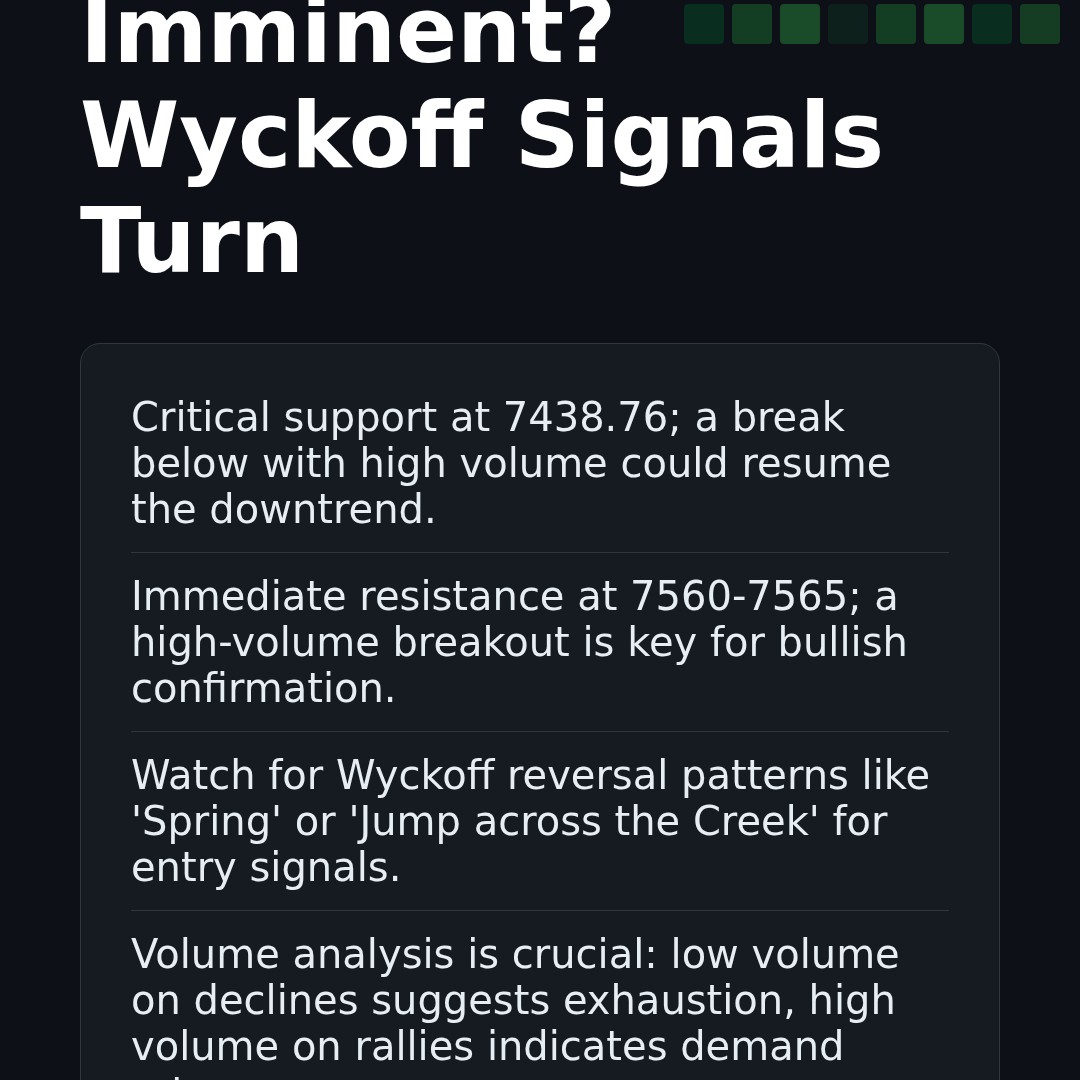
- 1. S1 (Immediate Support): 7438.76 - Intraday low on 2026-01-09.
- 2. S2 (Secondary Support): 7512.56 / 7490.95 - The area around the low on 2025-12-10 and the low on 2025-12-15.
- • Resistance Levels:
- 1. R1 (Immediate Resistance): 7560-7565 - The lower boundary of the previous consolidation platform and near the MA_20D (7561).
- 2. R2 (Strong Resistance): 7600-7640 - The confluence area of MA_30D/MA_60D and the rebound highs from late December 2025.
- • Support Levels:
- • Integrated Wyckoff Events and Trading Signals:
- • Current Signal: Cautiously Bullish / Seeking Rebound Opportunities. The market is at the tail end of a downtrend, showing signs of panic selling, and initial signs of supply exhaustion and potential absorption are emerging. However, a clear Wyckoff buying structure like a "Spring" or a successful "Secondary Test" has not yet materialized.
- • Operational Recommendations:
- 1. Aggressive Strategy: Consider establishing a small long position if the price retests the S1 (7438) area and shows low-volume stabilization (e.g., daily volume
VOLUME_AVG_30D_RATIO< 0.7) or forms a long lower shadow. Initial stop-loss should be placed below the 7400 psychological round number. - 2. Conservative Strategy: Maintain a wait-and-see approach, awaiting clearer Wyckoff reversal structures. Key confirmation signals would be: price breaking through the R1 (7565) resistance with significantly increased volume (
VOLUME_AVG_7D_RATIO> 1.2), forming a "Jump across the Creek" type breakout. Alternatively, price forming a "Spring" (breaking below support and quickly recovering) followed by a successful low-volume test.
- 1. Aggressive Strategy: Consider establishing a small long position if the price retests the S1 (7438) area and shows low-volume stabilization (e.g., daily volume
- • Future Validation Points:
- 1. Bullish Validation: Can the price stabilize at the current level or slightly lower, forming a low-volume, narrow-range consolidation? Can subsequent rallies show high-volume increases (demand returns)?
- 2. Bearish Validation: If the price easily breaks below the 7438 support accompanied by another surge in volume, the downtrend will likely resume, invalidating the above bullish hypothesis.
- 3. Smart Money Behavior Validation: Monitor the coming sessions to see if volume continuously diminishes during declines (supply exhaustion) and if incremental funds enter during rallies (demand expansion).
Conclusion Restatement: The quantitative analysis of 399986 based on Wyckoff volume-price principles indicates the market completed distribution at high levels and has undergone a panic decline. Currently in the late stage of the downtrend, the contrast between the historic high-volume backdrop and price making new lows with relatively subdued volume and converging volatility suggests supply may be drying up, with large investors potentially conducting preliminary accumulation amidst the panic. Traders are advised to closely monitor price action around the 7438 key support area, awaiting confirmation signals such as low-volume stabilization or high-volume breakouts to capture potential trend reversal or rebound opportunities. Until a clear reversal structure emerges, the overall strategy should remain defensive.
Disclaimer: The content of this report/interpretation is solely market analysis and research based on publicly available information and does not constitute any investment advice or operational guidance. While the author strives for objectivity and impartiality, no guarantees are made regarding its accuracy or completeness. Markets involve risks; investments require caution. Any investment actions based on this report are taken at one's own risk.
Thank you for your attention! Daily Wyckoff volume-price market interpretations are released promptly at 8:00 AM before market open. Your comments and shares are greatly appreciated. Together, let's see the market signals.
Member discussion: